When to plant tulip bulbs depends on how soon your soil cools and when it freezes. Plant dormant bulbs in fall, while the ground is cool and still easy to dig, so roots can develop before spring. In much of the United States, that means September through November; warm-winter gardens may need prechilled bulbs and later planting. If you missed the usual window, check the soil and the bulbs before deciding what to do.
Quick answer: Start with your local fall planting window, then check that the soil has cooled and remains unfrozen. Below 60°F (16°C) is a useful regional planting signal, not a nationwide deadline. In cold-winter gardens, firm bulbs can still go into workable late-fall soil. In warm-winter gardens, confirm the locally required prechilling treatment before planting.
When to plant tulip bulbs: check the soil first
Plant dormant tulip bulbs in cool fall soil before the ground freezes. The aim is to give them time to root and receive winter chilling, rather than hit one calendar date. Your local extension planting window is the starting point; current soil conditions tell you whether the bed is ready.
Tulips (Tulipa spp.) are spring-flowering bulbs. Their fall root growth and winter cold period happen before you see the spring display, as University of Minnesota Extension explains.
- Look up local timing. Use your county or state extension’s fall bulb guidance, then compare it with the examples below.
- Check for cooling. N.C. Cooperative Extension recommends planting when soil falls below 60°F (16°C), usually in November in its eastern North Carolina example. If you already have a soil thermometer, use it in the intended bed; otherwise, start with local guidance rather than buying a tool automatically.
- Check the ground. Can your existing digging tool make a hole to the required depth? A chilly morning or frost on the lawn does not necessarily mean the soil has frozen.
- Check the bulbs. Plant firm bulbs without mold or soft spots. Bulbs that have shriveled badly or become soft are poor candidates, whatever the date.
The below-60°F signal comes from N.C. Cooperative Extension’s local planting advice. It is not a rule to wait another two weeks after reaching that temperature. Nor should a northern gardener delay beyond a workable planting window while waiting for a particular number.
What if you plant too early? In Iowa, planting in September before the soil cools can produce fall foliage, according to Iowa State University Extension. Buy bulbs when available, but hold them in a cool, dry place for the short wait until your local planting window. They are living bulbs, not seeds to save casually until next fall.
US planting windows: local examples, not zone deadlines
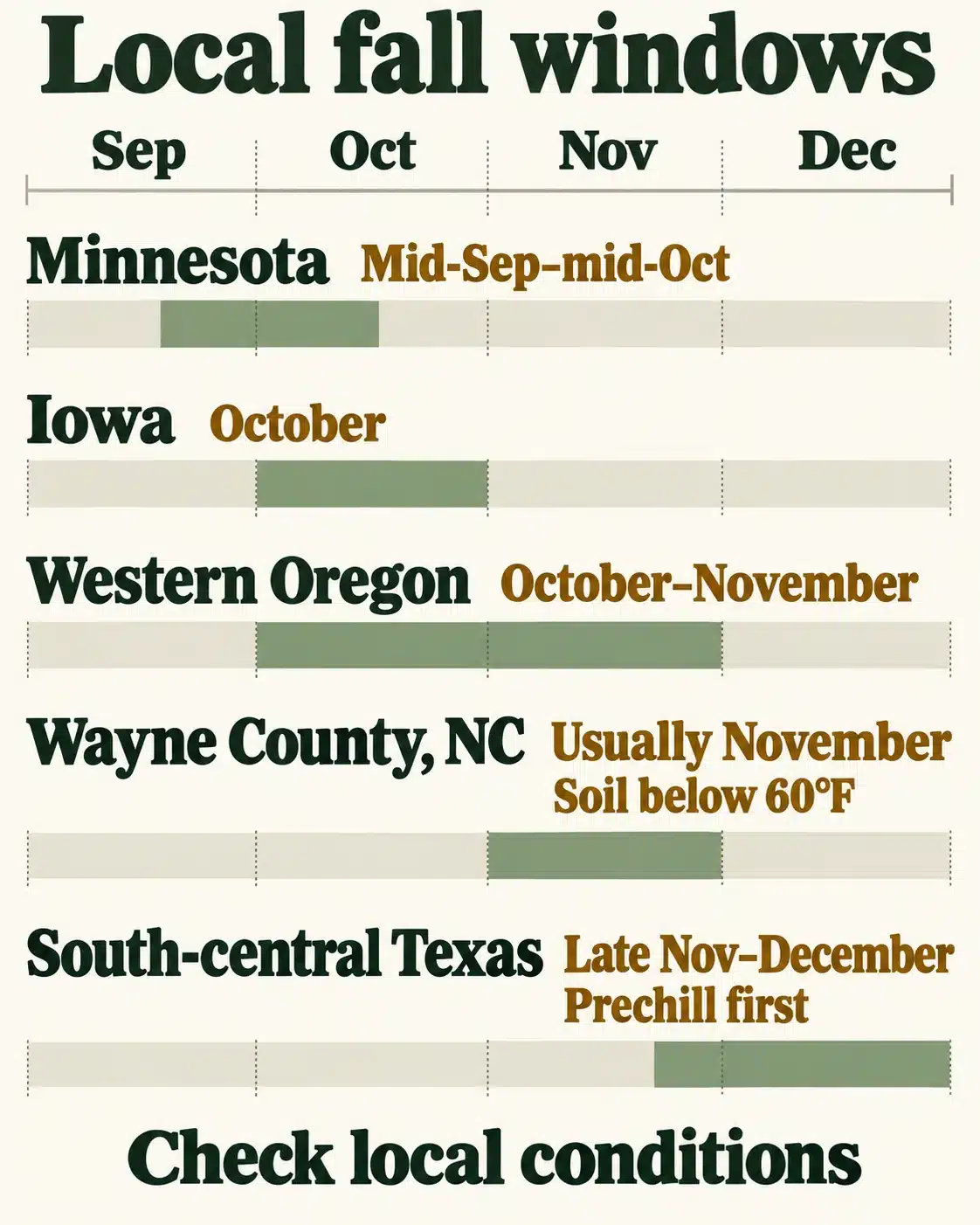
A Minnesota gardener and a south-central Texas gardener should not use the same calendar. These extension examples show how far timing can shift across the United States. Use the row closest to your conditions as context, then check local guidance, cooling soil, drainage and whether the ground can still be dug.
| Local example | Usual planting window | What changes the decision? |
|---|---|---|
| Minnesota | Mid-September through mid-October | Minnesota Extension allows later tulip planting while bulbs can still be put into the soil. |
| Iowa | October | Iowa State Extension identifies October as ideal; unfrozen soil can allow planting into December. |
| Most of western Oregon | October and November | Oregon State Extension says workable ground may allow planting until mid-December. Drainage remains essential. |
| Wayne County, eastern North Carolina | Usually November | Local extension guidance ties planting to soil below 60°F (16°C). |
| South-central Texas | Late November through December | Texas A&M’s archived local guidance specifies 45–60 days of refrigerator prechilling, followed by prompt planting. |
Why not give an exact month for every USDA zone? The USDA Plant Hardiness Zone Map describes average annual extreme minimum winter temperature. That makes it useful for cold hardiness, but it does not measure your fall soil temperature or how long bulbs experience suitable chilling. A zone number alone therefore cannot settle your planting date or refrigerator schedule.
Do tulip bulbs need prechilling in warm-winter gardens?
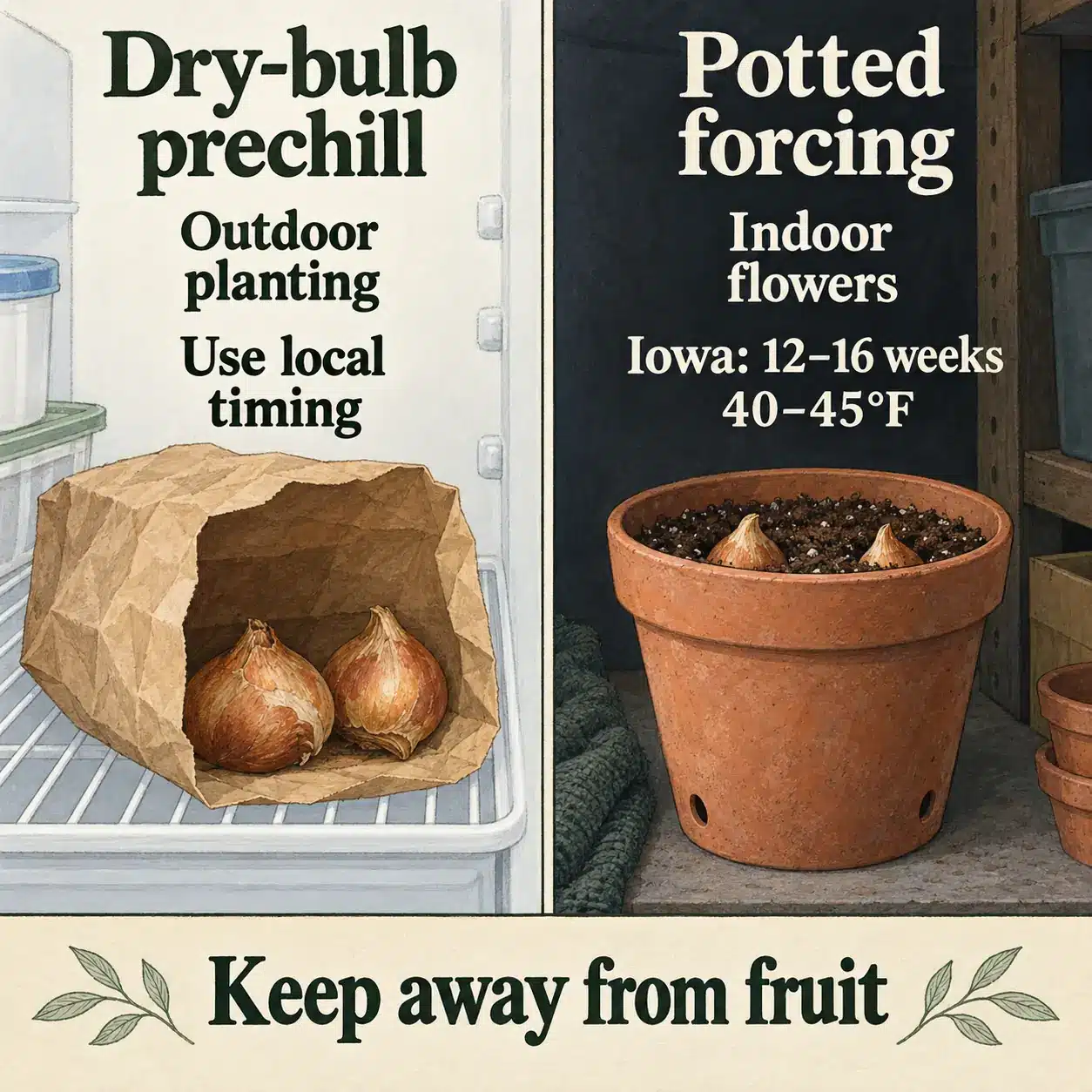
They may need supplemental chilling where winters are mild. First ask your local extension service what works in your area and check whether the supplier has already chilled your bulbs. Refrigerating dry bulbs before outdoor planting is a different job from chilling planted pots for an indoor flower display.
Published recommendations differ. UC IPM gives 4–6 weeks before planting; a UC Master Gardener article for Solano County describes at least 6–8 weeks of refrigerator treatment. The south-central Texas guidance above uses 45–60 days. These are regional outdoor-preparation recommendations, not interchangeable statements of every tulip’s complete cold requirement.
- Confirm the starting point. Check the bulb label or ask the supplier about prechilling. Do not assume a bulb sold in a warm region is already treated.
- Work backward from local planting time. Use the locally appropriate treatment and your bulb supplier’s instructions; write the refrigerator start and intended planting dates on the bag or calendar.
- Use a paper bag and keep it away from ripening fruit. The UC Solano article warns that fruit releases ethylene, which can interfere with flower development.
- Keep bulbs out of the freezer. Texas A&M’s local guidance explicitly says not to freeze them and to plant promptly after refrigerator removal.
Plan for a spring display without assuming those same bulbs will flower every year. Both North Carolina and the UC Solano guidance explain why gardeners in warm conditions often treat tulips as annuals.
What if you missed fall planting or the ground is frozen?
In a cold-winter garden, plant firm bulbs while late-fall ground remains unfrozen rather than storing them until spring. In a warm-winter garden, first confirm the locally recommended prechilling treatment and the supplier’s treatment history. If the ground is frozen at planting depth, a complete indoor-forcing routine is a separate option for sound bulbs. Dry bulbs stored until spring often deteriorate.
Late November or December, with workable ground
Iowa State’s late-planting advice is to plant as soon as possible if soil is not frozen, even into December. After planting, several inches of straw, pine needles or leaves can give roots additional time before the ground freezes. This cold-winter fallback does not replace the locally required prechilling treatment in warm-winter gardens. It is not a reason to postpone the normal local window or a method for digging frozen soil.
Frozen ground: consider a complete potted forcing routine
Forcing means growing bulbs to flower indoors by providing the cold and growing conditions they need. It takes months, suitable storage space and moisture checks. A pot left outdoors in a severe freeze is not automatically a suitable substitute for controlled cold storage.
- Use a pot with drainage holes and well-draining potting mix. For indoor forcing, Penn State Extension describes planting with only the bulb tips exposed, then watering thoroughly and letting excess water drain. This pot method differs from the outdoor depth table below.
- Keep the planted pot in a cool, dark location at 40–45°F (4–7°C) for 12–16 weeks, following Iowa State’s potted-tulip forcing routine. This is a complete planted-pot cold period; do not shorten it to an outdoor dry-bulb prechill period.
- Check the potting mix periodically. Add a little water if it is drying out, without leaving the pot sitting in water, as Penn State advises. Keep refrigerated pots away from ripening fruit.
- After completing that cold period, move the pot to a brightly lit location at 60–65°F (16–18°C), as Iowa State advises. Finishing the cold period is not a promise of flowers that day.
Spring: dry bulbs and growing tulips are different cases
If you discover a bag of unplanted bulbs in spring, check their condition first. Iowa State Extension warns that stored bulbs commonly shrivel or die and that spring-planted survivors often grow and bloom poorly. Planting a firm survivor is an experiment, not a reliable spring-flower plan; neither this year’s bloom nor next year’s is guaranteed.
A nursery pot with actively growing tulips is different from that dry bag: the plants have already reached spring growth. The RHS growing guide says growing container plants bought in spring can be planted straight away. For a US garden, use that plant-stage distinction when the outdoor soil is workable, well drained and local conditions suit the plants; the RHS calendar is UK-based. Planting a flowering pot does not guarantee repeat bloom next year.
How deep should you plant tulip bulbs?
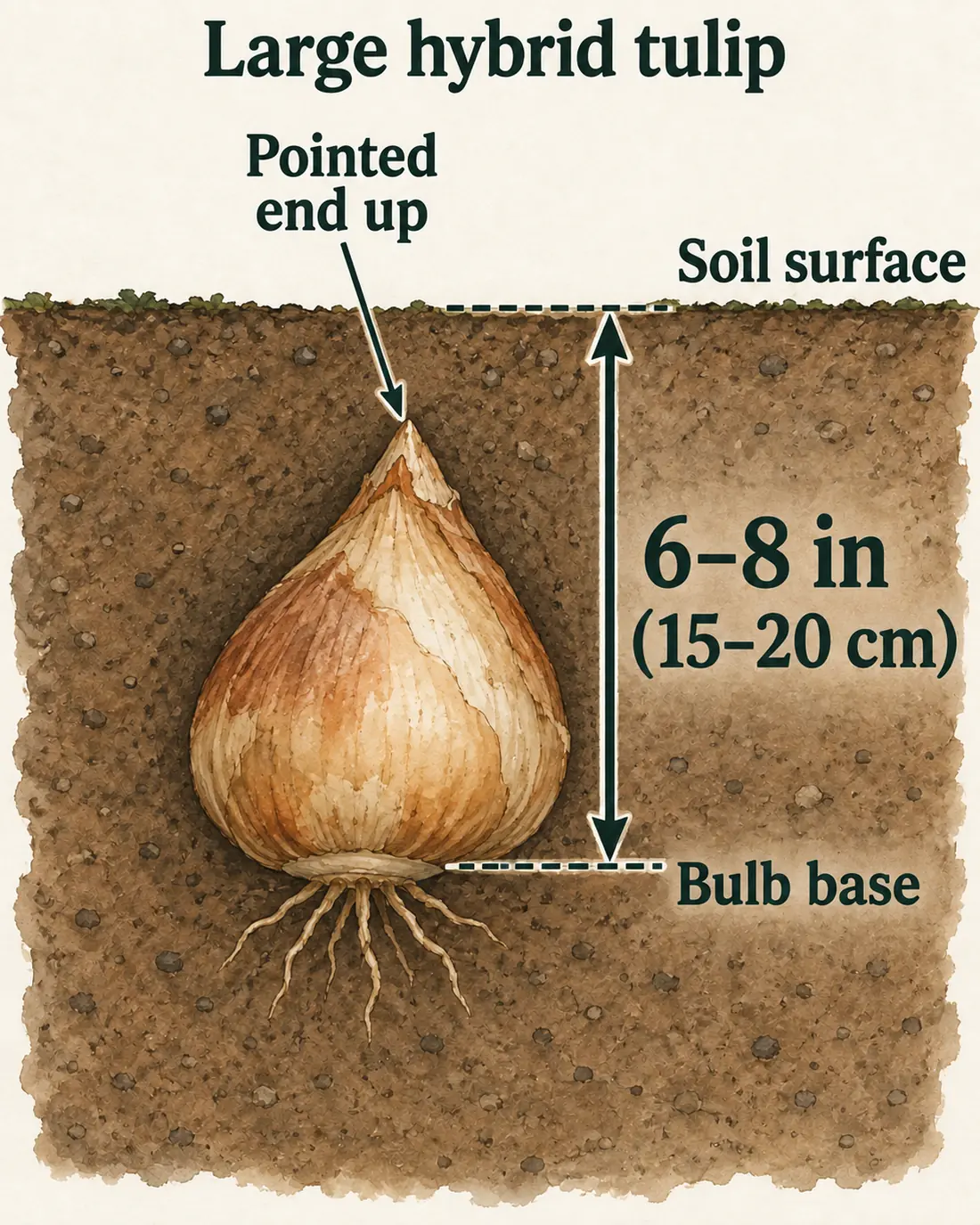
Plant large hybrid tulip bulbs about 6–8 inches (15–20 cm) deep and smaller species tulips about 3–5 inches (8–13 cm) deep, following the bulb package’s instructions. Measure from the soil surface down to the bulb’s base. The depth is not the amount of soil above its tip.
| Tulip type | Soil surface to bulb base | Spacing between bulbs |
|---|---|---|
| Large hybrid garden tulips | 6–8 inches (15–20 cm) | 4–6 inches (10–15 cm) |
| Species or botanical tulips | 3–5 inches (8–13 cm) | 3–4 inches (8–10 cm) |
These measurements come from the table and depth footnote in Iowa State’s spring-bulb planting guide. Check the identity and directions on your own package rather than assuming every small bulb is a species tulip.
- Choose the site before digging. Use a bed that drains well and receives sun during spring growth. Avoid a spot where water stands after rain.
- Dig to the base depth. Use an existing trowel, shovel or ruler. The bottom of the bulb, where roots form, sits at the stated depth below the finished soil surface.
- Set the bulb pointed end up. Backfill the hole with soil. Follow the package’s spacing for the type you bought.
- Water after planting and let water drain. This settles the soil and supports rooting, especially in a dry bed; keeping it soggy creates a different problem.
Iowa State’s tulip guide supports the site, orientation and watering steps. Fertilizer cannot replace chilling or root development. Its spring-bulb planting guide says fertilizer at planting is not typically necessary and matters more for developing next year’s bulb than the upcoming flowers. N.C. Cooperative Extension explains that bulbs already hold resources for their first display; it discusses feeding for future seasons and recommends a soil test before adding extra phosphorus. Bulb fertilizer or bone meal need not be an automatic purchase.
If you are planning other spring bulbs, our dwarf iris guide offers another option to compare. For bearded iris, use its separate rhizome planting instructions; tulip depth and timing do not transfer to it.
What should you check when spring arrives?
Look for shoots, then flowers, and note which planted areas performed well. If a spot produces leaves without flowers or no growth, review the bulb type, planting and chilling history, and whether the bed stayed wet. The calendar alone cannot identify the cause.
| What you see | Useful next check |
|---|---|
| Leaves but few or no flowers | Review chilling, bulb quality and whether these are older hybrid tulips that have lost vigor. One symptom does not prove a single cause. |
| No shoots in a wet patch | Check drainage and whether bulbs remain sound. Rot is one possibility; animal removal or damage is another. |
| Flowers fade normally | Remove spent flower heads, then leave the foliage until it dies back naturally if you want to keep the bulbs. |
Minnesota Extension’s bulb guidance and Iowa State’s tulip guide support these checks. Leaves replenish bulb reserves, so cutting them off while green can reduce later flowering. Keeping bulbs in the ground is possible in a suitable site; a repeat display depends on the tulip type and conditions.
FAQ: Tulip planting questions
What month is the best month to plant tulips?
The best month is the one in your local fall window when soil has cooled and remains workable. Minnesota guidance starts in mid-September, Iowa favors October, and eastern North Carolina commonly waits until November. Warm-winter areas may plant later after prechilling; use the regional table rather than a nationwide date.
Is it too late to plant tulip bulbs now?
In cold-winter areas, firm bulbs can still be planted in unfrozen soil at planting depth; Iowa State permits this into December and recommends mulch afterward. Warm-winter gardeners should first confirm the locally required prechilling treatment. If the ground is frozen, consider a complete indoor-forcing routine instead of storing dry bulbs until spring.
Can I leave tulip bulbs in the ground all year?
Yes, bulbs can remain in a well-drained garden bed, but leaving them there does not guarantee yearly flowers. Many modern hybrids decline over time, and warm climates can limit repeat bloom. If you keep them, remove spent flowers and let the foliage die back naturally so it can replenish the bulbs.
What not to plant next to tulips?
Avoid a planting arrangement that keeps the tulip bed persistently wet or prevents the leaves from finishing their growth. The extension sources used here do not establish a universal list of forbidden neighboring plants. Choose companions around compatible drainage, spring light and watering needs; later-growing perennials can conceal fading tulip foliage.
This is a site-compatibility recommendation based on Iowa State’s drainage and companion guidance, rather than a claim that particular plant pairs chemically harm tulips.
Can I plant tulip bulbs in spring?
Dry bulbs left unplanted until spring may have deteriorated and missed rooting or chilling, so flowering is unreliable. Actively growing nursery tulips are a different case: plant them in spring when soil is workable, well drained and local conditions suit the plants. Neither planting a dry survivor nor transplanting a flowering pot guarantees another display.
Does zone 8 or 9 always require the same chilling schedule?
No. A USDA zone describes winter temperature extremes, not the duration of suitable bulb chilling in your garden. Local extension recommendations and the supplier’s treatment history are more useful than a single zone-based number. Keep dry-bulb prechilling for outdoor planting separate from the longer planted-pot routine used for indoor forcing.
Sources and regional scope
Regional windows describe the places named, not guaranteed dates for every US garden. Texas A&M’s example is archived guidance from 2005; the UC Solano article is educational local advice. The RHS source supplies the distinction between dormant bulbs and growing spring plants, rather than the US planting calendar.
- University of Minnesota Extension: Planting bulbs, tubers and rhizomes — Minnesota timing, rooting and troubleshooting.
- Iowa State University Extension: All About Tulips — Iowa timing, planting and aftercare.
- Iowa State University Extension: Selecting and Planting Spring-Blooming Bulbs — bulb quality, base-measured depth and spacing.
- Iowa State University Extension: November planting or waiting for spring? — late planting and potted forcing.
- Oregon State University Extension: Plant spring-blooming bulbs in fall — western Oregon timing.
- N.C. Cooperative Extension: Plant Bulbs This Fall for Spring Flowers — local soil-temperature signal and first-season resources.
- Texas A&M Extension: Horticultural Activities for Fall — archived south-central Texas prechilling and timing.
- USDA: How to Use the Plant Hardiness Zone Maps — what a hardiness zone measures.
- UC IPM: Tulip and UC ANR: Chill Out, Tulips! — differing supplemental chilling guidance and fruit separation.
- Penn State Extension: Forcing Flowering Bulbs for Indoor Beauty — complete planted-pot cold treatment and moisture checks.
- RHS: How to grow tulips — dormant bulbs versus growing spring container plants.