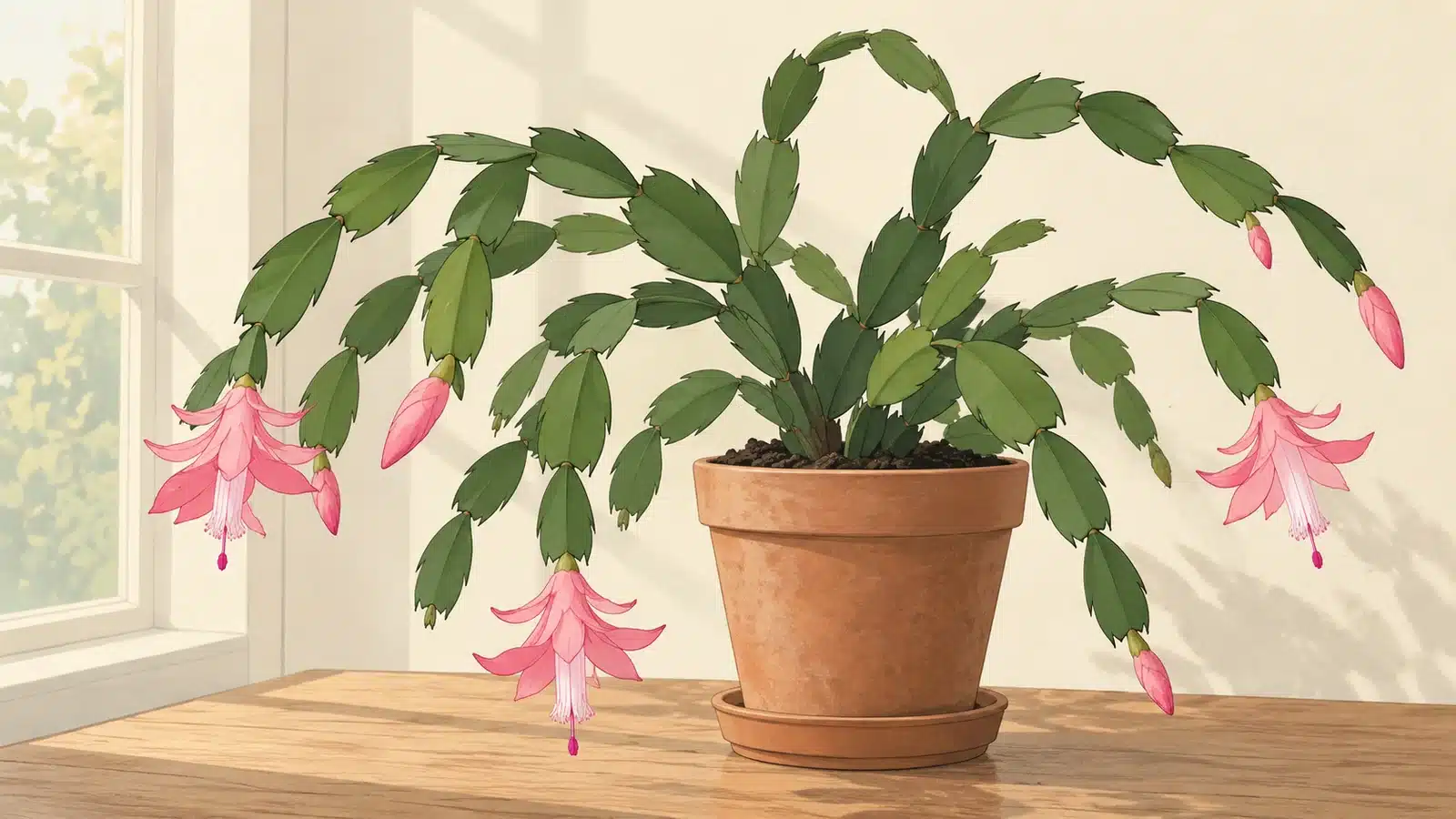
Christmas cactus care means bright indirect light, a draining pot, and thorough watering when the top inch (2.5 cm) of mix feels dry. For fall flowers, give a healthy unbudded Christmas or Thanksgiving cactus at least 12 hours of uninterrupted darkness nightly at 60–65°F (16–18°C) for about six weeks. Once buds appear, keep conditions steady; after flowering, water less often until growth resumes.
Christmas cactus grows best in bright indirect light, a loose well-draining mix, and more even moisture than desert cacti. It is a tropical holiday cactus, not a cactus that wants hot dry sun and bone-dry soil. The biggest care mistakes are harsh direct sun, soggy roots, interrupting the fall dark period, and moving the plant after buds form.
Fast Christmas Cactus Care Answer
- Light: bright indirect light; gentle morning sun is safer than harsh afternoon sun.
- Water: water when the upper mix dries; keep it steadier during bud set, never soggy.
- Soil: loose, airy, well-draining mix with a drainage hole.
- Bloom trigger: long uninterrupted nights and cooler fall temperatures help buds form.
- Bud drop: usually sudden changes in location, light, moisture, drafts, or temperature.
- After bloom: water less, prune if needed, and repot only if the mix or roots require it.
Choose a Christmas Cactus Guide for Your Next Task
Use this care hub for the year-round routine. For one specific decision, choose the matching guide below.
- No buds or unexplained bloom timing: Christmas cactus not blooming.
- Choosing a brighter daytime position: Christmas cactus light requirements.
- Reading moisture and watering by stage: how often to water Christmas cactus.
- Feeding during healthy new growth: Christmas cactus fertilizer.
- Choosing or refreshing the medium: best soil for Christmas cactus.
- Failed drainage or crowded roots after bloom: repotting Christmas cactus.
- Pointed vs scalloped segments or early blooms: Christmas cactus vs Thanksgiving cactus.
- Saving healthy stem cuttings or propagation steps: how to propagate Christmas cactus.
- Identified plant and cat/dog question: Christmas cactus toxicity to cats and dogs.
- Unexpected flower shade; color is not identity: Christmas cactus colors.
- Limp stems: check wet roots vs thirst before watering: why Christmas cactus leaves are limp.
Source note: This indoor-care guide draws on US university extension guidance checked October 7, 2026. Flowering conditions vary with plant identity and growing conditions; the fall routine below follows University of Minnesota Extension. See the sources and their scope.
| Care point | Best target | Common mistake |
|---|---|---|
| Light | Bright indirect light, away from hot glass | Treating it like a desert cactus in harsh sun, or like a low-light plant in a dim corner |
| Water | Even moisture during active growth and bud set, with drainage | Letting buds dry hard, or keeping the pot wet during cool low-light periods |
| Soil | Loose, airy, fast-draining mix | Dense potting soil inside a sealed decorative pot |
| Blooming | Long fall nights, cooler room, steady care once buds appear | Bright room lights at night, moving the plant too soon, or fertilizing instead of fixing conditions |
| Repotting | After bloom, only when roots or mix make it necessary | Repotting during bud formation or moving into an oversized pot |
Christmas Cactus vs Thanksgiving vs Easter Cactus
Before you diagnose care, identify what you actually have. Many plants sold as Christmas cactus are Thanksgiving cactus hybrids. That is common, and it does not mean the plant is bad, but it can change bloom timing and the way the stem segments look.
| Type | Common clue | Bloom timing | Care difference |
|---|---|---|---|
| Christmas cactus | Schlumbergera × buckleyi: rounded, scalloped stem segment edges | Often late fall to winter | Same broad holiday cactus care; name matters most for ID and expectations |
| Thanksgiving cactus | Schlumbergera truncata: pointed projections on the segment edges | Often earlier, around Thanksgiving season | Often sold as Christmas cactus; care is very similar |
| Easter cactus | Rhipsalidopsis gaertneri (also listed as Hatiora or Schlumbergera gaertneri): rounder segments, star-shaped flowers | Spring | Similar light/drainage needs, but bloom cycle differs |
Christmas cactus is commonly named Schlumbergera × buckleyi, a hybrid of S. russelliana and S. truncata; S. bridgesii appears in its naming history. Iowa State Extension and Wisconsin Horticulture explain the distinctions. Easter-cactus genus names differ between sources, and its spring flowering requirements differ: do not apply this autumn routine to it.
Use the label as a clue, not proof. Retail plants are often hybrids, and a plant’s care should still be guided by its light, roots, potting mix, and seasonal bloom stage.
For a focused visual comparison, use the Christmas cactus vs Thanksgiving cactus guide.
If You Just Bought a Blooming Christmas Cactus
A blooming holiday cactus has already done the hard part: it has formed buds. Your job now is to avoid sudden changes. Put it in bright indirect light, keep it away from heat vents and cold doors, and avoid repotting until after bloom.
First-week rule
Do less than you think. Check the soil, water only if the upper mix is drying, and keep the plant in one stable spot. Buds often drop when a plant moves from a greenhouse or store into a much warmer, darker, or drier room.
Christmas Cactus Care: Where Should You Put It Indoors?
Christmas cactus needs enough daytime light to grow and flower, but it is not built for hot desert sun. Indoors, a bright east window, a filtered south or west window, or a spot near a bright window but out of hot glass is usually safer than a harsh afternoon sill.
UF/IFAS recommends bright indirect light near a south, east, or west window while avoiding harsh exposure.
Artificial light can affect bloom timing
In fall, the dark period matters. A plant can receive bright daytime light and still fail to set buds if nearby lamps or room lights interrupt long nights.
When and How Should You Water a Christmas Cactus?
Water when the top inch (2.5 cm) of potting mix feels dry, rather than on a fixed weekly schedule. Slowly water from the top until excess drains out, then empty the saucer. Keep moisture steadier during bud set and flowering; after flowering, water less often until healthy new growth returns.
Penn State Extension recommends top watering; this does not establish that bottom watering is harmful. If stems are limp while the mix is wet, check drainage and roots before adding water.

For a deeper seasonal breakdown, use the how often to water Christmas cactus guide.
| Stage | Watering approach | Why it matters |
|---|---|---|
| After bloom rest | Water less often, but do not let stems shrivel hard for weeks | Growth slows and the pot dries more slowly |
| Spring and summer growth | Water when the upper mix dries; keep drainage strong | New stem growth needs moisture, but soggy soil still risks root trouble |
| Fall bud formation | Keep the mix more evenly moist, not wet | Clemson HGIC notes that drying during bud set can contribute to flower bud drop |
| Blooming | Keep care steady; avoid drought swings and standing water | Buds and flowers are sensitive to sudden change |
Wrinkled, thin stems can mean the plant is too dry, but they can also happen when wet roots are damaged and cannot take up water. Soft or mushy stems are more urgent because they can point to rot.
Soil, Pot, and Roots: Air Matters as Much as Moisture
Christmas cactus is a tropical epiphyte, so its roots should not sit in dense, airless soil. A good mix holds some moisture but drains freely. A drainage hole is not optional if you want predictable watering.
UF/IFAS recommends a well-drained potting medium and notes that Christmas cactus prefers to be somewhat root-bound. That does not mean the plant likes stale, compacted soil. It means you should avoid moving it into an oversized pot that stays wet for too long.
| Situation | Best move | Why |
|---|---|---|
| Blooming or full of buds | Leave it alone unless rot is urgent | Repotting can add stress during the most sensitive stage |
| Mix drains well and plant is stable | Do not repot just because it is old | Unneeded repotting can set growth back |
| Mix stays wet for many days | Refresh into a looser mix after bloom | Wet, compacted media raises root-risk |
| Roots are crowded but healthy | Move up one small pot size after bloom | A small size-up gives room without creating a wet outer soil ring |
| Soft base, sour smell, black roots | Treat as a rescue, not a normal repot | Isolate spreading stem damage and seek diagnosis before trimming or taking cuttings |
Temperature and Humidity
Normal home temperatures work for everyday growth, but bloom formation responds to seasonal change. Cooler fall nights and long dark periods help the plant switch from vegetative growth to buds.
Iowa State Extension notes that Christmas cactus bloom depends on day length and temperature, and that artificial light at night can interfere with flowering. It also gives night temperatures around 60–65°F (16–18°C) as useful for flower formation.
Humidity helps keep stems from drying too quickly, especially in heated winter homes. It does not replace drainage. A humid room with wet roots is still a rot risk.
How Do You Get a Christmas Cactus to Bloom?
For a healthy Christmas or Thanksgiving cactus without buds, provide at least 12 hours of complete, uninterrupted darkness each night, night temperatures of 60–65°F (16–18°C), and bright indirect daytime light for about six weeks. Once buds appear, keep light, moisture and temperature steady rather than continuing to move or rotate the plant.
University of Minnesota Extension supplies these conditions together. This is an approximate flowering response, not a guaranteed bloom date or a separate six-week bud-only countdown. Easter cactus has a different flowering cycle.

- Choose an existing bright room that stays cool at night and can remain fully dark for at least 12 hours. Keep lamps and other artificial light out of the dark period.
- Write down the start date and keep the routine consistent. Continue checking the top inch (2.5 cm) of mix and drain after watering.
- Inspect stem tips for buds. Once buds develop, prioritize steady light, moisture and temperature; avoid relocating or rotating the plant.
- Wait until the first flowers open before a display move, following Iowa State Extension. Keep the new location away from drafts and heat sources.
October–December bloom countdown: check the plant at each stage
The calendar below applies the Minnesota routine to a US indoor Christmas or Thanksgiving cactus. Dates are review checkpoints, not promises; an already-budded plant needs stable aftercare instead of a new initiation routine.
| When | What to do | What to check next |
|---|---|---|
| October: when you start the routine | Identify the likely group and inspect for buds. If healthy and unbudded, establish the dark-night and cool-room routine. | Can the room supply uninterrupted darkness and 60–65°F (16–18°C) nights? If already budded, leave it settled. |
| Rest of October | Continue the same nightly routine and daytime light. Water when the upper mix dries; drain thoroughly. | Record missed dark periods or temperature changes before changing the care plan. |
| November | Inspect tips for buds. Review the setup about six weeks after your recorded start date; the timing is approximate. | If buds appear, keep placement and moisture steady. If none appear, audit the setup rather than adding fertilizer. |
| December, if flowering | Keep bright indirect light, drainage, and stable conditions through bloom. | No buds: use the not-blooming guide. Dropped buds: check recent moves, drafts and watering swings. After flowering, reduce watering frequency until new growth resumes. |
Bloom trigger checklist
- Give bright indirect light during the day.
- Keep nights dark and uninterrupted in fall; avoid lamps, TVs, and bright room lights near the plant.
- Use cooler fall night temperatures if your home allows it.
- Keep the potting mix lightly and evenly moist once buds form.
- Do not rotate, relocate, repot, or fertilize heavily after buds appear.
No buds and dropped buds need different checks. If no buds formed, review nighttime light and temperature. If visible buds fell off, review moisture, drafts, and recent changes in care or location. Changing the dark period will not replace buds that have already dropped.
If your plant has no buds, blooms at the wrong time, or drops buds after they form, use the focused Christmas cactus not blooming troubleshooting guide.
Why Are Buds Falling Off a Christmas Cactus?
Developing buds can fall after sudden changes in location, light, temperature or humidity, or after watering problems. Check recent moves, drafts, heat sources and whether the potting mix is too dry or wet. Restore steady conditions; a plant that never formed buds needs a different check of nighttime darkness and temperature.

| What changed? | Why it matters | What to do now |
|---|---|---|
| Moved after buds formed | Light direction, temperature, and humidity changed suddenly | Keep it in one bright, stable spot through bloom |
| Soil dried hard | Buds are sensitive to drought swings | Rehydrate gradually and keep moisture steadier |
| Pot stayed wet | Roots lose air and uptake slows | Check drainage and let the mix recover before watering again |
| Near heater, fireplace, or door | Hot or cold drafts stress buds | Move it away from direct air flow |
Why Are Christmas Cactus Stems Limp, Wrinkled, or Soft?
Limp stems can mean thirst or damaged roots, so check the potting mix before watering. If it is dry and stems are wrinkled, water thoroughly and watch for recovery. If it is wet and stems are soft, stop adding water, check drainage, and inspect the base and roots for rot.
For the full dry-versus-wet diagnosis, use the Christmas cactus limp leaves guide.
Check wet-root damage before trying a rescue
- If the mix is wet and stems are soft, pause watering and empty any standing water.
- Check that the pot and mix drain freely. Wet-soil wilting can result from damaged roots.
- If the base is collapsing or has black, wet, spreading lesions, isolate the plant and seek diagnosis from your local Extension office before trimming tissue or taking cuttings. Minnesota Extension distinguishes several infectious stem rots that may require discarding the affected plant.
Propagation is for firm, healthy, unaffected stem segments; it is not a guaranteed rescue for an unidentified rot.
Seasonal Christmas Cactus Care Calendar
| Season | Main job | Avoid |
|---|---|---|
| Late winter after bloom | Let the plant rest; water less often | Heavy feeding or urgent repotting unless drainage is failing |
| Spring | Prune, propagate, refresh soil if needed, resume growth care | Taking cuttings from a weak or rotting plant without fixing the cause |
| Summer | Bright indirect light, steady watering, optional outdoor shade | Direct hot sun, sealed pots, or missed watering during heat |
| Fall | Long nights, cooler temperatures, steady moisture during bud set | Artificial light at night, moving the plant repeatedly, or drought swings |
| Winter bloom | Stable light, temperature, and watering | Repotting, rotating, overfeeding, drafts, or letting buds dry hard |

Spring care after flowering
Use the plant’s stage rather than March or April alone. After flowering ends, keep bright indirect light and water less often until active growth returns; when watering is needed, still wet the mix thoroughly and let it drain. Take cuttings only from healthy segments, and repot only when the roots or deteriorated mix make it necessary.
Fertilizer: Useful in Growth Season, Not a Rescue Fix
Fertilizer can support new growth in spring and summer, but it does not fix poor light, soggy roots, bud drop, or a failed dark period. If the plant is limp, yellowing, rotting, or dropping buds, diagnose conditions before feeding.
Clemson HGIC’s rainforest-cacti guidance recommends a balanced liquid fertilizer monthly during the growing season, stopping in September. Keep feeding paused through fall bud setup and flowering; resume after flowering only when healthy active growth returns.
Do not fertilize first
If a Christmas cactus is stressed, fertilizer can make the situation harder to read. Fix light, watering, drainage, drafts, and temperature first.
Pests and Disease
NC State Extension lists mealybugs, scale and spider mites as possible pests of Schlumbergera. Inspect stem joints and both sides of the segments. Separate a plant with suspected pests from nearby houseplants while you identify the problem; ask your local Extension office for treatment guidance.
Minnesota Extension associates fungus gnats with continuously wet potting mix and notes that excess water can cause wilting and root rot. Check drainage and moisture before adding more water; soft, spreading stem lesions need diagnosis.
Can Christmas Cactus Go Outside in Summer?
A Christmas or Thanksgiving cactus can spend summer outdoors in filtered light or part shade. Minnesota Extension recommends filtered sunlight, such as beneath a tree, and warns that excessive sunlight can cause sunburn. Protect it from harsh afternoon sun, check drainage after rain, and bring it indoors before frost threatens in your area. These are summer-container instructions, not a claim of year-round outdoor hardiness.
Pruning After Bloom
The best time to prune is after flowering, when the plant is no longer carrying buds. Twist or cut between stem segments to shape the plant. Pruned segments can become propagation cuttings if they are healthy and firm.
UF/IFAS advises avoiding pruning after mid-summer. Keep fall bud preparation focused on stable conditions rather than major shaping.
Repotting Timing
Christmas cactus does not need frequent repotting. Repot after bloom if the mix is broken down, roots are crowded, or the pot no longer drains well. Move up only a small size; an oversized pot can hold too much wet mix around the roots.
Check the root zone and drainage first; the focused repotting Christmas cactus guide covers pot size and aftercare.
Propagation Overview
Christmas cactus is usually propagated from stem segments. Take healthy segments after bloom or during active growth, let the cut end dry briefly, and root in a lightly moist, airy medium. Keep cuttings bright but out of harsh direct sun while they root.
For cutting size, drying time, soil vs water rooting, and rot prevention, use the step-by-step how to propagate Christmas cactus guide.
Pet Safety Note
ASPCA lists its Christmas cactus entry, named Schlumbergera bridgesii, as non-toxic to cats and dogs. Confirm your plant’s identity rather than extending that entry to every plant sold as a holiday cactus. That is not the same as edible. If a pet eats a large amount, vomits repeatedly, acts lethargic, or may have eaten soil, fertilizer, or pesticide residue, call a veterinarian.
Before Replacing a Christmas Cactus
Check light, moisture and drainage before deciding the plant needs replacement. Holiday cacti can survive for decades and be passed between generations, according to Wisconsin Horticulture. If the base is failing, seek a diagnosis before taking cuttings; the propagation guide is for healthy, unaffected segments.
Christmas Cactus Care FAQ
How do you care for a Christmas cactus indoors?
Keep a Christmas cactus in bright indirect light with freely draining potting mix and a drainage hole. Water thoroughly when the top inch (2.5 cm) feels dry, then empty the saucer; keep conditions steady during buds and flowers, and water less often after flowering until active growth returns.
What two things trigger a Christmas cactus to bloom?
Long uninterrupted nights and suitable cool night temperatures encourage flowering in Christmas and Thanksgiving cacti. The Minnesota Extension routine combines at least 12 hours of complete darkness nightly with 60–65°F (16–18°C) nights for about six weeks, plus bright daytime light; it does not promise flowers on a particular holiday.
Should you water a Christmas cactus from the top or bottom?
Top watering is a straightforward default: slowly wet the potting mix thoroughly, let excess water drain through the bottom, and empty the saucer. Penn State Extension recommends this method; it does not establish that bottom watering is harmful, and neither method replaces checking moisture before deciding to water again.
Why are buds falling off my Christmas cactus?
Developing buds may drop after sudden changes in light, temperature, humidity or location, or after watering problems. Check recent moves, drafts, heat sources and the potting mix, then restore stable conditions; a plant that never formed buds needs a different check of nighttime darkness and temperature.
What is the lifespan of a Christmas cactus?
A well-cared-for holiday cactus can live for decades and may pass between generations. NC State Extension notes that plants can exceed a century, but that is a possibility rather than a typical lifespan promise; drainage, suitable light and replacing deteriorated potting mix matter more than chasing a particular age.
Should I fertilize Christmas cactus while it is blooming?
Keep fertilizer paused during fall bud preparation and flowering, then resume only after flowering when healthy active growth returns. Clemson’s rainforest-cacti guidance recommends monthly balanced liquid fertilizer during the growing season and stopping in September; fertilizer does not replace darkness, correct watering or recovery from damaged roots.
Sources
University and extension care guidance checked October 7, 2026. The flowering routine uses Minnesota; identification and naming use Iowa, Wisconsin and NC State; top watering uses Penn State; feeding uses Clemson’s rainforest-cacti section. ASPCA’s safety scope is its named Christmas-cactus entry.
- Holiday cacti — University of Minnesota Extension
- Holiday Cactus — Wisconsin Horticulture
- Christmas Cactus — UF/IFAS Gardening Solutions
- All About Holiday Cacti — Iowa State Yard and Garden
- My Christmas cactus does not bloom well. Why? — Iowa State Yard and Garden
- Schlumbergera — NC State Extension Plant Toolbox
- Holiday Cacti Care — Penn State Extension
- Indoor Cacti, rainforest-cacti section — Clemson HGIC
- Christmas Cactus — ASPCA