Christmas cactus propagation is simple, but most failures come from rot, buried segments, or starting with weak cuttings.
To propagate Christmas cactus, take a healthy stem cutting, let the cut end dry briefly, then root it shallowly in lightly moist airy mix or clean water. Keep cuttings bright but out of harsh direct sun, and do not keep the base soggy.
Fast Propagation Answer
- Best cutting: firm, healthy stem segments.
- Best time: after bloom or during active growth.
- Rooting medium: airy soil mix or clean water.
- Main risk: rot from stale water or soggy buried segments.
Affiliate disclosure: This article contains paid links. As an Amazon Associate, we may earn from qualifying purchases at no extra cost to you.
Source note
Propagation guidance is based on Iowa State Extension and plant identity details from NC State Extension. Product suggestions are optional role matches, not hands-on lab tests.
Best Time to Propagate Christmas Cactus
The best time is after flowering or during active growth, when the plant is not trying to hold buds. Avoid taking cuttings from a plant that is collapsing, mushy, or actively dropping buds unless you are trying to rescue healthy segments.
Choose a Healthy Stem Cutting
Choose firm green segments, not wrinkled, soft, yellow, or translucent material. A cutting with two to four joined segments is easy to handle, but smaller pieces can root if they are healthy.
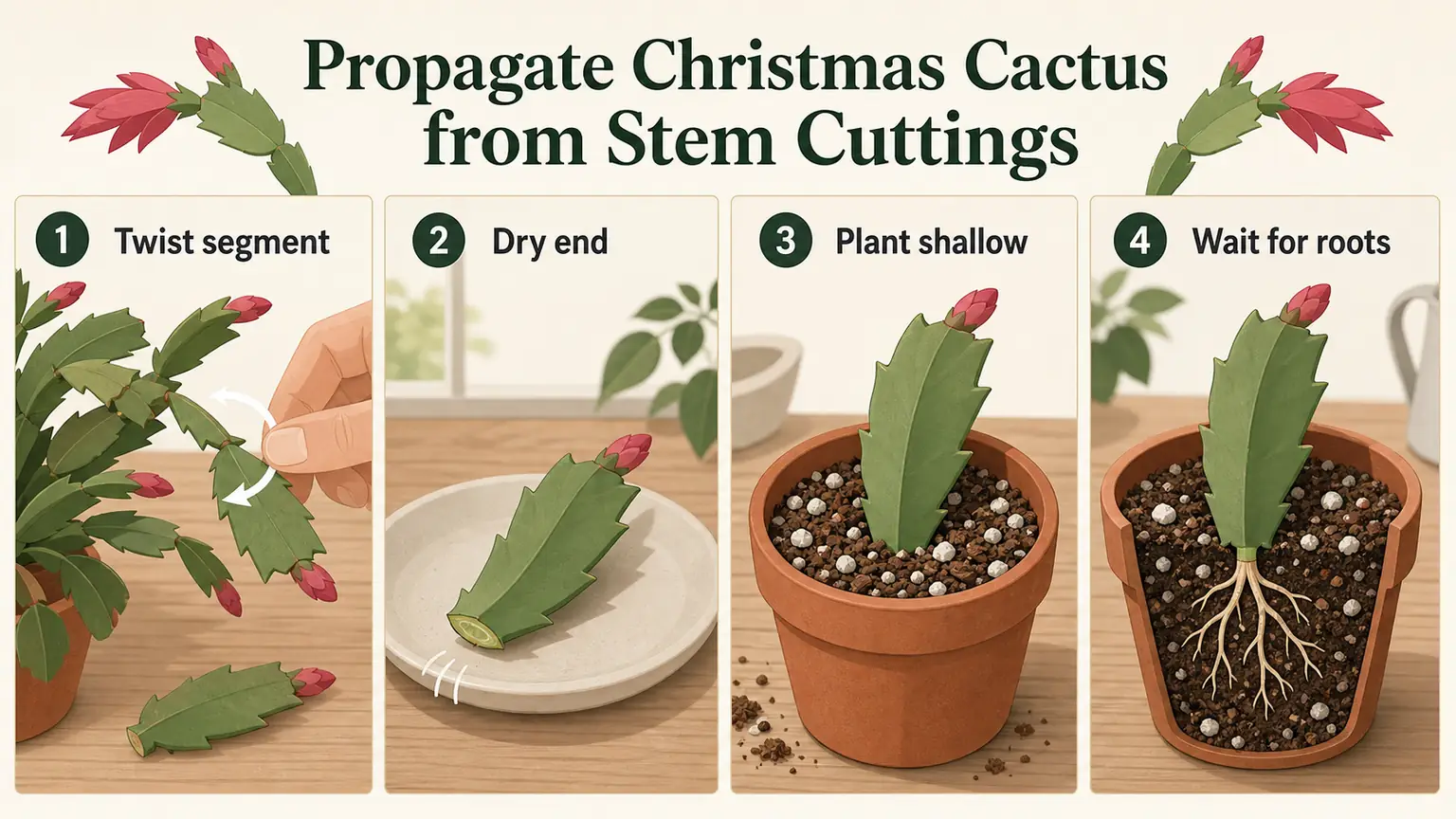
You can twist a segment at the joint or cut between segments with clean snips. Do not crush the stem, and do not bury a long section under the mix.
Do not propagate rotten material
If the base of the mother plant is mushy, sour-smelling, or collapsing, take only firm healthy segments above the failing area. Soft tissue usually keeps rotting instead of rooting.
Use this only if you prefer cutting instead of twisting segments or your current scissors crush stems.
Small sharp snips can make cleaner cuts, but healthy Christmas cactus segments can often be twisted apart by hand.
Let the Cut End Dry Briefly
Let the cut or twisted end sit briefly before planting. The goal is not to dehydrate the cutting; it is to avoid putting a fresh wet wound straight into damp mix.
For a normal firm cutting, a short drying period is enough. If your room is very humid or the cutting was made with a wet crushed edge, give it a little more time before it touches moist media.
What You Actually Need
You do not need a complicated propagation station for Christmas cactus. Start with healthy stem segments, a small clean pot or jar, airy medium or clean water, and bright indirect light.
| Item | Needed? | Why |
|---|---|---|
| Clean fingers or snips | Yes | Use clean separation between stem segments. |
| Small pot or clean jar | Yes | Large pots stay wet too long for small cuttings. |
| Rooting hormone | Usually no | Healthy Christmas cactus segments normally root without it. |
| Humidity dome | Usually no | Stale humidity can raise rot risk for succulent stem segments. |
| Heat mat | Only in cool rooms | Useful only if temperature is the limiting factor. |
Soil vs Water Rooting

| Method | Best for | Main risk |
|---|---|---|
| Soil rooting | Cuttings you want to establish directly in a pot | Mix kept too wet or cutting buried too deeply |
| Water rooting | Readers who want to see roots forming | Stale water, submerged segments, and transplant shock later |
Step-by-Step: Rooting in Mix
- Choose firm healthy stem segments.
- Twist or cut cleanly between segments.
- Let the end dry briefly.
- Place the base shallowly in airy, lightly moist mix.
- Keep it bright, warm, and out of harsh direct sun.
- Water lightly when the mix begins to dry; do not soak repeatedly.
Step-by-Step: Rooting in Water
- Use a clean jar with just enough water to reach the base of the cutting.
- Keep most of the segmented stem above water.
- Refresh the water if it clouds, smells stale, or collects debris.
- Keep the jar in bright indirect light, not hot direct sun.
- Move to potting mix once roots are present but before they become long and tangled.
Water roots still need a soil transition
Water rooting lets you watch roots form, but the cutting still has to adapt to potting mix later. Keep the first pot small and the mix lightly moist while it adjusts.
When to Pot Rooted Cuttings
Do not wait for a mass of long roots. Potting is easier when roots are visible and growing but still short enough to spread into the mix. Use a small container with drainage and a loose medium, then water lightly.
If several cuttings are rooted together, plant them close enough to make a fuller pot but not so crowded that air cannot move through the center.
Christmas Cactus Propagation Failure Fixes
| Problem | Likely cause | Fix |
|---|---|---|
| Cutting turns soft | Rot from wet base or weak material | Discard soft tissue and restart with a firm segment |
| No roots after weeks | Too cold, too dark, or cutting not healthy | Move to brighter indirect light and warmer stable conditions |
| Water smells bad | Stale water or decaying plant tissue | Refresh water and keep only the base near water |
| Cutting shrivels | Too dry before roots formed | Increase humidity slightly, but avoid sealed stale air |
Aftercare for Rooted Cuttings
Once roots form, treat the young plant like a small Christmas cactus: bright indirect light, a small pot, and a loose mix that never stays soggy. Do not rush into a large pot.
More Christmas Cactus Guides
Potting rooted cuttings
Once cuttings have roots, use the repotting guide for potting rooted Christmas cactus cuttings.
FAQ
Can you propagate Christmas cactus from a single segment?
Yes, a single healthy segment can root, but two to four joined segments are often easier to handle and less likely to be buried too deeply.
Should Christmas cactus cuttings dry before planting?
Let the cut or twisted end dry briefly before planting so the wound is not fresh and wet when it enters the rooting mix.
Is soil or water better for Christmas cactus propagation?
Both can work. Soil avoids a later water-to-soil transition, while water makes roots easy to see. The main risk in either method is rot from stale water or soggy mix.
Do Christmas cactus cuttings need rooting hormone?
Usually no. Healthy stem segments root readily when conditions are bright, warm, airy, and lightly moist.
When should I pot Christmas cactus cuttings?
Pot water-rooted cuttings when they have a small root system, not when roots are extremely long and tangled.
Why did my Christmas cactus cutting rot?
The most common causes are burying it too deeply, using soggy dense mix, keeping water stale, or starting with weak/soft plant material.
Sources