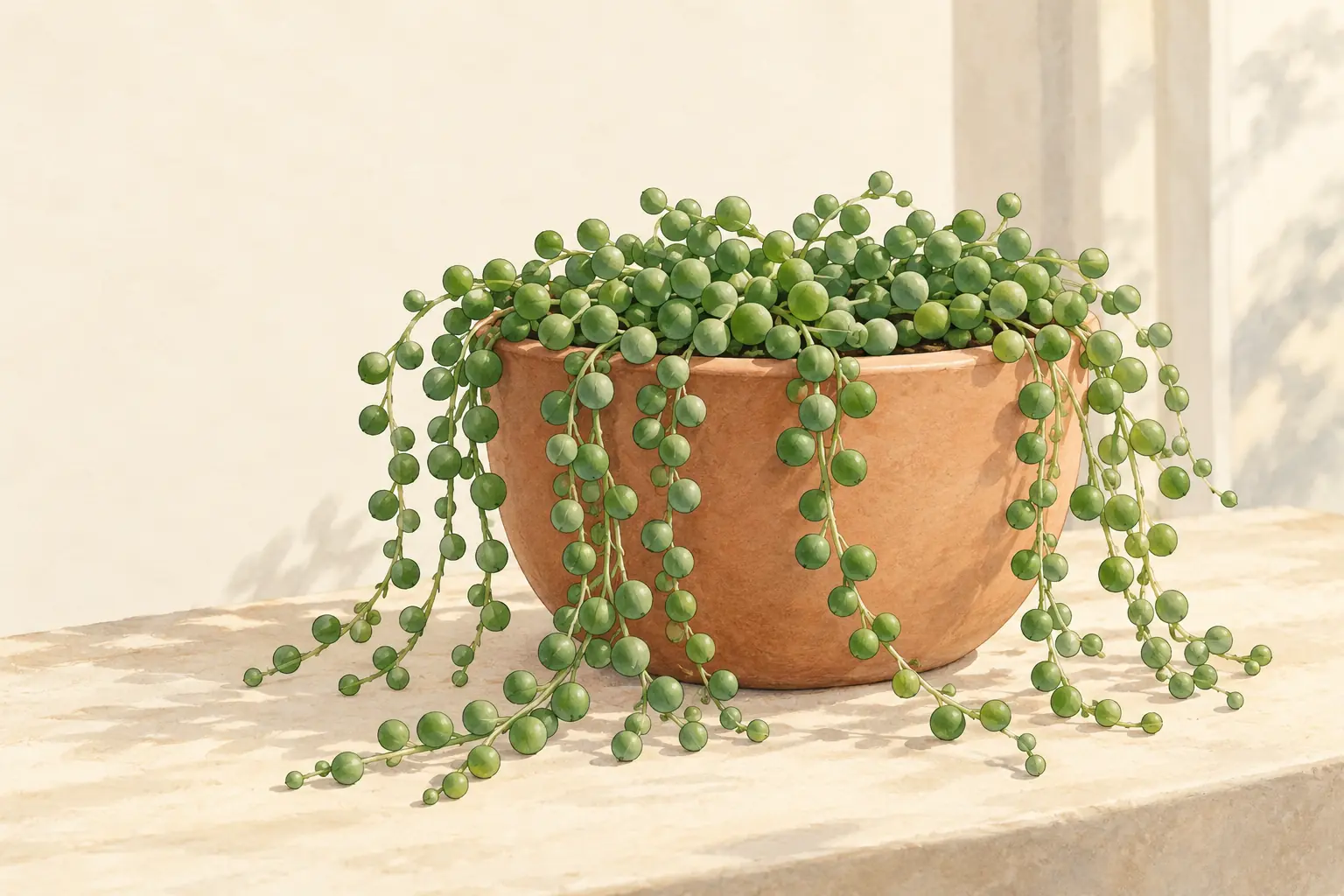
String of pearls care starts with bright, indirect light, a freely draining pot, and checking the growing medium before adding water. This guide covers Curio rowleyanus, also sold as Senecio rowleyanus. Its water-storing leaves do not make it immune to watering problems: wilted pearls can accompany either too much or too little water, and Extension sources disagree about letting the medium dry completely.
Is your plant string of pearls?
This is care for Curio rowleyanus, the trailing succulent with nearly spherical, water-storing leaves. Wisconsin Extension describes stems that can root where they touch the growing medium. You may still find its former name, Senecio rowleyanus, on a nursery label or in an older guide.
String of Hearts, Ceropegia woodii, is a different plant. Other plants sold as strings of bananas, dolphins, or tears should not be treated as alternative names for this species. If your plant’s identity is uncertain, confirm its botanical name with the seller or your local Extension service before transferring this advice to it.
The IPNI naming record connects the Curio and Senecio names; it is a nomenclatural record, rather than a ruling on every plant sold under a common name. This guide does not attempt to identify cultivars from leaf color or shape.
Where should you put string of pearls indoors?
Start with a bright location that receives indirect light. NC State Extension’s species profile recommends bright, indirect light indoors and warns that direct sunlight can scorch the leaves. Wisconsin Extension also calls for bright light and gradual acclimation when a plant moves outdoors.
Look at the whole plant’s placement: where does light reach the top of the pot, and where do the trailing stems hang? A high shelf or deep overhang can leave parts of the plant shaded even when the window nearby looks bright. Checking the actual placement is a practical application of the light guidance, not a measured exposure target.
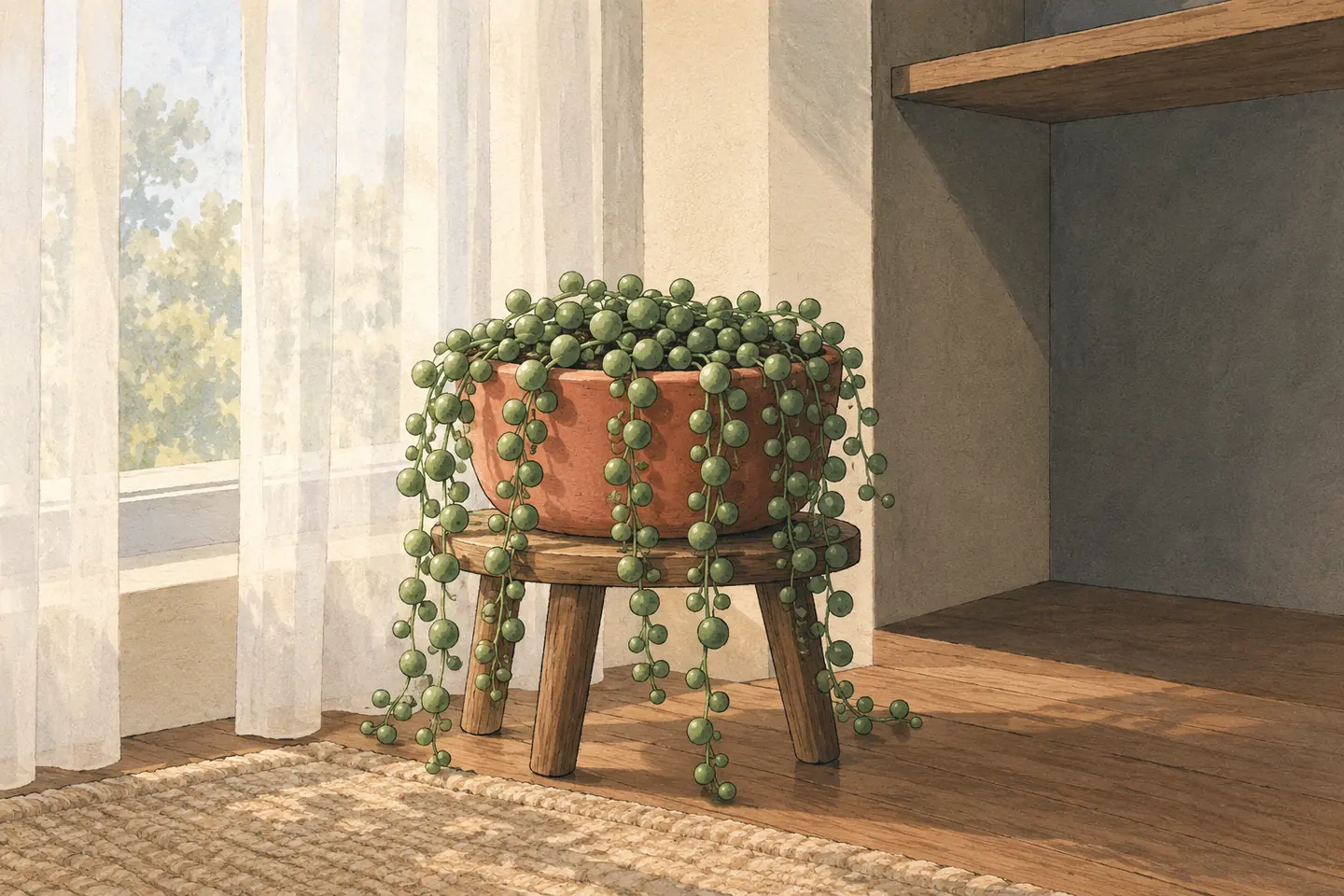
Filtered light · Check the pot top · Check trailing stems
Placement check: Look at light reaching the pot top and trailing stems. A nearby bright window does not establish exposure at the plant; use bright, indirect conditions and change exposure gradually.
Try a suitable brighter position you already have before buying equipment. Change exposure gradually rather than moving a shaded plant straight into strong sun. Do not assume that every south-facing window, or a fixed number of hours of sun, gives the same conditions across US homes and seasons. If you are unsure what your window provides, compare bright indirect light with direct indoor sun before increasing exposure.
If your available daylight remains inadequate after repositioning the pot, our explanation of how grow-light distance and coverage interact provides background for evaluating a setup. It does not establish a lamp distance or a product recommendation for this species.
How do you decide whether to water?
Check the medium, drainage, recent watering, and the plant together. There is no single watering interval or pearl appearance that establishes what this plant needs. NC State specifically notes that both underwatering and overwatering can cause wilting; adding water to every wilted plant can therefore address the wrong problem.
| Source | Its guidance | What that leaves uncertain |
|---|---|---|
| NC State Extension | Water infrequently, avoid overwatering, and do not let the plant dry out completely between waterings. | It does not give a measurable moisture depth or a test that identifies the watering point. |
| Wisconsin Extension | Use very well-draining medium, let it dry completely, and use some leaf shriveling as a watering cue. | This conflicts with NC State’s complete-drying instruction; shriveling does not exclude another problem. |
| UC Master Gardeners of Sonoma County | Water infrequently when the soil is dry. | Its regional entry does not define how dry or how deeply to check. |
These are different instructions, not a demonstrated agreement about one ideal dry-down point. The consulted sources do not establish why they differ. A pot, climate, or mix might affect a plant’s response, but that does not prove the explanation for this disagreement.
A cautious way to make the next decision: use the checks below to avoid an automatic watering response. This is observational guidance, not a validated moisture threshold or a claim that one source’s rule has been proved superior.
Check before watering: Look for collected water, compare the surface with accessible medium below it, and note recent watering and placement. Read the attributed source disagreement above; neither a dry-looking surface nor wilted pearls establishes a water-now threshold.
- Check for retained water first. Look inside the decorative cover or saucer. If water has collected, remove it and let the planted pot drain freely.
- Compare the surface with the accessible medium below it. Do not assume a dry-looking surface describes the whole pot. Note whether the medium you can check remains damp and when you last watered.
- Consider the whole pattern. A recent soaking plus damp medium calls for checking drainage before adding more water. A dry medium and a history of drying make insufficient water a possibility, but a wilted pearl alone does not establish it.
- Act on the problem you have evidence for. Correct trapped water or blocked drainage first. When the observations support watering, let excess water leave the pot and empty the collection container; do not use a fixed calendar to decide the next watering.
- Keep a short record. Note the medium’s condition, watering, placement, and whether decline continues. If you cannot distinguish dry medium from a root or drainage problem, ask local Extension for an assessment before repeatedly adding water.
Do not deliberately wait for obvious shriveling as a universal test, or interpret this guide as an instruction to keep every pot continuously moist. Neither approach resolves the source conflict. A plant that keeps declining needs its conditions investigated, rather than increasingly frequent watering based on appearance alone.
Does the pot let excess water escape?
A drainage hole in the planted pot gives excess water an exit. If an existing nursery pot sits inside a decorative cover, remove the liner when needed so it can drain, empty collected water, and return it without leaving the roots standing in water. This simple check may solve a container problem without buying a new planter.
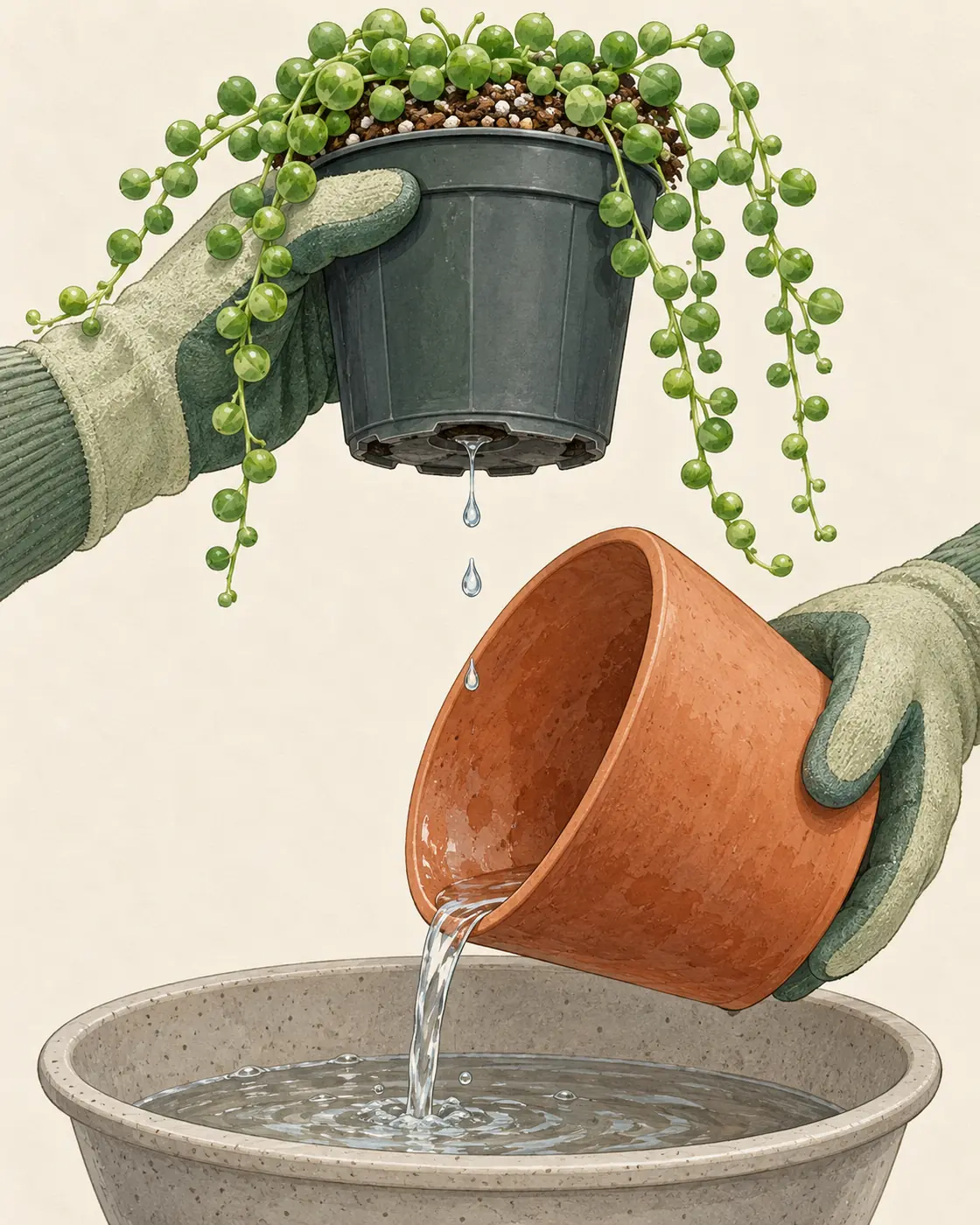
Drainage hole · Separate cover · Empty collected water
Drainage check: Take the planted liner out when needed, let water drain freely through its hole, and empty the separate cover or saucer before returning it. Do not leave roots standing in collected water.
Illinois Extension’s container drainage guidance distinguishes a draining liner inside an outer pot from gravel placed beneath the medium inside the planted pot. A gravel layer under the medium does not improve drainage. Mineral particles mixed throughout a growing medium serve a different function; the two arrangements are not interchangeable.
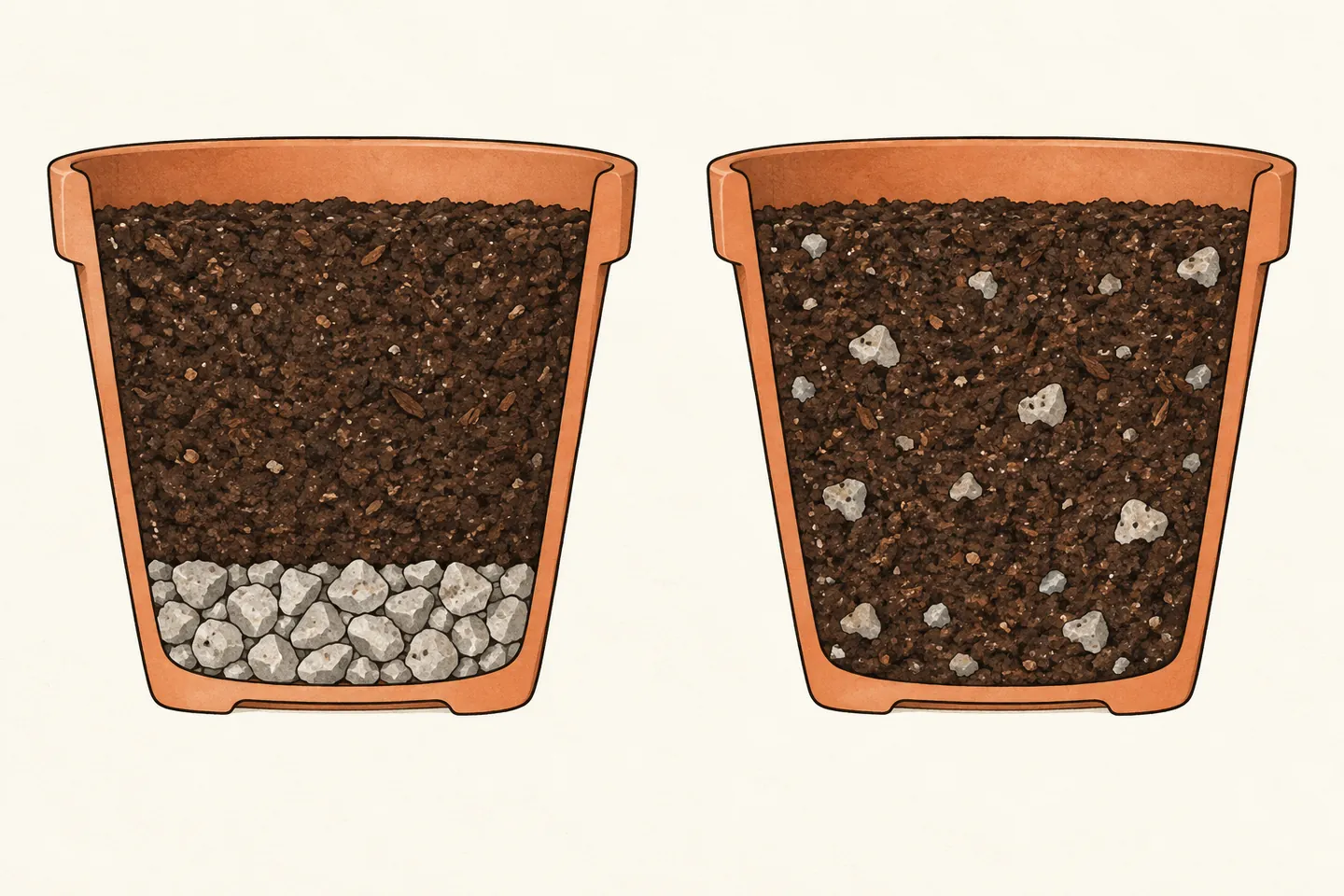
Gravel beneath medium · Particles mixed throughout
Different arrangements: Gravel beneath the medium does not improve container drainage. Particles mixed throughout the medium have a different role; this illustration provides no species-specific ratio or recommendation to repot.
Wisconsin describes a shallow root system and recommends a shallow container with very well-draining medium. Check whether your existing container and medium already work before repotting a healthy plant. Container material changes drying, so changing the pot also means reassessing the way its medium behaves.
A cactus-type mix is one source-supported starting point, but a label alone does not establish how a particular bag will perform in your container. This guide does not prescribe a universal amendment ratio, promise that terracotta prevents rot, or recommend a product to compensate for trapped water. For background on water retention and air spaces, see what potting-mix ingredients change; those general explanations are not a tested String of Pearls recipe.
What should you check when pearls wilt or growth thins?
Start by describing the change, rather than naming a cause from one symptom. The next table helps organize observations; it cannot diagnose root rot, thirst, or an insect problem from leaf appearance alone.
| What you notice | What to check next | Useful next action |
|---|---|---|
| Wilted or shriveled pearls | Current medium, last watering, drainage, and whether the change is spreading. | Use the watering checks above; do not make wrinkling an automatic water-now signal. |
| Medium remains wet | Collected water, a blocked exit, and the volume of medium around the roots. | Remove standing water and investigate drainage; wet medium is a concern, not proof of a specific disease. |
| Damage follows a move into stronger sun | The exposure change and which parts received the stronger light. | Return to protected bright conditions and make future exposure changes gradually; timing alone does not prove scorch. |
| Sparse growth or a thin top | Light reaching the plant, stem condition, moisture history, and any visible insects. | Address basic conditions before taking cuttings or trying fertilizer as a rescue. |
Take dated photos and keep notes on the medium, watering, placement, and continuing changes. Check whether further deterioration follows your correction and whether new growth develops; do not set a guaranteed recovery deadline. If decline continues, bring the observations, plant name, and care history to your county Extension office. Photos and symptoms can guide assessment without proving the cause by themselves.
How can you encourage fuller string of pearls growth?
First correct unsuitable light or drainage. Adding more stems to a struggling pot does not solve the underlying conditions. For a healthy plant, stem propagation is a source-supported way to grow additional rooted stems, but it does not guarantee that a sparse or unhealthy crown will recover.
Wear protective gloves when handling cut stems: NC State notes that the sap can irritate skin. Keep removed leaves and cuttings away from children and pets.
For string of pearls (Curio rowleyanus, formerly Senecio rowleyanus), Wisconsin Extension’s propagation method uses a 3- to 4-inch (about 8- to 10-cm) stem-tip cutting. Its instructions are specific to establishing a cutting:
- Remove three or four leaves from the lower end of the cutting.
- Place that end in or on moist potting medium, lightly covering the lower nodes, the points on the stem where leaves attach and roots can form.
- Follow the source’s light surface-moistening approach while roots establish, avoiding a waterlogged pot. Do not transfer a rooting-cutting moisture instruction into a rule for every established plant.
Watch for establishment and subsequent growth rather than expecting roots on a promised date. A loose pearl is not equivalent to a stem cutting with nodes. Wisconsin also mentions light spring fertilization, but feeding is not a substitute for correcting an unsuitable growing environment; this guide does not supply a fertilizer dose or shopping recommendation.
What changes if the plant goes outdoors?
Move an indoor plant outside gradually, protect it from excessive rainfall, and bring it back indoors before frost. Those are Wisconsin Extension’s transition precautions; NC State also describes this plant as frost tender. A location sheltered from strong sun can still receive rain, so reassess both exposure and water collection.
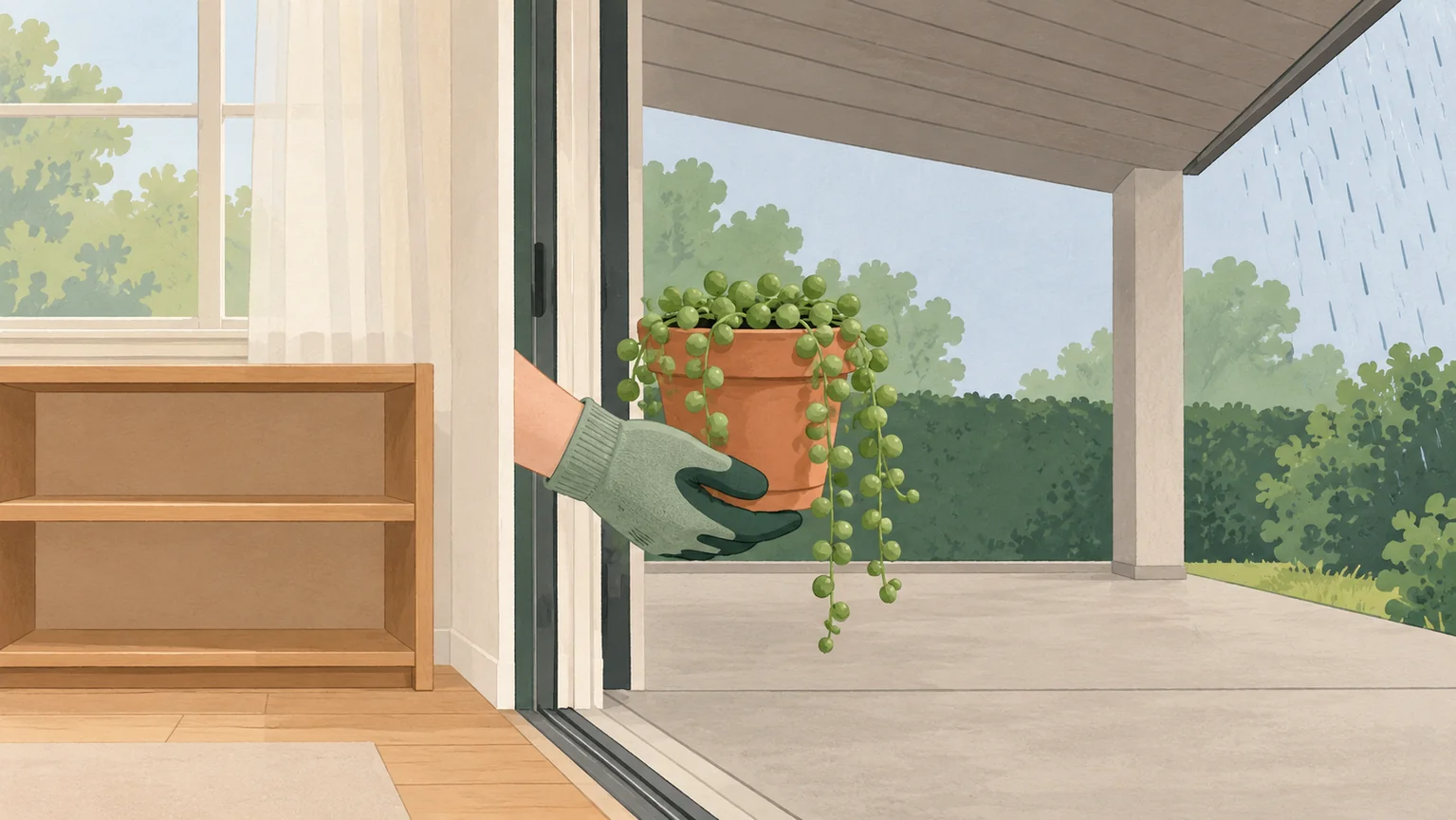
Roof overhead · Rain beyond the roof edge
Outdoor checks: Change exposure gradually, protect the pot from excessive rainfall, and reassess collected water. Use your local forecast and return indoors before frost; an outdoor shelter is not a winter guarantee.
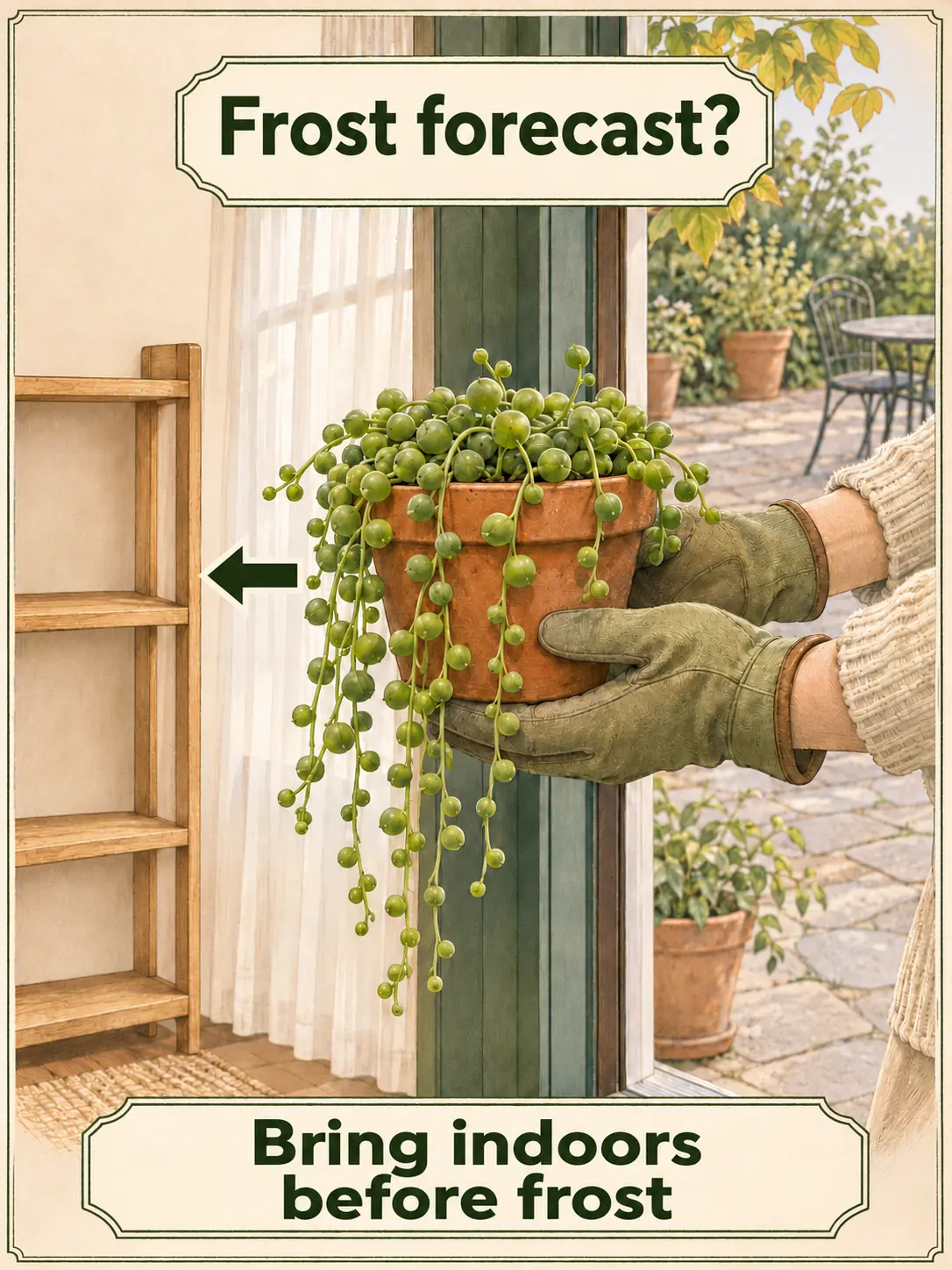
Frost forecast? Bring indoors before frost.
There is no single US moving-out or moving-in date. Use your local forecast and conditions rather than a national calendar, including in generally mild areas. A sheltered summer location is not proof that the same spot is suitable through winter.
What should pet owners know?
Prevent pets from reaching this plant and any fallen pieces. The ASPCA’s species-named succulent guidance lists String of Pearls as Senecio rowleyanus and says ingestion can cause stomach upset, predominantly vomiting, and lethargy.
If you suspect a pet has ingested it, contact your veterinarian or the ASPCA Animal Poison Control Center immediately; do not wait for symptoms. Hanging the pot does not guarantee that a pet cannot reach it. This brief warning does not establish a safe amount or predict an individual animal’s outcome.
Frequently asked questions
How to make a String of Pearls fuller?
Start by checking light, drainage, and the health of the existing stems before adding more growth. A healthy String of Pearls can be propagated from stem cuttings with nodes placed against suitable medium, as Extension describes, but this does not guarantee a full crown or repair an unresolved root problem.
What are some common problems that String of Pearls plants encounter?
Watering problems, inadequate light, and leaf scorch are concerns described by NC State Extension, while prolonged wet conditions can contribute to root rot. Wilting can follow either too much or too little water, so compare the medium, drainage, recent watering, and exposure before choosing a correction or assuming a diagnosis.
What are the best growing conditions for String of Pearls?
Bright, indirect light, well-draining medium, and a container that lets excess water escape are a supported indoor starting point. Check moisture and plant condition rather than following a weekly schedule: NC State and Wisconsin give conflicting complete-drying advice, and the consulted sources do not establish a universal watering threshold.
Does String of Pearls like direct sunlight?
Bright, indirect light is NC State Extension’s indoor recommendation; direct sun can scorch the leaves. Wisconsin advises gradual acclimation when moving plants outdoors, so do not move a shaded plant straight into strong sun or use a fixed sunlight-hour rule without considering the plant’s previous exposure and its actual location.
Sources and scope
This guide synthesizes the sources below; it does not report an in-house growing trial. The watering disagreement remains explicit because the consulted guidance does not establish one complete-drying rule for every pot. The FAQ questions were recorded in Ahrefs’ US search data dated October 22, 2026, retrieved October 29; that observation date is separate from the care evidence.
- NC State Extension: Curio rowleyanus — identity, indoor light, watering cautions, propagation, and plant problems.
- Wisconsin Extension: String of Pearls — revised October 2026; growth habit, containers, contrasting watering advice, outdoor transitions, and stem propagation.
- UC Master Gardeners of Sonoma County: Succulents — the species entry’s regional light and watering guidance.
- Illinois Extension: Container Drainage Options — drainage holes, double potting, and why a gravel layer beneath the medium does not improve drainage.
- International Plant Names Index: Curio rowleyanus — botanical naming and its Senecio basionym.
- ASPCA: Are Succulents Safe to Have Around Pets? — the species-specific ingestion warning and prompt professional contact.