Begonia care starts with the plant’s group and current growth, not a weekly watering schedule. Give most indoor foliage begonias bright, protected light and a draining pot; keep growing plants moist with slight drying between waterings. A leafy cane begonia, a winter-flowering gift plant, and a dormant summer-flowering tuber need different winter routines. Check the label before choosing yours.
Start with what you already have: the nursery tag, the pot, your finger, and a record of recent watering or moves. The guide below brings together Extension and American Begonia Society advice so you can choose a care route, make a small adjustment, and check what happens next.
Begonia care: choose a group before changing the routine
Growers use informal groups based on growth habit. They are useful care routes, not a complete identification key. Rex begonias belong within the rhizomatous group; winter-flowering hybrids do not fit neatly into a simple root-system division. NC State describes the common groups, while New York Botanical Garden explains the winter-flowering hybrid exception.
| What the label establishes | Useful context | Care route |
|---|---|---|
| Wax or Semperflorens begonia | Usually a compact, fibrous-rooted bedding plant. | Growing-plant watering; it may stay leafy indoors over winter. |
| Cane or angel-wing type | Upright, cane-like stems; leaf patterns vary. | Growing-plant watering and bright light, with gentle sun where appropriate. |
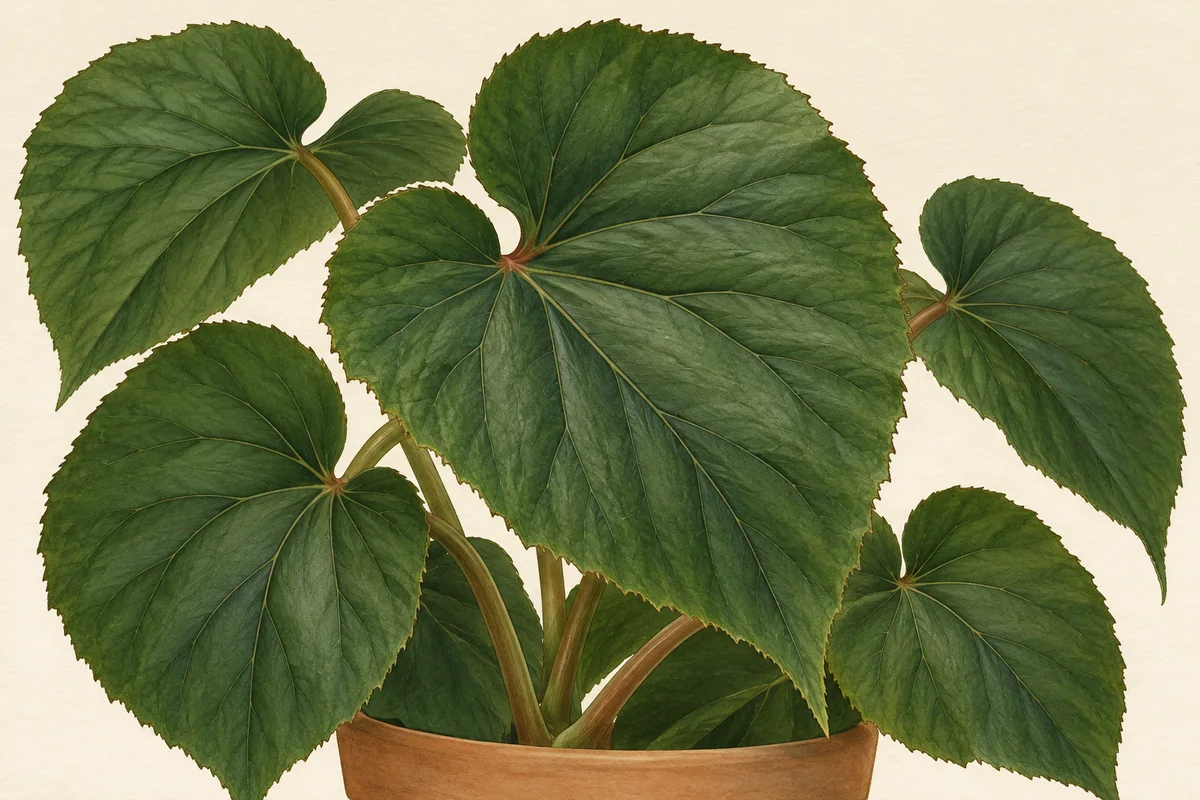
| Rhizomatous or rex | Leaves arise from a creeping modified stem called a rhizome. | Use the surface-moisture check below; reduce water if growth slows. |
| Summer-flowering Tuberhybrida | A confirmed tuberous plant, often sold for seasonal flowers. | Active care in growth; a separate dry-storage route for winter. |
| Begonia × hiemalis, Rieger, or Elatior | A winter-flowering hybrid sold as a flowering houseplant. | Follow its flowering-houseplant care; do not assume it needs summer-tuber storage. |
| Begonia grandis | The identified hardy-begonia species. | Outdoor perennial care adapted to your region; see the winter exception below. |
| Only “begonia,” or no label | Spots, bright leaves, or large flowers do not settle the identity. | Check moisture, drainage, and light. Ask the nursery or local Extension service to identify it before cutting back, lifting, or drying it for storage. |
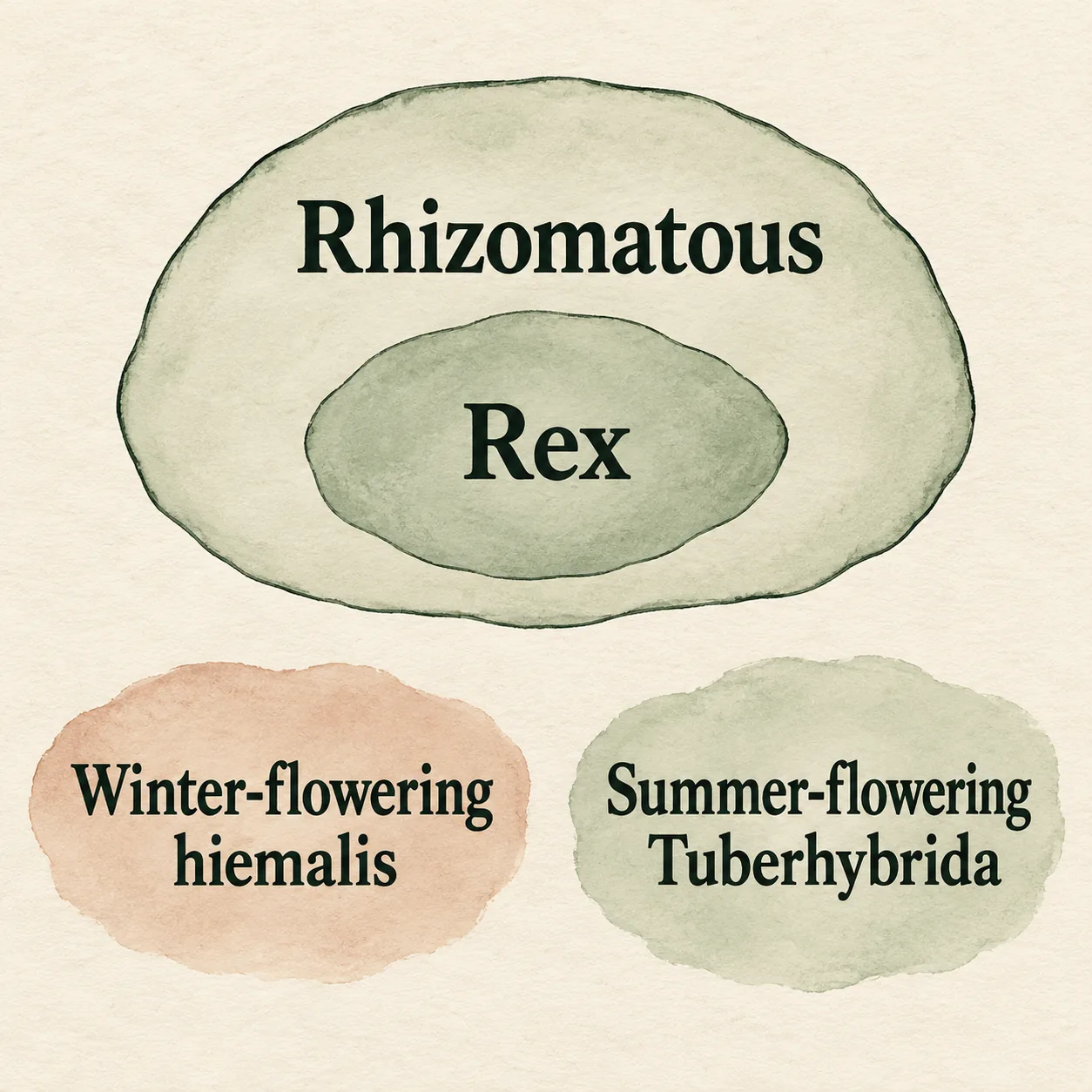
A rhizome is a stem; a tuber stores energy underground. Those differences matter more than whether the leaves look colorful or “tropical.” Do not dig up a healthy, actively growing unknown plant just to look for a tuber. The American Begonia Society’s rhizomatous guide and tuberous guide describe the distinct structures and growth cycles.
How to decide when to water
First decide whether the plant is growing, slowing down, or a confirmed dormant tuber. New leaves, ongoing flowering, and the plant’s known seasonal history help you choose the route. Winter on the calendar, wilting, or one yellow leaf does not establish dormancy.
- Check the plant’s route. Keep a leafy, growing plant on the growing-plant routine. Use dry storage only for the confirmed summer-flowering tuberous route described below.
- Feel the potting mix before adding water. For common indoor flowering and foliage begonias, Clemson advises moist soil with only slight drying between waterings. For common rhizomatous begonias in active growth, the American Begonia Society uses a surface that feels dry to the touch. Neither instruction means drying the entire root ball.
- Check where excess water goes. Use a pot with drainage holes. Water the mix rather than routinely wetting the leaves, let excess escape, and empty collected saucer or outer-pot water.
- Check again before the next watering. If the mix is still wet, do not add water just because the plant droops or the usual watering day has arrived. Review drainage, light, and recent changes first.
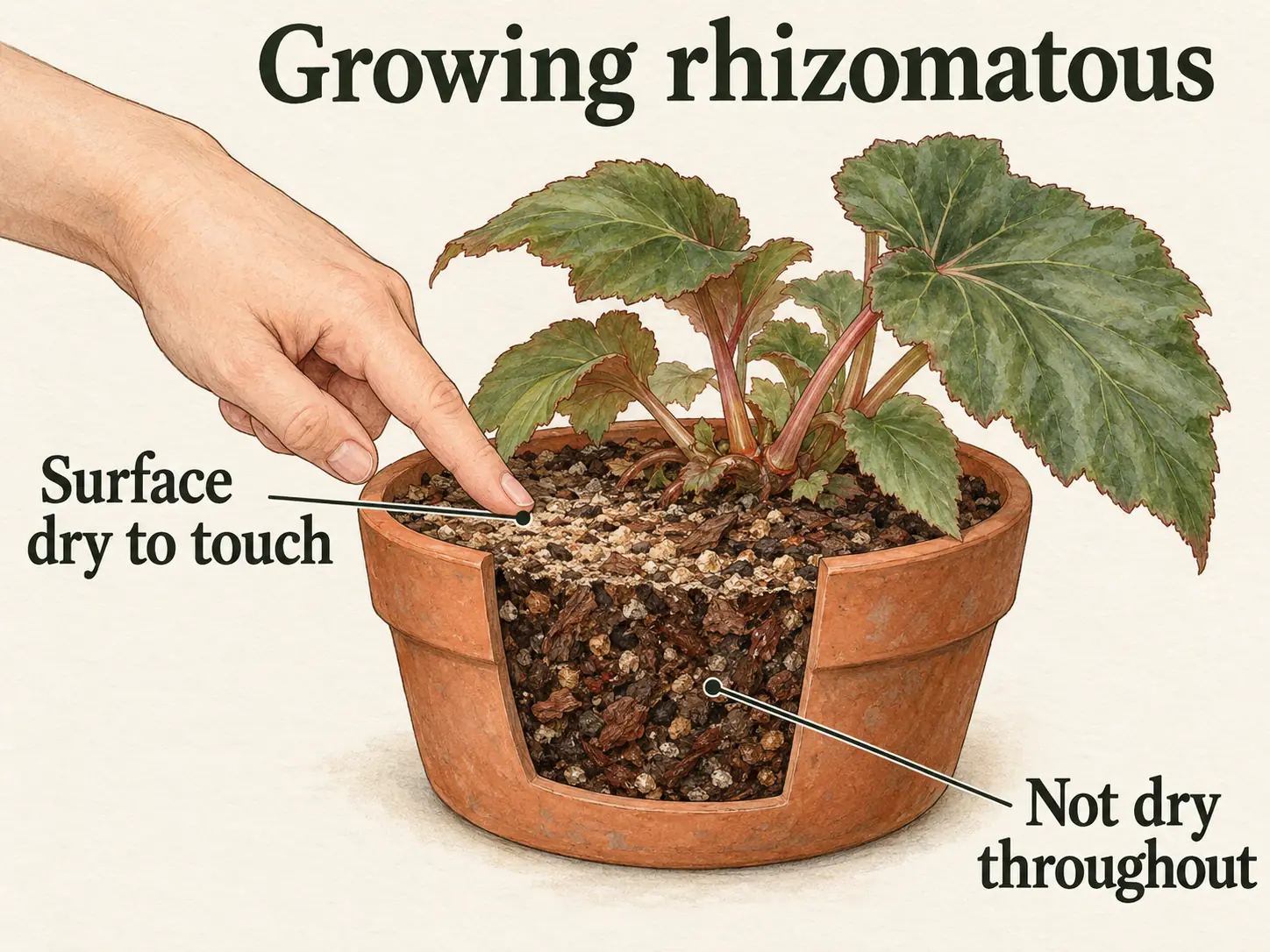
These steps combine Clemson’s indoor moisture and saucer guidance, the Society’s rhizomatous surface check, and NC State’s advice to water at the base and avoid overwatering. They are an observation routine, not a tested all-begonia watering formula.
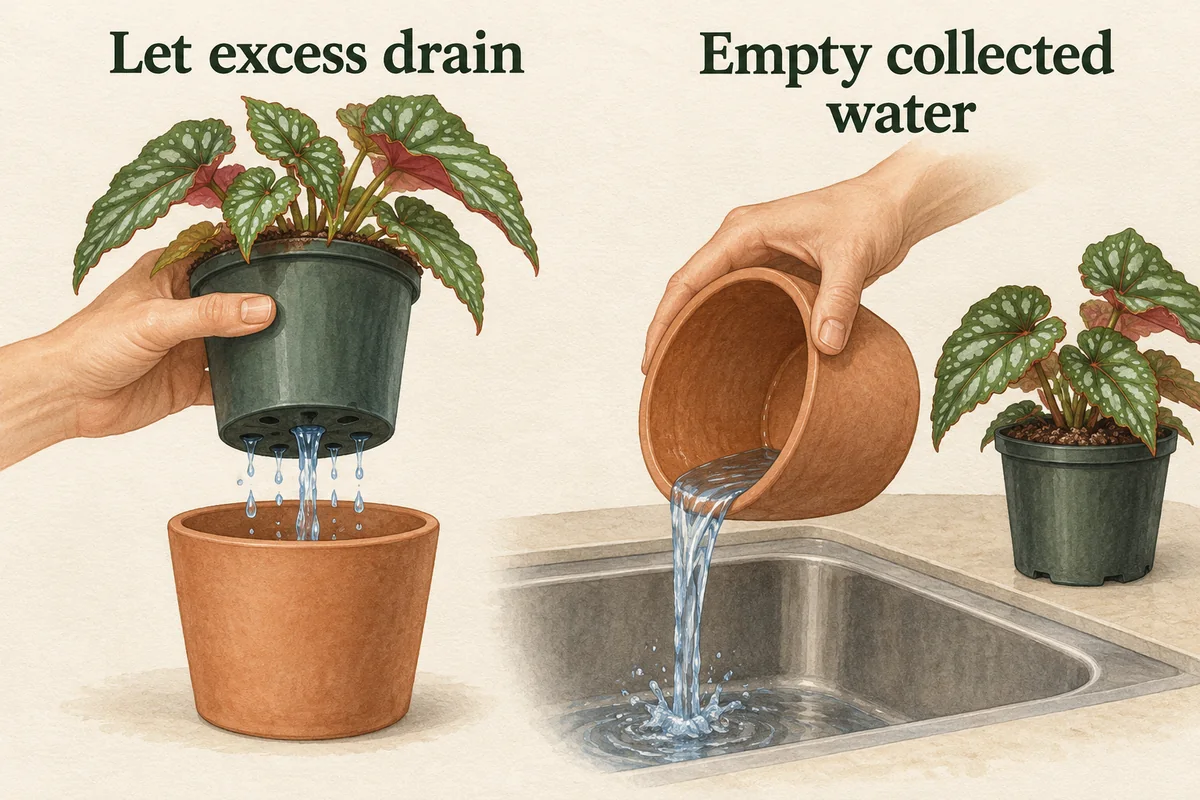
Starting a known tuber is another case: keep its medium moist rather than wet. The Society’s starting-tuber instructions say to withhold more water when the mix already feels damp. Container size, material, medium, and plant size all affect water retention; exposed hanging baskets can dry faster. That is why a single weekly interval is unreliable. See the tuberous growing guide.
Light indoors and outdoors
For foliage and rhizomatous begonias, begin with bright light sheltered from strong direct sun. For cane and some flowering houseplant begonias, gentle morning sun can be useful. An east-facing window is one option in Clemson’s flowering-houseplant guidance, not a guarantee for every window or every begonia.
Check what the plant actually receives: a window shaded by a porch is different from unobstructed glass. If a rhizomatous plant grows lanky with elongated leaf stems, reassess inadequate light; bleaching can indicate excessive light. Keep these observations in context rather than diagnosing from color alone. The American Begonia Society describes both light responses.
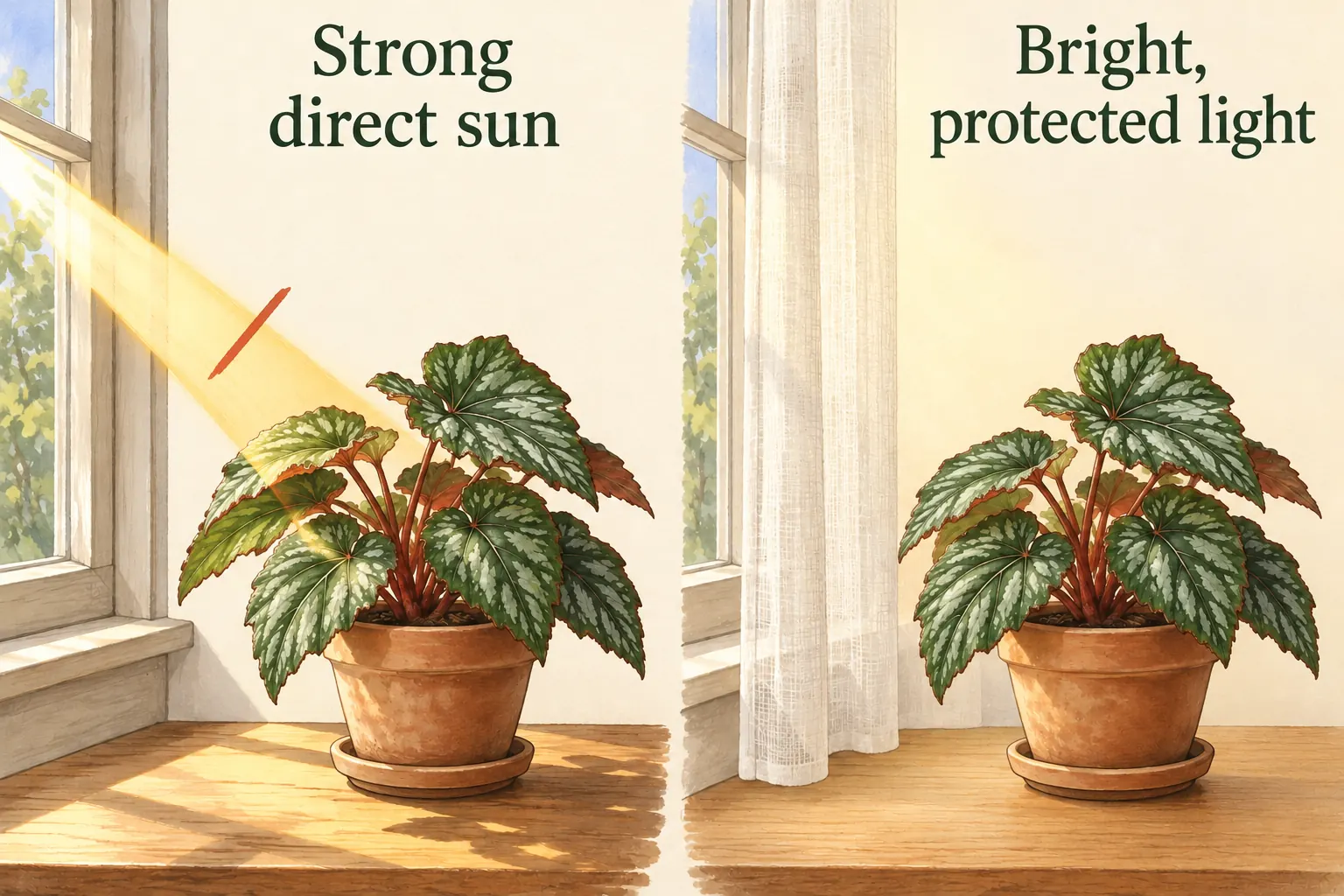
For a labeled Begonia × hiemalis: New York Botanical Garden recommends bright, filtered light from spring through fall, with greater sunlight during winter flowering. Make the transition gradually. Keep this seasonal advice specific to that hybrid; a rex begonia does not inherit it. Read NYBG’s winter-flowering begonia guidance.
Outdoors, partial shade is a useful starting point for many cultivated begonias. Tuberhybrida needs protection from intense midday sun. Some bronze-leaved wax cultivars tolerate more sun than green-leaved wax types, but bronze leaves alone do not certify an unknown plant for full sun. Clemson’s outdoor recommendations describe South Carolina conditions, including the difficulty of growing tuberous begonias in its hottest, most humid areas. Use the group and regional qualifications in Clemson’s outdoor guide.
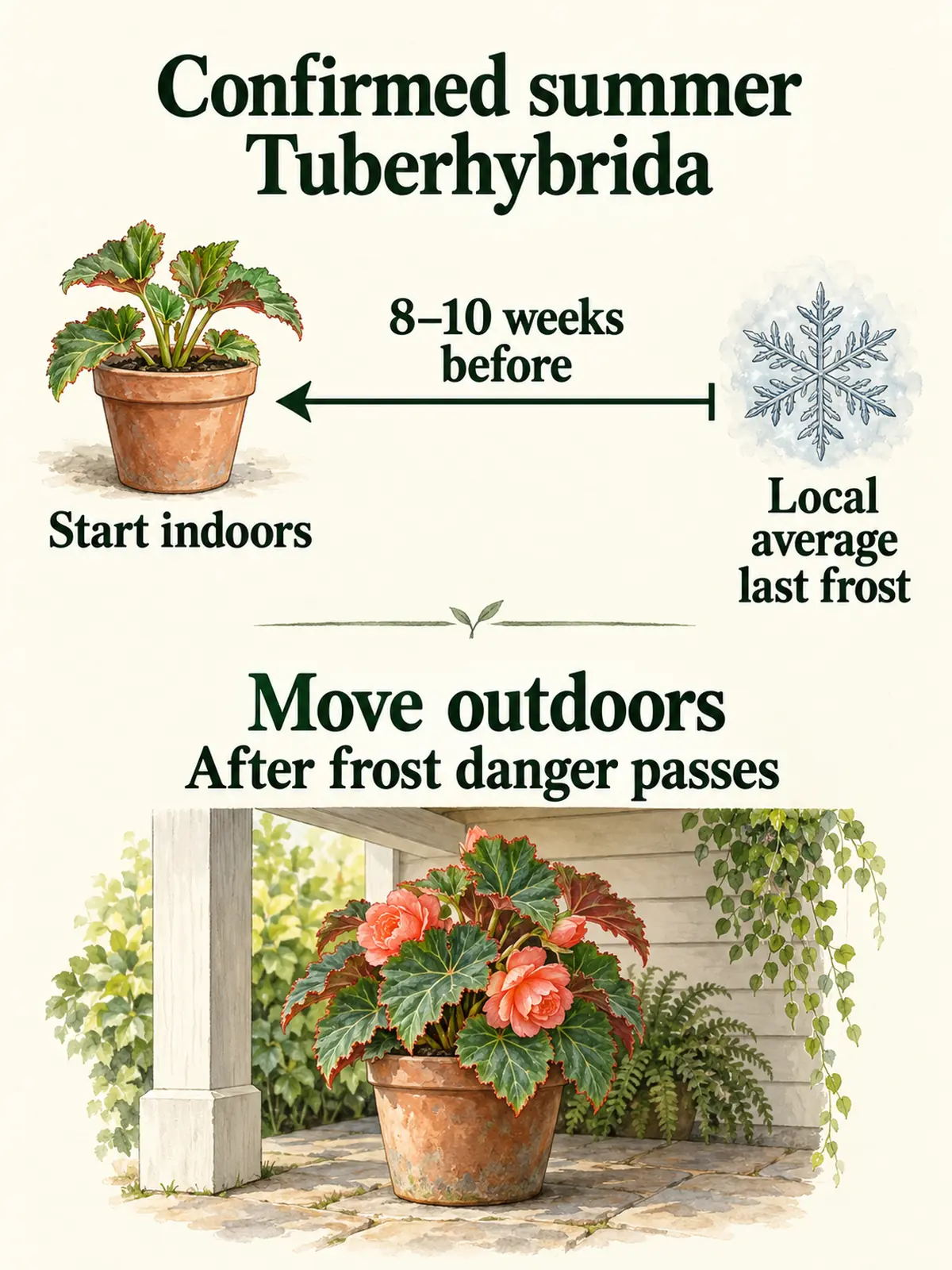
For tuberous begonias moving outside in spring, wait until local frost danger has passed. Begin in a shaded, sheltered place and gradually introduce the appropriate gentler sunlight. A national planting date cannot cover a Gulf Coast patio and an Upper Midwest garden. Iowa State gives this acclimation sequence.
Pots, mix, humidity, and feeding
Before replacing the mix, empty trapped water and confirm that the growing pot drains. A well-drained container medium should retain useful moisture without leaving the plant waterlogged; drainage holes and moisture control are central to Iowa State’s tuber-starting advice and Clemson’s indoor care.
For common rhizomatous begonias, the Society recommends a shallow container and coarse, fast-draining mix. Move up only when roots have filled the present pot, and then only one pot size. A rhizome extending over the rim is not, by itself, an emergency requiring pruning. These are rhizomatous recommendations, not a demand that every begonia use the same pot.
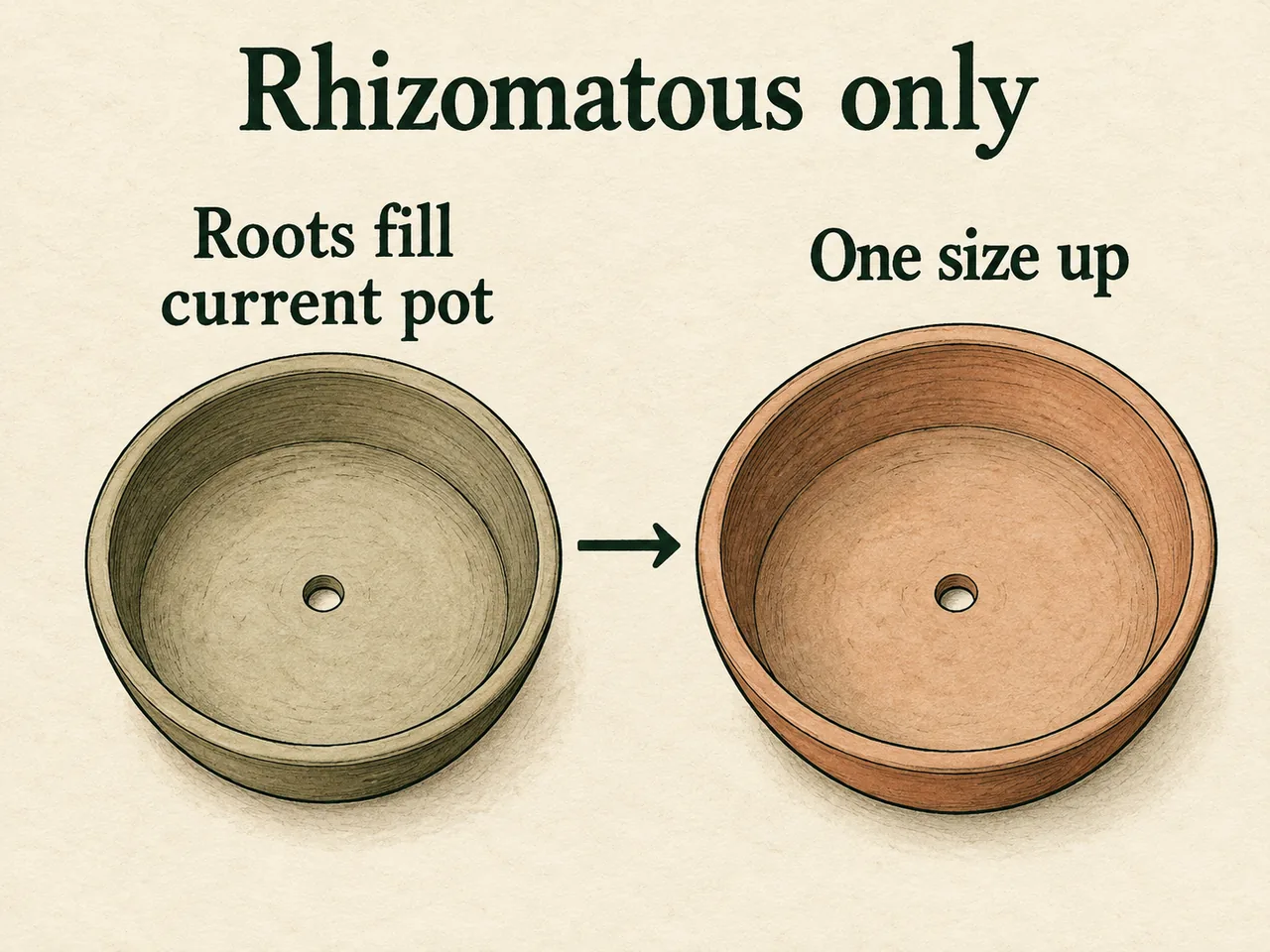
If you need help understanding container media, our general indoor potting-mix guide explains moisture, air, and drainage. It is general background, not a tested Begonia recipe; another plant’s specialized blend is not automatically right for yours.
Humidity needs vary. Clemson recommends a humid environment for foliage begonias but advises against leaf misting; the Society notes that many common rhizomatous types are adaptable, while some distinctive-foliage types are more demanding. Do not chase one humidity percentage for the entire genus or treat every crisp edge as proof of dry air. Check watering and light as well. Clemson’s foliage guidance and the Society’s group exceptions explain the different scopes.
Feed a growing plant according to its group guidance and the fertilizer label. Check whether its current mix already includes fertilizer before adding another feeding system. Do not feed a dormant rhizomatous plant or a dry stored tuber. Feeding is a growth task, not the first response to unexplained decline. The Society explicitly separates active growth from dormancy; its tuberous guide also distinguishes feeding stages and pre-fertilized media.
For an established cane begonia that has become overlong, Clemson recommends cutback in spring or early summer to encourage basal growth. Pinching tips can encourage branching. Identify the type and correct its growing conditions before using pruning as the answer to decline. See Clemson’s cane and branching guidance.
Winter: keep growing or store a tuber?
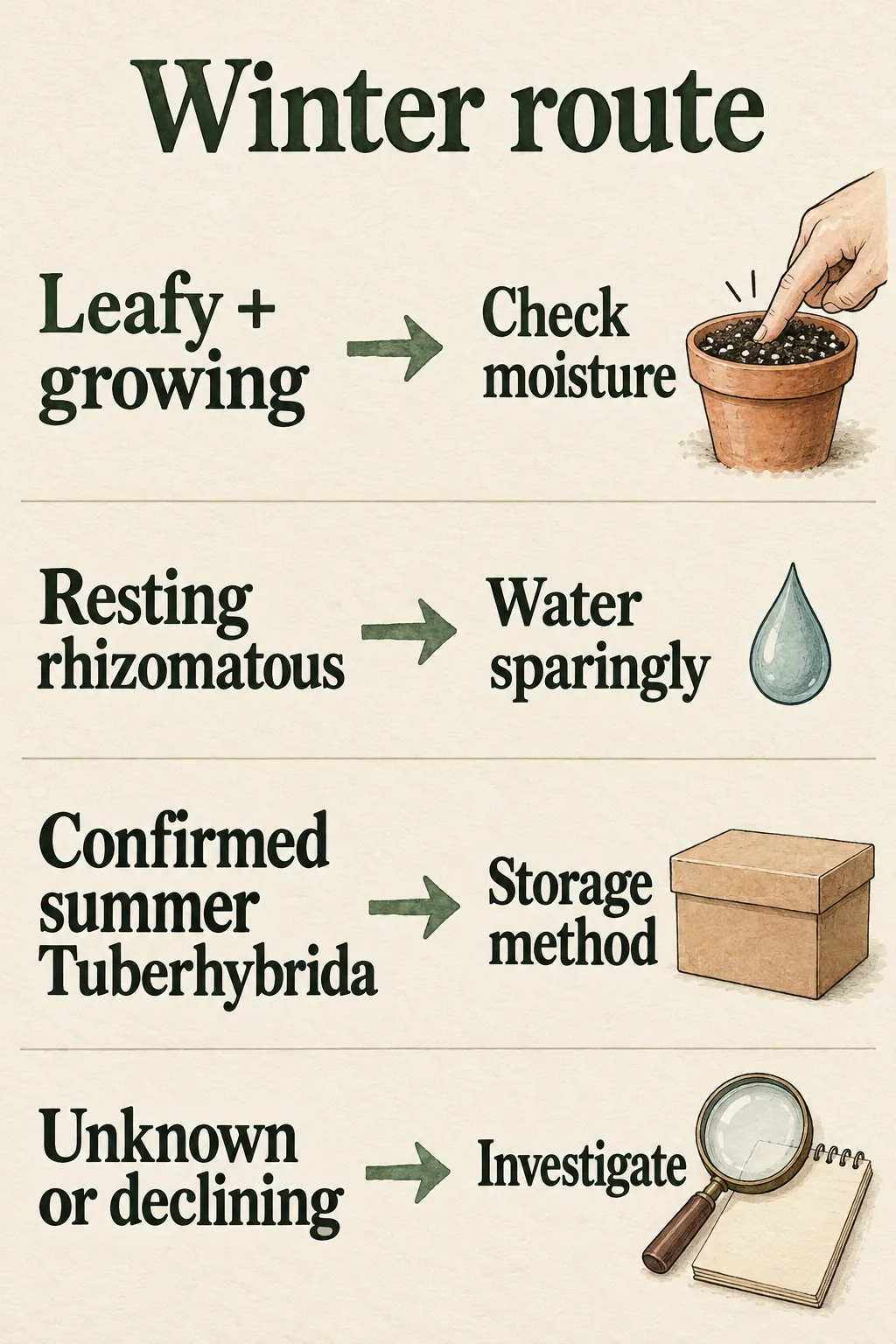
Choose the winter route from identity and growth history. Some wax and cane begonias can stay leafy indoors, some rhizomatous types slow down, and some flowering hybrids bloom in winter. A confirmed summer-flowering tuberous begonia follows a different cycle. Clemson separates these indoor groups.
- Leafy and growing: continue moisture checks, suitable light, and protection from cold. Reduce watering if the mix dries more slowly; do not deliberately dry the whole plant for storage.
- Known rhizomatous plant slowing or resting: water sparingly until growth resumes and withhold fertilizer during dormancy, following the Society’s rhizomatous guidance.
- Known summer-flowering Tuberhybrida: use its tuber-storage method, with frost protection arranged before freezing weather.
- Unknown type, sudden collapse, or yellowing in wet mix: use the problem checks below. Do not declare the plant dormant and stop investigating.
One source-specific method for Tuberhybrida
Clemson’s outdoor guide gives this method for its tuberous begonias:
- Dig the tubers before the first frost.
- Cut tops to within a couple of inches of the tubers.
- Let them dry.
- Then pack them in cardboard boxes between layers of vermiculite, peat moss, or wood shavings.
- Store at 45–55°F (about 7–13°C).
This is Clemson’s complete storage sequence, not a temperature range for living houseplants or every Begonia storage organ.
In spring, Iowa State recommends starting known tuberous begonias indoors 8–10 weeks before your local average last spring frost. Its full restart instructions cover tuber orientation, planting depth, warmth, and keeping the medium moist rather than wet. Outdoor planting still waits for actual frost danger to pass.
The hardy-begonia exception
An identified Begonia grandis is an outdoor perennial with seasonal dieback, not simply a tender pot plant to dry and box up. NC State recommends moist, rich, well-drained soil in shade and warns that winter hardiness is unreliable in some colder parts of its listed range. Confirm local suitability and winter protection with your Extension service. Do not transfer this species’ hardiness to wax, cane, rex, or Tuberhybrida begonias. Read the species-specific profile.
Yellowing or wilting: check the history before treating
Yellow leaves can accompany inadequate light, too much water, or too little water in winter-flowering begonias. Other begonias can have pests, root disease, or leaf disease. A symptom starts an investigation; it does not identify the cause. NYBG lists overlapping causes of yellowing, and Clemson describes pest and disease possibilities.
| What you notice | Check before acting | Action and next observation |
|---|---|---|
| Wilting or yellowing with wet mix | Last watering, trapped saucer water, drainage holes, a recent move to dimmer light, or a much larger pot. | Empty trapped water and pause automatic watering. If decline continues, seek help assessing the roots and growing conditions rather than adding fertilizer or assuming dormancy. |
| Wilting with a mix that has become dry | Known growing versus stored-tuber route; whether a hanging basket or changed conditions altered drying. | Return an active plant to its group’s moisture routine. Recheck moisture and whether wilting persists before deciding that water was the only problem. |
| Lanky rhizomatous growth or bleached leaves | Actual light and any recent placement change. | Adjust toward bright, protected light. Compare subsequent growth and whether bleaching continues; leaf color alone is not proof of the cause. |
| Leaf loss as days shorten | Plant label, previous seasonal cycle, current moisture, and whether decline was gradual or sudden. | Use the confirmed growth/rest route. Without that identity and history, investigate decline before drying or cutting the plant. |
| Persistent spotting, visible pests, or collapsing stems | Leaves and stems, including undersides; where damage begins and whether it is spreading. | Seek identification from your local Extension service or a plant clinic. Do not choose a pesticide from a leaf color or an unconfirmed diagnosis. |
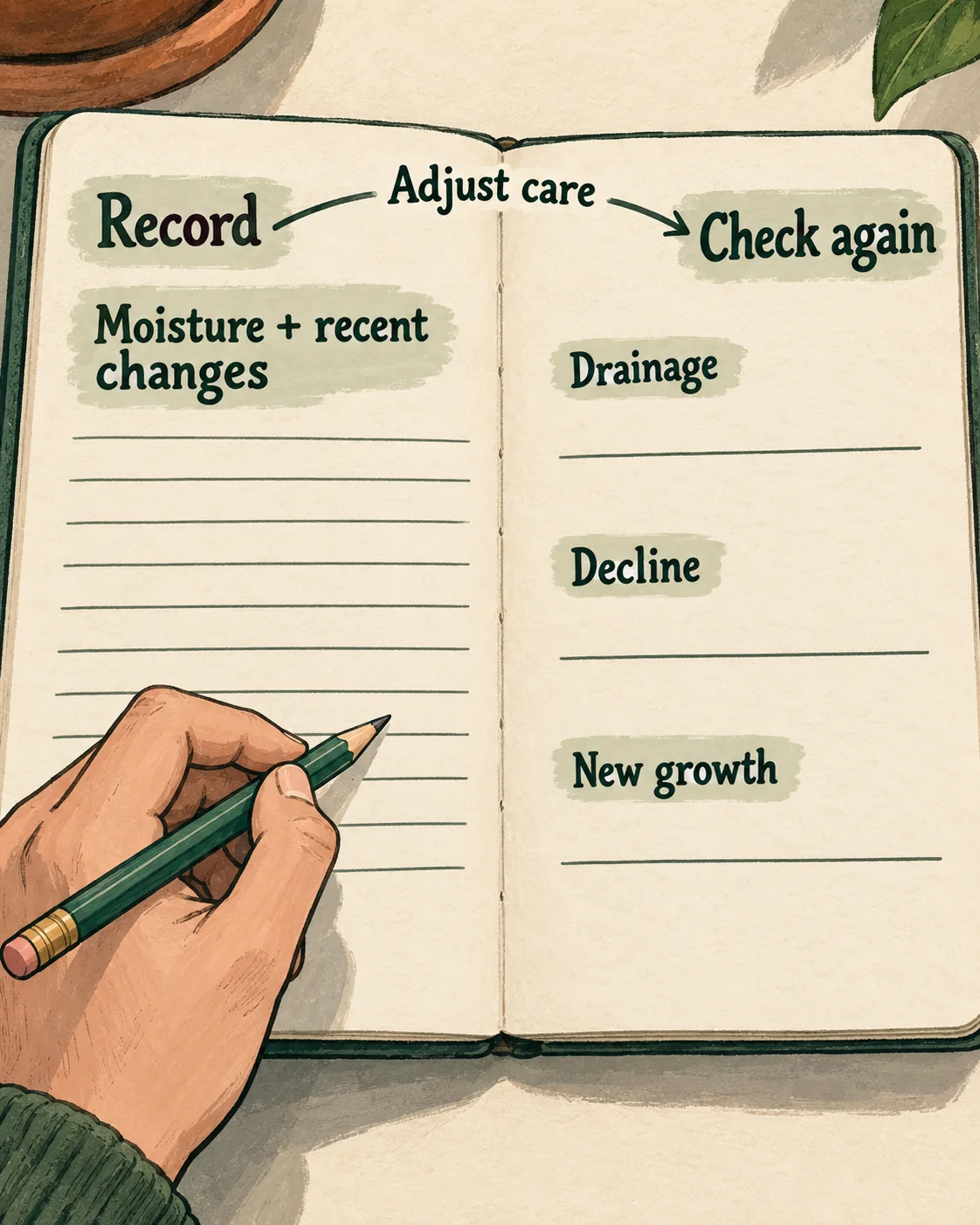
The table is a care-triage synthesis of the sources above, not a diagnosis chart. Photograph the plant, record its label and recent changes, and note moisture before and after your adjustment. At the next checks, ask whether the pot is draining, whether decline is continuing, and whether new growth is developing normally. Persistent decline calls for reassessment, not an invented recovery deadline.
Do not assume a homemade spray or insecticidal soap is a harmless default. Clemson specifically warns that begonias may be sensitive to insecticidal soaps. Get the problem identified before selecting a treatment. See Clemson’s problem and sensitivity notes.
Keep begonias away from pets
The ASPCA lists Begonia species as toxic to cats, dogs, and horses because of soluble calcium oxalates. It lists vomiting and salivation in dogs and cats; the underground part is most toxic. That does not make the leaves or flowers safe to chew. The listing’s kidney-failure wording refers specifically to grazing animals. Read the ASPCA’s Begonia listing.
If you suspect ingestion, contact your veterinarian or ASPCA Poison Control at (888) 426-4435 as soon as possible. Do not wait for symptoms. A consultation fee may apply. Keep both growing plants and stored tubers inaccessible to pets.
Begonia care questions
How often should I water a begonia?
Water by the plant’s group, growth, and potting-mix condition, not once a week. Clemson recommends only slight drying for growing indoor begonias; the American Begonia Society uses a dry-to-touch surface for common rhizomatous types. A confirmed dormant summer-flowering tuber needs a separate dry-storage routine. Indoor guidance; rhizomatous guidance.
Do begonias prefer sun or shade?
Many begonias suit bright, protected light or outdoor partial shade, but the group matters. Foliage begonias need shelter from strong direct sun; cane and some flowering types benefit from gentler morning sun. Tuberous begonias need protection from intense midday sun. Follow the known cultivar’s outdoor guidance. Clemson indoor care; outdoor care.
Do all begonias go dormant in winter?
No. Some wax and cane begonias remain leafy indoors, and some flowering hybrids bloom in winter. Certain rhizomatous types slow or rest, while confirmed summer-flowering Tuberhybrida can be stored as dormant tubers. Check the label and seasonal history; yellow leaves alone do not establish normal dormancy. Clemson’s group distinctions; rhizomatous winter care.
Can begonias live outdoors all year?
That depends on the identified plant and your local winter. Most commonly grown bedding and indoor begonias need protection from frost, while Begonia grandis is a hardy-perennial exception with regional limits. Do not apply its hardiness to an unlabeled begonia; check the plant and local Extension advice first. Clemson’s outdoor guide; NC State’s grandis profile.
Are begonias toxic to cats and dogs?
Yes. The ASPCA lists begonias as toxic to cats and dogs, with soluble calcium oxalates and signs including vomiting and salivation. The underground part is most toxic. After suspected ingestion, contact your veterinarian or ASPCA Poison Control promptly, even without symptoms; do not wait to see whether illness develops. ASPCA Begonia listing.
Sources and scope
This guide synthesizes published horticultural advice; it does not report a hands-on trial. Clemson’s outdoor recommendations are written for South Carolina. Group-specific society guidance and the identified hardy species qualify the broader advice; no single watering interval, humidity target, or cold limit applies to this entire genus.
- Clemson Cooperative Extension: Growing Begonias Indoors
- Clemson Cooperative Extension: Begonia
- American Begonia Society: Rhizomatous—Leaves, Flower Clusters
- American Begonia Society: Growing Tuberous Begonias
- NC State Extension Gardener Plant Toolbox: Begonia
- NC State Extension Gardener Plant Toolbox: Begonia grandis
- Iowa State University Extension: Starting Tuberous Begonias Indoors
- New York Botanical Garden: Winter-flowering Begonia
- ASPCA Poison Control: Begonia