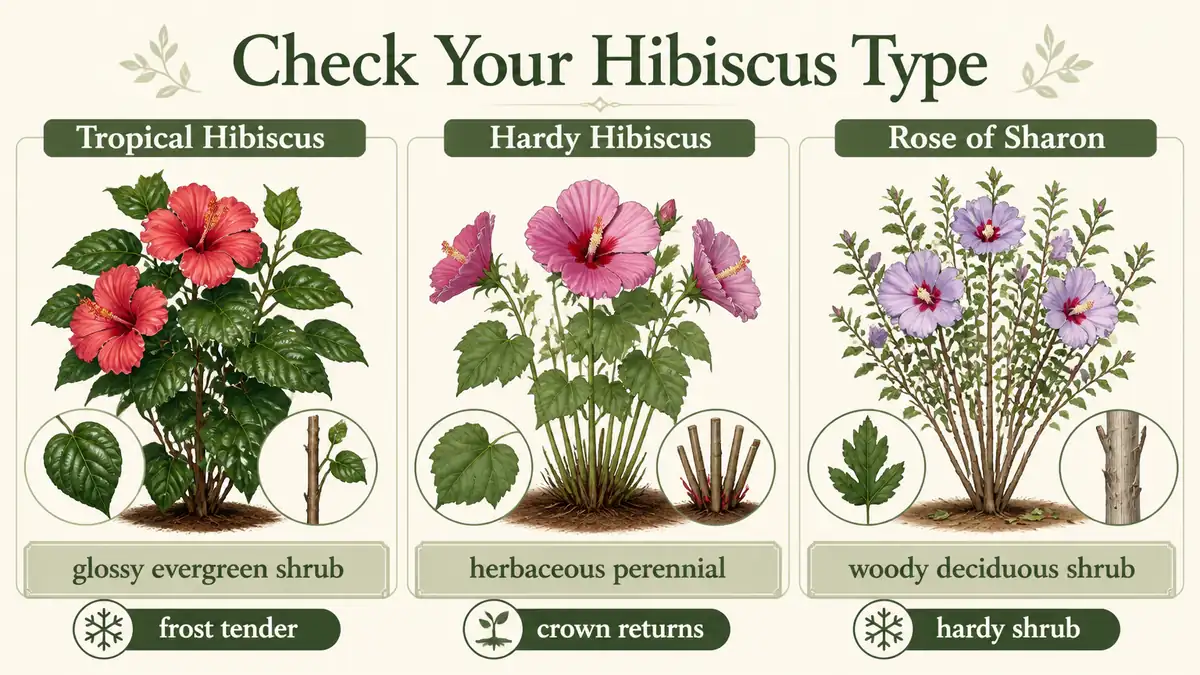
The fastest way to tell tropical and hardy hibiscus apart is to combine the plant tag, stem habit, leaf texture, and winter behavior. A glossy potted patio plant is usually tropical; a plant that dies back and returns from the crown is usually hardy; a permanent woody shrub is often Rose of Sharon.
Quick Hibiscus ID Table
| What you see | Likely type | Next check |
|---|---|---|
| Glossy potted patio plant | Tropical hibiscus | check tag/species |
| Huge dinner-plate blooms, stems die back | Hardy hibiscus | watch winter behavior |
| Permanent woody shrub outside | Rose of Sharon | compare stems |
| Not sure before frost | Treat as tender until identified | winter protection guide |
Before you change watering, prune hard, or move the plant indoors, identify which hibiscus you have. The same symptom can mean different things. Brown stems on hardy hibiscus after frost are normal dormancy. Brown stems on tropical hibiscus after a freeze may mean cold damage. Bare winter branches on Rose of Sharon are normal, but cutting those branches to the ground can remove the shrub structure you actually want to keep.
| Quick clue | Most likely type | What to check next |
|---|---|---|
| Tag says Hibiscus rosa-sinensis | Tropical hibiscus | Check the plant tag or species name |
| Stems die to the ground after frost, then new shoots return from the base | Hardy hibiscus | Watch what happens in winter |
| Permanent woody shrub with bare winter branches | Rose of Sharon | Look at the leaves and stems |
| Huge dinner-plate flowers on soft seasonal stems | Hardy hibiscus | Compare the flowers without relying on color alone |
| Grows outdoors year-round in Zone 4 or 5 and returns each spring | Hardy hibiscus or Rose of Sharon | Match the plant to your USDA zone |
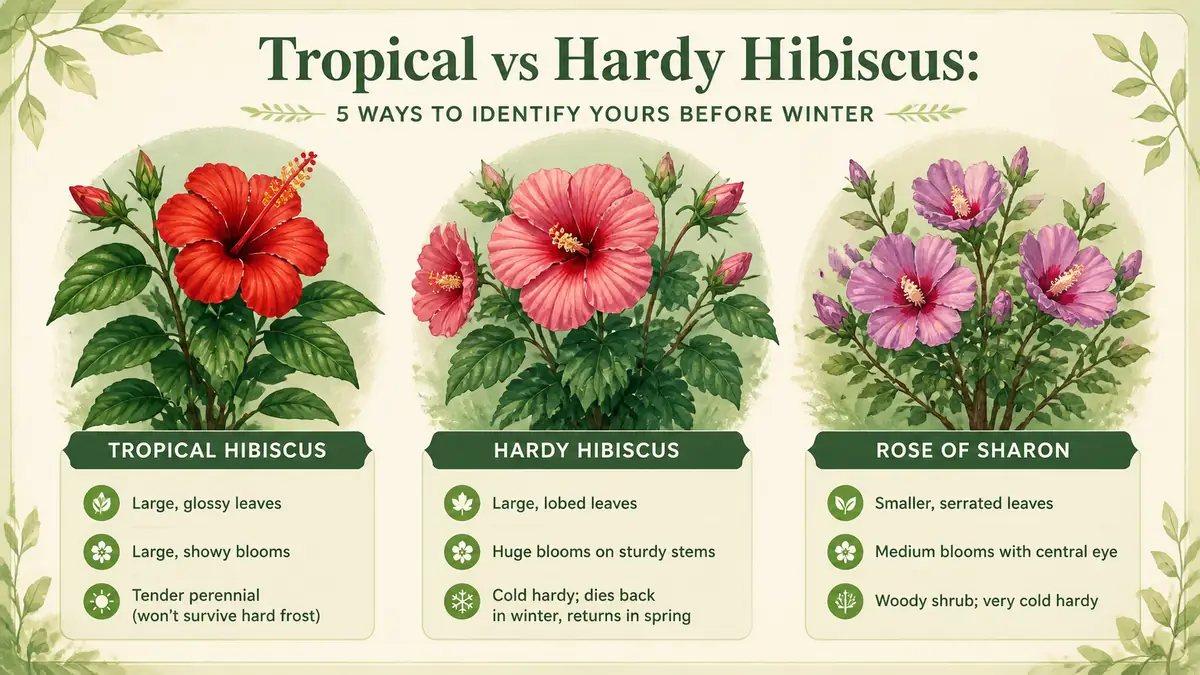
1. Check the Plant Tag or Species Name
The plant tag is the fastest clue, but it is not always complete. Many tags simply say “hibiscus,” which is why you should look for the species name, hardiness range, and whether the label calls it a houseplant, perennial, or shrub.
| Label clue | Type | What it means before winter |
|---|---|---|
| Hibiscus rosa-sinensis | Tropical hibiscus | Bring indoors before cold nights; do not expect it to survive freezing soil. |
| Hibiscus moscheutos, rose mallow, or hardy hibiscus hybrid | Hardy hibiscus | Outdoor perennial in cold-winter regions; top growth usually dies back. |
| Hibiscus syriacus or Rose of Sharon | Hardy woody shrub | Drops leaves in winter but keeps permanent woody branches. |
If the tag gives a USDA zone, treat that as more important than flower color. “Hardy to Zone 4” or “Zone 5” points to hardy hibiscus or Rose of Sharon. “Protect from frost,” “houseplant,” or “tropical” points to Hibiscus rosa-sinensis.
Also check the small print for words such as “perennial,” “patio,” “greenhouse,” “conservatory,” “shrub,” or “standard.” A patio hibiscus sold in bloom near annuals is often tropical, especially if the tag warns against frost. A perennial hibiscus tag usually mentions full sun, moist soil, and a hardiness zone.
A Rose of Sharon tag may list mature height in feet because it is sold as a landscape shrub, not as a soft perennial or houseplant.
Common mistake: a hardy hibiscus that turns brown after frost is not necessarily dying. A tropical hibiscus doing the same indoors after cold exposure may be in trouble. The correct response depends on the type.
2. Look at the Leaves and Stems
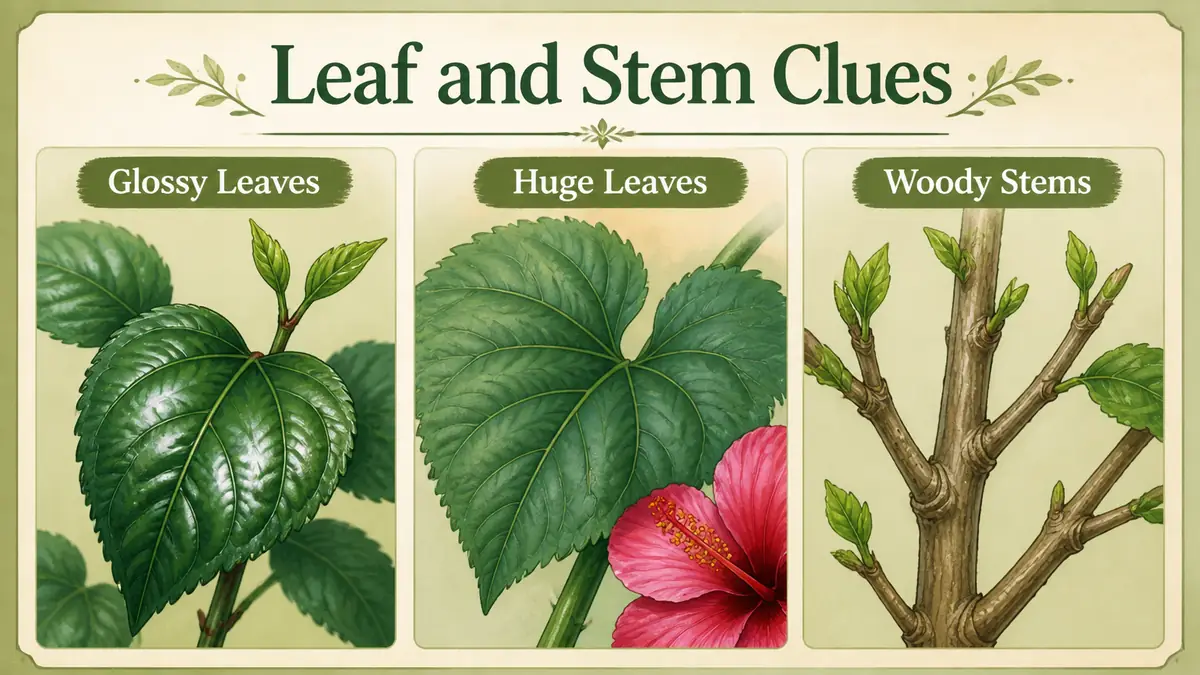
Leaves and stems are more reliable than flower color. Check the plant when it is not blooming, because many hibiscus types can have pink, red, white, or bicolor flowers.
| Feature | Tropical hibiscus | Hardy hibiscus | Rose of Sharon |
|---|---|---|---|
| Stem habit | Woody, often kept as a potted shrub or standard | Soft, cane-like seasonal stems from the crown | Permanent woody shrub or small tree |
| Winter stems | Should stay alive if kept warm and bright | Usually die back to ground level | Stay woody but lose leaves |
| Leaves | Often glossy, deep green, oval to slightly toothed | Often larger, matte to medium green, sometimes heart-shaped or lobed | Smaller, toothed, often lobed, deciduous |
| Growth pattern | Branches from woody stems | New shoots rise from the base each spring | Branches from an older woody framework |
For a quick stem test, look low on the plant. Hardy hibiscus usually has multiple stems emerging from the crown at soil level. Tropical hibiscus usually has a more shrub-like woody framework above the soil. Rose of Sharon has true woody trunks and branches that persist year after year.
If the plant is in a pot, lift it before watering. A tropical hibiscus often lives in a lighter container mix and dries from the top down. Hardy hibiscus in a container usually needs a consistently moist root zone and may be much heavier when properly watered.
Use your fingers as well as your eyes. On tropical hibiscus, young stems may be flexible, but older stems should still feel woody and alive rather than hollow and papery. On hardy hibiscus, last year’s stems often become dry tubes after winter, while the living plant is protected below at the crown.
On Rose of Sharon, scratch a tiny spot on a young branch in late winter or early spring; green tissue under the bark suggests the woody branch is alive even before leaves appear.
Leaf texture can help, but do not make it the only test. Tropical hibiscus often has smooth, glossy leaves that look like a houseplant or patio shrub. Hardy hibiscus leaves can be broader and less shiny, and some cultivars have dark burgundy foliage. Rose of Sharon leaves are usually smaller and more shrub-like. Because cultivars vary, combine leaf clues with stem habit, hardiness, and winter response.
3. Compare the Flowers Without Relying on Color Alone
Flower color alone is a weak identification tool. Tropical and hardy hibiscus can both bloom in red, pink, white, yellowish tones, or blends. Instead, compare flower size, texture, plant habit, and how long the stems remain alive.
| Flower clue | Likely meaning |
|---|---|
| Large, flat, dinner-plate blooms on tall herbaceous stems | Often hardy hibiscus |
| Glossy-leaved potted plant with showy tropical-looking blooms | Often tropical hibiscus |
| Many smaller flowers along a woody shrub in summer | Often Rose of Sharon |
| Double or ruffled flowers on a woody potted plant | Often tropical hibiscus, but verify by tag and winter tolerance |
Hardy hibiscus blooms are often enormous, but size is not foolproof. Some tropical cultivars have large flowers, and stressed hardy plants may bloom smaller than expected. Use flowers as supporting evidence, not the final decision.
Spent blooms can be removed on all types if you dislike the look. Do not prune hard just because flowers drop after one day. Many hibiscus flowers are naturally short-lived, and new buds can follow when light, water, and temperature are steady.
Look at where the flowers are being produced. A tropical hibiscus often blooms from a branching potted framework with glossy foliage. Hardy hibiscus commonly sends up tall seasonal stems and produces dramatic flowers from that new growth. Rose of Sharon typically carries many buds and flowers along woody branches in summer, and the shrub remains visible as a permanent framework after bloom season ends.
If buds yellow, drop, or fail to open, treat that as a care clue rather than an identification clue. Tropical hibiscus may drop buds after being moved from outdoor sun to indoor lower light, after a cold draft, or after irregular watering. Hardy hibiscus may abort buds when the root zone dries out in hot sun.
In both cases, check light exposure, soil moisture, and recent temperature swings before assuming the plant was mislabeled.
4. Watch What Happens in Winter
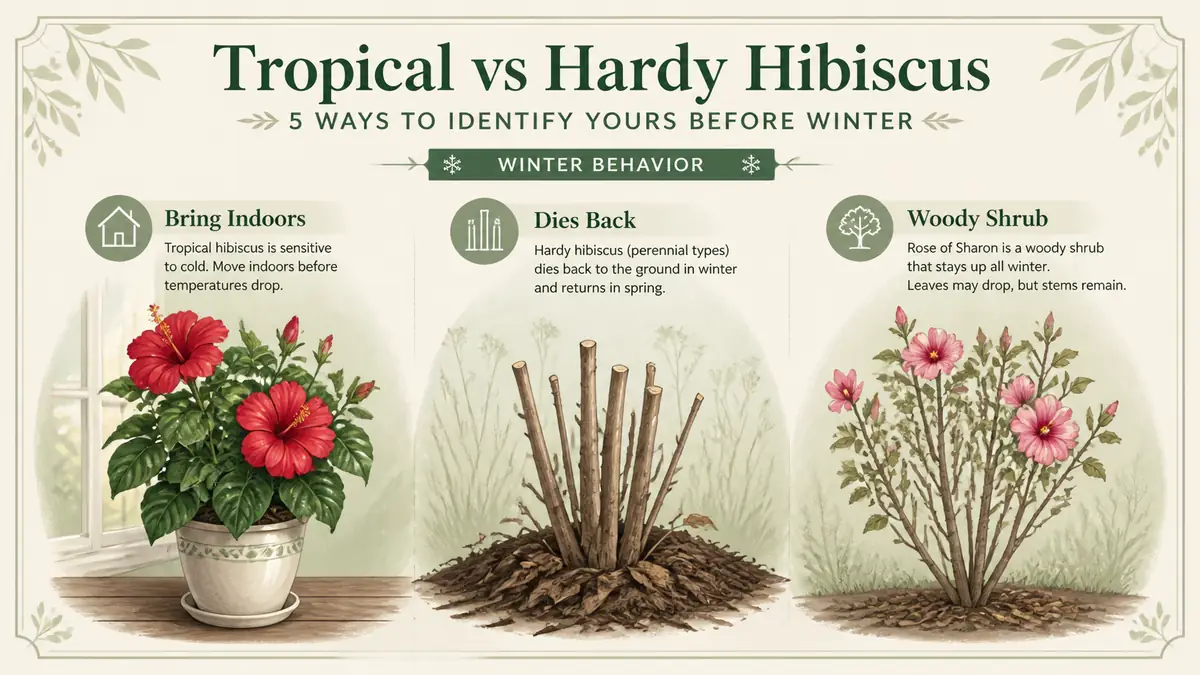
Winter behavior is the clearest field test. Tropical hibiscus is tender and should come indoors before frost. Hardy hibiscus is expected to die back above ground. Rose of Sharon goes dormant like a deciduous shrub but keeps its woody structure.
| Winter sign | Do this | Do not do this |
|---|---|---|
| Tropical hibiscus outdoors and nights are dropping near 50°F | Start moving it inside gradually before frost | Wait for a freeze to “harden it off” |
| Hardy hibiscus stems turn brown after frost | Wait for dormancy, then cut stems down according to your timing preference | Assume the crown is dead |
| Rose of Sharon drops leaves | Leave the woody framework in place | Cut it to the ground like hardy hibiscus |
For tropical hibiscus, use nighttime temperature as your cue. When nights are consistently approaching 50°F, begin the move indoors. Place it first in a bright sheltered spot, then indoors near your brightest south or west window if possible.
Indoors, tropical hibiscus needs very bright light to bloom well. Four to five hours of bright direct light helps. A sudden move from full outdoor sun to a dim room often causes yellow leaves, bud drop, or stalled growth.
Make the move gradually when you can. A good transition is a few days on a porch or under filtered shade, then a brighter protected spot, then the indoor location. Before bringing the pot inside, inspect the undersides of leaves and the tender stem tips for aphids, whiteflies, or other pests. Water thoroughly, let excess drain, and avoid leaving the pot standing in a saucer of water.
Once indoors, check moisture by the top inch of potting mix and by pot weight. Water when the top inch is starting to dry and the container feels noticeably lighter, then water until excess drains. Do not keep tropical hibiscus saturated in a cool, lower-light room. As growth slows, feeding should also slow or stop until stronger growth resumes.
For hardy hibiscus, patience matters. New shoots often appear late compared with many perennials. Mark the crown, keep the root zone evenly moist, and wait until the soil warms before declaring it dead.
If you cut hardy hibiscus down in fall, leave short stem stubs of about 3 to 4 inches so you know where the crown is. If you prefer wildlife cover or winter markers, you can wait until late winter or early spring and cut the dead stems before or as new shoots emerge. Do not divide hardy hibiscus in fall; spring is the safer timing if division is needed.
If you need detailed cold-season steps, use this overwinter hibiscus guide after you identify the type. The indoor routine for tropical hibiscus is very different from the outdoor dormancy routine for hardy hibiscus.
5. Match the Plant to Your USDA Zone
Your USDA zone does not identify the plant by itself, but it tells you what can survive outdoors. Hardy hibiscus is commonly winter hardy to Zone 4 or 5, depending on the cultivar. Tropical hibiscus is not treated as a freezing-winter perennial.
| Plant type | Outdoor winter expectation | Best use |
|---|---|---|
| Tropical hibiscus | Tender; protect from frost and cold nights | Container, patio plant, bright indoor overwintering |
| Hardy hibiscus | Root-hardy in many cold-winter zones; top dies back | Sunny perennial bed, rain garden edge, large moist container |
| Rose of Sharon | Hardy deciduous woody shrub in many temperate zones | Landscape shrub, hedge, small specimen tree |
If you live in a cold-winter region and your hibiscus has returned from the ground for several years, it is almost certainly hardy hibiscus. If it survives winter outside as a woody shrub, it may be Rose of Sharon. If it only survives when brought indoors, treat it as tropical.
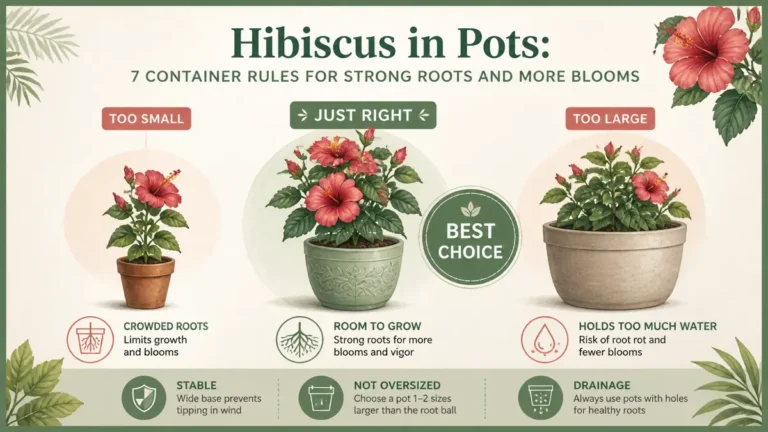
Zone also affects container decisions. A tropical hibiscus in a pot is mobile by design. A hardy hibiscus in a pot may still need root protection, because container roots get colder than roots in the ground. For container-specific care, see hibiscus in pots.
Microclimates can complicate the zone clue. A hibiscus planted against a warm wall, in a protected courtyard, or near a heat-retaining patio may survive slightly better than one exposed to open wind. The reverse is also true for pots: a hardy hibiscus that would survive in the ground can fail in a container if the root ball freezes hard and repeatedly thaws.
If the plant matters to you, match the tag zone to your actual garden conditions, not just your regional map number.
Quick Identification Checklist
If you still are not sure, use this sequence instead of relying on one clue. First, read the tag for species and zone. Second, inspect the base of the plant for a woody trunk, a shrub framework, or soft stems from a crown. Third, compare leaf texture and size. Fourth, watch the plant through the first frost or winter rest period.
Finally, match what you observed to your USDA zone and how the plant was sold.
| Question | If yes, this points to… | Next step |
|---|---|---|
| Does the label say Hibiscus rosa-sinensis or warn to protect from frost? | Tropical hibiscus | Plan an indoor move before nights approach 50°F. |
| Do all stems die back, then new shoots return from the crown in spring? | Hardy hibiscus | Keep the crown marked and wait for warm soil. |
| Does the plant keep a permanent woody branch structure outdoors? | Rose of Sharon | Prune as a shrub in late winter or early spring. |
| Is it a glossy potted patio plant that only survives winter indoors? | Tropical hibiscus | Give very bright light and avoid soggy cool soil. |
What to Do After You Identify Your Hibiscus
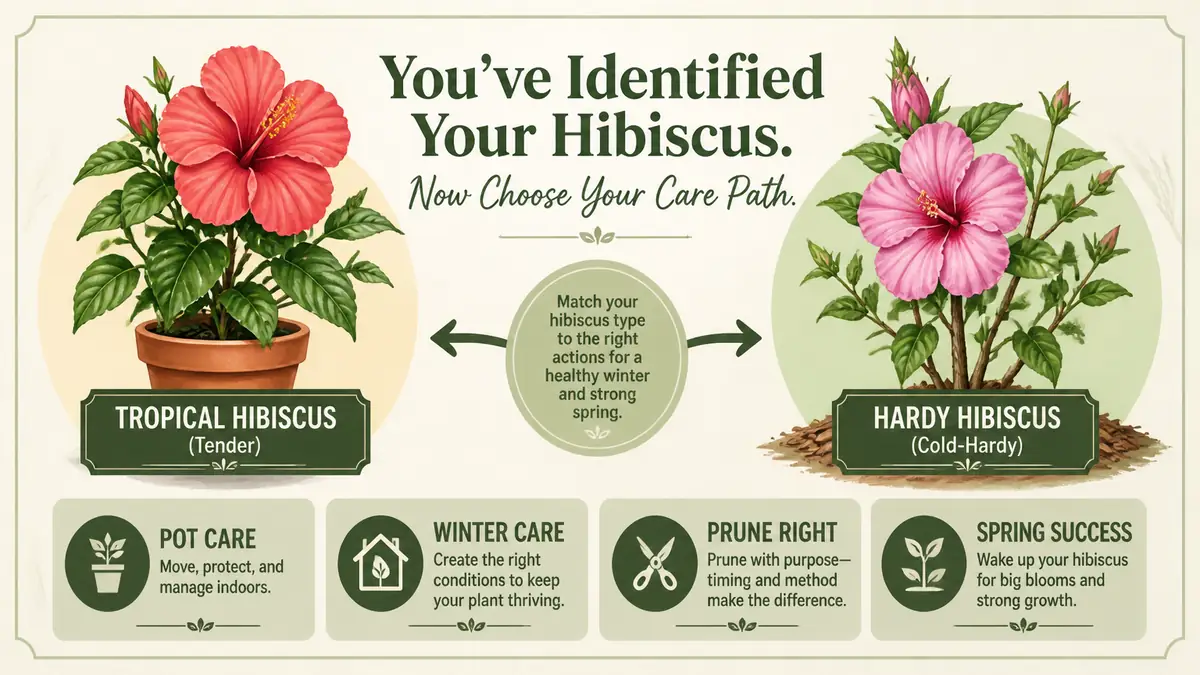
Once you identify hibiscus type, care gets much easier. The biggest differences are winter handling, pruning height, watering target, and whether leaf drop is normal dormancy or a stress signal.
| If yours is… | Water check | Light check | Pruning timing |
|---|---|---|---|
| Tropical hibiscus | Water thoroughly when the top inch is starting to dry and the pot feels lighter; drain excess | Very bright indoor light; south or west exposure is best in winter | Late winter, before stronger spring growth |
| Hardy hibiscus | Keep the root zone consistently moist, especially in sun and heat | Full sun gives strongest stems and best flowering | Cut old stems down in late fall or when new growth emerges |
| Rose of Sharon | Water deeply during establishment and drought | Full sun to light part sun for best bloom | Late winter or early spring, shaping the woody framework |
For tropical hibiscus pruning, cut just above a leaf node, preferably an outward-facing node. Remove thin, weak, crossing, or unproductive shoots first. Late winter pruning encourages bushier growth before the plant starts pushing stronger spring shoots.
For hardy hibiscus, do not prune like a houseplant. The flowers form on new seasonal growth. Cut old dead stems to about 3 to 4 inches, or nearly to ground level, depending on your local practice and how visible you want the crown marker to be.
For Rose of Sharon, think in terms of shrub structure. Remove dead, damaged, crossing, or inward-growing branches first, then shape lightly if needed. Because it is woody, you are not trying to restart the plant from the ground every year. Heavy cutting at the wrong height can leave you with a misshapen shrub rather than a rejuvenated perennial.
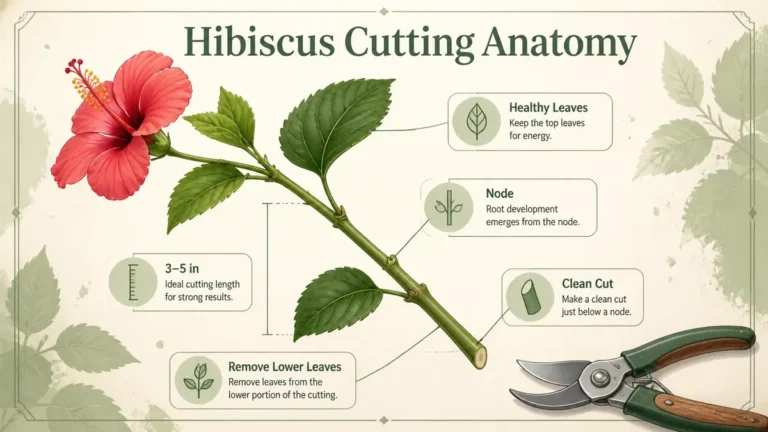
For propagation, tropical hibiscus cuttings are commonly 3 to 5 inches long and should include nodes. Under warm, humid conditions, they may root in about 3 to 5 weeks. Hardy hibiscus cuttings can also root from firm new growth, often in about 4 to 5 weeks.
If taking cuttings, cut just below a node with clean pruners, remove lower leaves, and keep the cutting humid but not waterlogged. A warm rooting area and bright indirect light are usually better than hot direct sun. If a cutting wilts immediately, reduce leaf area and increase humidity rather than soaking the medium.
If your plant is yellowing indoors, identify the type before changing everything. Tropical hibiscus often drops yellow leaves after abrupt changes in light, moisture, temperature, drafts, or water routine. Start with the checks in hibiscus yellow leaves.
For a broader type-aware routine, use the main hibiscus care guide. If pruning is the next decision, use how to prune hibiscus so you do not cut hardy, tropical, and Rose of Sharon the same way.
Some links are affiliate links. As an Amazon Associate I earn from qualifying purchases at no extra cost to you.
Only useful after type ID if you are deciding whether a tropical hibiscus indoors has enough light.
FAQ
- Is my hibiscus tropical or hardy?
- Check the tag first. Hibiscus rosa-sinensis is tropical. Hibiscus moscheutos or hardy hibiscus hybrids are perennial hardy types. If the top dies back after frost and returns from the crown in spring, it is likely hardy hibiscus.
- Is Rose of Sharon the same as hardy hibiscus?
- No. Rose of Sharon is Hibiscus syriacus, a hardy deciduous woody shrub. Hardy hibiscus usually refers to herbaceous perennial types such as Hibiscus moscheutos and hybrids that die back to the ground.
- Can tropical hibiscus survive winter outside?
- Not in freezing-winter climates. Bring tropical hibiscus indoors before frost, ideally when nights approach about 50°F. It needs very bright light indoors and should not sit in saturated soil.
- Should I cut my hardy hibiscus to the ground?
- Yes, after dormancy or when new growth shows, old dead stems can be cut down close to the ground. Many gardeners leave 3 to 4 inches as a crown marker. Do not cut Rose of Sharon this way.
- Why did my hibiscus lose leaves after I brought it indoors?
- If it is tropical hibiscus, leaf drop often follows abrupt changes in light, moisture, temperature, drafts, or watering routine. Move it gradually when possible, give it your brightest window, and water thoroughly only when the top inch is starting to dry.
- Can I identify hibiscus by flower color?
- Not reliably. Red, pink, white, and bicolor flowers can appear on more than one type. Use species name, stems, leaves, winter behavior, and hardiness zone before relying on flower color.
- Why is my hardy hibiscus so late to come back in spring?
- Hardy hibiscus often emerges later than many perennials, especially when spring soil is still cool. Keep the area marked, maintain even moisture, and wait for warmer soil before assuming the crown failed.
- Can I grow hardy hibiscus in a pot?
- Yes, but the container must be large enough to hold consistent moisture, and the roots may need winter protection in cold climates. A plant that is hardy in the ground can be more vulnerable in an exposed pot.
If Frost Is Coming Tonight
If you cannot identify the plant before a cold night, protect it like tropical hibiscus. Move potted plants indoors or into a protected bright space. For in-ground plants, cover the crown and stems temporarily, then identify the plant properly the next day.
This cautious step prevents the expensive mistake: leaving a tender tropical hibiscus outside because it was confused with hardy hibiscus.
Source note: This article checks its hibiscus care and safety claims against University of Minnesota Extension: Hibiscus, RHS: Hibiscus rosa-sinensis growing guide, Clemson HGIC: Hibiscus, NC State Extension: Hardy Hibiscus. Generated visuals are educational illustrations, not proof photos or fake testing results.
More Hibiscus Guides
Use the focused hibiscus guide that matches what you see. This keeps the care hub from becoming a guessing game.
The 5-Question Hibiscus ID Quiz
- Was it sold as a patio or houseplant? That leans tropical.
- Does the top die back in winter and return from the crown? That leans hardy hibiscus.
- Is it a permanent woody shrub? That leans Rose of Sharon.
- Are leaves glossy and evergreen in warm conditions? That leans tropical.
- Are you unsure before frost? Protect it like tropical hibiscus until identified.
Plant Tag Clues That Help
Names such as Hibiscus rosa-sinensis usually point to tropical hibiscus. Names such as Hibiscus moscheutos or “hardy hibiscus” point to perennial types. Hibiscus syriacus is commonly sold as Rose of Sharon.
If the tag only says “hibiscus,” use winter behavior, stem habit, and leaf clues before making winter or pruning decisions.