Seeing your first cluster of spider plant babies dangling from the mother plant is an incredibly rewarding moment for any indoor gardener. These tiny offsets, officially called spiderettes or pups, are the plant’s natural way of multiplying.
But if you have been staring at your pot waiting for these little offshoots to appear, you are not alone. Many plant owners also struggle with newly cut babies wilting as soon as they touch the dirt.
When we first started propagating these plants in our Aarhus apartment, we assumed they just needed bright light and a quick snip. We quickly learned that simply cutting them off and throwing them in dirt leads to failure.
In this comprehensive guide, we will answer exactly how to trigger runners, where to cut them safely, and how to plant spider plant babies using three proven propagation methods.
Why Won’t My Plant Grow Spider Plant Babies?
If your mature plant refuses to make offshoots, standard internet advice usually tells you to just “give it more light.” But the biological truth is much more specific.
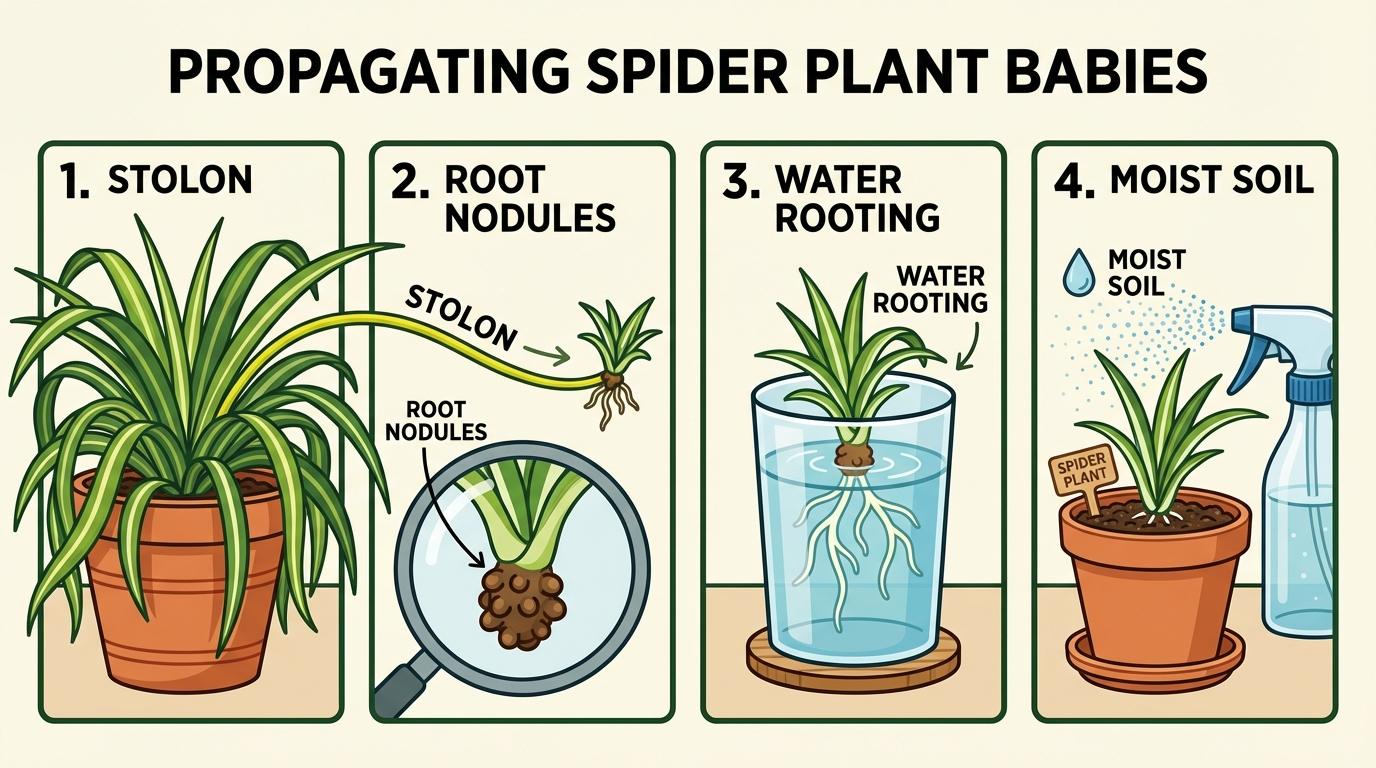
The mother plant relies on two exact environmental triggers to push out those long runners (scientifically called stolons):
- Photoperiodism (Short Days): According to botanical research from Wisconsin Horticulture, these plants actually need short daylight hours to trigger offspring. They require a cycle of 8 to 10 hours of light followed by 14 to 16 hours of total, uninterrupted darkness.
- Mild Root-Bound Stress: If a pot is too large, the plant spends all its energy expanding its root system. A slightly snug pot signals the plant that it is running out of space and needs to reproduce. Resist the urge to use our Repotting Guide too early.
- Plant Maturity: A spider plant generally needs to be at least one to two years old before it has the stored energy required to support babies.
Where to Cut Spider Plant Babies (The 1-Inch Rule)
Patience is critical here. Knowing exactly where to cut spider plant babies is the difference between a thriving new plant and a dead cutting.
Before you take a pair of scissors to the mother plant, look very closely at the bottom of the tiny spiderette. You are looking for adventitious root nodules—small, knobby white bumps at the base of the leaves.
Do not snip the stem yet. You must wait until these starter roots are at least 0.5 to 1 inch (1.2 to 2.5 cm) long.
If you separate the babies from the mother before they reach this size, they lack the physical ability to absorb water. They will likely dry out and die within a single week.
How to Plant Spider Plant Babies: 3 Methods
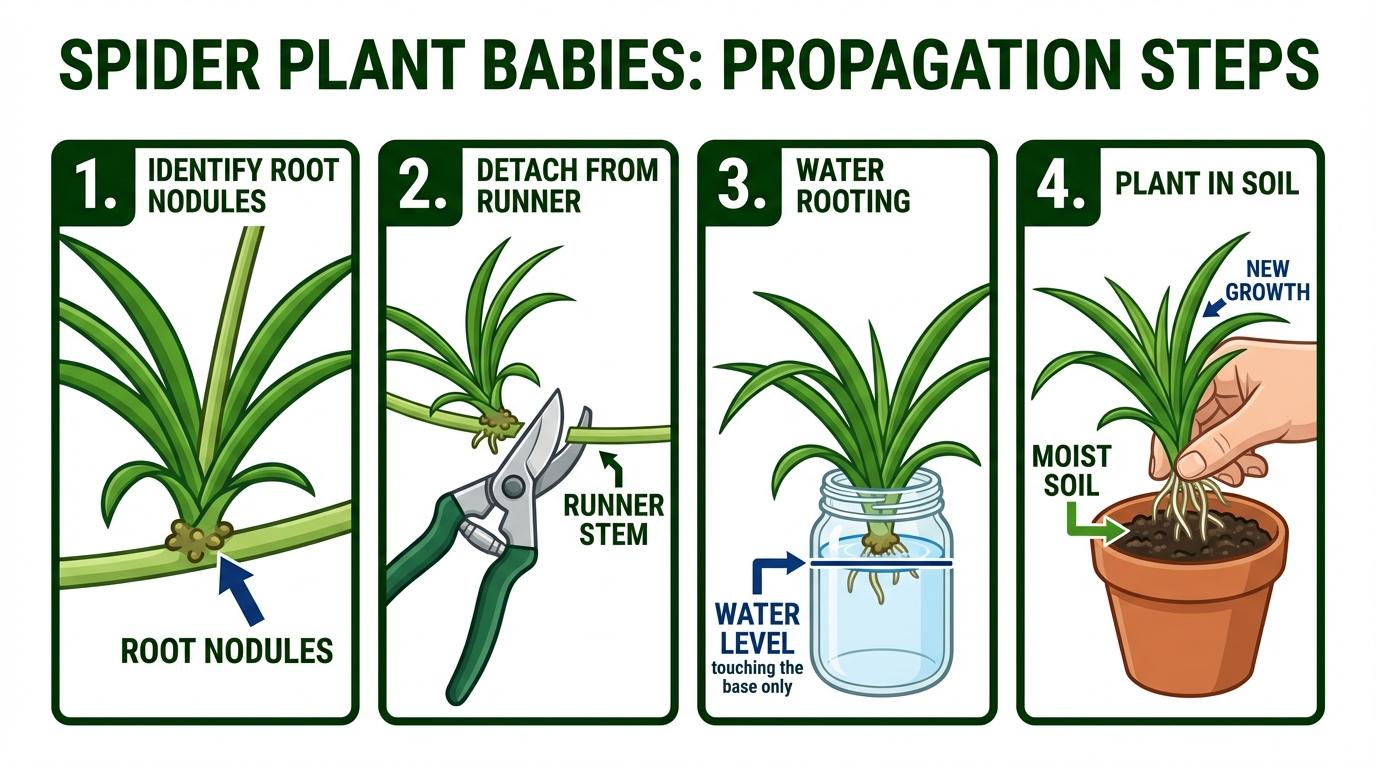
Once your cuttings have developed visible root nodules, you have three excellent options for propagating them. We have tested all three extensively in our home.
Method 1: Water Rooting (Best for Visual Progress)
This is the most popular method because watching the roots grow through a glass is incredibly satisfying.
- Cut the Stolon: Snip the stem connecting the baby to the mother plant. Leave about an inch of the stem attached to the baby to help anchor it in the glass.
- Prepare the Glass: Fill a small, shallow jar with room-temperature filtered water.
- Submerge the Roots ONLY: Place the plantlet so that only the white root nodules touch the water. The green leaves must stay completely dry to avoid bacterial rot.
- Monitor and Wait: Change the water every 5-7 days. Within 2-3 weeks, you will see a robust system of white water roots form. Once the roots are 2 inches long, it is time for soil.
Method 2: Direct Soil Planting (Skip the Shock)
If you want to skip the extra step of transferring the plant from water to dirt, you can plant spider plant babies directly into potting mix.
- Cut and Callus: Snip the baby off the runner. Let the cutting sit on a paper towel for 1-2 hours so the cut end can dry and “callus” over.
- Prepare the Pot: Fill a tiny nursery pot (2-3 inches max) with a well-draining indoor potting mix.
- Plant and Moisten: Gently press the root nodules into the soil. Water the soil thoroughly so it is damp, but not soaking wet.
- Maintain Humidity: Place a clear plastic bag loosely over the pot for the first week to lock in humidity while the roots establish themselves.
Method 3: Stolon Pinning (The Safest Route)
This mimics exactly how the plant propagates in the wild. It carries a near 100% success rate.
- Leave it Attached: Do not cut the runner! Place a small pot of moist potting soil right next to the mother plant.
- Pin the Baby: Gently place the attached baby onto the soil of the new pot. You can use a bent paperclip to gently “pin” the runner down.
- Keep Moist: Keep the soil consistently damp for 2-3 weeks.
- Cut the Cord: Give the baby a gentle tug. If you feel resistance, it has rooted! You can now safely snip the runner.
The Water-to-Soil Transition Shock (Crucial Step)
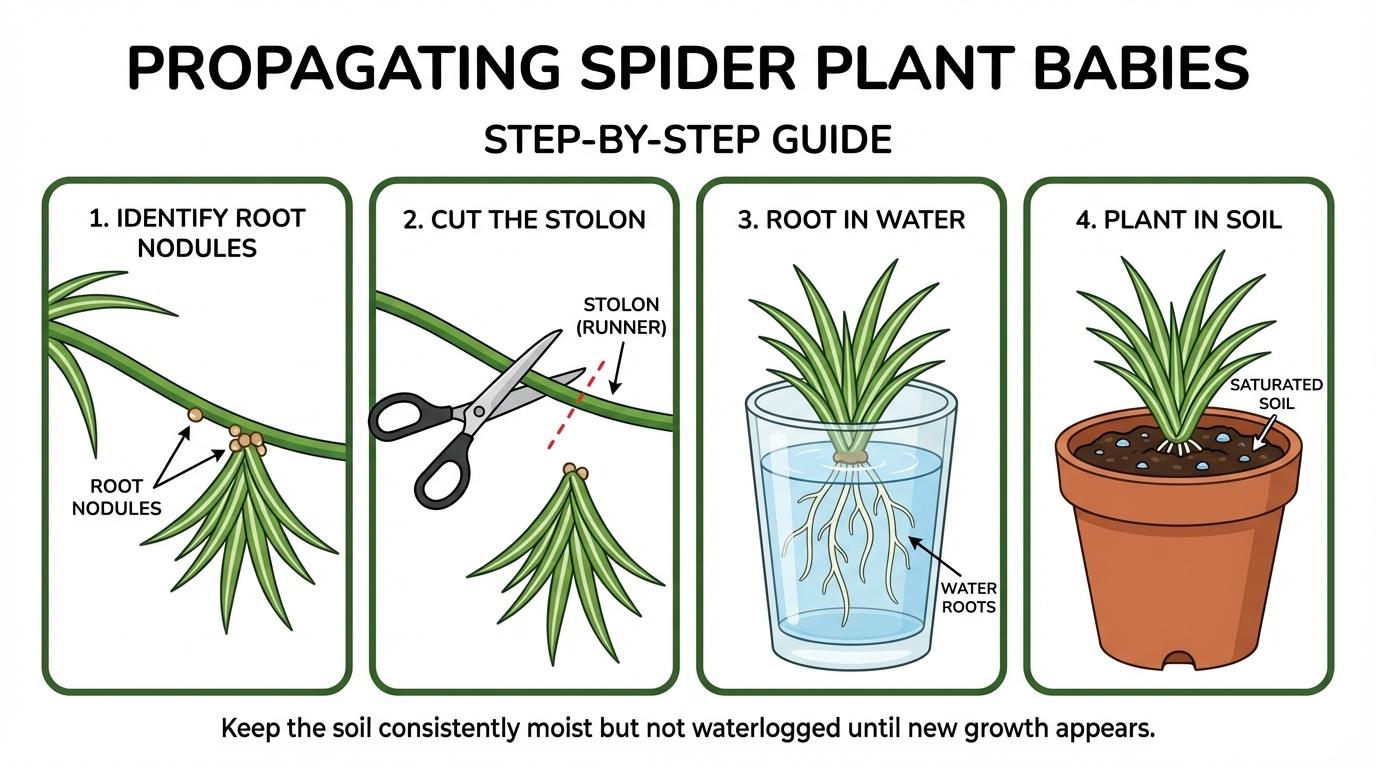
If you chose the water rooting method (Method 1), you absolutely must understand transition shock. Water roots are morphologically completely different from regular soil roots.
When you move water-rooted spider plant babies directly into dry potting mix, they cannot efficiently absorb moisture from the dirt. They will wilt almost overnight. Here is how to prevent that:
- Hyper-Saturate the Soil: You must keep the soil incredibly moist (almost muddy) for the first 7 to 10 days. This heavily saturated environment gives the fragile water roots time to physically adapt to the dirt.
- Use Filtered Water Only: Young spiderettes are hyper-sensitive to the chlorine and halogens found in tap water. This heavy mineral buildup causes instant toxicity, leading to cellular collapse and crispy leaf tips.
Note: If your mother plant already has crispy edges, review our guide to fixing Brown Tips before you begin propagating.
Rookie Mistakes That Kill Spider Plant Babies
Even with step-by-step instructions, things can go wrong. Here are the most common pitfalls we see when people attempt to grow spider plant babies:
- Ignoring the Mother Plant: Pushing out dozens of babies takes massive energy. If you spot Yellow Leaves on the main plant while it is heavy with offsets, review How Often to Water. The mother plant usually needs a slight increase in hydration.
- Over-potting the Cuttings: When you finally pot up your rooted babies, you must use a very small nursery pot. Putting a tiny cutting into a massive 6-inch pot causes the soil to stay wet for way too long, leading to root rot.
- Too Much Direct Sun: While mature plants can handle some morning sun, unrooted babies will scorch and dry out rapidly. Keep them in bright, but purely indirect, light while they establish.
Recommended Spider Plant Essentials
Each product below was hand-picked after thorough research and testing.
Bottom heat speeds up rooting significantly, especially in winter. Keeps the root zone at the ideal 75–85°F without heating the whole room.
Check Price → (paid link)
Produces an ultra-fine continuous mist with one pump. Better than trigger sprayers for foliar feeding and applying neem oil evenly.
Check Price → (paid link)
The industry standard for plant shelves. Run cool, easy to mount under shelves, and give a warm pleasant light.
Check Price → (paid link)
The industry standard for garden pruning. Sharp bypass blade makes clean cuts on stems up to 3/4 inch — perfect for trimming iris fans and removing dead yucca leaves.
Check Price → (paid link)
As an Amazon Associate I earn from qualifying purchases.
Spider Plant Babies FAQ
Why won’t my mature plant produce runners?
It is almost always a lighting issue. Spider plants rely on photoperiodism, needing 8 to 10 hours of daylight followed by 14 to 16 hours of total, uninterrupted darkness for three weeks to trigger runners. They also require slightly root-bound conditions.
Why do my cuttings wilt as soon as I plant them in soil?
This is called water-to-soil transition shock. Water roots cannot absorb moisture from dry dirt efficiently. You must keep the potting soil hyper-moist for the first 7 to 10 days to give the delicate water roots time to adapt and harden off.
Why do my new cuttings get brown tips immediately?
This is almost always caused by hard tap water. Baby plants are highly susceptible to fluoride and chlorine toxicity, which chemically burns the leaf tips. Switch exclusively to filtered, distilled, or rainwater for all young cuttings.
Can I leave the babies on the mother plant forever?
Yes, you can leave them attached to create a beautiful, cascading aesthetic. However, supporting dozens of spider plant babies drains a massive amount of water and nutrients from the mother plant. You will need to water and fertilize much more frequently.
How long do spider plant babies take to root?
If you use the water propagation method, you should see white roots emerge within 7 to 14 days. They are generally ready to be transferred to soil within 3 to 4 weeks once the roots are about 2 inches long.