A practical guide to the plants that tolerate dim rooms best — plus how to measure light, water correctly, and avoid popular plants that slowly decline in low light.
Transparency note: Some links in this article are affiliate links. As an Amazon Associate I earn from qualifying purchases. We may also earn through partner programs, including Plant Addicts through Awin, when you buy through our links at no extra cost to you. Product mentions are selected to match the care problem or plant-buying decision discussed.
Not every “low-light plant” is actually happy in a dark room. Some houseplants can tolerate dim spaces for months, but that does not mean they will grow well there.
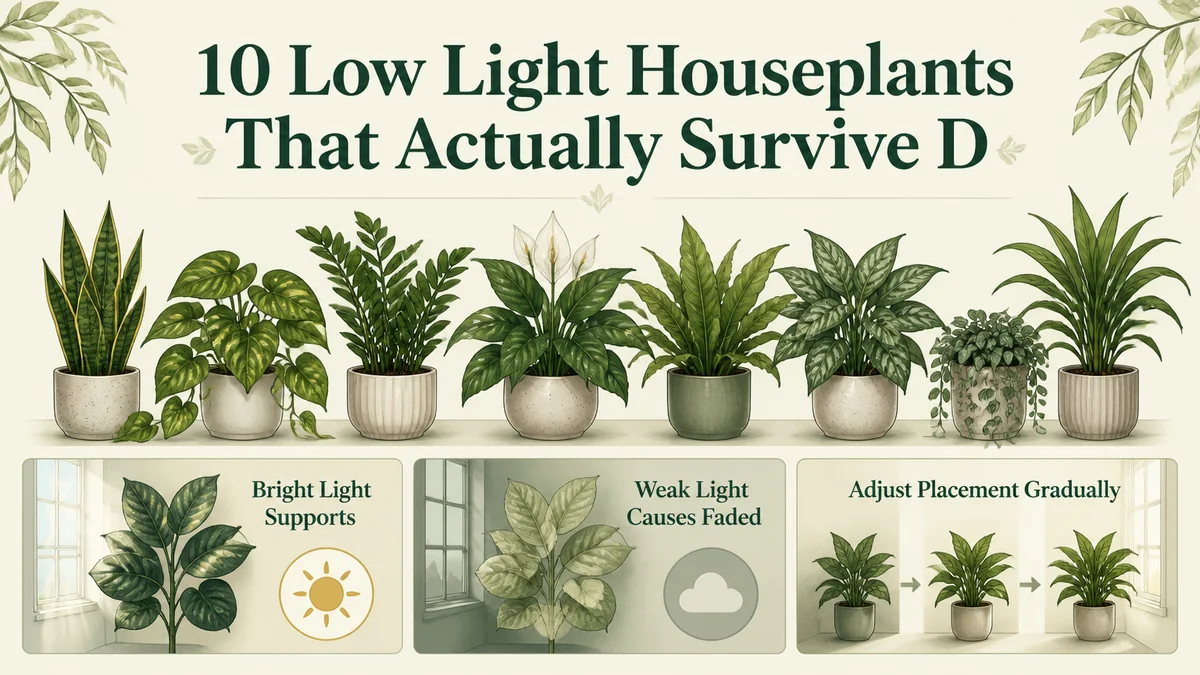
The best low-light indoor plants are the ones that stay healthy, hold their shape, and forgive slower drying soil when light is limited. For genuinely dim rooms, we would start with ZZ plant, snake plant, cast iron plant, pothos, Chinese evergreen, heartleaf philodendron, spider plant, peace lily, dragon tree, or parlor palm.
The important catch is that low light still means some light. If you can barely read in the spot during the day, most plants will slowly decline unless you add a grow light. In this guide, ‘best’ does not mean the plant grows fastest in darkness. It means the plant has the best chance of staying healthy, compact, and recoverable in a dim room with measurable light. We’ll show you which plants tolerate dim rooms best, what “low light” actually means in foot-candles, and how to water without rotting the roots.
This guide is written for normal homes where light is limited by windows, seasons, and room layout. Joakim handles the research and source-checking; practical recommendations are kept conservative unless a source or provided test supports them.
How we chose these plants: We combined guidance on indoor light levels from the University of Minnesota Extension, the University of Maryland Extension, and the University of Missouri Extension with our own experience growing houseplants in normal apartment conditions.
Quick Answer
- The best low-light indoor plants are ZZ plant, snake plant, cast iron plant, pothos, Chinese evergreen, heartleaf philodendron, spider plant, peace lily, dragon tree, and parlor palm.
- Low light usually means around 50–250 foot-candles; below 50 fc, most plants are surviving rather than growing.
- ZZ plant, snake plant, and cast iron plant are the safest choices for the darkest livable spots.
- Let drought-tolerant plants dry deeply, but keep peace lily and parlor palm lightly and evenly moist.
- Dust leaves monthly, use pots with drainage, and avoid watering by calendar.
| Room Situation | Best Plant Pick | Why It Fits |
|---|---|---|
| Darkest Corner / Low Light | ZZ Plant or Cast Iron Plant | Both tolerate dense shade and slow soil evaporation without dropping leaves. |
| Pet-Safe & Low Light | Spider Plant or Parlor Palm | ASPCA-listed non-toxic to dogs and cats, though chewing any plant can still cause mild stomach upset. |
| Hanging Basket / Trailing Vines | Golden Pothos or Heartleaf Philodendron | Vigorous climbers/trailers that handle dim shelves and low-light maintenance. |
| Narrow Floor Corner (Vertical Height) | Marginata Cane Dracaena (Dragon Tree) | Slender upright cane form that saves floor space while adding height. |
| Windowless Office / Fluorescent Only | ZZ Plant or Chinese Evergreen | Windowless office with lights on all day: ZZ plant or Chinese evergreen may work if the light is bright enough at plant height. If the space is dim even with lights on, use a grow light. |
| Bathroom with a Window | Peace Lily or Parlor Palm | Appreciate the steam and warm humidity while tolerating lower light, provided the room has a window for natural light. |
| Best First Buy | Why | Action |
|---|---|---|
| ZZ Plant | Best for the darkest livable corner | Check Price → |
| Laurentii Snake Plant | Best upright beginner plant | Check Price → |
| Golden Pothos | Best trailing shelf plant | Check Price → |
| Green Spider Plant | Best pet-safer starter option | Check Price → |
| Peace Lily | Best lower-light flowering option | Check Price → |
What Does “Low Light” Actually Mean for Houseplants?
Low-light houseplants are indoor plants that can maintain their health and foliage in environments receiving 50 to 250 foot-candles (roughly 500 to 2,500 lux) of indirect illumination. Below about 50 foot-candles, most houseplants grow very slowly and have little margin for watering mistakes. Treat this as a survival zone rather than a growth zone, and use artificial grow lights in spaces that remain below 50 foot-candles during the day.
Low light usually means about 50–250 foot-candles at leaf height. Some tough houseplants can tolerate less for a while, but below about 50 fc most plants grow very slowly and have little margin for watering mistakes. Treat that as a survival zone, not a growth zone — and use a grow light if the spot stays dim all day.
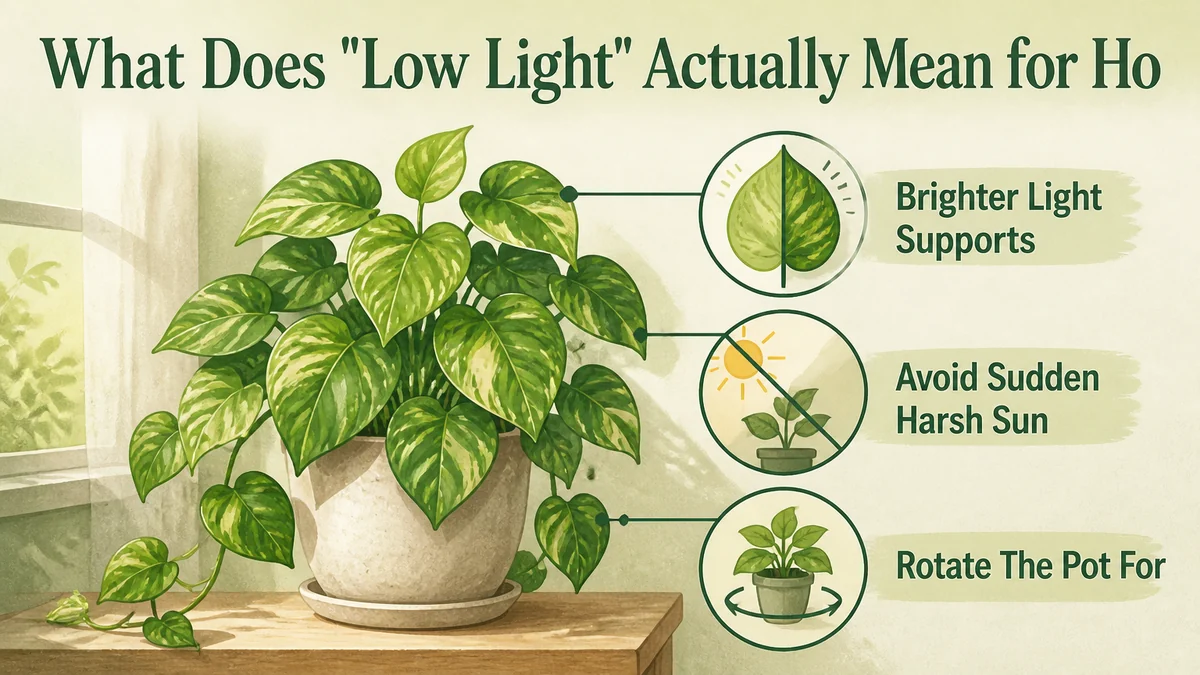
Direct light means sun rays hit the leaves. Indirect light means the room is bright, but the sunbeam is filtered, reflected, or off to the side. Many “low light” houseplants actually prefer bright indirect light and simply tolerate darker rooms.
The newspaper test
At midday, stand where the plant will sit and try to read normal newspaper or book print without turning on a lamp. If you can read comfortably and the page looks evenly lit, the spot may be usable low light. If you are squinting, the plant is probably below its useful range. This is only a rough test; a cheap light meter or phone app gives a better answer.
Joakim’s Science Corner: foot-candles are useful, but not perfect
The University of Minnesota Extension explains indoor plant light using foot-candles, while also noting that plant growth depends on usable light, duration, and plant response. Foot-candles are based on human-visible brightness, so they are not as precise as PAR or PPFD for grow lights. For normal window placement, though, they are practical enough: measure at leaf height, in the exact spot, and use the lowest repeatable reading.
Low-Light Survival Map: Match the Spot Before You Buy
| Measured light at leaf height | What it really means | Best plant choices | Expected result | Your next check |
|---|---|---|---|---|
| Below 25 fc | Too dark for long-term living plants without artificial light | Use a grow light, rotate plants temporarily, or use artificial foliage | Live plants slowly decline | Add a timer-controlled light before buying |
| 25-75 fc | Survival or holding zone | ZZ plant, snake plant, cast iron plant | Very slow growth; little recovery from mistakes | Photograph monthly to catch decline |
| 75-150 fc | Practical low-light maintenance | ZZ plant, snake plant, pothos, Chinese evergreen, peace lily, parlor palm | Stable foliage, slow new growth | Water only after checking deep dryness |
| 150-250 fc | Better low-light growth | Pothos, spider plant, peace lily, parlor palm, heartleaf philodendron, dragon tree | More visible new leaves and better shape | Rotate the pot monthly for even growth |
| 250-500 fc | Medium-bright indirect light | Most “low-light tolerant” plants look fuller here | Faster growth, stronger variegation, better recovery | Watch for faster drying and summer scorch |
Quick care snapshot
| Care factor | Low-light rule | Why it matters |
|---|---|---|
| Water | Check soil first; do not water by calendar | Dim plants use less water |
| Pot size | Keep the pot close to root-ball size | Oversized pots stay wet too long |
| Fertilizer | Feed lightly only during active growth | Fertilizer cannot replace light |
| Leaf cleaning | Wipe dust from broad leaves monthly | Dust blocks already-limited light |
| Winter | Move closer to safe light and reduce watering | Short days slow growth further |
Indoor vs. outdoor use
These are indoor houseplants in most US homes. In warm climates, some can live outdoors in shade or on covered patios, but they should not be treated like full-sun garden plants. If you move them outside for summer, place them in bright shade first; direct afternoon sun can scorch leaves that adapted to a dark room.
Five-minute placement workflow
- Measure the intended spot at leaf height around midday.
- If it reads below 25 fc, add a grow light before choosing a plant.
- If it reads 25-75 fc, pick ZZ, snake plant, or cast iron plant and expect survival, not speed.
- If it reads 75-250 fc, choose from the full list below.
- Use a pot with drainage and avoid upsizing until roots prove they need it.
- Check the top 1-2 inches of mix, then lift the pot before watering.
- Take one monthly photo from the same angle to catch stretching, fading, or leaf loss.
The 10 Best Low-Light Houseplants
These are the plants we would choose first for dim rooms. The order starts with the toughest survival plants and moves toward plants that look better when the low-light spot is closer to 150-250 foot-candles.

| # | Plant | Botanical name | Best dim-room use | Pet note |
|---|---|---|---|---|
| 1 | ZZ plant | Zamioculcas zamiifolia | Dark corners, offices, neglect-prone rooms | Keep away from pets |
| 2 | Snake plant | Dracaena trifasciata | Upright floor plant for low water use | Keep away from pets |
| 3 | Cast iron plant | Aspidistra elatior | True shade-tolerant foliage | ASPCA-listed non-toxic to dogs and cats. |
| 4 | Pothos | Epipremnum aureum | Trailing shelves and cabinets | Keep away from pets |
| 5 | Chinese evergreen | Aglaonema spp. | Full, leafy tabletop plant | Keep away from pets |
| 6 | Heartleaf philodendron | Philodendron hederaceum | Soft trailing vines in low indirect light | Keep away from pets |
| 7 | Spider plant | Chlorophytum comosum | Hanging baskets and pet-safer homes | ASPCA-listed non-toxic to dogs and cats, though chewing any plant can still cause mild stomach upset. |
| 8 | Peace lily | Spathiphyllum spp. | Lower-light foliage with possible white spathes | Keep away from pets |
| 9 | Dragon tree | Dracaena marginata | Narrow upright tree form | Keep away from pets |
| 10 | Parlor palm | Chamaedorea elegans | Soft palm texture without direct sun | ASPCA-listed non-toxic to dogs and cats, though chewing any plant can still cause mild stomach upset. |
1. ZZ Plant — Zamioculcas zamiifolia
Choose ZZ plant for the dimmest livable corner. It has glossy, thick leaflets and underground rhizomes that store water, which is why it tolerates missed waterings better than most leafy plants. In very low light, new shoots may appear only occasionally, so judge success by firm stems and stable foliage rather than speed.
Check it: if the stems lean sharply toward the window or new growth is thin and pale, the spot is too dark for growth. Move it closer to indirect light or add a grow light.
Looking to buy a healthy live plant online?
A strong upright choice for beginners who want a plant that tolerates lower light and infrequent watering. Best in measurable light, not total darkness. ASPCA lists as toxic to cats and dogs due to insoluble calcium oxalates. Keep out of reach.
2. Snake Plant — Dracaena trifasciata
Snake plant is a strong floor-plant choice for bedrooms, offices, and darker hallways with measurable light. The stiff, sword-like leaves hold shape even where softer plants flop. Low light slows it down dramatically, so overwatering is the main way people lose it. For detailed routines, see our guides on Snake Plant light requirements and how to water a Snake Plant.
Check it: press the base of each leaf gently. Firm is good. Mushy, wrinkled, or collapsing leaves usually point to wet roots, cold damage, or both.
Looking to buy a healthy live plant online?
A tough architectural plant that stores water in its upright leaves. Forgives slow dry-down times, but highly sensitive to wet root conditions. ASPCA lists as toxic to cats and dogs due to saponins. Keep out of reach.
3. Cast Iron Plant — Aspidistra elatior
Cast iron plant is one of the most honest low-light choices. It is not flashy and it is not fast, but its dark, broad leaves handle shade better than many trendy houseplants. It suits corners where you want a calm, long-lived plant rather than constant new leaves.
Check it: brown, crispy patches can come from direct sun or dry stress; yellow lower leaves can come from staying wet too long. In low light, the pot should feel noticeably lighter before you water again.
Looking to buy a healthy live plant online?
Looking to buy a healthy live plant online?

1-YEAR WARRANTY
A slow, sturdy foliage plant for dim corners where faster growers struggle. Let the potting mix dry down between waterings because low light slows water use.
4. Pothos — Epipremnum aureum
Pothos is the low-light vine most people should try first. Green cultivars handle dimmer spots better than highly variegated ones. In low light, variegation may fade and internodes can stretch, but a healthy pothos still pushes flexible vines and heart-shaped leaves. To keep your vines full, check out our comprehensive Golden Pothos Care Guide.
Check it: compare the newest leaves with older leaves. Smaller leaves, long bare gaps, and fading variegation mean the plant is surviving but asking for more light.
Looking to buy a healthy live plant online?
A fast-growing, flexible vine with heart-shaped leaves. Tolerates lower-light shelves but needs moderate indirect light to maintain gold variegation. ASPCA lists as toxic to cats and dogs due to insoluble calcium oxalates. Keep out of reach.
5. Chinese Evergreen — Aglaonema spp.
Chinese evergreen gives you broad, patterned foliage without needing a bright window. Greener cultivars are the safer choice for the darkest rooms. Pink, red, or heavily silver cultivars usually hold color better in brighter indirect light.
Check it: if a colorful cultivar turns mostly green or grows floppy, move it into the 150-250 fc range if possible.
Looking to buy a healthy live plant online?
Looking to buy a healthy live plant online?
1-YEAR WARRANTY
A patterned foliage plant that tolerates lower light better than most variegated houseplants. Keep it warm and avoid soggy soil.
6. Heartleaf Philodendron — Philodendron hederaceum
Heartleaf philodendron is softer and thinner-leaved than pothos, with a relaxed trailing habit. It tolerates low indirect light, but it looks best when the room is bright enough to cast a soft shadow. It is a good shelf plant if you want graceful vines rather than rigid leaves.
Check it: long spaces between leaves and tiny new leaves mean it needs more light or pruning to reset the shape.
Looking to buy a healthy live plant online?
Looking to buy a healthy live plant online?
1-YEAR WARRANTY
A forgiving trailing plant for shelves and bookcases. It tolerates lower light, but brighter indirect light keeps growth fuller.
7. Spider Plant — Chlorophytum comosum
Spider plant tolerates shade, but it is more satisfying in the brighter end of low light. It makes arching leaves and, when happy, dangling plantlets. It is also one of the better choices for homes with pets, though any chewed plant can still upset a stomach.
Check it: pale floppy leaves and no new center growth suggest the room is too dark. Brown tips can also come from dry air, mineral-heavy water, or inconsistent moisture.
Looking to buy a healthy live plant online?
Looking to buy a healthy live plant online?
1-YEAR WARRANTY
A pet-safe, arching plant that handles moderate to lower light better than many colorful houseplants. Use a pot with drainage and avoid constant wet soil.
8. Peace Lily — Spathiphyllum spp.
Peace lily is the best lower-light flowering candidate on this list, but do not expect constant white spathes in a dark room. In true low light, treat it as a foliage plant that may bloom when conditions improve. It prefers moisture more than ZZ or snake plant, but soggy mix still causes trouble.
Check it: a dramatic wilt that perks up after watering means it dried too far; yellowing and limpness in wet soil point the other direction. For exact moisture timing, use the deeper guide on Peace Lily watering.
Looking to buy a healthy live plant online?
Looking to buy a healthy live plant online?
1-YEAR WARRANTY
A lush, dark green plant that tolerates dimmer rooms and signals thirst by drooping. Keep away from pets because ASPCA lists peace lily as toxic to cats and dogs.
9. Dragon Tree — Dracaena marginata
Dragon tree gives a narrow, sculptural shape for apartments and offices. It tolerates lower light than many indoor trees, but it grows slowly and may drop older lower leaves as it adjusts. Keep it away from cold drafts and hot direct sun.
Check it: if the cane is firm and the newest leaf cluster is upright, the plant is probably adjusting. Soft canes, sour soil smell, or rapid yellowing need immediate root and watering checks.
Looking to buy a healthy live plant online?
Looking to buy a healthy live plant online?
1-YEAR WARRANTY
A narrow upright cane plant for adding height without using much floor space. Best in measurable indirect light, not a windowless dark corner.
10. Parlor Palm — Chamaedorea elegans
Parlor palm is an understory palm with fine, soft fronds. It tolerates lower light and brings a different texture than the upright or trailing plants above. It dislikes hot direct sun and usually looks better with steady, moderate moisture rather than deep drought.
Check it: crispy leaflet tips can come from dry air, under-watering, mineral buildup, or old fronds. Yellowing entire fronds in wet mix suggests the roots are staying too damp.
Looking to buy a healthy live plant online?
Looking to buy a healthy live plant online?
1-YEAR WARRANTY
A soft, pet-safe palm for lower-light rooms. It grows slowly, so choose this when you want steady foliage rather than fast growth.
Plants Often Sold as “Low Light” (That Will Actually Decline)
Many big-box stores and nurseries label popular houseplants as “low light” because they don’t die immediately in dim conditions. However, there is a massive gap between surviving for a few months and actually staying healthy. The following plants are frequently sold for dark rooms but will rapidly decline, stretch, or drop leaves without bright light:
- Monstera Deliciosa: May survive dim rooms for a while, but growth becomes leggy, fenestrations are less likely, and wet soil becomes riskier because the plant uses water slowly.
- Fiddle Leaf Fig (Ficus lyrata): Requires intense, bright indirect light. In a dim corner, it will shed lower leaves rapidly and become a bare, spindly stem within months.
- Succulents & Cacti (e.g., Aloe Vera, Echeveria): Adapted to desert sun. Placing them in low light causes them to stretch aggressively toward the nearest window (etiolation), weaken, and rot.
- Crotons (Codiaeum variegatum): Famous for fiery red and yellow foliage, but they need bright light to maintain these colors. In low light, their new leaves grow solid green, and they may drop foliage.
- String of Hearts (Ceropegia woodii): Often marketed for dark shelves, but this delicate succulent vine will develop wide gaps between leaves, grow thin, thread-like stems, and easily succumb to overwatering.
- Bird of Paradise (Strelitzia nicolai): Adapted to direct tropical sun. In low-light rooms, it will stretch, stop producing new leaves, and slowly decline.
- Calathea & Prayer Plants (Maranta): While they can tolerate lower light, their extreme sensitivity to dry indoor air and tap water minerals makes them very difficult to keep alive for beginners in low-light spots.
The Golden Rule: Underwatering is Better Than Overwatering
In a dim room, a plant photosynthesizes and grows more slowly, so it uses less water. That is why a weekly watering habit that works near a bright window can rot the same plant across the room.

A basic probe meter can help you check deeper moisture before watering, especially in tall pots where your finger only reaches the dry top layer. Use it as a second opinion, not the only signal.
What to do: let dry-down plants such as ZZ plant, snake plant, cast iron plant, and pothos dry deeply before watering. For peace lily and parlor palm, keep the root zone from becoming bone-dry for long, but still avoid soggy soil. Always empty the saucer after runoff drains.
Why it matters: roots need oxygen. Wet, airless potting mix in low light is the classic setup for yellow leaves, mushy stems, fungus gnats, and sour-smelling soil.
How to check: use three signals together: feel the top 1-2 inches with your finger, lift the pot to compare wet weight versus dry weight, and check the drainage holes for dampness. If the top is dry but the pot still feels heavy, wait.
Do not ignore dust. Low-light leaves need every bit of usable light they can get. Wipe broad leaves with a damp cloth every few weeks. Avoid shiny leaf-polish sprays; they can leave residue and do not fix poor light.
Emilie’s Pro Tip: make a “dry weight” memory
After you water and drain a plant, lift the pot and notice the heavy feel. Then lift it again a week or two later when the mix is dry. That weight difference is often more reliable than the top surface, especially in dark rooms where the top can look dry while the bottom is still wet.
When to Repot Low-Light Houseplants
Low-light houseplants rarely need frequent repotting because they are not growing fast. Repotting into a much larger container is one of the easiest ways to create slow, wet soil around a small root system.

Repot only when you see real evidence:
- Roots circle tightly around the outside of the root ball.
- Roots grow out of the drainage holes.
- Water runs straight through because the pot is packed with roots.
- The plant dries unusually fast despite being in low light.
- The plant is top-heavy because the roots have filled the pot, not because the decorative pot is too light.
Pot size rule: move up only 1-2 inches wider in diameter. A 6-inch pot usually goes to a 7- or 8-inch pot, not a 10-inch pot. For very slow plants like cast iron plant, ZZ plant, and snake plant, the smaller jump is usually safer.
How to check roots without causing chaos: water lightly a day before, tip the plant sideways, slide the root ball out just enough to inspect the edge, then put it back if roots are not crowded. Healthy roots should feel firm. Rotten roots are mushy, dark, and may smell sour.
When deeper detail helps: if roots are rotten, if the plant is huge, or if you are dividing snake plant or ZZ rhizomes, handle that as a repot-and-rescue job rather than a routine pot upgrade.
One Tool That Helps: A Moisture Meter
You do not need a shelf full of gadgets. The most useful low-light tools are the ones that stop guessing: a way to check moisture, containers that drain, and a light check if the room is genuinely dark.

Container rules that matter more than the brand
- Drainage holes first. A beautiful sealed pot is fine as a cover pot only if the inner pot can drain.
- Snug fit. Choose a pot close to the root-ball size. Extra soil stays wet.
- Stable base. Tall snake plants and dragon trees need weight so they do not tip.
- Visible saucer. If you can see runoff, you are more likely to empty it.
Can You Propagate Low-Light Houseplants?
Yes, but propagate in brighter indirect light than the parent plant receives if you can. Cuttings have no full root system yet, so they need enough energy to make roots without being cooked by direct sun. A dark shelf is a poor propagation station.

Water propagation for pothos and heartleaf philodendron
- Cut a healthy vine just below a node. The node is the bump where a leaf and aerial root can emerge.
- Remove the lowest leaf so no foliage sits underwater.
- Place the node in clean water and keep the leaf above the rim.
- Put the jar in bright indirect light, not a dark corner.
- Change water weekly or whenever it turns cloudy.
- Pot up when roots are about 1-2 inches long.
For more detailed pothos shaping and aftercare, use the Pothos Plant Care Complete Guide.
Leaf or division propagation for snake plant
Snake plant can be propagated by division or leaf cuttings. Division is faster and keeps variegated types more true to the parent. Leaf cuttings are slower and may lose edge variegation depending on the cultivar. For step-by-step cuts, rooting orientation, and timing, see Snake Plant propagation.
Division for ZZ plant, cast iron plant, and peace lily
These are usually multiplied by division. Wait until the plant is healthy and naturally crowded, then separate sections with roots attached. Do not divide a stressed plant just because it is not growing; low light may be the real reason.
Spider plant plantlets
Spider plant is the easiest on the list when it produces baby plantlets. Set a plantlet onto moist mix while still attached, or cut it once small roots have started. For routine care after rooting, see Spider Plant care.
Common Problems and Pests in Low-Light Environments
Most low-light problems come from a mismatch: too little light, too much water, an oversized pot, or all three. Pests then take advantage of a stressed plant or wet potting mix.

Low-Light Symptom Checker
| Symptom | Most likely cause in a dim room | Check this first | What to do next |
|---|---|---|---|
| Yellow leaves and wet soil | Overwatering or slow dry-down | Pot weight, drainage holes, saucer water | Pause watering, improve light, inspect roots if smell is sour |
| Mushy stem or leaf base | Root or crown rot | Base firmness and root smell | Remove rotten parts, repot only if roots are failing |
| Long gaps between leaves | Insufficient light | Compare new growth with old growth | Move closer to window or add grow light |
| Variegation fading | Plant is making more green tissue to cope | New leaf color | Move to brighter indirect light; choose greener cultivars for dark spots |
| Tiny black flies near soil | Fungus gnats in damp mix | Tap pot; use yellow sticky card | Let top 1-2 inches dry when plant allows; use BTI if persistent |
| Fine webbing or stippled leaves | Spider mites, often on stressed plants | Undersides of leaves and stem joints | Rinse foliage, isolate, repeat treatment with insecticidal soap if needed |
| Cottony white clusters | Mealybugs | Leaf axils and nodes | Remove with alcohol-dipped swab; isolate and recheck weekly |
| Brown crispy tips | Dry air, mineral buildup, inconsistent watering, or old leaves | Water source, humidity, soil dryness pattern | Trim only dead tips, flush salts if needed, stabilize care |
Fungus gnats: the dark-room pest to watch
Fungus gnats are not caused by darkness itself. They show up because low-light pots dry slowly, and damp organic mix supports larvae. Put a yellow sticky card at soil level to confirm adults. Then fix the cause: reduce watering frequency, empty saucers, remove dead leaves from the soil surface, and increase light or airflow if the pot stays wet for more than a week.
Spider mites, scale, and mealybugs
Check leaf undersides monthly. Low-light plants can decline slowly, so pests may be present before the plant looks dramatic. Isolate the plant, wipe or rinse what you can, and repeat treatment because eggs and hidden insects are easy to miss.
Seasonal care calendar
| Season | What to change | Why |
|---|---|---|
| Spring | Watch for new growth; resume light feeding only if the plant is actively growing | Longer days increase water and nutrient use |
| Summer | Protect shade-grown plants from hot direct sun; check moisture more often | Rooms are brighter and warmer, so pots may dry faster |
| Fall | Slow watering and stop pushing fertilizer | Growth drops as day length falls |
| Winter | Move closer to safe light, avoid cold glass, and water less | Short days and cool rooms make rot more likely |
Frequently Asked Questions
Can houseplants survive in a room with no windows?
Not long-term in total darkness. A windowless room needs artificial light bright enough at plant height and on long enough each day. Normal ceiling lights may keep a plant visible to you but still be too weak for growth. If the room measures below about 25 foot-candles with lights on, add a grow light on a timer or use artificial foliage.
How can I tell if my plant is not getting enough light?
Look for smaller new leaves, long stretched stems, leaning toward the window, fading variegation, slow decline, and soil that stays wet for too long. A plant can stay green for weeks while using stored energy, so monthly photos are useful. Compare the newest growth to the older growth; that tells you what the current spot is doing.
Which low-light plants are safe for cats and dogs?
Do not treat “low-light plant” as a pet-safe category. Many popular choices are irritating or toxic if chewed. Better low-light-tolerant candidates to verify by scientific name include spider plant, Chlorophytum comosum, and parlor palm, Chamaedorea elegans. The ASPCA plant database is the best quick check, and if a pet eats any plant and shows symptoms, contact a veterinarian or pet poison-control service.
Can a snake plant live in a dark bathroom?
Only if the bathroom has measurable light or a grow light. Snake plant is tough, but it is not battery-powered. In a bathroom with no window and weak overhead light, it may look unchanged for a while and then decline.
Do low-light plants need fertilizer?
Only lightly, and only when they are actively producing new growth. Fertilizer does not fix a dark room. In very dim conditions or winter, skip feeding rather than forcing weak growth or salt buildup.
More Low-Light Plant Guides
Still narrowing down the problem? Use the focused low-light guides below that match your exact plant care needs:
- Pothos Plant Care Complete Guide — Keep your pothos full, lush, and climbing in dim spaces.
- Snake Plant Propagation — Learn the correct division and cutting cuts to expand your collection.
- Spider Plant Care — How to manage offsets and cure brown crispy tips.
- Peace Lily Watering — Stop the dramatic wilting and yellowing leaves cycle.

Our Low-Light Starter Recommendation
If you are looking for the absolute easiest entry point for a dim room, we recommend starting with a ZZ plant or a snake plant. Both are incredibly resilient, forgive slower drying soil, and hold their form beautifully where other plants stretch and weaken. Just remember to verify your light level first, water only when deep soil is dry, and avoid overpotting.
Editorial Sources
We built the light, care, and safety recommendations from university extension and horticultural references, then translated them into practical home checks.
- University of Minnesota Extension — Lighting for indoor plants, including light intensity, duration, and slower plant water use in lower light.
- University of Maryland Extension — Indoor plant lighting and foot-candle ranges.
- University of Missouri Extension — Indoor houseplant light levels and artificial-light guidance.
- University of Illinois Extension — Houseplant lighting and seasonal changes indoors.
- NC State Extension Gardener Plant Toolbox — Plant profiles for ZZ plant, snake plant, cast iron plant, pothos, Chinese evergreen, peace lily, spider plant, parlor palm, and related houseplants.
- ASPCA Toxic and Non-Toxic Plants List — Pet-safety cross-checks by scientific name.
Choosing Peace Lily for a dim room? Read the full Peace Lily light requirements guide first so you understand low-light survival versus bloom-friendly bright indirect light.
Choosing for work? If the plant will live on a desk or in a cubicle, compare these with the guide to office plants for lower-light workspaces.


