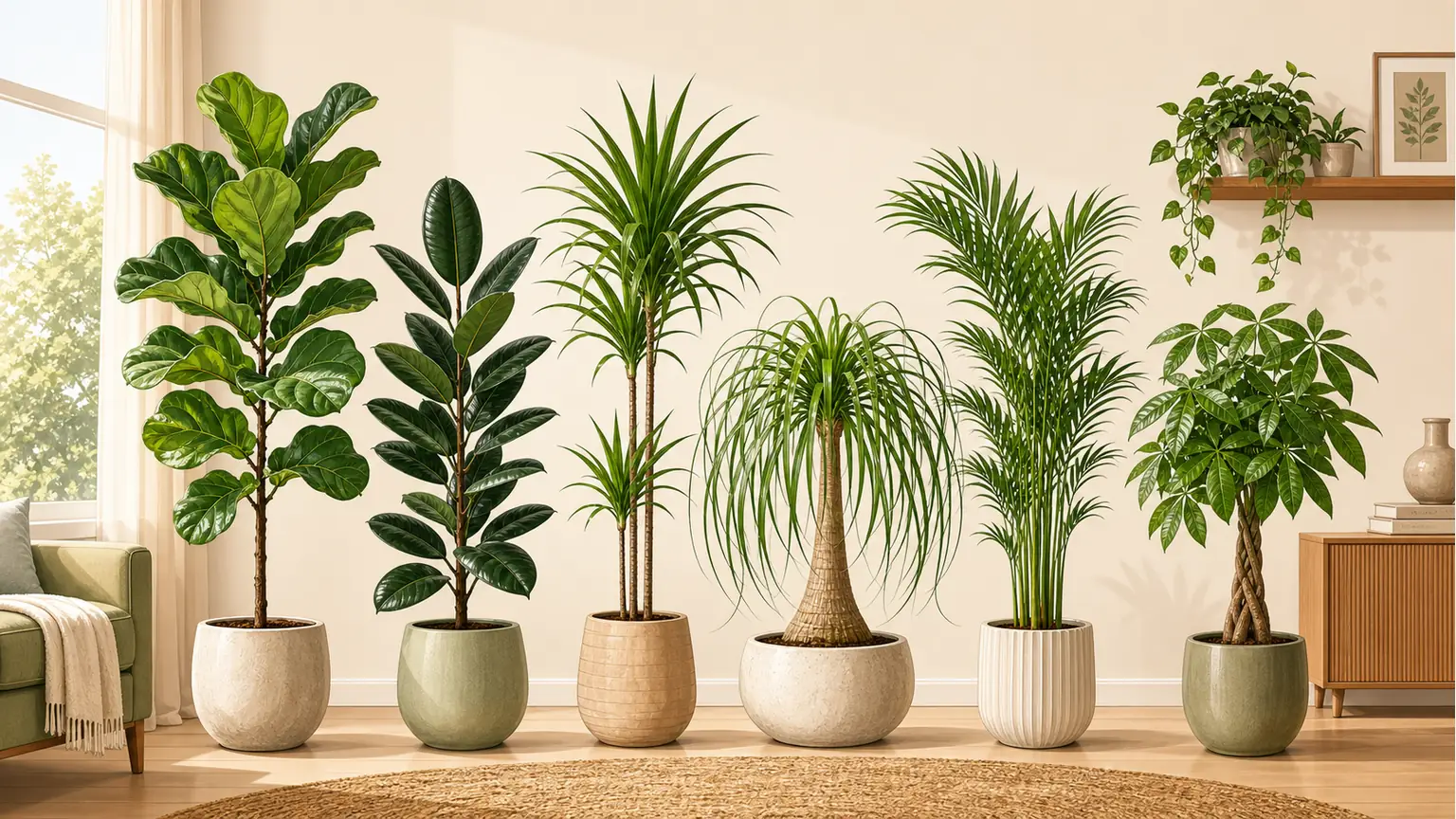
The best indoor trees are tall houseplants that match your room’s light, floor space, ceiling height, and pet situation. A fiddle leaf fig is the classic statement pick, but a dragon tree, rubber plant, ponytail palm, parlor palm, money tree, or cast iron plant may be a better fit for normal homes.
Quick answer: choose fiddle leaf fig or bird of paradise for a bright statement room, dragon tree for a narrow corner, rubber plant for an easier ficus look, ponytail palm for bright rooms and forgetful watering, parlor palm or cast iron plant for lower-light floor foliage, and money tree if you want a softer tree-form plant.
How this guide was built
Care guidance is based on extension and botanical sources, including Illinois Extension, Missouri Extension, University of Minnesota Extension, and NC State Extension. Pet notes use ASPCA listings where available. Product cards point to verified live-plant pages when there was an exact retailer match during the research pass; they are not a claim of hands-on nursery testing.
Affiliate disclosure: This article may contain paid links. If you buy through them, The Plant Manual may earn a commission at no extra cost to you.
Quick Picker: Best Indoor Tree by Room and Use
If you only remember one thing, remember this: do not buy by height alone. A good indoor tree must fit the light, walkway, pot weight, pets, and care rhythm of the room.
Choosing the classic statement tree? Read the full fiddle leaf fig care guide before placing one in a corner; light, watering, and moving shock matter more than the label on the pot.
| Plant | Best for | Light | Care | Pet note |
|---|---|---|---|---|
| Fiddle Leaf Fig | a dramatic statement tree | Bright indirect light; gentle morning sun can work after acclimation | Moderate | Not a good choice for pets that chew. Ficus sap can irritate pets and people. |
| Rubber Plant | a sturdier ficus alternative | Bright indirect light; tolerates medium light better than fiddle leaf fig | Easy to moderate | Not pet-safe for chewing pets; keep ficus plants out of reach. |
| Dragon Tree | narrow corners | Medium to bright indirect light; tolerates lower light with slower growth | Easy | Not pet-safe; dracaena is a caution plant for cats and dogs. |
| Ponytail Palm | bright rooms and forgetful waterers | Bright indirect light to gentle direct indoor sun after acclimation | Easy | ASPCA lists bottle palm / ponytail palm as non-toxic to cats and dogs. |
| Parlor Palm | pet-safer medium-light rooms | Medium to bright indirect light; tolerates lower light | Easy to moderate | ASPCA lists parlor palm as non-toxic to cats and dogs. |
| Money Tree | beginner-friendly tree form | Bright indirect to medium light | Easy to moderate | ASPCA lists money tree as non-toxic to cats and dogs. |
| Norfolk Island Pine | a living-tree shape | Bright indirect light; avoid dark rooms | Moderate | ASPCA lists Norfolk Island pine / Australian pine as non-toxic to cats and dogs. |
| Bird of Paradise | large bright rooms | Bright indirect light; some direct sun after acclimation | Moderate | Not pet-safe for chewing pets. |
| Umbrella Tree | full corner foliage | Medium to bright indirect light | Easy to moderate | Not pet-safe for chewing pets. |
| Yucca Cane | sunny, dry rooms | Bright light; tolerates more direct indoor sun than many tropicals | Easy if light is strong | Not a good choice for chewing pets. |
| Cast Iron Plant | low-light floor foliage | Low to medium indirect light | Easy | ASPCA lists cast iron plant as non-toxic to cats and dogs. |
| Olive Tree | very sunny rooms only | Very bright light and direct sun indoors | Moderate to difficult indoors | Not treated as a pet-safer pick here; verify the exact plant before using it in a chewing-pet home. |
Before You Buy a Tall Indoor Plant
Indoor trees fail less often from one dramatic mistake and more often from a mismatch: a high-light plant in a dim room, a top-heavy plant in a lightweight pot, or a wide plant blocking a walkway. Check these five things first.
- Light: bright indirect light is not the same as outdoor full sun. Most indoor trees want a bright window but not hot glass all day.
- Footprint: measure width, not just height. Bird of paradise and umbrella tree can fill a corner fast.
- Ceiling height: leave room for growth and for rotating the pot.
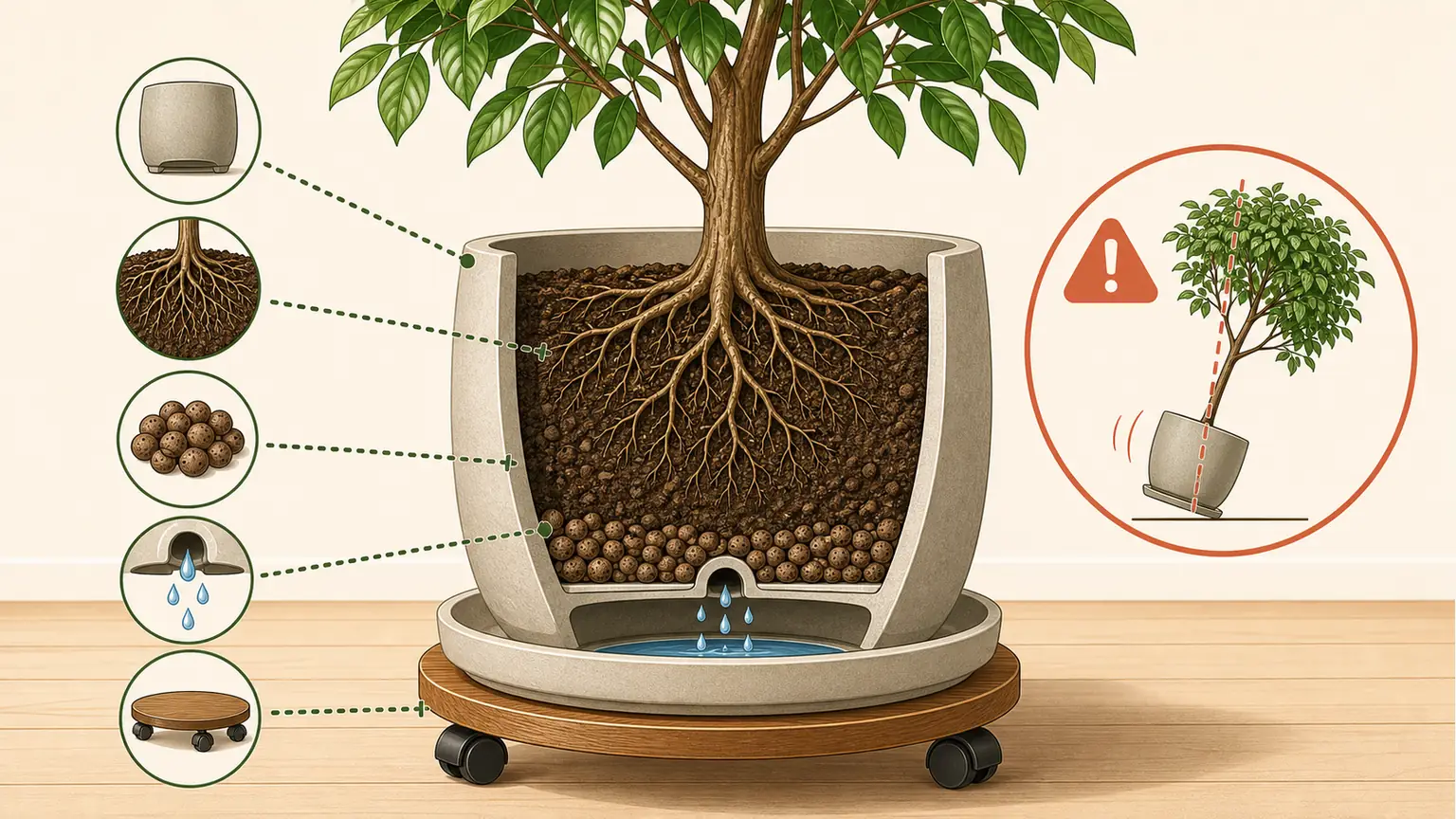
- Pot stability: tall plants need drainage and enough weight at the base to avoid tipping.
- Pets: if your cat or dog chews leaves, choose a source-backed pet-safer plant or place the tree where chewing is not possible. Non-toxic does not mean edible, and common names can overlap.


The Best Indoor Trees and Tall Houseplants
1. Fiddle Leaf Fig (Ficus lyrata)
Best for: a dramatic statement tree. Placement: Bright living room, office corner, or wide window area.
Fiddle leaf fig earns the first spot because it is the plant many people picture when they search for an indoor tree: one trunk, large leaves, and a strong interior-design shape.
Fiddle Leaf Fig care snapshot
- Light: Bright indirect light; gentle morning sun can work after acclimation
- Water: Water when the upper mix dries; avoid soggy lower soil
- Care level: Moderate
- Pet note: Not a good choice for pets that chew. Ficus sap can irritate pets and people.
Give it a stable spot with consistent light. It dislikes repeated moves, cold drafts, and sudden changes, so choose the placement before bringing home a large plant.
Watch this before you buy
Skip it if your best spot is a dark corner. A fiddle leaf fig in weak light usually drops leaves, leans, or grows sparse.
Looking to buy this live plant online?

A classic statement indoor tree for bright rooms with enough floor space.
2. Rubber Plant (Ficus elastica)
Best for: a sturdier ficus alternative. Placement: Bright corner, entry area, or office floor plant.
Rubber plant gives you the tree-form ficus look with thicker leaves and a calmer reputation than fiddle leaf fig.
Rubber Plant care snapshot
- Light: Bright indirect light; tolerates medium light better than fiddle leaf fig
- Water: Let the top part of the mix dry before watering again
- Care level: Easy to moderate
- Pet note: Not pet-safe for chewing pets; keep ficus plants out of reach.
Rotate it occasionally so the trunk grows straight. Wipe the leaves when dusty because broad leaves collect dust quickly indoors.
Watch this before you buy
Do not put it in a decorative cachepot that traps water. Ficus roots still need air and drainage.
Looking to buy this live plant online?
A colorful rubber plant option for bright rooms and tree-form houseplant displays.
3. Dragon Tree (Dracaena marginata)
Best for: narrow corners. Placement: Narrow living-room corner, bedroom corner, or office.
Dragon tree is one of the best indoor trees for tight rooms because the canes grow upright without the wide leaf spread of bird of paradise or fiddle leaf fig.
Dragon Tree care snapshot
- Light: Medium to bright indirect light; tolerates lower light with slower growth
- Water: Let the top few inches dry; avoid constantly wet soil
- Care level: Easy
- Pet note: Not pet-safe; dracaena is a caution plant for cats and dogs.
Use it when you want height but not a plant that blocks a walkway. It handles normal room humidity better than many tropical statement plants.
Watch this before you buy
Leaf tips can brown from dry air, mineral-heavy water, or inconsistent watering. A few brown tips are not the same as plant failure.
Looking to buy this live plant online?
A narrow cane-style indoor tree for corners where a wide floor plant would crowd the room.
4. Ponytail Palm (Beaucarnea recurvata)
Best for: bright rooms and forgetful waterers. Placement: Sunny shelf, bright floor spot, or dry apartment.
Ponytail palm looks like a small sculptural tree but behaves more like a dry-tolerant plant with water stored in its swollen base.
Ponytail Palm care snapshot
- Light: Bright indirect light to gentle direct indoor sun after acclimation
- Water: Let the pot dry well; water less often than leafy tropicals
- Care level: Easy
- Pet note: ASPCA lists bottle palm / ponytail palm as non-toxic to cats and dogs.
Use it where you want a tree-like silhouette without frequent watering. A smaller ponytail palm can start on a stand and later move to the floor.
Watch this before you buy
The main mistake is treating it like a moisture-loving palm. It wants a draining pot and time to dry.
Looking to buy this live plant online?
A bright-room, pet-safer indoor tree look for people who forget to water.
5. Parlor Palm (Chamaedorea elegans)
Best for: pet-safer medium-light rooms. Placement: Tabletop, plant stand, or smaller floor planter.
Parlor palm is smaller than most indoor trees, but it belongs here because it gives a soft floor-plant look in rooms that cannot support a giant tree.
Parlor Palm care snapshot
- Light: Medium to bright indirect light; tolerates lower light
- Water: Keep lightly moist, not wet
- Care level: Easy to moderate
- Pet note: ASPCA lists parlor palm as non-toxic to cats and dogs.
It is a good choice when you want pet-safer foliage and do not have the bright window needed for citrus, olive, or bird of paradise.
Watch this before you buy
Do not put it in harsh direct sun. The thin leaflets scorch more easily than thick succulent leaves.
Looking to buy this live plant online?
A pet-safer palm-style plant for medium-light rooms and smaller floor displays.
6. Money Tree (Pachira aquatica)
Best for: beginner-friendly tree form. Placement: Bright room, office, or entry table/floor spot.
Money tree is a good indoor tree for people who want a softer, friendlier look than ficus and a plant that can adapt to normal home conditions.
Money Tree care snapshot
- Light: Bright indirect to medium light
- Water: Water when the top mix dries; do not leave the root ball wet
- Care level: Easy to moderate
- Pet note: ASPCA lists money tree as non-toxic to cats and dogs.
Choose a pot with drainage and avoid letting the braided trunk sit in wet soil. The trunk can rot if the lower mix stays saturated.
Watch this before you buy
The verified Plant Addicts page was out of stock during this research pass, so this draft keeps money tree editorial-only for now.
7. Norfolk Island Pine (Araucaria heterophylla)
Best for: a living-tree shape. Placement: Bright room, holiday display, or cool indoor corner.
Norfolk Island pine gives the clearest small-tree silhouette indoors: layered branches, a central trunk, and a soft evergreen shape.
Norfolk Island Pine care snapshot
- Light: Bright indirect light; avoid dark rooms
- Water: Keep evenly moist but not soggy
- Care level: Moderate
- Pet note: ASPCA lists Norfolk Island pine / Australian pine as non-toxic to cats and dogs.
It prefers steady moisture and brighter light than many beginner plants. It is best for someone who checks plants regularly rather than someone who forgets them for weeks.
Watch this before you buy
Do not buy it only as a holiday decoration if you cannot give it bright light afterward.
8. Bird of Paradise (Strelitzia nicolai or Strelitzia reginae)
Best for: large bright rooms. Placement: Bright window, sunroom, or wide living-room corner.
Bird of paradise is not a tree botanically, but it acts like a tall indoor statement plant and often solves the same design problem as an indoor tree.
Bird of Paradise care snapshot
- Light: Bright indirect light; some direct sun after acclimation
- Water: Water when the upper mix dries; do not let the pot stay soggy
- Care level: Moderate
- Pet note: Not pet-safe for chewing pets.
Give it room. Mature leaves are broad, and the plant can overwhelm a narrow walkway or small bedroom corner.
Before buying it for a corner, check the full Bird of Paradise light requirements guide so the room is bright enough for long-term growth.
Watch this before you buy
The verified Plant Addicts page was out of stock during this research pass, so this draft does not include a live-plant card.
9. Umbrella Tree (Heptapleurum arboricola / Schefflera arboricola)
Best for: full corner foliage. Placement: Living-room corner, office, or bright hallway.
Umbrella tree is useful when you want a fuller, bushier indoor tree instead of one tall bare trunk.
Umbrella Tree care snapshot
- Light: Medium to bright indirect light
- Water: Water when the upper mix dries
- Care level: Easy to moderate
- Pet note: Not pet-safe for chewing pets.
Prune leggy stems to keep the plant compact and rotate it so one side does not stretch toward the window.
Watch this before you buy
It can get wider than expected. Measure the floor footprint, not just the listed height.
10. Yucca Cane (Yucca gigantea)
Best for: sunny, dry rooms. Placement: Bright window, sunroom, or modern minimal room.
Yucca cane is a strong indoor tree choice for people who have real brightness and want a structural plant that does not need constant watering.
Yucca Cane care snapshot
- Light: Bright light; tolerates more direct indoor sun than many tropicals
- Water: Let the soil dry well between waterings
- Care level: Easy if light is strong
- Pet note: Not a good choice for chewing pets.
Use a heavy pot because cane plants can become top-heavy. It is better in a bright room than in a dim corner.
Watch this before you buy
Skip it if your room is medium or low light. A yucca in weak light often declines slowly while looking fine at first.
11. Cast Iron Plant (Aspidistra elatior)
Best for: low-light floor foliage. Placement: Lower-light corner, hallway, or understated room.
Cast iron plant is not a true indoor tree, but it deserves a place in a tall-plant guide because it is one of the best floor plants for rooms where tree-form ficus or bird of paradise would struggle.
Cast Iron Plant care snapshot
- Light: Low to medium indirect light
- Water: Let the top few inches dry before watering
- Care level: Easy
- Pet note: ASPCA lists cast iron plant as non-toxic to cats and dogs.
Choose it when durability matters more than fast vertical growth. It is slow, steady, and much less dramatic about imperfect light.
Watch this before you buy
Do not expect fast new leaves. Slow growth is normal.
Looking to buy this live plant online?
A low-light, pet-safer floor plant for rooms where true indoor trees may struggle.
12. Olive Tree (Olea europaea)
Best for: very sunny rooms only. Placement: South-facing window, sunroom, or indoor/outdoor seasonal setup.
Olive tree is a beautiful indoor-tree idea, but it is also where many articles overpromise. It belongs only in genuinely sunny rooms.
Olive Tree care snapshot
- Light: Very bright light and direct sun indoors
- Water: Let the mix dry partly; avoid constantly wet soil
- Care level: Moderate to difficult indoors
- Pet note: Not treated as a pet-safer pick here; verify the exact plant before using it in a chewing-pet home.
If you have weak winter light, treat olive as a high-light project plant, not a beginner living-room tree.
Watch this before you buy
Do not buy an olive tree for a dim apartment corner. It may look good for a while, then thin out because the light is wrong.
Best Indoor Tree by Situation
| Situation | Best pick | Why |
|---|---|---|
| Best dramatic statement tree | Fiddle Leaf Fig | Large leaves and a strong trunk shape make it the clearest interior-design plant. |
| Best narrow corner plant | Dragon Tree | Upright canes give height without taking over the walkway. |
| Best pet-safer tall plant | Ponytail Palm, Parlor Palm, or Norfolk Island Pine | These have clearer ASPCA non-toxic listings than ficus, dracaena, yucca, schefflera, or bird of paradise. |
| Best lower-light floor plant | Cast Iron Plant | Not a tree, but more realistic than forcing a high-light tree into a dim corner. |
| Best bright sunny room plant | Yucca Cane or Olive Tree | These need much stronger light than most tropical foliage plants. |
| Best if you forget to water | Ponytail Palm | The swollen base stores water and the plant prefers drying down. |
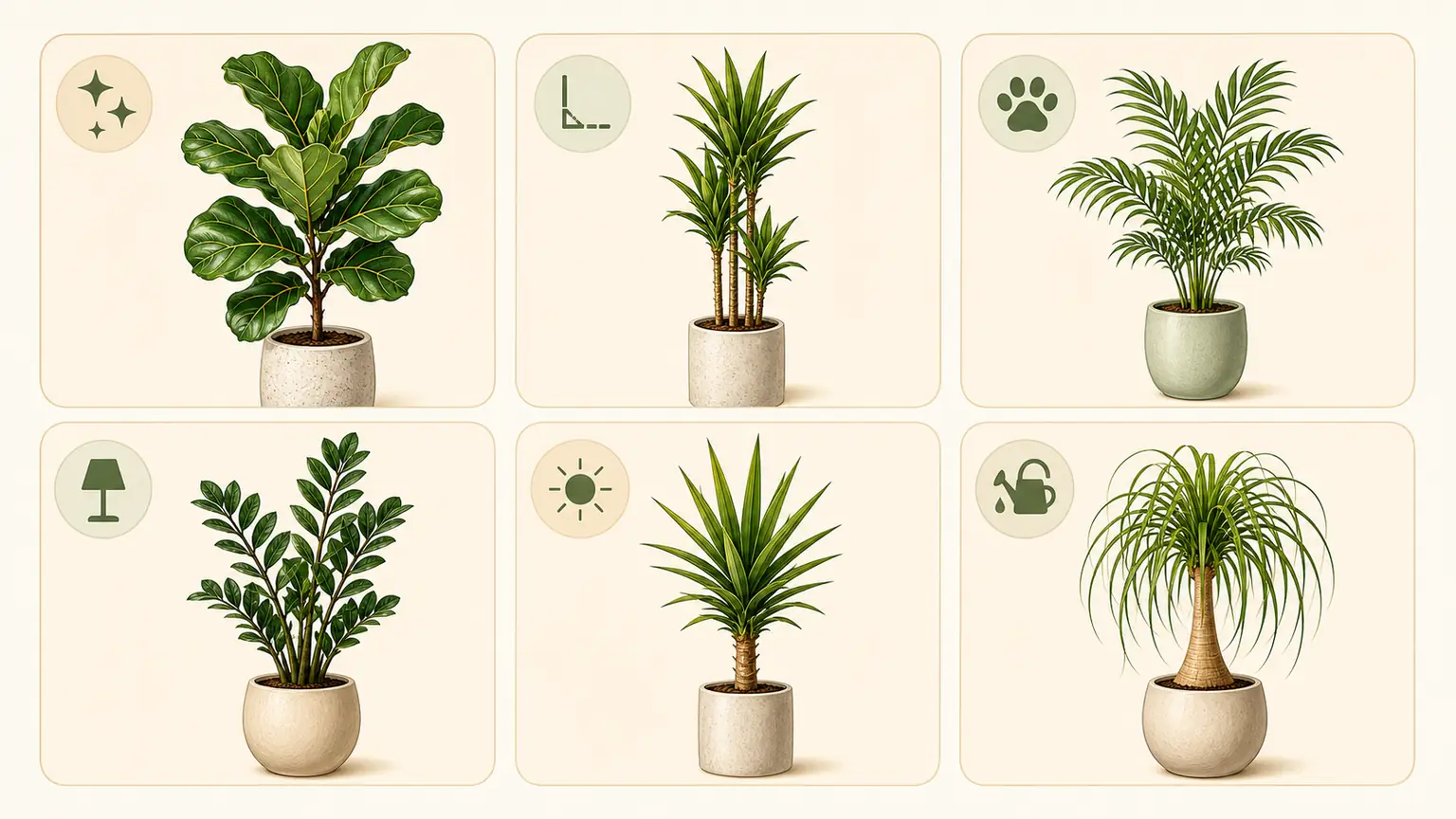
Indoor Tree Mistakes That Ruin the First Month
Do not buy the tallest plant first
A smaller healthy plant often adapts better than a huge stressed plant. Large plants are expensive, harder to move, and less forgiving when the room is wrong.
- Putting a bright-light tree in a decorative dark corner: the room may look better for a week, but the plant will stretch or drop leaves.
- Using a pot without drainage: large pots dry unevenly, and trapped water at the bottom can rot roots.
- Ignoring vents and radiators: hot or cold drafts can stress broad-leaf tropical plants.
- Choosing only by aesthetics: pet safety, ceiling height, and watering rhythm matter as much as leaf shape.
- Moving the plant every few days: many indoor trees adapt better when the light and temperature stay consistent.
Large pots behave differently from small ones, so use our guide to choosing potting mix by plant type before repotting an indoor tree.
More Indoor Plant Guides
Keep choosing by the room, not by the label
Compare this guide with the best beginner indoor plants, low-light indoor plants, bright-light indoor plants, pet-safe indoor plants, grow lights for indoor plants, and soil moisture meters for indoor plants.
Considering a Money Tree? Check the money tree light requirements guide so the room is bright enough before you buy a large floor plant.
For commercial spaces: If you need a plant for a desk, lobby, or cubicle instead of a living room, compare these with large office plants and compact desk picks.
FAQ
What is the easiest indoor tree?
For most homes, a ponytail palm, dragon tree, rubber plant, or money tree is easier than a fiddle leaf fig. The easiest choice depends on your light and watering habits.
What indoor tree is best for low light?
A parlor palm or cast iron plant is usually more realistic for lower-light rooms than a true tree-form ficus. Low light means slower growth, so choose for tolerance rather than speed.
Which indoor tree is safest around pets?
ASPCA-listed non-toxic options in this guide include parlor palm, ponytail palm, money tree, Norfolk Island pine, and cast iron plant. Non-toxic still does not mean edible, and soil or pest products can be separate risks.
Can an olive tree grow indoors?
An olive tree can grow indoors only in a very bright, sunny setup. It is a poor choice for dim rooms or north-facing corners.
How big should the pot be for an indoor tree?
Use a stable pot with drainage and size up gradually. Oversized pots can stay wet too long, while lightweight pots can make tall plants unstable.
Sources
- Illinois Extension: Lighting for Houseplants
- Missouri Extension: Caring for Houseplants
- University of Minnesota Extension: When Houseplants Go Outside
- NC State Extension: Ficus lyrata
- NC State Extension: Ficus elastica
- NC State Extension: Beaucarnea recurvata
- NC State Extension: Chamaedorea elegans
- NC State Extension: Pachira aquatica
- NC State Extension: Araucaria heterophylla
- NC State Extension: Strelitzia nicolai
- NC State Extension: Heptapleurum arboricola
- NC State Extension: Yucca gigantea
- NC State Extension: Olea europaea
- ASPCA: Pony Tail
- ASPCA: Chamaedorea
- ASPCA: Money Tree
- ASPCA: Australian Pine / Norfolk Island Pine
- ASPCA: Cast Iron Plant
- ASPCA: Toxic and Non-Toxic Plants Database


