Snake Plant Light: A Complete Guide to Thriving (Not Just Surviving)
The definitive guide to providing the perfect light for your Sansevieria to encourage growth and vibrant color.
Transparency note: Some links in this article are affiliate links. As an Amazon Associate I earn from qualifying purchases — at no extra cost to you. Product suggestions are selected for their fit with the plant-care problem being discussed are useful.
It’s the most famous trait of the Snake Plant, the one piece of advice everyone seems to know: “They’re great for low light!” You might have even bought one for that dim corner in your office or hallway, trusting in its reputation as the unkillable champion of the shade. But now, you might be looking at your plant and feeling a little confused. Maybe it hasn’t grown an inch in a year. Perhaps its vibrant yellow stripes have faded. Or worse, it’s started to look a little pale and floppy.
If your plant is not getting enough natural light, this in a standard floor lamp changes everything:
Fits a standard lamp but delivers intense, full-spectrum light. Powerful enough for large floor plants in dark corners.
That feeling of confusion is completely valid. The term “low light” is the most misunderstood concept in houseplant care, and you’ve come to the right place for clarity. The truth is, there’s a huge difference between where a Snake Plant can survive and where it will thrive. This guide will demystify snake plant light needs, connecting the science to simple, practical advice. You’ll finish this article feeling empowered, confident, and ready to give your plant the perfect light it deserves. For a full overview of all care topics, please refer back to our main Snake Plant Complete Care Guide.
💡 What Are the Real Snake Plant Light Requirements?
The most critical concept to understand about snake plant light is the difference between tolerance and preference. While a Snake Plant is famous for its ability to tolerate very low light conditions, its strong preference—where it will show vigorous growth, strong color, and robust health—is in bright, indirect light. If you are trying to grow your snake plant in a dim room, check out our guide to plants that survive in low light to see how it compares to other shade-tolerant varieties.
Why the difference? It comes down to the plant’s native habitat. Snake Plants (Dracaena trifasciata) are native to arid, rocky regions in West Africa. They often grow in open areas or under the sparse shade of larger trees, where they receive plenty of bright, dappled sunlight throughout the day. They are not deep-jungle floor dwellers. Their ability to survive in low light is a remarkable adaptation, a survival mechanism—but it is not their ideal state. Think of it like a hibernating bear: it’s surviving by using its stored energy, not actively thriving. Providing bright, indirect light is like waking the bear up in springtime.
🤔 Debunking the “Low Light Snake Plant” Myth
So why is the “low light” tag so prevalent? Because compared to other popular houseplants that will quickly die in a dim corner (like a Fiddle Leaf Fig), the Snake Plant’s ability to hang on for months or even years is extraordinary. It does this by entering a state of near-dormancy, putting all its energy into simple survival.
Here’s what really happens in low light:
- Photosynthesis Slows: Photosynthesis is the process plants use to convert light into energy (food). In low light, this process slows to a crawl. The plant produces just enough energy to stay alive but has none left over for new growth.
- Growth Halts: With no spare energy, the plant will stop producing new leaves. If you’ve had a Snake Plant for a year with no new growth, insufficient light is the most likely cause.
- Increased Risk of Rot: A plant that isn’t growing isn’t using much water. In a low-light setting, the soil stays wet for much longer after watering, dramatically increasing the risk of root rot—the #1 killer of Snake Plants. Proper snake plant light is your best defense against overwatering. For a full watering guide, see our article on How to Water a Snake Plant.
- Fading Color: Variegated varieties, like the popular ‘Laurentii’ with its yellow stripes, will start to fade. The plant will produce more chlorophyll (which is green) to try and capture every bit of available light, causing the yellow parts to diminish or disappear.
☀️ How to Measure Light for Your Snake Plant
“Bright indirect” and “low light” can feel vague. Let’s define them in practical terms you can use right now. A simple way to measure light is the “hand shadow test.”
- Stand in the spot where you want to place your plant during the brightest part of the day.
- Hold your hand about one foot (30 cm) above a plain surface, like a piece of paper or the floor.
- Observe the shadow your hand casts.
- Bright, Indirect Light (Ideal): Your hand casts a soft but clearly defined shadow. This is the perfect snake plant light. It’s the light found a few feet away from a south- or west-facing window, or right in an east-facing window.
- Low Light (Survival): Your hand casts a very faint, fuzzy shadow, or no shadow at all. This is a dim corner, a north-facing window, or a spot more than 8 feet (2.4 meters) from any window. Your plant will survive here, but not thrive.
- Direct Light (Use with Caution): Your hand casts a sharp, dark, well-defined shadow. This is the light found directly in an unfiltered south- or west-facing window. A little is okay, but too much can be harmful.
🏠 The Ultimate Placement Guide: Best Spots in Your Home
Finding the perfect spot is easy once you understand how light moves through your home. Here’s a room-by-room guide to the best snake plant light exposure.
East-Facing Windows (The Sweet Spot)
An east-facing window provides several hours of gentle, direct morning sun, followed by bright, indirect light for the rest of the day. This is arguably the perfect location for a Snake Plant. You can place it right on the windowsill or on a table nearby without fear of burning its leaves.
South-Facing Windows (Bright but Beware)
South-facing windows offer the brightest, most intense light all day long. This is excellent for fueling growth, but you should not place your plant directly on the windowsill. The intense afternoon sun can scorch the leaves.
- Best Placement: Position your plant 3 to 5 feet (about 1 to 1.5 meters) back from the window, or use a sheer curtain to diffuse the light.
West-Facing Windows (Good, with Caution)
Similar to south-facing windows, west-facing windows get strong, direct afternoon sun, which can be harsh. This is a great location for bright light, but the same rule applies: pull the plant back a few feet from the glass to prevent sunburn.
North-Facing Windows (Survival Mode)
A north-facing window provides the least amount of light. It offers gentle, indirect light all day but is often considered low light, especially in the winter. Your Snake Plant will survive here, but do not expect much growth. Be extra cautious with watering, as the soil will take a very long time to dry out.
🎨 How Light Affects Your Snake Plant’s Color and Growth
The amount of light your plant receives has a direct and visible impact on its appearance.
- Variegation: For varieties like ‘Laurentii’ (yellow edges), ‘Moonshine’ (silvery-green), and ‘Bantel’s Sensation’ (white stripes), bright light is essential. In low light, these plants will revert to a darker green to maximize their photosynthetic ability. If your plant’s colors are fading, it is a clear sign it needs more light. For more on this, see our guide on Why Your Snake Plant has Yellow Leaves.
- Growth Speed: In bright, indirect light during the spring and summer, a healthy Snake Plant can produce new pups (offshoots) and leaves quite rapidly. In low light, it may not produce a single new leaf all year.
- Leaf Strength: With ample light, a Snake Plant’s leaves will grow strong, thick, and upright. In very low light, new leaves may be weaker, thinner, and more prone to flopping over.
😟 Troubleshooting Common Light-Related Problems
Is your plant sending you an SOS? Here’s how to read the light-related signals.
Signs of Too Little Light
- No new growth for an extended period (6+ months).
- Fading variegation (yellow or white stripes turning green).
- Weak, floppy leaves that bend or crease easily.
- Soil stays wet for weeks, leading to a musty smell or fungus gnats.
- Leaves are a very dark, dull green.
Solution: Gradually move the plant to a brighter location over a week or two to avoid shocking it. Do not immediately move it from a dark corner into direct sun.
Signs of Too Much Light (Sun Scorch)
Sun scorch, or photooxidation, occurs when the leaves are exposed to more intense light than they are adapted for, causing the chlorophyll to be destroyed faster than it can be replaced.
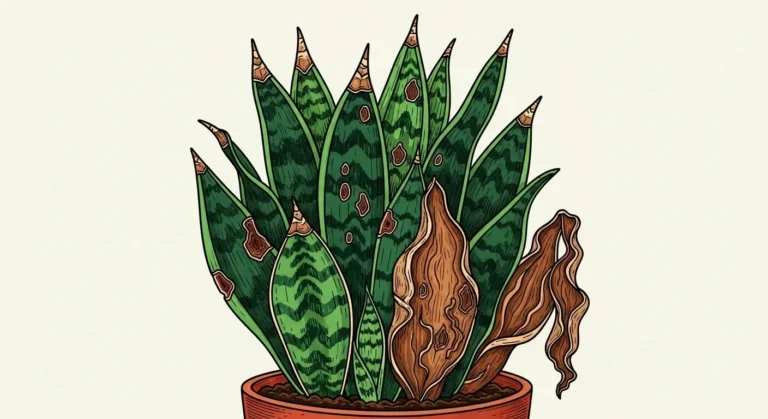
- Dry, brown, crispy patches appearing on the leaves.
- Yellowing or bleaching of the leaves, making them look washed out.
- Reddish or brown edges on the leaves.
Solution: Move the plant a few feet further away from the window or hang a sheer curtain to filter the intense rays. The scorched spots will not heal, but the new growth will be healthy.
💡 Using Grow Lights for Snake Plants
What if you don’t have a bright window? A grow light for a snake plant is a fantastic solution for providing perfect light anywhere in your home. Snake Plants are not demanding and do not require expensive, high-powered lights. A simple, full-spectrum LED bulb in a standazrd lamp, run for 10-12 hours a day, is more than sufficient.
❓ Frequently Asked Questions
Can snake plants live in a room with no windows?
No, a snake plant cannot live indefinitely in a room with zero natural light. It is a living organism that requires at least some light for photosynthesis to survive. However, it can live very happily in a windowless room if you provide it with an artificial light source, like a simple LED grow light, for about 10 hours a day.
Will direct sunlight kill a snake plant?
A little bit of direct morning sun is generally fine and even beneficial. However, several hours of intense, direct afternoon sun (especially through a south- or west-facing window in the summer) can scorch the leaves, causing permanent brown or yellow patches. It’s best to place it where the light is bright but filtered during the harshest part of the day.
My ‘Moonshine’ snake plant is turning dark green. What’s wrong?
This is a classic sign of insufficient snake plant light. The ‘Moonshine’ variety needs bright, indirect light to maintain its beautiful, pale, silvery-green color. In lower light, it produces more chlorophyll to compensate, which makes the leaves turn a darker green. It’s not unhealthy, but to restore its color, you must move it to a brighter spot.