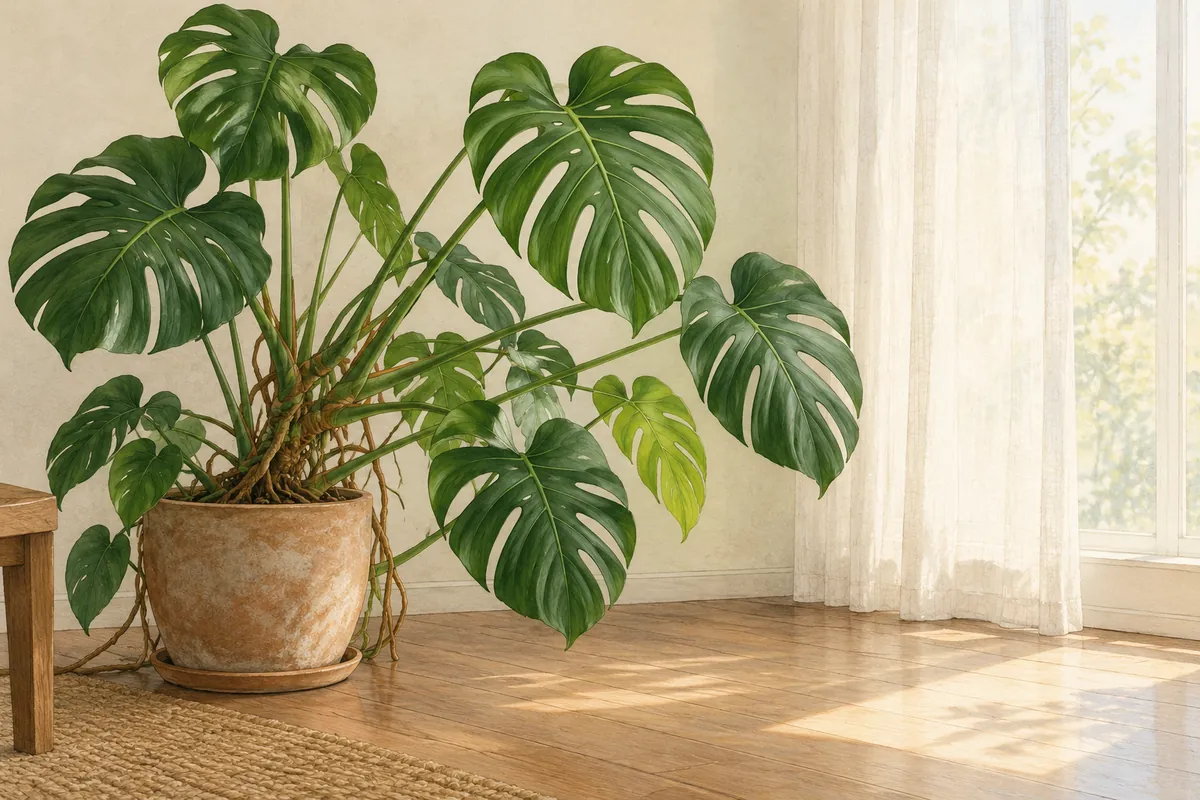
Monstera light requirements start with bright indoor light away from direct sun for an ordinary green Monstera deliciosa. Compare the light reaching its leaves in your available window spots, then filter direct rays with an existing curtain or change position. Recheck when the sun path changes: a US winter window can admit sunlight farther into the room even as days shorten.
Start with the plant you actually have
This guide is for an established, green Monstera deliciosa indoors. “Swiss cheese plant” and “split-leaf philodendron” are common names, not reliable species identification. Monstera is not a philodendron, and other Monstera species have different leaf forms. Use the botanical name on your plant’s record or label as a starting point; leaf holes alone do not establish identity. Penn State Extension describes these naming overlaps.
Young M. deliciosa leaves are commonly small and mostly uncut; mature foliage develops cuts and holes. A solid leaf therefore does not prove that the room is too dark. Keep the placement decision separate from a promise of split leaves. For a broader species reference, see the Monstera deliciosa care guide; for the specific growth question, use why Monstera leaves are not splitting.
If your plant is the variegated cultivar Monstera deliciosa ‘Thai Constellation’, use its cultivar-specific light guide. This page does not set targets for cream-colored tissue or variegation.
Choose a position by exposure, not compass direction alone
Penn State’s indoor recommendation is a site near a sunny window with bright light but no direct sun; it also notes leggy growth in lower light. Start there before buying a lamp. Bright light does not mean a sunbeam must fall on the plant.
University of Georgia Extension explains why the same window direction can produce different conditions: trees, roof overhangs, curtains, time of day, and season all change the light. Its example of a south window beneath wide eaves is especially useful: the overhang can keep summer sun from entering at all.
- Compare available places at leaf height. Look where the upper and lower leaves would actually sit, rather than judging the brightness beside the glass or in the middle of the room. Check at different times as the sun moves.
- Locate direct rays. A sunbeam landing on foliage is direct exposure through the window. Note which leaves it reaches. A spot outside that beam can still receive bright daylight.
- Use what you own. Shift the plant out of the beam or draw an existing light-filtering curtain. Then check again: blocking direct rays and retaining useful brightness are separate tasks.
- Compare the alternatives. If the curtain makes that spot dim, examine another available position. Do not keep a plant in a dark corner solely because the corner avoids direct sun.
| Available spot | Check at the leaves | Placement decision |
|---|---|---|
| East-facing window | Does morning sun reach the foliage, or do trees and buildings block it? | Keep the bright daylight; filter or avoid direct rays rather than assuming east means indirect. |
| South-facing window under an overhang | Does the roof shade the glass now? Does a beam reach farther inside later in the year? | Judge today’s exposure, then revisit the position as the season changes. |
| West-facing window | Where do afternoon rays fall after the morning inspection? | Use a curtain or a position outside the beam if direct rays reach the plant. |
| North-facing or obstructed window | How much daylight reaches the plant past the tree, porch, neighboring wall, or curtain? | Compare with your other filtered positions; the absence of direct sun does not establish adequate light. |
A room example: suppose an east window faces a neighboring wall, while a south window has open daylight and an existing curtain. The south position deserves a comparison; “east is best” would overlook the obstruction. This is a hypothetical application of Georgia Extension’s guidance, not a measured result for either room.

Can Monstera take direct sun?
Use bright light without direct sun as the cautious indoor starting point. NC State lists dappled sunlight and partial shade for the species, but those broad cultural categories do not establish a safe indoor sun duration. Check the actual exposure before treating any window as suitable for your plant.
The apparent source conflict has a practical explanation. NC State’s species profile itself recommends moderate brightness without direct sunlight for home conditions, alongside its broader light categories. Neither its partial-shade label nor an outdoor shade description is a tested window-sun allowance for your established houseplant.
If the plant’s current position receives direct rays, try the filtered option first. Avoid a sudden move from a shaded interior to strong sun. Georgia Extension warns that strong exposure can injure sensitive foliage plants; it does not provide a Monstera-specific burn threshold. A curtain reduces exposure, but no particular curtain or setback guarantees the right result.
Recheck winter beams before moving closer
Shorter winter days do not mean every indoor spot receives weaker direct exposure. Georgia Extension explains that the lower winter sun can penetrate farther into a room. In a US home, leaves beyond the summer sun patch may enter the winter beam, depending on the window, latitude, and obstructions.
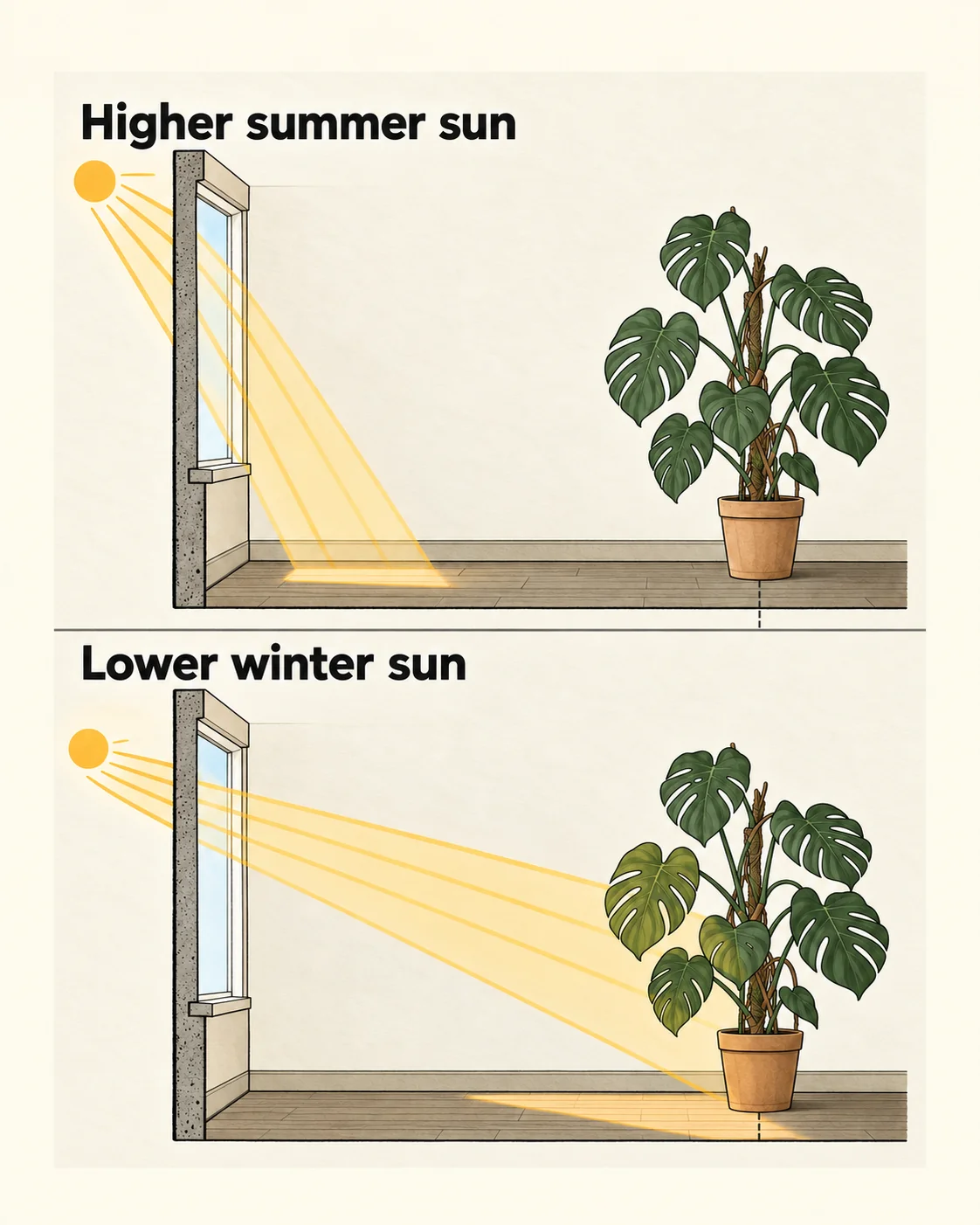
Revisit the placement when you notice the sun patch moving or daylight conditions changing. Look for two different situations:
- The room is dimmer, with no beam on the plant. Compare a brighter available position, then repeat the direct-ray check there. Moving closer is useful only if the new position provides suitable exposure.
- A winter beam now reaches the leaves. Filter it or move outside its path before assuming that a closer position is better. Recheck later in the day because the patch moves.

A fixed distance from glass cannot account for both situations. A tree, overhang, or neighboring building can also change the result. The useful seasonal habit is to inspect the leaves’ exposure again, rather than move every Monstera closer to a south window on a calendar date.
Check exposure first, then compare growth
There are two different checks after a move. First, confirm that the chosen position provides the intended filtered daylight as the sun moves. Then compare subsequent growth and new damage. A room check can establish where rays fall; it cannot prove a biological response before the plant has grown.
Take a dated photo before changing the location so existing marks are distinguishable from new ones. This is an observation aid, not a diagnostic test. The following sequence applies Penn State’s light guidance and Georgia Extension’s general houseplant guidance; it is not a tested Monstera recovery protocol.
- Confirm the actual change. Did the foliage receive brighter filtered daylight, or did only the pot move? Check for newly exposed upper and lower leaves.
- Compare subsequent growth. Penn State associates leggy growth with lower light. Georgia Extension also describes longer spaces between leaves and smaller new leaves as possible low-light clues. Use the pattern together with the exposure check, rather than interpreting one solid leaf as a light shortage.
- Investigate new damage. Bleaching or scorching after stronger exposure raises a light concern, but a yellow or brown mark alone does not establish the cause. Check moisture and other growing conditions too; do not keep increasing light because the plant has not produced holes.
- Reassess watering after the move. Georgia Extension explains that light intensity affects water use. Check the medium before watering instead of carrying over the old calendar. For a persistent drainage or medium problem, continue with the Monstera potting-mix guide.
There is no source-supported number of days to new splits or recovery in the consulted guidance. If damage continues or growth declines despite suitable exposure, broaden the investigation rather than repeatedly moving the plant toward stronger sun.
When window light still falls short
Supplemental lighting becomes worth considering when your available placements remain dim or cannot accommodate the plant. Georgia Extension supports adding artificial light when a location cannot meet a plant’s needs. Try a brighter filtered position or your existing curtain first; a purchase is unnecessary if that solves the placement problem.
If equipment is needed, the remaining task is to match a particular fixture to the plant’s position and foliage coverage. A generic instruction to hang any lamp at one distance or run it for one fixed cycle does not settle that choice. This guide does not prescribe lamp inches, a lux target, or a lamp-on schedule.
Questions about Monstera light requirements
What is the best window for a Monstera?
Choose the available window position that provides bright light without direct rays on the foliage. East-facing glass may admit morning sun; a south-facing window may be shaded by an overhang. Compare the actual leaf positions through the day, then use an existing curtain or reposition the plant as needed.
How far from a window should a Monstera be?
There is no universal distance in the consulted Extension guidance. Window size, orientation, curtains, and outside obstructions change exposure. Compare light at the leaves, including the lower foliage, and check where direct rays fall. Recheck after moving: a position farther inside can still receive the lower winter sun.
Can a Monstera grow in low light?
Lower light can produce leggy growth, according to Penn State Extension, so a dim corner is not the preferred placement. Try brighter filtered daylight first. If your available positions remain inadequate, supplemental light may help. Judge growth and exposure together; a green plant or a solid leaf alone cannot establish sufficiency.
Do leaves without holes mean my Monstera needs more light?
No. Juvenile Monstera deliciosa leaves are commonly mostly uncut, while mature foliage develops cuts and holes. Check plant identity and maturity alongside actual exposure before blaming light. If the question is specifically about missing splits, follow the linked fenestration guide rather than trying to force them with stronger sun.
Should I move my Monstera closer to the window in winter?
Only after checking the new position. Shorter days may leave a room dimmer, yet the lower winter sun can reach farther inside. Inspect for direct rays at the leaves before moving closer. Filter a newly arriving beam, or compare a brighter filtered position if the current spot stays dim.
Sources and scope
- Penn State Extension: Monstera as a Houseplant — species and common names, juvenile foliage, and cautious indoor light guidance.
- NC State Extension Gardener Plant Toolbox: Monstera deliciosa — mature foliage, indoor brightness, and the distinction between broad light categories and home placement.
- University of Georgia Extension: Growing Indoor Plants with Success — general indoor-light principles, obstructions, seasonal sun penetration, growth clues, and water use. The placement sequence here is editorial synthesis, not a species-specific home trial.


