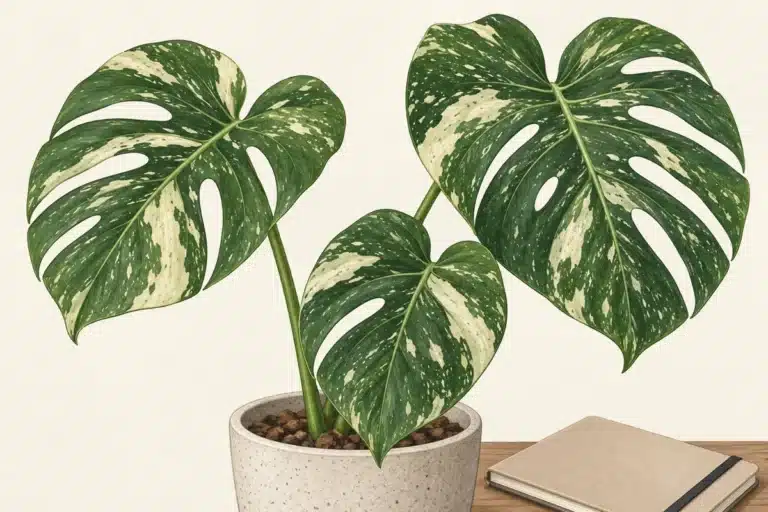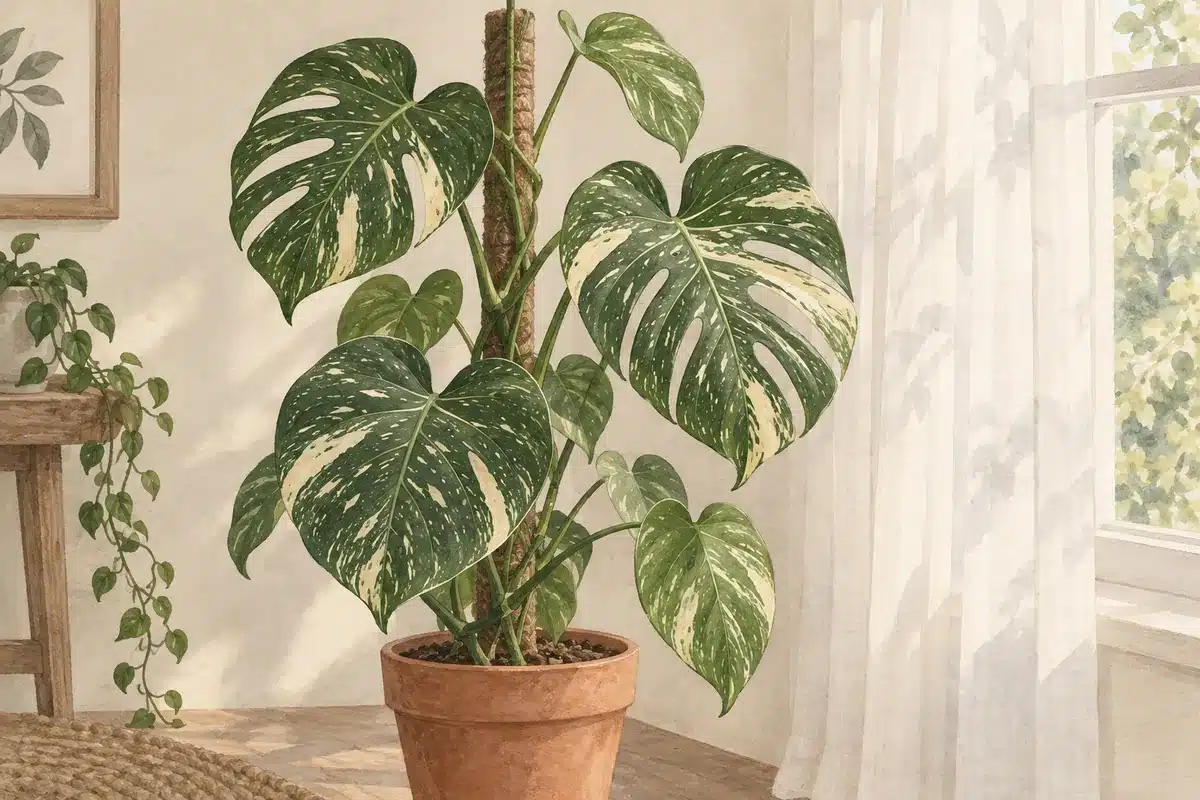
Thai Constellation Monstera light requirements are best approached with bright, filtered indoor light and a check at the leaves. Choose a spot where harsh direct rays do not hit an unacclimated plant, then observe growth and new damage. Window direction, distance from glass, and the amount of cream on a leaf cannot establish the right exposure by themselves.
Quick reference: choose, check, adjust
- Start: Bright indoor light, filtered or outside the path of harsh direct rays.
- Check: Look at the actual foliage in the morning, around midday, and in the afternoon.
- Adjust: Use an existing curtain or a better position before buying equipment; increase exposure gradually.
- Supplement: Consider a grow light when available window light remains inadequate. Follow the fixture’s setup and coverage guidance.
- Reassess: Compare new growth and new damage. Cream percentage and brown patches alone do not diagnose light.
Why light matters for this variegated Monstera
Monstera deliciosa ‘Thai Constellation’ is a variegated cultivar, rather than a separate species. Its cream-and-green pattern does not provide a calibrated measure of light. Penn State Extension’s indoor Monstera guidance recommends bright light away from direct sun and describes leggy growth in lower light; it does not give a tested light optimum for this cultivar.
Will more light make Thai Constellation more variegated?
More light is not a reliable way to produce more cream tissue. The consulted Thai Constellation propagation study describes relatively genetically stable variegation, but does not test whether brighter home conditions create whiter leaves. Assess growth and exposure separately from the leaf pattern; one greener leaf does not establish insufficient light.
The cultivar-specific study by Jing, Beleski, and Vendrame concerns tissue culture and acclimatization. Its laboratory light schedule is not a prescription for a mature houseplant. Relatively stable variegation also does not mean that every leaf must look alike or that reversion is impossible.
How do you assess Thai Constellation Monstera light requirements at a window?
Choose a bright candidate spot, then watch the leaves at different times of day. A visible sunbeam on a leaf is direct exposure, even through glass. East windows can receive morning sun, while north windows may be dim. Filter harsh rays or move outside their path, then check the remaining light.
A window check that starts at the leaves
University of Georgia Extension explains that window light changes with direction, season, obstructions, and curtains. No fixed setback in feet guarantees either enough light or freedom from direct sun.
- Observe the whole plant. Check the upper and lower leaves in the morning, around midday, and in the afternoon. Note when a beam reaches them, rather than judging only how bright the room feels.
- Change the beam path first. If harsh direct rays hit a newly arrived or previously shaded plant, use a curtain you already have or shift the plant outside the beam. Recheck later: the sun patch moves.
- Check what remains. A heavily shaded corner may avoid sunburn but offer too little light. Compare a brighter filtered position before deciding a lamp is needed.
- Record one adjustment. Note the new location and orientation. Make further exposure increases gradually, and use the worksheet below to compare what happens.

| Candidate window | What to check | Placement decision |
|---|---|---|
| East-facing | Does morning sun fall on the leaves? Do a porch, tree, or building block it? | Start with filtered light for an unacclimated plant. Do not assume east means indirect all day. |
| North-facing | Is the spot unobstructed, or shaded by nearby structures and trees? | Compare it with other available spots. A north window is not automatically bright enough. |
| South- or west-facing | Do strong midday or afternoon rays reach the foliage? Does an existing curtain intercept them? | Filter harsh exposure or move out of its path, then recheck brightness and the sun path. |
| Any heavily shaded window or interior spot | How much light reaches the actual leaves across the day, rather than the window itself? | Try a brighter suitable location first. Consider supplemental light if no useful window position is available. |
If growth is one-sided, an occasional small turn may help distribute exposure, but rotation does not supply additional light. After turning, check whether leaves that were shaded now receive direct rays. There is no need to follow a universal rotation calendar.
Can Thai Constellation receive any direct sun?
Some direct morning sun may be tolerated after acclimation, according to US grower Costa Farms. That is conditional grower guidance, not a guarantee for a new plant or every window. A cautious indoor starting point is bright, filtered light; avoid an abrupt move from shade into harsh sun.
Costa Farms’ cultivar guidance explicitly distinguishes acclimated plants from those that may burn after a sudden exposure change. Penn State’s indoor advice takes the more cautious approach of avoiding direct sun. NC State’s species-level light categories include dappled sunlight and partial shade, but do not establish a direct-sun threshold for an unacclimated variegated houseplant. Intensity, duration, and previous conditions matter; there is no supported instant-burn rule.
How can you tell whether the light needs changing?
Stretching or slow growth can suggest insufficient light, and damage after a sudden exposure increase can raise concern about sunburn. Neither is conclusive by itself. Check the actual light, recent changes, potting-mix moisture, and other stress signs before choosing a correction. Variegation alone cannot tell you whether the light is right.
Clue, check, action
University of Maryland Extension’s diagnostic guidance lists several causes of leaf spots and poor growth. This table is a way to choose the next check, rather than identify a cause from a leaf’s appearance.
| Clue | Check before deciding | Next action |
|---|---|---|
| New growth stretches toward the window or becomes leggy | Compare light at the foliage across the day. Look for obstructions; check moisture and recent environmental changes too. | If the spot is consistently dim, try brighter filtered light gradually. Reassess new growth. |
| Growth slows without obvious stretching | Has light changed with the season? Are temperature, moisture, or root problems also plausible? | Use the light record below. Investigate other care conditions instead of assuming more light is the entire fix. |
| Brown patches appear after a move into stronger sun | Did direct rays reach those leaves? Check moisture stress and other causes of spots as well. | Reduce harsh exposure while investigating. Compare new damage with your dated photo; do not diagnose sunburn from cream browning alone. |
| Browning or wilting accompanies persistently wet mix | Check drainage, standing water, and root condition where needed. Was watering kept unchanged after a move to dimmer light? | Investigate water or root stress. A lamp is not a substitute for addressing wet roots. |
| A new leaf has more green or cream than the last | Separate pattern variation from growth and damage. What did the exposure record actually change? | Do not chase a cream-percentage target. Keep a suitable location if the other checks give no reason to change it. |
For spreading patches, root concerns, or symptoms that do not match a recent light change, use the Thai Constellation brown-spots checks. Costa Farms also notes slower growth and greater watering vulnerability in lower light. After changing the location, check moisture before watering instead of assuming the previous interval still applies.
When should you add a grow light?
Add supplemental light when a better window position is unavailable or still too dim after your checks. First try a brighter filtered spot using what you already own. If a lamp is needed, choose its setup by output at the leaves, coverage, and manufacturer directions, rather than wattage or a promised variegation improvement.
University of Minnesota Extension explains that source distance affects intensity and that watts describe energy use, rather than the light received by the plant. No single mounting height suits every grow light.
- Setup: Follow the exact fixture’s recommended distance and mounting instructions. For a bulb, confirm the specified US socket, holder rating, and any restrictions on enclosed fixtures.
- Coverage: Check whether the usable illuminated area reaches the plant’s foliage, including leaves beyond the center of the beam.
- Exposure: Begin with the manufacturer’s guidance and adjust gradually. Check for excessive heat and new damage after setup or a height change.
- Schedule: Use daylight and lamp timing together; maintain a daily dark period. An existing suitable timer can simplify the schedule.

If window light still falls short, compare the setup you need. A compatible bulb can reuse a holder you own; choose a complete pendant only when you need its mounting setup or built-in dimming. Check foliage coverage with either option.
How many hours of light should it receive?
University of Minnesota Extension gives 12–14 total daily light hours as general guidance for foliage houseplants. Treat that as a starting framework, not a proven Thai Constellation optimum or automatic lamp-on schedule. Account for useful daylight and overlapping lamp hours, and leave a dark period rather than running a lamp continuously.
Count the clock hours during which usable daylight or the lamp reaches the plant, counting overlap once. A long day at a very dim window does not automatically supply enough light, and a timer controls duration rather than brightness. Avoid adding a full lamp cycle on top of a full day of window light without checking the combined schedule.

A light-change worksheet: record one adjustment
Before moving the plant or adding a lamp, take a dated photo and record the current location. Use this worksheet in a notebook or copy it into your notes. It is an observation aid based on the Extension guidance, not a tested cultivar-light formula or a promise of a new leaf by a deadline.
| Record | Before the change | After the change |
|---|---|---|
| Date, weather, and leaf position | ____; window direction ____; curtain/obstructions ____; orientation ____ | ____; new position ____; orientation ____ |
| Rays on foliage | Morning ____; midday ____; afternoon ____; exposed leaves ____ | Morning ____; midday ____; afternoon ____; exposed leaves ____ |
| Optional meter readings | Device/unit ____; reading, time, leaf location ____ | Same device/unit ____; reading, time, comparable leaf location ____ |
| Useful daylight and lamp schedule | Daylight ____; lamp ____; overlap ____; dark period ____ | Daylight ____; lamp ____; overlap ____; dark period ____ |
| One adjustment and reason | What the checks suggest ____ | Moved/filtered/changed lamp setup ____; why ____ |
| Growth, damage, and moisture | Photo ____; existing patches ____; new growth ____; mix moisture ____ | Photo ____; new patches or spread ____; new growth ____; mix moisture ____ |
If you already have a light meter, compare readings at foliage level at several times using the same device, unit, and method. Record foot-candles or lux as the device reports them. A reading estimates illuminance at that moment; it is not the day’s accumulated plant-usable light. Do not use a universal conversion from lux to a plant-light target. The consulted sources do not establish a tested foot-candle optimum for mature Thai Constellation plants at home.
Recheck the sun path promptly after moving or rotating the plant. Compare subsequent new damage and new growth with your photo and notes before making another adjustment; do not wait for a deadline if damage is spreading. In US homes, changing day length and sun angle can change a winter window’s usefulness, but latitude, trees, buildings, glazing, and curtains prevent one national winter schedule. Repeat the placement check when seasonal conditions change.
Keep this light task separate from broader care decisions. For watering frequency, root-bound plants and repotting, ease of care, humidity, fertilizer, and support, continue with the Thai Constellation care guide. If wet mix is the issue, the Monstera potting-mix guide addresses the soil question.
Common questions about Thai Constellation light
How many foot-candles does Thai Constellation need?
The consulted Extension guidance and cultivar study do not establish a tested foot-candle optimum for mature Thai Constellation plants at home. Use bright, filtered light as a cautious starting point. If you have a meter, compare the actual leaf position across the day, then reassess growth and new damage.
Can Thai Constellation grow in low light?
It can tolerate lower light, according to Costa Farms, but growth is slower and watering issues may become more likely. Low light is not the preferred starting placement. Try a brighter filtered location first; if that is unavailable, consider supplemental light and reassess moisture rather than keeping the old watering interval.
What is the best window for Thai Constellation?
The best available window is one that provides useful bright light without abrupt harsh exposure. East-facing windows can receive direct morning sun, and north-facing windows may be too dim. Check actual rays on the leaves throughout the day; filter or reposition when needed, rather than relying on a fixed distance.
How long should grow lights be on each day?
There is no single lamp-on schedule for every home. University of Minnesota Extension’s 12–14 hours is general foliage-houseplant guidance for total daily light, not a tested cultivar optimum. Count useful daylight and lamp overlap once, preserve a dark period, and check intensity and coverage as well as the timer.
Will brighter light bring back more white variegation?
Brighter light does not guarantee more white tissue in subsequent leaves. The consulted Thai Constellation study describes relatively genetically stable variegation but does not test that home-lighting claim. A greener leaf alone cannot diagnose low light; use the exposure record, new growth, and new damage to decide whether a change is warranted.
Are brown patches on cream areas proof of sunburn?
No. Sunburn is one possible cause, especially after a sudden increase in direct exposure, but indoor leaf spots have several possible causes. Check recent rays, moisture, drainage, and other stress signs. Reduce harsh exposure if it is present, and use the brown-spots guide when the cause remains uncertain or damage spreads.
Sources and the limits of the advice
- University of Georgia Extension: Growing Indoor Plants with Success — window direction, obstructions, and changing indoor light; general houseplant guidance.
- University of Minnesota Extension: Lighting for indoor plants and starting seeds — intensity, distance, and general daily light duration; not a cultivar-specific home trial.
- Penn State Extension: Monstera as a Houseplant — species-level indoor care and cultivar identification.
- University of Maryland Extension: Diagnose Indoor Plant Problems — overlapping causes of spots, scorch, and poor growth; gradual acclimation.
- Jing, Beleski, and Vendrame: Micropropagation and Acclimatization of Monstera deliciosa ‘Thai Constellation’ — cultivar propagation research, published in Horticulturae; laboratory methods do not set home-lighting targets.
- NC State Extension Gardener Plant Toolbox: Monstera deliciosa — species-level cultural conditions.
- Costa Farms: Monstera Thai Constellation — attributed US grower guidance on acclimated morning sun, lower light, and artificial light.