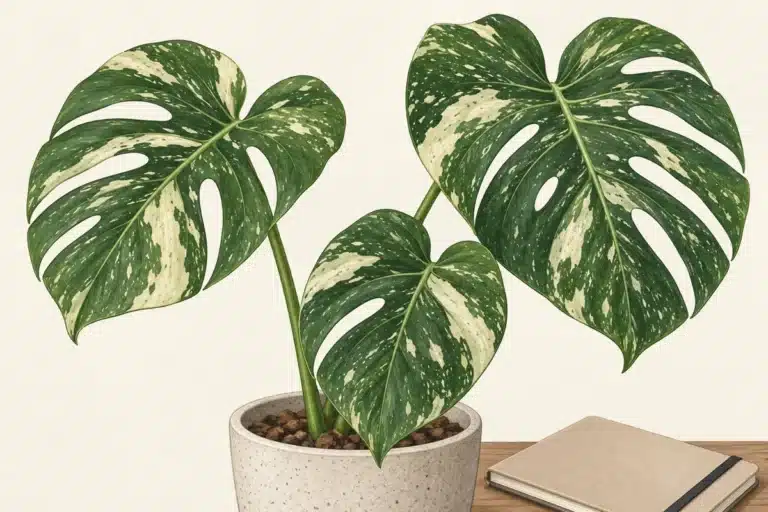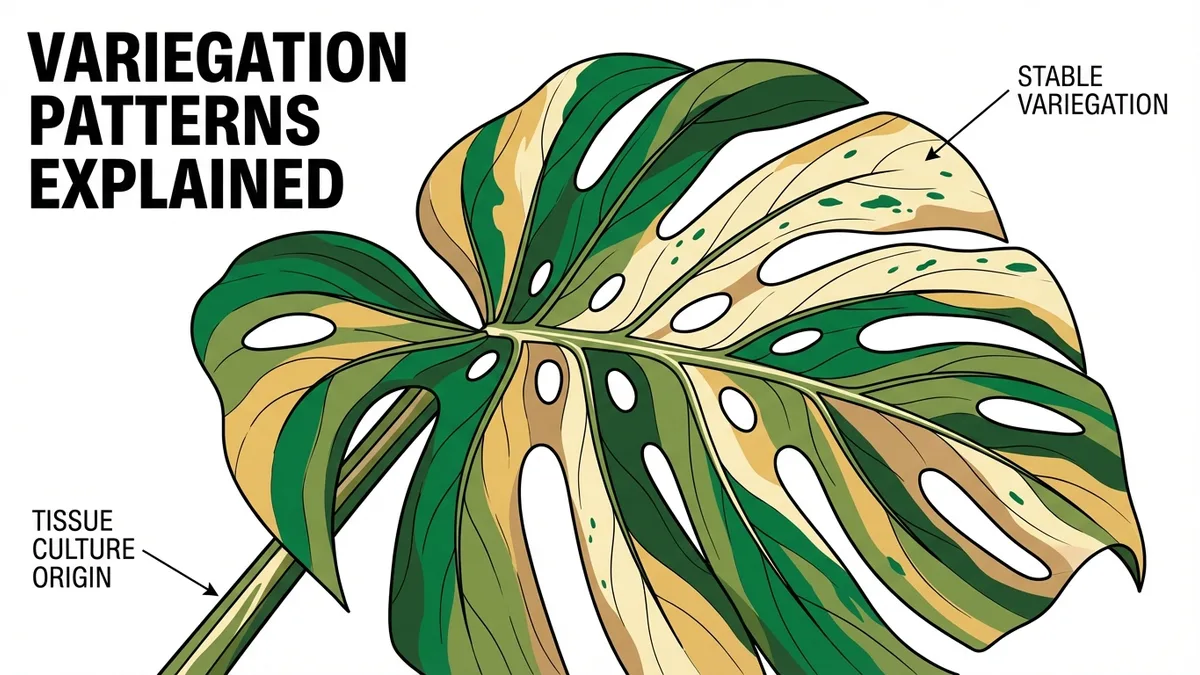
Understanding Thai Constellation Variegation Patterns
The cream-and-green patterning on a Thai Constellation Monstera is one of the most distinctive sights in the plant hobby. Unlike most variegated plants, these patterns are completely stable — they will never revert to solid green. Here is the science behind why, and what the different pattern types mean for your plant.
Quick Reference
- Variegation type: Tissue culture — stable, genetically locked
- Can it revert?: No. Every cell carries the mutation.
- Pattern variation: Yes — each new leaf will have a unique cream-to-green ratio
- Best light for variegation: 400–800 foot-candles of bright indirect light
- Why cream sectors are fragile: No chlorophyll = cannot handle intense direct sun
Why Thai Constellation Variegation Is Permanently Stable

Most variegated plants — like the Albo Monstera — rely on a phenomenon called chimeral variegation. Only one layer of cells carries the white mutation. Under the right (or wrong) conditions, the green cells can outcompete the mutated ones and the plant reverts to solid green.
Variegated plants need more light than their all-green cousins. This covers the gap in darker rooms:
Fits a standard lamp but delivers intense, full-spectrum light. Powerful enough for large floor plants in dark corners.
The Thai Constellation is fundamentally different. It was created in a laboratory in Thailand using tissue culture propagation. Scientists treated a Monstera deliciosa at the cellular level, ensuring the mutation was written into every single cell of the plant — not just one layer.
This means there is no “competition” between green and mutated cells. Every new leaf your plant produces will always show variegation. The ratio of cream to green may shift from leaf to leaf, but the trait itself is permanent.
📚 Thai Constellation vs Albo — full comparison
Want to understand all the differences between these two cultivars? Thai Constellation vs Albo Monstera — Which Should You Buy?
The 5 Variegation Patterns You Will See

Not every leaf looks the same, and that is completely normal. Here are the five pattern types you will encounter:
Heavy Green — Mostly green with small cream speckles.
The plant is getting enough energy but has fewer decorative spots. Common in low-light conditions.
Balanced (Ideal) — Roughly 50/50 cream and green sectors.
The most sought-after pattern. The plant can photosynthesize efficiently while displaying maximum variegation.
Heavy Cream — Large cream sectors covering most of the leaf.
Visually stunning but fragile. Large cream areas cannot photosynthesize, so the plant may grow slower and the white tissue is more prone to sunburn and browning.
Marble — Fine, irregular cream streaks throughout the green tissue.
Creates a marbled effect. Very stable and usually a sign of healthy, consistent genetics.
Sector — One half green, the other half cream.
A dramatic split that looks striking. Both halves function independently — the green half supports the cream half.
Thai Constellation vs Albo: The Key Difference

This is the most important distinction in the variegated Monstera world:
- Thai Constellation: Tissue culture origin. Mutation in every cell. Variegation is permanent and will never revert.
- Albo Monstera (Monstera deliciosa var. albo-variegata): Chimeral mutation in one cell layer. Can and does revert to all-green growth, especially under stress or low light.
This stability is a large part of why the Thai Constellation commands a premium price — buyers know the variegation is guaranteed.
📖 Pricing guide
Wondering what this stability is worth in the market? Thai Constellation Monstera Price Guide (2026)
How to Maximise Variegation Expression
While you cannot change the genetic program, you can influence how dramatically it expresses:
Light is the primary lever. Give the plant 400–800 foot-candles of bright indirect light. In strong indirect light, the plant produces more cream sectors. In low light, it compensates by producing more green tissue to capture available energy.
Temperature consistency matters. Sudden cold snaps or drafts cause the new leaf to harden off before it fully develops, which can result in smaller cream sectors.
Moss pole support triggers mature growth. When the plant can climb, it enters its adult growth phase — producing larger leaves where the variegation pattern is more dramatically expressed.
📚 Complete care guide
For full light, watering, and support instructions: Thai Constellation Monstera Care Guide
Recommended Thai Constellation Monstera Essentials
Each product below was hand-picked after thorough research and testing.
The cheapest upgrade you can make to any potting mix. A handful per pot dramatically improves drainage and aeration.
Check Price → (paid link)
Extendable and bendable coco coir pole that encourages aerial roots to attach. Produces larger, more mature leaves on climbing plants.
Check Price → (paid link)
Complete liquid fertilizer with all 16 essential nutrients. The 7-9-5 ratio is dialled in for lush foliage plants.
Check Price → (paid link)
Premium long-fibre sphagnum moss. Used for propagating in moss, air layering, wrapping moss poles, and orchid potting.
Check Price → (paid link)
As an Amazon Associate I earn from qualifying purchases.
Common Questions About Thai Constellation Variegation
Will my Thai Constellation revert to green?
No. Unlike the Albo Monstera, the Thai Constellation was created through tissue culture that locks the mutation into every cell. New leaves will always show variegation.
Why does each leaf have a different amount of cream?
The genetic program determines which cells become cream-coloured during each new leaf’s development. This process varies naturally from leaf to leaf — it is not a sign of a problem.
Can I make my plant produce more white/cream leaves?
You can encourage more variegation expression by providing bright indirect light (400-800 foot-candles). Low light causes the plant to produce more green tissue to compensate for reduced photosynthesis.
Are heavily cream leaves healthy?
They look stunning but are more fragile. Cream sectors have no chlorophyll and cannot photosynthesise. Very cream-heavy leaves may brown more easily from direct sun and the plant may grow slower overall.
What is the difference between Thai Constellation and Albo Monstera variegation?
Thai Constellation has stable tissue-culture variegation — it never reverts. Albo Monstera has chimeral variegation — only one cell layer carries the mutation, and the plant can revert to solid green under stress.
⬅️ Back to the full care guide