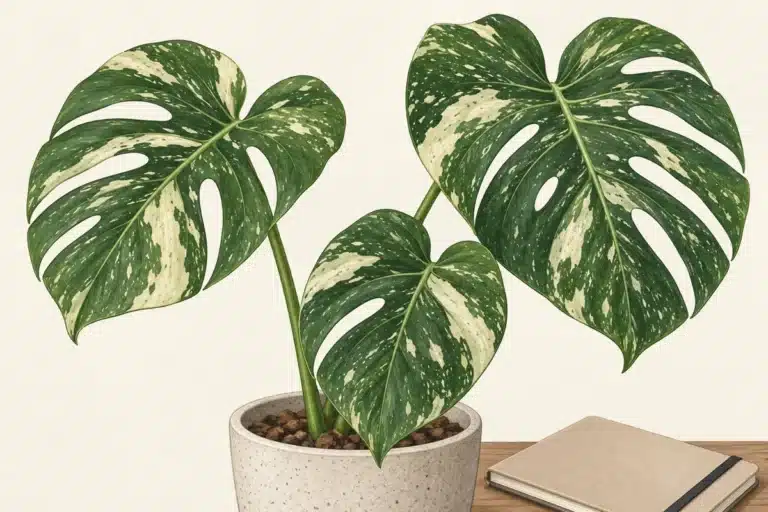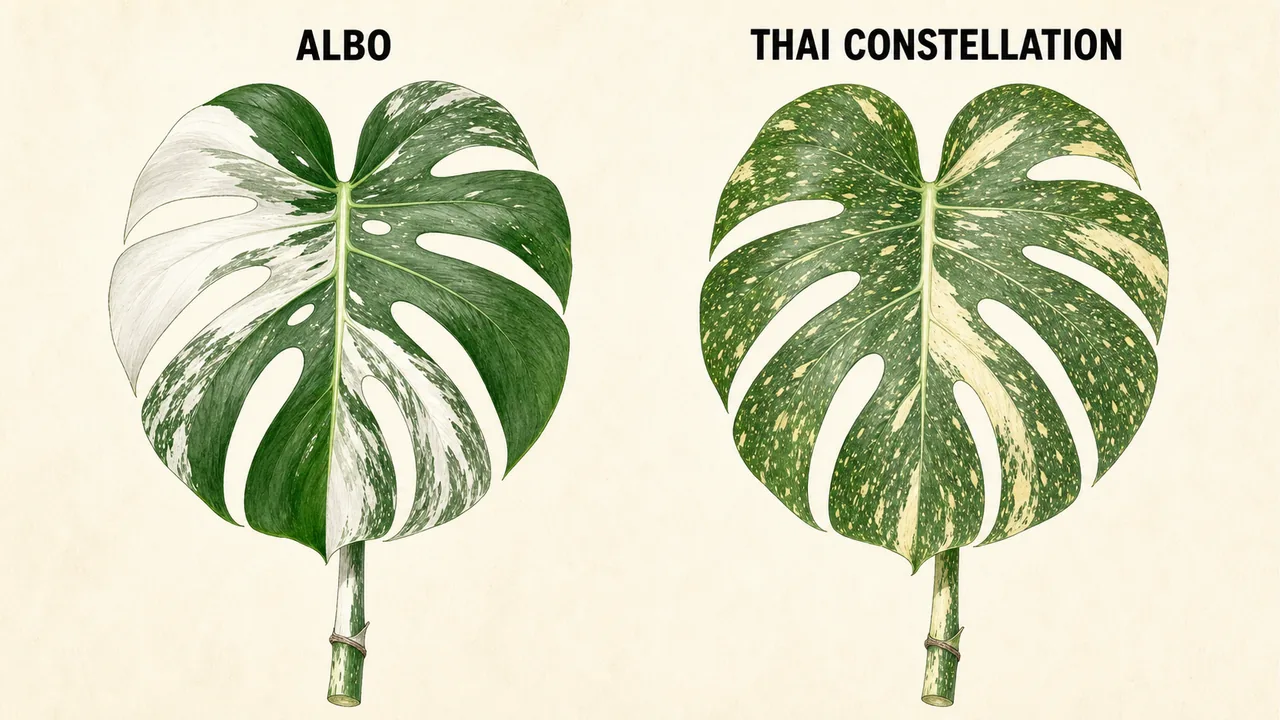
Short answer: choose Monstera Albo if you prefer sharp white sectors and accept that the pattern may need closer monitoring. Choose Thai Constellation if you prefer cream speckling and want variegation that is generally more predictable. Both are variegated forms of Monstera deliciosa, and neither is automatically healthier, easier, or worth a fixed premium.
Evidence note: cultivar names in the houseplant trade are not always supported by documented lineage or genetic testing. This guide separates published evidence from common visual buying cues and avoids promising that every future leaf or cutting will behave the same way.
Eight Key Differences
| Factor | Monstera Albo | Thai Constellation |
|---|---|---|
| 1. Main color | Usually described as white against green. | Usually cream to pale yellow against green. |
| 2. Pattern | Often sectoral, marbled, or sharply divided. | Usually fine constellation-like speckling with occasional larger cream sectors. |
| 3. Predictability | Future leaves may shift toward more green or more white, depending on the active growth point. | Published research describes the cultivar as relatively genetically stable, but the amount and placement of cream can still vary. |
| 4. Buying clues | Inspect the stem, node, growth point, roots, and seller history—not only the prettiest leaf. | Look for characteristic cream flecking, healthy roots, an active growth point, and credible labeling. |
| 5. Propagation | A viable node is required, and the stem pattern near the growth point matters when estimating future variegation. | A viable node is also required. Relative stability improves predictability but does not make every cutting visually identical. |
| 6. Light nuance | Heavily white leaves have less green tissue available for photosynthesis and can be more vulnerable to damage. | Still needs strong filtered light; cream tissue also contributes less chlorophyll than green tissue. |
| 7. Market price | No fixed rule. Region, supply, plant size, root quality, provenance, and demand change prices quickly. | |
| 8. Best fit | For buyers who prioritize dramatic white contrast and accept more variation to monitor. | For buyers who prefer cream speckling and relatively more predictable variegation. |
How to Compare the Visible Patterns
Start with color and distribution. Albo plants are usually sold for bright white sectors or marbling that can create strong blocks of contrast. Thai Constellation usually shows many smaller cream flecks spread across green tissue, creating the “constellation” effect, with some leaves also developing larger cream patches.
Then inspect the stem and node. On an Albo cutting, white or light striping near the active growth point can help a buyer assess whether the next shoot has access to both green and variegated tissue. That is still an estimate, not a guarantee. On Thai Constellation, finer cream mottling may be visible through the stem as well as the leaf.
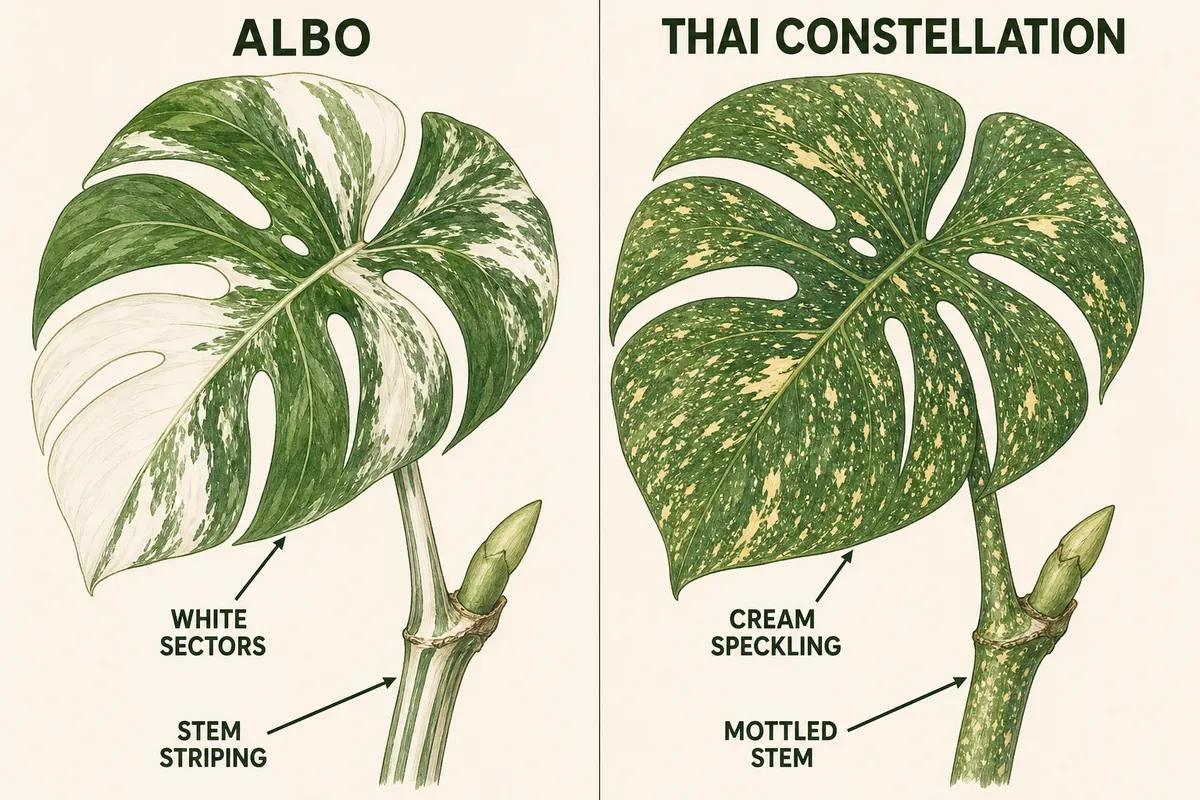
Do not identify a plant from one dramatic leaf alone. Lighting, camera exposure, juvenile growth, damage, and seller editing can distort color. A nursery label, propagation history, several leaves, and clear stem photographs provide a stronger identification than a marketplace thumbnail.
What “Stable Variegation” Actually Means
A peer-reviewed micropropagation study describes Monstera deliciosa ‘Thai Constellation’ as relatively genetically stable. That wording matters. It supports treating Thai Constellation as more predictable than a sectorally variegated Albo, but it does not justify claims that every cell, leaf, cutting, or future plant is guaranteed to display the same amount of cream.
Plant-variegation mechanisms are diverse. Research on plant chimeras shows that genetically different cell lineages in a shoot can create visible sectors, and shifts in the growing point can alter the pattern expressed in later growth. This is relevant to the way sectorally variegated Albo plants are managed, but a seller name alone does not prove the precise cellular mechanism of an individual plant.
In practical terms, watch the new growth rather than trying to control variegation with fertilizer or by moving the plant into harsh sun. If an Albo shoot produces repeated all-green leaves, growers sometimes cut back to a node with a better balance of green and light striping. That can encourage a different growth point; it cannot guarantee the next leaf.
Care Similarities and Important Nuances
Both plants are Monstera deliciosa and share the same basic container-care framework. Give them bright, filtered light, a well-drained potting mix, a container with drainage, and sturdy climbing support. North Carolina State Extension notes that variegated cultivars need more light than darker green forms, while also recommending protection from direct sun.
Light
Use the brightest position that does not bleach, scorch, or overheat the leaves. Introduce stronger light gradually, particularly after transport or winter. A heavily variegated leaf cannot photosynthesize through its white or cream areas as effectively as through green tissue, but exposing it abruptly to hot sun is not a safe shortcut.
For placement details, see the Thai Constellation light guide.
Water and roots
Water thoroughly, allow excess water to drain, and wait until the upper portion of the mix has dried before watering again. Do not follow a fixed weekly schedule. Pot size, root volume, temperature, light, and season all change drying time. Persistent wetness is more useful evidence of a root-zone problem than a single brown patch on a cream section.
Support and growth
Both are climbing vines. A stable support keeps the stem from bending and helps the plant develop more mature growth. For the complete baseline routine, use the Monstera deliciosa care guide. If a Thai Constellation already has damaged cream tissue, use the brown-spot diagnosis guide before changing several care variables at once.
Propagation and Future Variegation
Both plants can be propagated from a healthy stem cutting, but the cutting must contain a viable node. A leaf and petiole without a node may remain green for a time, but it cannot produce a new climbing shoot.
For an Albo cutting, examine the stem around the node and axillary bud. A beautiful donor leaf does not determine the pattern of the next shoot. Avoid cuttings that are rotting, freshly damaged, or almost entirely white with very little green tissue.
Thai Constellation is widely propagated through tissue culture, and the published study cited here developed a micropropagation and acclimatization protocol for the cultivar. Home growers can still propagate it by stem cutting. “Relatively stable” means the characteristic variegation is more predictable; it does not mean every propagated plant will have an identical cream percentage.
Buyer Checklist: Inspect the Whole Plant
Prices change too quickly for a permanent percentage claim. Use the current Thai Constellation price guide as one reference, then compare local sellers and the actual plant in front of you.
Which One Should You Choose?
Choose Albo if pure-white contrast is your priority and you are comfortable evaluating the stem, watching several rounds of new growth, and accepting that the balance of green and white may change.
Choose Thai Constellation if you prefer cream speckling and want variegation that is generally more predictable. It still needs careful acclimation, healthy roots, enough green tissue, and appropriate light.
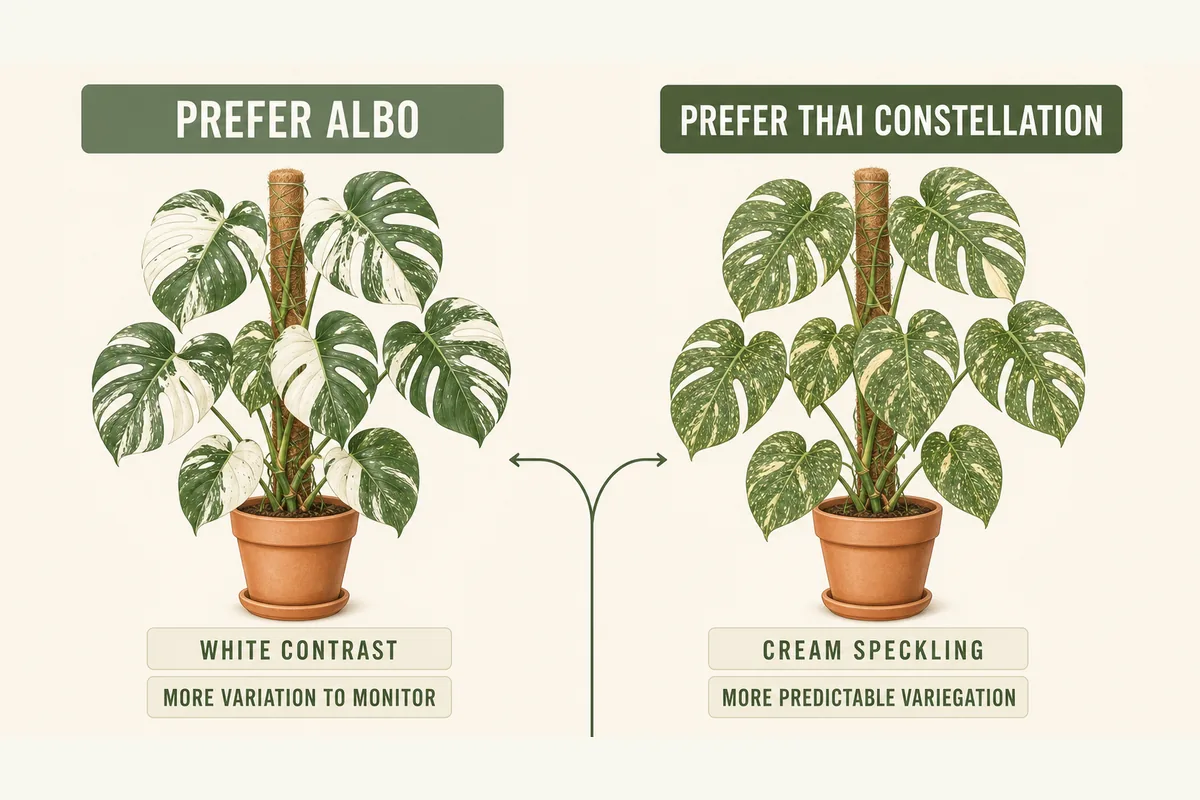
If both patterns appeal to you, buy the healthier plant from the more transparent seller. A sound root system, viable growth point, pest-free foliage, and clear provenance are better buying criteria than the whitest single leaf.
Continue with the detailed Thai Constellation care guide or learn how to interpret Thai Constellation variegation patterns.
Frequently Asked Questions
Which is easier to identify: Monstera Albo or Thai Constellation?
Thai Constellation commonly shows cream or pale-yellow speckling across green tissue. Albo is commonly sold for sharper white sectors and irregular white-green marbling. Nursery labels, seller provenance, stems, nodes, and continued growth are more reliable than one leaf photo.
Can a Thai Constellation revert to solid green?
Thai Constellation is generally treated as more stable than sectorally variegated Albo plants, and published research describes it as relatively genetically stable. That is not a guarantee that every leaf or propagated plant will show the same amount of cream.
Can both plants be propagated from cuttings?
Both can be propagated from a healthy stem cutting that includes a viable node. A leaf or petiole without a node cannot produce a new climbing shoot. Future variegation can vary, so inspect the stem and growth point rather than relying only on the donor leaf.
Does more white or cream variegation mean a healthier plant?
No. White or cream tissue contains less chlorophyll than green tissue. A plant still needs enough healthy green area, sound roots, and an active growth point. Choose overall plant health before chasing the whitest leaf.
Which plant is more expensive?
There is no dependable fixed winner. Prices change with region, supply, plant size, root quality, and current demand. Compare plants of similar size and condition, and use a current price guide rather than an old percentage claim.
Reviewed Sources
- Micropropagation and Acclimatization of Monstera deliciosa ‘Thai Constellation’ — peer-reviewed cultivar-specific propagation research.
- Plant chimeras: The good, the bad, and the ‘Bizzaria’ — peer-reviewed review of plant chimeras and sectoring.
- Chimeras and Variegation: Problems in Propagation — horticultural review of variegated chimeras and propagation.
- North Carolina Extension: Monstera deliciosa — species identification, light, watering, support, and propagation guidance.