Thai Constellation Monstera Price Guide (2026): What You Should Pay
Thai Constellation Monstera prices have stabilised significantly since the 2021–2022 rare plant boom. The market has matured, tissue culture production has scaled up, and prices are now more predictable. Here is what you should realistically expect to pay in 2026, and how to spot a fair deal.
Quick Reference
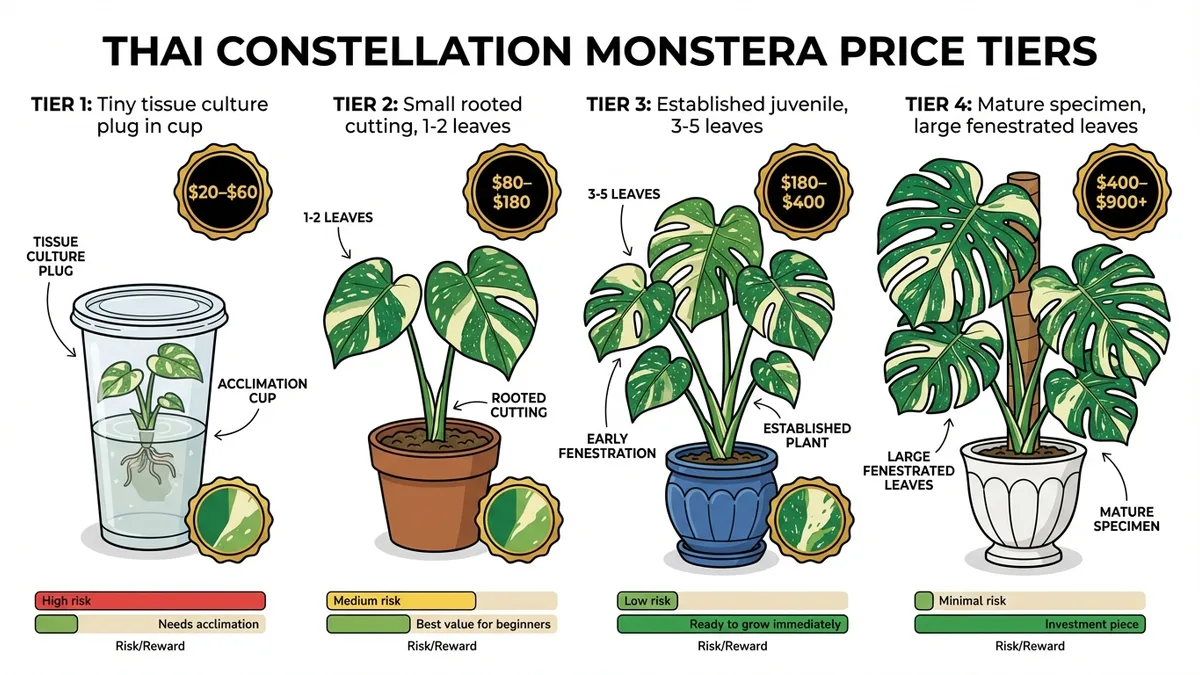
- Tissue culture plug: $20–$60 (high care requirement)
- Small rooted cutting (1–2 leaves): $80–$180
- Established juvenile (3–5 leaves): $180–$400
- Mature specimen (6+ large leaves): $400–$900+
- Price trend 2026: Stable to slightly declining as tissue culture supply increases
Looking to buy a healthy live plant online?

1-YEAR WARRANTY
Get a nursery-quality, well-rooted live Thai Constellation Monstera shipped directly to your door. Backed by a best-in-class plant warranty so you can shop with confidence.
Price Breakdown by Plant Size
Tissue Culture Plug — $20–$60
These tiny plantlets arrive in sealed cups with agar gel on the roots. They are the cheapest way to own a Thai Constellation, but they require careful acclimation over 2–3 weeks (humidity dome, gradual hardening). Mortality rate for beginners is high. Best for experienced growers.
Small Rooted Cutting (1–2 Leaves) — $80–$180
The best entry point for most buyers. The plant has survived its most vulnerable phase and has an established root system. One or two small leaves with visible variegation. Grows quickly with proper care.
Established Juvenile (3–5 Leaves) — $180–$400
The safest purchase. The plant is proven — it has produced multiple leaves with consistent variegation and is clearly adapted to growing conditions. Ready to accelerate with good care. Price varies significantly based on variegation quality.
Mature Specimen (6+ Large Leaves) — $400–$900+
Investment-grade plants. Often sold by collectors or specialist nurseries. Prices above $600 are typically for specimens with exceptional variegation balance or rare growth forms. Verify seller reputation carefully at these price points.
The 6 Factors That Drive Price Up or Down
Variegation ratio
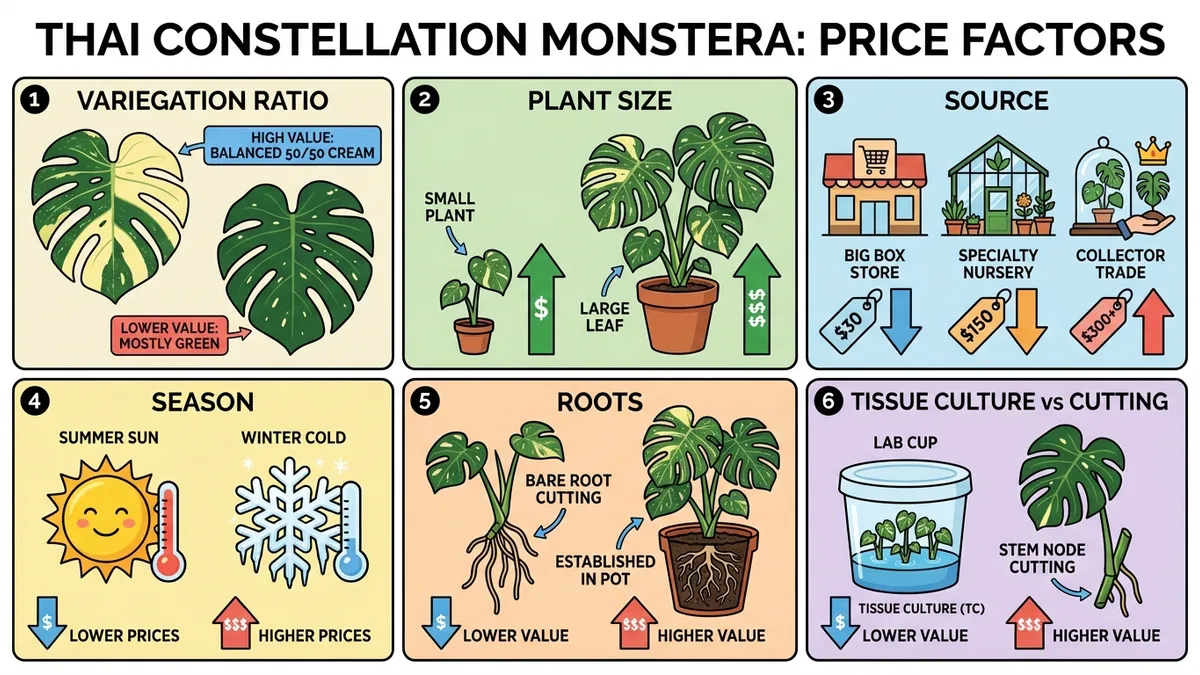
Plants with a balanced 40–60% cream ratio command a premium. Heavily green plants with only small speckles sell for less. Heavily cream plants are visually striking but actually less desirable to experienced growers due to fragility.
Source
Big box stores like Home Depot occasionally stock Thai Constellations for $30–$80, usually small tissue culture plants. Specialist nurseries and Etsy sellers charge more but often sell healthier, larger specimens. Collector trades can go either direction.
Season
Prices are typically 15–25% lower in summer when nursery stock is at its peak. In winter, fewer plants are available and prices creep up.
Whether it is rooted
An unrooted node cutting (just stem + node, no leaves) can be $20–$60 but carries risk. A rooted plant with confirmed new growth is worth the premium.
Leaf size and fenestration
Plants producing large, fenestrated leaves with strong variegation signal genetic expression and command higher prices than plants producing only small, un-split leaves.
Online vs local
Local purchases allow inspection but limit options. Online (Etsy, Facebook Plant Groups, r/RareHouseplants) offers more variety but add $15–$40 in shipping and the plant faces transit stress.
How to Spot a Good Deal (and Avoid Getting Burned)
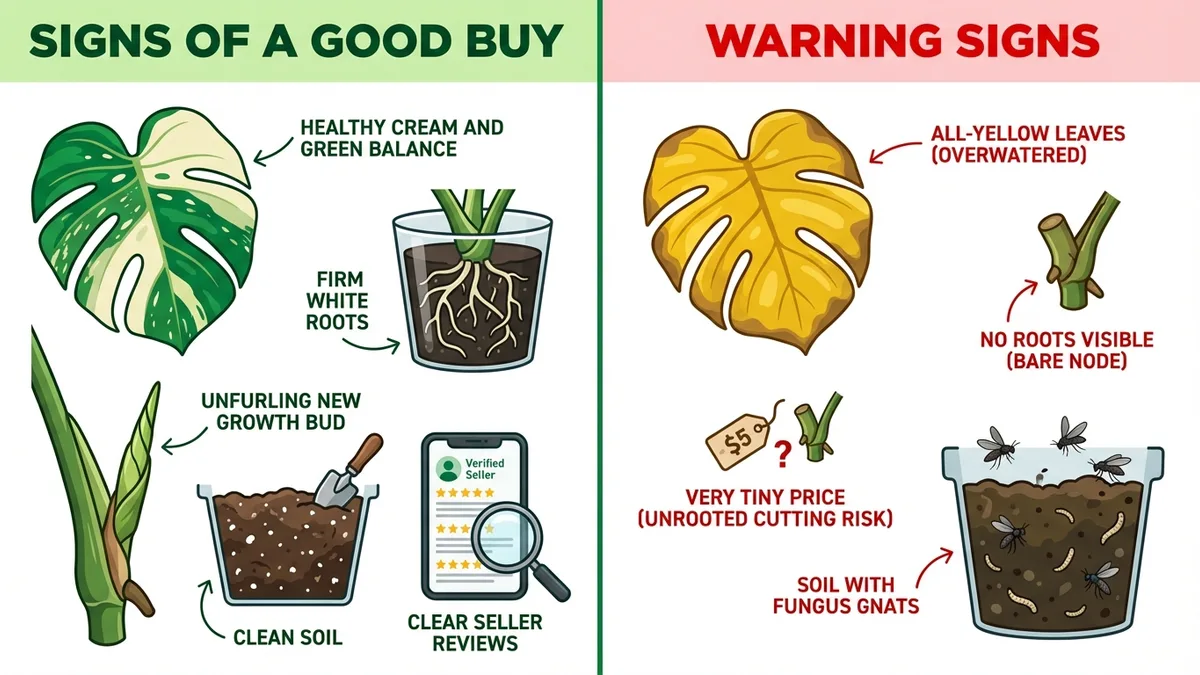
Green flags when buying:
- Seller has multiple positive reviews with plant photos
- Clear photos showing both sides of each leaf, plus the roots
- Plant shows a new unfurling leaf — proof it is actively growing
- Balanced cream-to-green ratio (not 90% cream, not 90% green)
- Roots are white/tan and visible in pot drainage holes
Red flags:
- Price far below market (tissue culture sold as “rooted plant”)
- Yellowing leaves or soft stems (overwatered or diseased)
- No root photos offered
- Seller refuses to show the actual plant being purchased
- Claims of “giant” or “monster” variegation without clear photos
Is the Thai Constellation Worth the Price?
Compared to its closest rival, the Albo Monstera, the Thai Constellation is generally the better value. The Albo typically costs 30–50% more for equivalent sizes, and its unstable chimeral variegation means it can revert to all-green — eliminating the primary reason you bought it.
The Thai Constellation’s tissue culture origin means the variegation is guaranteed permanent. Once you have an established plant growing well, you can also propagate it for free — each cutting you take is a new guaranteed-variegated plant.
📚 Thai Constellation vs Albo — full comparison
Detailed side-by-side comparison of both cultivars: Thai Constellation vs Albo Monstera — Which Should You Buy?
For plants that need 60%+ humidity, a proper humidifier beats any other method:
6L tank that runs 24–60 hours per fill. Quiet, cool-mist, and large enough to raise humidity in a whole room.
Recommended Thai Constellation Monstera Essentials
Each product below was hand-picked after thorough research and testing.
The cheapest upgrade you can make to any potting mix. A handful per pot dramatically improves drainage and aeration.
Check Price → (paid link)
Fits a standard lamp but delivers intense, full-spectrum light. Powerful enough for large floor plants in dark corners.
Check Price → (paid link)
Complete liquid fertilizer with all 16 essential nutrients. The 7-9-5 ratio is dialled in for lush foliage plants.
Check Price → (paid link)
Premium long-fibre sphagnum moss. Used for propagating in moss, air layering, wrapping moss poles, and orchid potting.
Check Price → (paid link)
As an Amazon Associate I earn from qualifying purchases.
Common Questions About Thai Constellation Prices
Why has the Thai Constellation price dropped so much?
Tissue culture production scaled up significantly after 2022. More nurseries now produce them in volume, increasing supply and normalising prices. This is good news for buyers.
Is a $30 Thai Constellation from Home Depot good value?
It can be, if you are an experienced grower comfortable with tissue culture acclimation. These plants are typically very small and require a 2-3 week humidity dome period. For beginners, paying $100-150 for an already-established plant reduces stress and risk.
What is a fair price for a Thai Constellation in 2026?
A small rooted plant with 1-2 leaves and visible variegation: $80-150. An established juvenile with 3-5 leaves: $180-350. Anything significantly above those ranges should have exceptional variegation or size to justify the premium.
Should I buy Thai Constellation or Albo Monstera?
For most buyers, Thai Constellation is the better choice — lower price, guaranteed stable variegation, and easier to propagate. Albo has more dramatic half-half leaves but costs more and can revert to green.
Can I find Thai Constellation locally?
Increasingly yes. Large garden centres, Trader Joe’s, and IKEA locations occasionally stock them. Online (Etsy, Facebook Plant Groups) has the widest selection but adds shipping cost and stress.