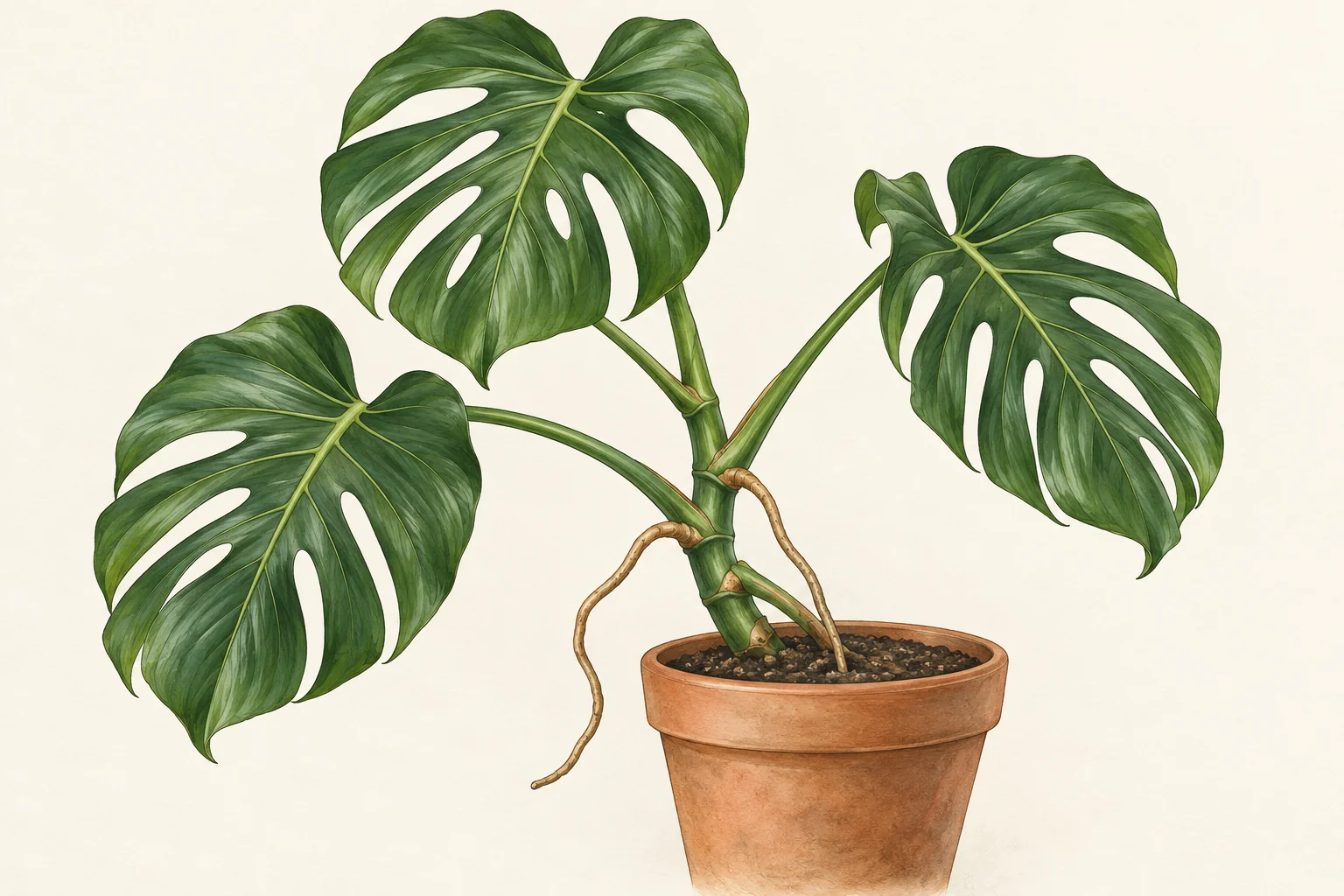
Monstera aerial roots are normal roots growing from the vine. On an established plant, leave unobtrusive roots alone, gently guide a flexible root toward reachable potting mix, and preserve roots already attached to soil or support. Trimming a loose root is an optional, limited choice—not a necessary care step. A root alone cannot make a new Monstera; propagation needs a stem node with a growth bud.
This guide covers an established, ordinary green Monstera deliciosa indoors. Start by tracing where the root begins and where it ends; that tells you more about what to do than its length or color.
Identify the aerial root before moving anything
Follow the rope-like structure back to the thick main vine. Monstera aerial roots emerge from the stem and may hang freely, grip a support, or grow down into the pot. In the wild, they attach to branches and trunks; long descending roots can root in the ground, as University of Wisconsin–Madison Extension explains.
Keep these parts separate when you inspect the plant:
- Main stem or vine: the continuous structure connecting the leaves and their attachment points.
- Petiole: the stalk connecting one leaf blade to the main stem. Trace it to the leaf rather than treating it as a root.
- Aerial root: a root extending from the main stem, with no leaf blade at its end.
- Node and axillary bud: a node is the point on the stem where a leaf develops; the axillary bud is the growth point needed for a new shoot. A root and a bud are different structures.

The distinction matters if you are thinking about cutting. University of Minnesota Extension’s propagation guide identifies the stem node and axillary bud as essential for new growth. Do not assume an unidentified nub is a bud or cut the main vine while trying to tidy a root.
Choose what to do with Monstera aerial roots
The free first step is to leave a sound, unobstructive root in place. Aerial roots are part of this species’ ordinary growth habit. Seeing them alone does not create a reason to buy a pole, add fertilizer, repot, or change watering.
| What the root is doing | Your next action | What to preserve or check |
|---|---|---|
| Hanging freely without getting in the way | Leave it alone. | Check that the vine remains stable; the root needs no cosmetic treatment. |
| Loose, flexible, and able to reach the current potting mix | Gently guide its tip toward the mix if you want a tidier route. | Keep the existing soil level. Stop if the root resists bending. |
| Already growing into potting mix | Retain that connection. | Do not pull it out merely to straighten its route. |
| Attached to a pole or other support | Keep the root and support together. | Do not peel it away for tidiness; check the whole support is stable. |
| Loose but stiff, or unable to reach the pot without force | Leave its current shape while you consider another route or a limited trim. | Do not kink it, pull on the vine, or add soil around the stem to hide it. |
A 2024 Ask Extension repotting answer advises guiding aerial roots toward soil, keeping an existing pole attached to its roots, and retaining the planting level. For a root in the current pot, apply that approach only if it can reach the mix without force.
If you guide a root, move only as far as it yields easily and leave the main stem, leaf stalks, and growing tip at their existing level. You do not need to bury the vine or fill the pot higher. If the potting mix itself needs attention, use the separate Monstera soil and drainage guide rather than repotting just to conceal aerial roots.

An existing sturdy support can give roots somewhere to attach. Penn State Extension lists several support types, so a new moss pole is not the only possible choice. Roots already entering a moist moss support should remain attached.
Decide whether an obstructing root needs a trim
A limited trim is an option for a loose aerial root that is not needed for support. Leaving it alone or gently redirecting it comes first. In a 2020 Ask Extension answer about Monstera, an Oregon Master Gardener volunteer passed along advice permitting trimming when the roots were not needed to support the plant. Treat this as limited practical guidance, not a guarantee that cutting is harmless.
Before trimming, trace the entire root: if it enters the mix, grips a support, or helps hold the vine upright, preserve it. If you cannot tell what it supports, leave it and ask your local Extension office for help.
If you choose to shorten a clearly loose root, keep the cut limited to that root and avoid the main stem, node, and leaf stalk. Use a clean, sharp tool as a basic handling precaution. The answer gives no exact cutting distance or pruning fraction, so do not use a “cut every root flush” rule. Wear gloves when handling the plant; Penn State notes the possibility of contact dermatitis.
Do not keep cutting to chase a neat appearance if the vine shifts or you discover an attachment. A soft, deteriorating root also needs the condition check below rather than an automatic cosmetic snip.
Should you put Monstera aerial roots in water?
A water jar is not needed for managing aerial roots on an established Monstera: leave unobtrusive roots alone or gently guide flexible roots toward reachable mix. Minnesota Extension supports water rooting for stem cuttings with a node and growth bud, which is a different task. This does not establish a growth benefit for an attached-root jar.
| What you have | What the evidence supports | Practical decision |
|---|---|---|
| An aerial root still attached to the established vine | It can serve attachment or soil-rooting functions. The consulted Extension guidance does not establish a need for an added water jar. | Use the leave-or-gently-guide choices above. No jar is needed to complete those actions. |
| A detached piece of aerial root without stem | It lacks the stem node and axillary bud required for a new shoot. | Do not treat it as a Monstera cutting. |
| A stem cutting containing a node and axillary bud | This is the structure used to propagate a new plant; water is one possible rooting medium. | Follow the dedicated Monstera propagation guide. |

Recheck texture, attachments, and the plant
Brown color alone does not diagnose rot in an aerial root. UConn’s Monstera disease guidance describes affected roots as brown or black and soft and mushy, alongside possible wilting and deteriorating stem tissue. That is general root-and-stem disease guidance, not a color chart for exposed aerial roots.
- A firm root, stable vine, and no other concerning change: leave the root or retain the gentle route you chose. A woody appearance alone is not a reason to cut.
- A newly strained root or shifting support: stop repositioning it. Preserve existing attachments and reassess stability before moving the plant again.
- Soft, mushy, or deteriorating root or stem tissue, especially with wilting: stop treating this as tidying. Check pot drainage and standing water, and seek an Extension assessment if the cause is unclear.
After guiding or trimming, recheck whether the vine and support remain stable and whether tissue is deteriorating. There is no need to judge success by a deadline for attachment, regrowth, or the next leaf. The useful outcome is a manageable root route that preserves the plant’s existing connections.


