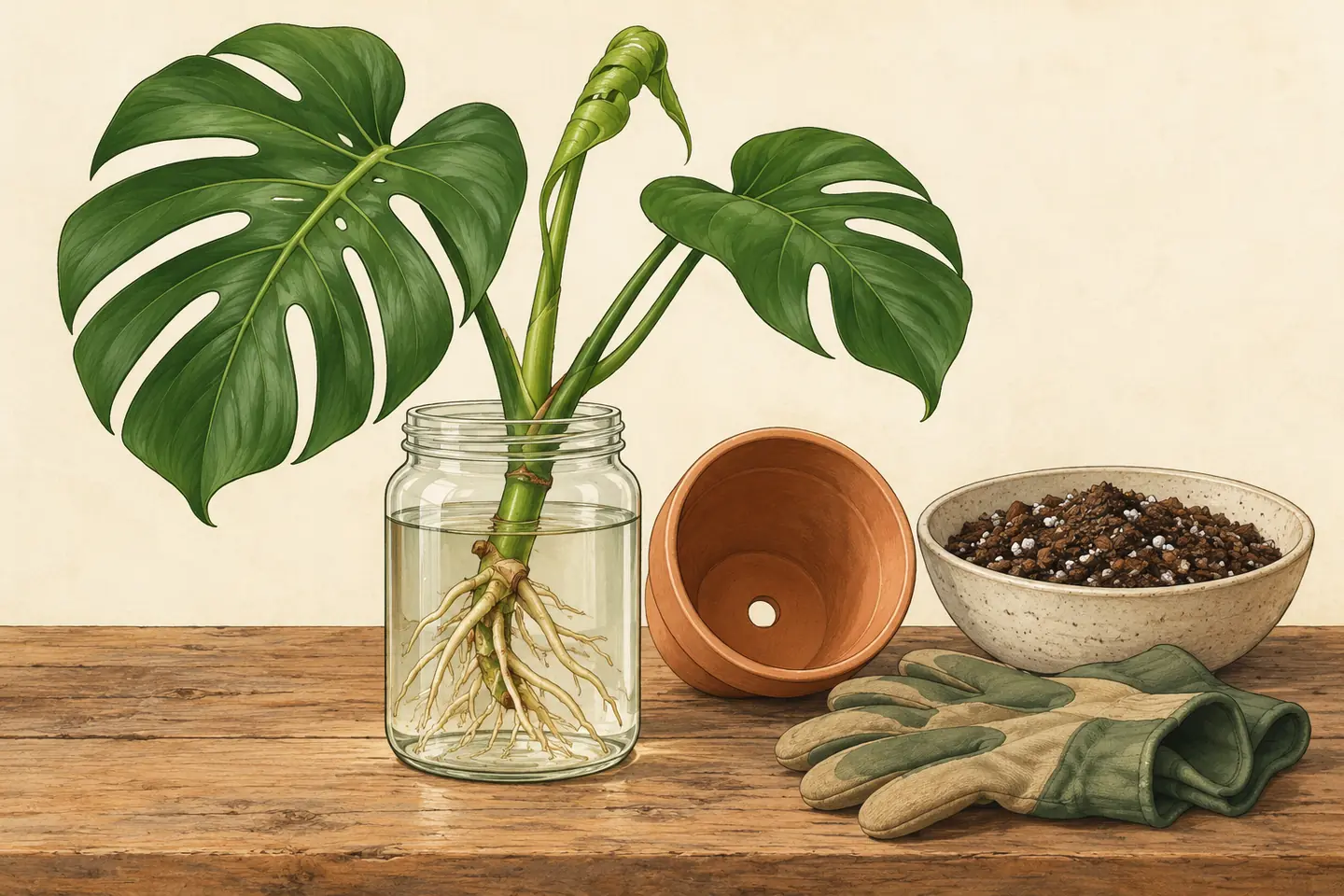
Here is how to propagate monstera: take healthy main-stem tissue from an established green Monstera deliciosa, retaining a node and living shoot or bud tissue. Root it in clean water or an airy, moist medium, then pot developed roots in a draining container. Check the cutting’s condition throughout; roots, a surviving leaf, and a new vine are different outcomes.
This guide follows a leafy stem cutting through its first pot. It does not identify your plant from leaf holes or cover every plant sold as “Monstera.” For Thai Constellation, moss setups, or rooting a stem while it remains attached, use our separate propagation guide with an attached-rooting section. Seed and leafless cane propagation are outside this workflow.
1. Check the plant and what each part will keep
Start with a healthy, actively growing plant. A struggling parent is a reason to postpone routine propagation. Wisconsin Extension describes Monstera stem cuttings year-round; Iowa State generally favors early spring through summer for houseplants. In a US home, assess available light, warmth, and plant condition rather than treating a month as permission to cut.
- Trace a leaf back to the main stem. Its stalk is the petiole. Where it joins the main stem is a node; the stem between nodes is an internode. A leaf stalk alone is not the main-stem cutting used here.
- Account for future shoot growth. A tip cutting keeps the current growing top. Stem tissue also bears axillary buds that can produce side shoots. Do not mistake an aerial-root nub for a shoot bud. In adult M. deliciosa, buds can be indistinct swollen regions rather than obvious separate bumps.
- Plan both sides of the separation. Keep the cutting’s node and growing tissue intact. Leave healthy rooted stem with living nodes and bud tissue on the mother plant; do not strip a small parent to obtain a cutting. Cutting off a top removes that growing top from the parent.
- Wait if the structure is unclear. On a compact young plant, leaf stalks can crowd the main stem. Leave it attached if you cannot identify the intended cutting and what will remain. Ask a local Extension office or an experienced grower to inspect the actual plant before cutting.
The node, petiole, and bud distinctions follow Oregon State’s general plant anatomy. The indistinct-bud description comes from Madison’s Monstera monograph, page 94, describing adult stems. Neither a brown bump nor firm tissue alone confirms that a particular cutting can grow.
Illinois Extension lists M. deliciosa for stem propagation and distinguishes rooting from producing new stems and leaves. For this home method, choose main-stem tissue with an intact node and living growing tissue. A leaf with its petiole, or an aerial root by itself, is not an adequate substitute. This is a practical material-selection rule, not a claim that detached leaf tissue can never form roots.
Handle cuttings and scraps carefully. Wear gloves and avoid sap contact; NC State notes that the sap can irritate skin. Keep the plant, jar, and discarded pieces away from children and pets. ASPCA lists M. deliciosa as toxic to cats and dogs. After suspected pet chewing or ingestion, contact your veterinarian or ASPCA Poison Control promptly, without waiting for symptoms.
2. Prepare a rooting setup before making the cut
Use a suitable clean, sharp blade you already own, gloves, and a clean container. The tool must cut the actual stem without crushing it; a tiny pair of snips need not suit a thick vine. For water, test whether your existing jar can support the cutting and let you remove it without forcing the stem or attached aerial root through the opening. For solid medium, use a container with drainage.
| Route | Useful feature | Your ongoing job |
|---|---|---|
| Water | You can see developing roots without lifting the cutting. | Keep rooting tissue and developing roots covered, foliage out, and water fresh. Plan a later move into potting mix. |
| Airy rooting medium | Supports the cutting and avoids a later water-to-medium change. | Keep the medium evenly moist with air and free drainage. Roots are harder to observe. |
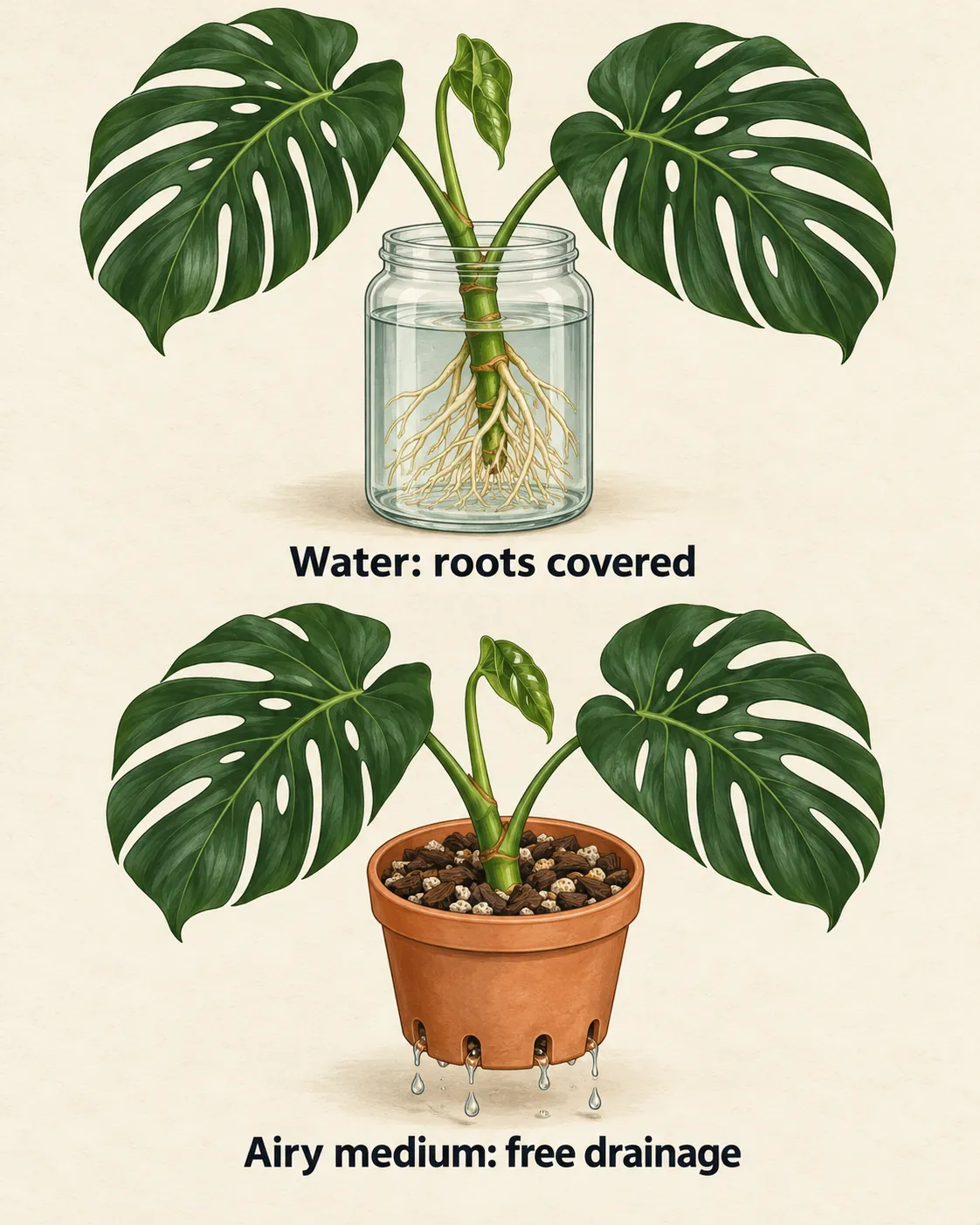
Iowa State’s stem-cutting guide, which includes M. deliciosa, explains these general houseplant tradeoffs. It warns that plain potting soil may provide too little aeration for rooting; combinations such as perlite and peat are examples, not a mandatory Monstera recipe. Moisten solid medium before use and let excess water drain.
You do not need to buy rooting hormone to follow this workflow. Maryland Extension’s Monstera case response says hormone is not essential for many houseplants, including aroids. That response does not establish a Monstera-specific protocol or product success rate. General hormone guidance cannot tell you that a particular powder belongs in a water jar.
3. Take the stem cutting and maintain its conditions
- Recheck your separation point. Cut through the main-stem internode below the node retained on the cutting, preserving the node and growing tissue. The rooted mother keeps its own healthy node and bud region below the separation. Do not cut through either region to meet a fixed inch measurement. If there is no clear space to separate them, stop.
- Place it promptly. In water, put the rooting node region and any developing roots in water with leaves above it. Keep an attached aerial root if it fits without damage. In solid medium, make a hole first, insert the cutting with a node in the moist medium, leave foliage above the surface, then settle the medium gently around it. Support a top-heavy cutting without crushing the stem.
- Provide steady warmth and bright indirect light. Keep the setup out of direct sun. Iowa State gives 65–75°F (18–24°C) as general cutting-room guidance, not a measured Monstera optimum. If using a clear bag to retain humidity, support it away from leaves, leave air exchange, and keep it out of direct sun.
- Check the setup, not just the calendar. For water, top up before developing roots become exposed and replace water regularly. Iowa State suggests once or twice weekly for houseplant cuttings; cloudy water calls for a fresh-water and clean-container check sooner. For solid medium, check moisture, moisten when drying, and let excess drain. Do not add water to an already wet pot.
Wisconsin’s species guidance supports stem-tip cutting below an aerial root. Protecting both retained growth regions applies general node and pruning anatomy; it is not a guarantee of mother-plant branching. Placement, humidity, temperature, and maintenance above draw on Iowa State’s general stem-cutting procedure. For room placement context, see Monstera light requirements; that established-plant guide is not a rooting-light dose.
Expect a process measured in weeks, with variation. Iowa State’s general estimate is 3–6 weeks for houseplant stem cuttings; it is not a Monstera deadline. A new root shows rooting activity. An old leaf staying green shows that leaf is surviving. A new shoot is a separate observation. Record those separately, and check the mother plant’s remaining stem for progressive softening rather than expecting a new branch by a set date.
4. Move developed roots into the first pot
Assess roots and stem before potting. Iowa State suggests transplanting water cuttings when roots are about 1 inch (2.5 cm) long; RHS’s Monstera guidance asks for a good set of roots. These are general and genus-level cues, not a compulsory Monstera root-length window. Do not pot a deteriorating stem simply because one root reaches a measurement. Longer roots do not by themselves mean the opportunity has passed.
The sequence below adapts Missouri Botanical Garden’s general water-cutting potting procedure, illustrated with begonia. It supplies handling steps, not a Monstera experiment.

- Prepare the mix while the roots remain in water. Moisten an airy container mix evenly in a separate container. It should be moist, not soggy. If choosing a mix is the remaining problem, use our Monstera soil-choice guide; its example recipe is not required here.
- Fit the pot to the roots you actually have. Choose a clean pot with drainage holes and just enough room for the root system. Check that the roots fit without forcing them; do not choose a large future pot from the size of the leaf.
- Set the cutting and fill around the roots. Add base mix, gently position the roots, and fill the spaces with premoistened mix. Keep leaves above the surface and leave room below the rim for watering. Gently settle the mix into contact with the roots rather than packing it hard.
- Check stability. Support the cutting if the leaf makes it tip or rock. Use suitable support already available; burying extra stem deeply is not a substitute for support.
- Water through, then drain. Water until the mix is moistened throughout and water exits the holes. Let excess drain and empty the saucer or decorative outer pot. Check that the cutting remains upright and the roots are covered after settling.
- Return it to bright indirect light and reassess. Keep the mix moist with drainage while the new plant establishes. Water-grown roots can show stress after transfer. At the next check, assess moisture and tissue condition before deciding to add water.
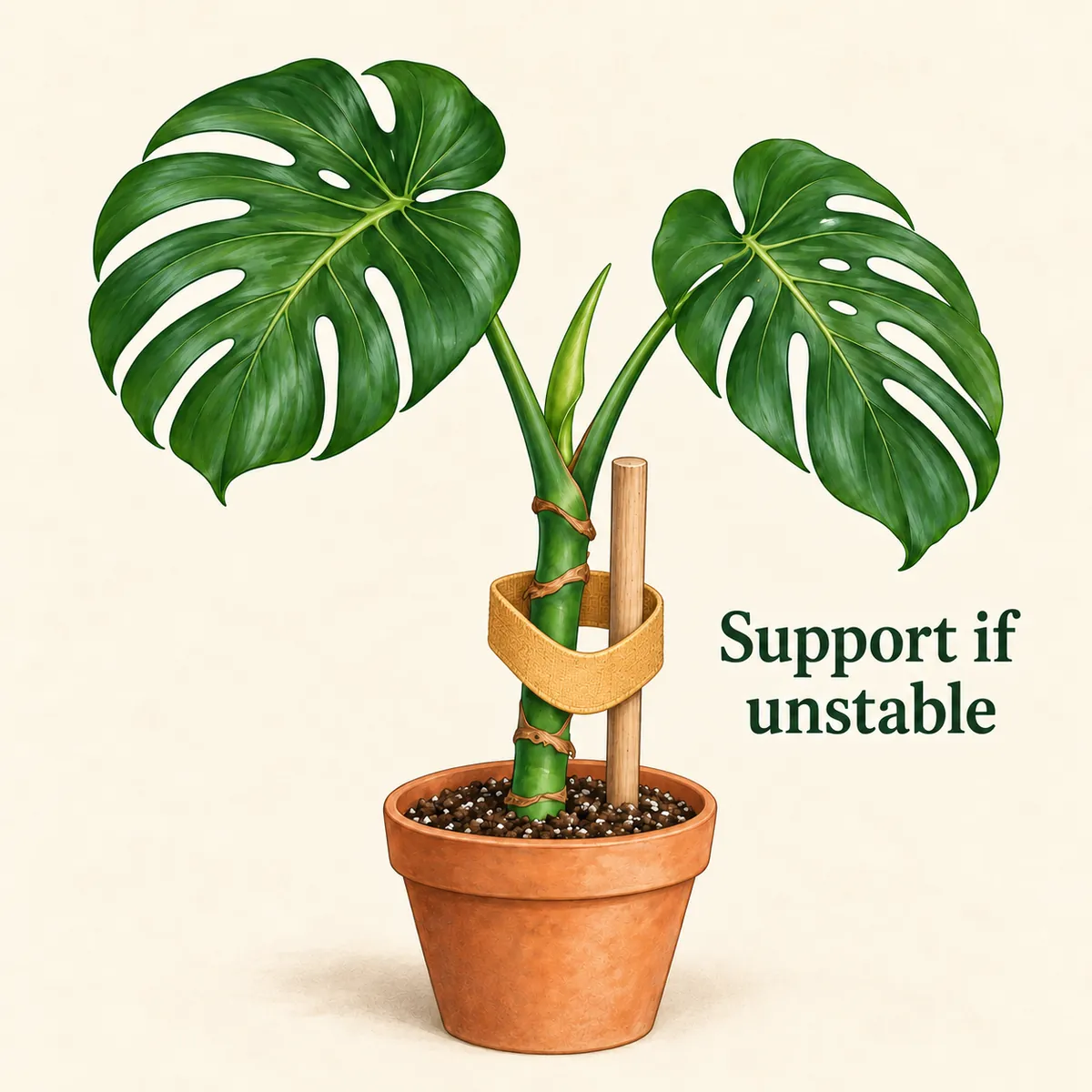
A cutting rooted in solid medium also needs developed roots before a move. Do not repeatedly pull it up to look for progress. If it is already in an appropriate draining first pot, it does not need another transfer just to match the water route. Follow its moisture and growth instead. Established-plant repotting is a later task: our repotting Monstera guide begins after this newly rooted stage.
At the next check: water, maintain, or investigate?
| What you observe | What to do now | What to check next |
|---|---|---|
| Mix is still moist; stem remains firm; no progressive decline | Maintain indirect light and support. Do not add water merely because no leaf has appeared. | Whether the mix is beginning to dry and whether stem or leaf condition is changing. |
| Mix around the roots is drying | Moisten it and let excess drain. Keep water out of the saucer or outer cover. | That moisture reached the mix and excess escaped, rather than pooling below the pot. |
| Mix stays wet, water pools, or wilt is worsening | Investigate drainage and the cutting’s condition before watering again. Empty standing water and check that holes are open. | Whether wetness persists or soft tissue develops; use the deterioration decision below. |
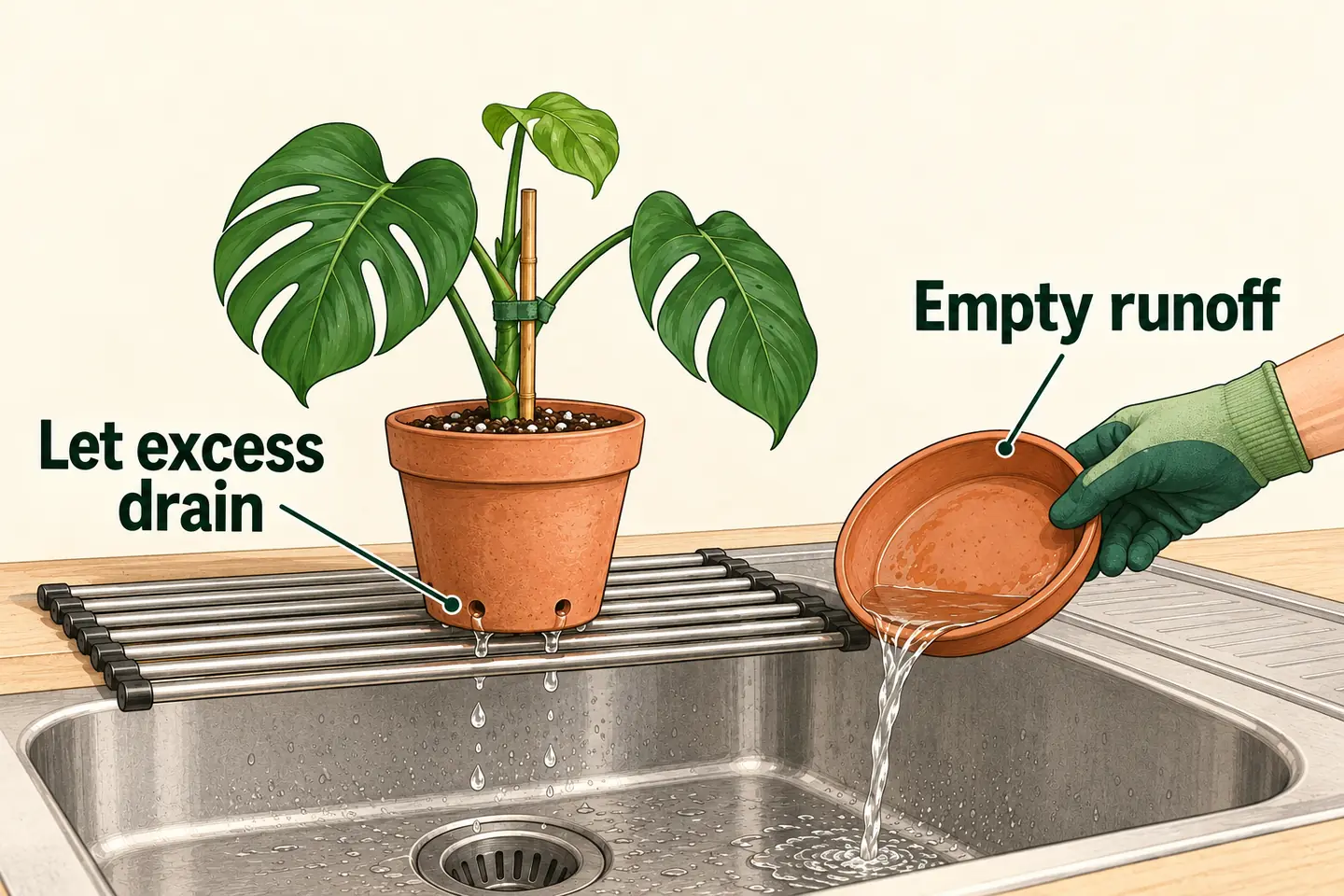
This moisture-and-drainage check combines Illinois’s moist-but-not-soggy cutting guidance with Missouri Botanical Garden’s potting steps. Iowa State notes possible wilt and leaf loss after water-to-soil transfer. Slowdown can occur, but worsening collapse should not be dismissed as adjustment. Avoid both a fixed “extra-wet fortnight” and the dryback routine for a mature plant. Use our established Monstera watering guide only after the new plant has established.
5. Investigate deterioration before making another cut
Soft, mushy tissue and spreading deterioration deserve attention. Brown color alone does not identify rot: an existing firm aerial root is different from a collapsing stem end. Maryland Extension’s general indoor disease guidance supports separating affected plants, checking excess moisture, and taking replacement stem cuttings only from healthy tissue. It does not identify a pathogen from your cutting’s color.
| Condition | Decision and action | Next observation |
|---|---|---|
| Stem is firm; roots or shoot are slow; no spreading soft area | Maintain and check conditions. Verify water level or medium moisture, drainage, and light. Firmness is encouraging but does not prove bud viability or future success. | Record whether roots extend, a shoot develops, or tissue starts to soften. Do not keep recutting a stable piece to make it grow. |
| Cloudy water, or wet medium without obvious softening | Correct the setup and inspect. Replace the water and clean the container, or check drainage and stop adding water to wet medium. Check the actual stem and visible roots. | Whether water clarity or moisture improves and tissue remains firm; deterioration calls for the next branch. |
| Softening or collapse is spreading | Separate and assess. Keep the affected cutting apart from healthy material. Before any recut, establish whether healthy main stem with an intact node and living growing tissue can remain. | The boundary and extent of deterioration, including whether usable growth tissue remains. A cleaner setup alone is not proof of recovery. |
| You cannot judge what healthy growth tissue would survive a recut | Stop cutting and get actual-plant help. Ask Extension or an experienced grower to inspect it. Uncertainty is not proof that the cutting is dead. | A supported assessment before a destructive cut; do not trim away the only possible growing region. |
| Healthy stem and intact growing tissue clearly can remain | Consider a new cutting attempt. Cut only from healthy tissue, retaining the required node and growing region. Use clean tools and a clean container; this does not establish a cure. | Watch for renewed deterioration as well as roots and shoots. No recut guarantees rescue. |
| Severe deterioration leaves no usable healthy growth tissue | Discard and restart. Discard the unusable material and begin with healthy stock rather than repeatedly trimming a piece that cannot retain its growing region. | Recheck the replacement material and rooting setup before starting; the failed piece is not evidence that every cutting will fail. |

The stop decision applies the anatomy check in step 1 to Maryland’s healthy-tissue rule. It is not a disease-treatment protocol. There is no supported one-hour drying cure in the consulted guidance. A fresh cut, rooting powder, or green leaf cannot replace lost growing tissue.
Common questions about how to propagate monstera
Where do I cut a Monstera for propagation?
Cut through the main stem between nodes, below the node retained on your cutting. Preserve its node and living growing tissue, and leave usable growth tissue on the rooted mother. If crowded leaf stalks hide those structures, leave the plant attached and get help rather than following a fixed cutting distance.
Is it better to propagate Monstera in water or soil?
Neither water nor airy rooting medium is universally better for Monstera: water lets you observe roots, but the cutting later has to adjust to potting mix. Airy medium supports the cutting and avoids the water-to-medium transition, while requiring moisture and drainage checks. Choose the route you can maintain; plain dense soil is not equivalent.
Are monsteras easy to propagate?
Monstera can be propagated by stem cuttings, but suitable material and consistent care matter more than an “easy” label. Start with a healthy plant and main-stem tissue retaining a node and living shoot or bud tissue. Maintain a stable rooting setup and monitor moisture and tissue condition; no method guarantees success or a deadline.
What happens to Monstera after cutting?
Taking a tip cutting removes the mother plant’s current growing top; a stem section needs living bud tissue to produce a new shoot. Leave healthy rooted stem with living nodes and buds on the mother plant. Keep it supported and check for deterioration; further growth is possible, but branching and its timing are not guaranteed.
Can I propagate Monstera from a leaf without a node?
A leaf with its petiole is not a suitable substitute for a main-stem cutting with a node and living shoot tissue. Root formation and a new vine are separate outcomes. Even if detached material stays green or forms roots, that does not establish that it can produce a new Monstera vine.
How long does a Monstera cutting take to root?
Allow weeks rather than a fixed deadline for a Monstera cutting to root: Iowa State’s general houseplant stem-cutting estimate is 3–6 weeks, not a Monstera-specific promise. Check warmth, light, moisture, and tissue condition while waiting. New roots and a new leaf are separate milestones; no leaf yet does not, by itself, mean failure.
These steps and decision tables combine species guidance with clearly identified general propagation advice. They are editorial decision aids, not personal trials, measured success claims, or a diagnosis of an individual plant.
Sources and their scope
- Wisconsin Extension: Monstera deliciosa — species-level stem-cutting and seasonal guidance.
- Iowa State Extension: houseplant stem-tip cuttings — general rooting media, maintenance, and transfer guidance; its inch and week estimates are not Monstera-specific measurements.
- Missouri Botanical Garden: rooting cuttings in water — the general first-potting sequence, illustrated with begonia. Other claim-specific references remain beside the relevant instructions above.


