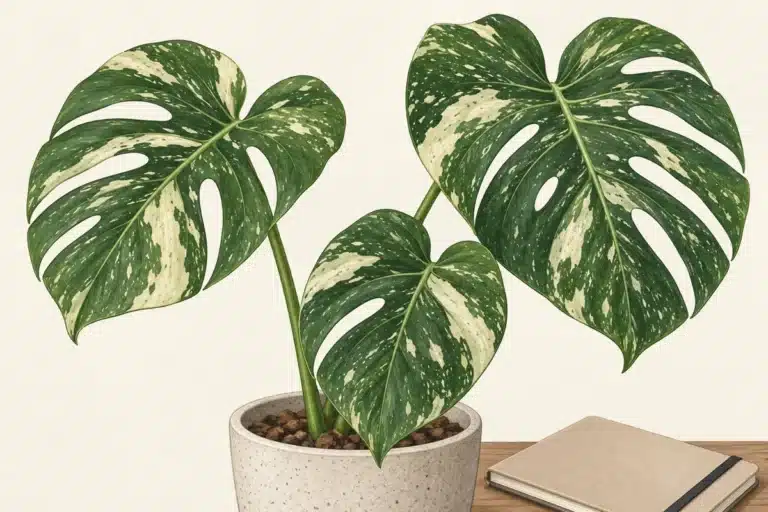
Monstera leaves usually do not split because the plant is juvenile, the light is too weak, the vine lacks climbing support, or overall growth is not strong enough. Old leaves will not split later, so judge the next new leaves. If the newest leaves are getting larger and showing more cuts, you are on the right track.
Fenestration is not a quick repair. It is a growth response. A monstera has to be mature enough, bright enough, rooted well enough, and supported well enough to make the larger adult-style leaves people expect from Monstera deliciosa.
| What you see | Most likely cause | Best first fix |
|---|---|---|
| Small, heart-shaped leaves with no splits | The plant is still juvenile | Keep it growing strongly and wait for new leaves |
| Long stems, wide gaps between leaves, small new growth | Light is too weak | Move closer to a bright window or add a grow light |
| Vine flopping sideways with leaves staying modest | No real climbing support | Tie the stem to a moss pole, plank, or sturdy support |
| Older leaves are solid but newer leaves have cuts | Normal development | Do not expect old leaves to change |
| New leaves are smaller than the last ones | Watering, roots, light, or stress issue | Check soil moisture, roots, pot size, and light |
| Pale growth, weak stems, slow growth in winter | Low energy or poor timing for feeding | Improve light first, then feed lightly in active growth |
The goal is not to force holes into existing leaves. The goal is to help the plant produce larger, more mature new leaves. That means the useful question is: “Are the next leaves increasing in size and complexity?”
Use the six checks below in order. They start with free fixes because most non-splitting monstera problems are caused by maturity, light, and support before fertilizer or accessories matter.
Looking to buy a healthy live plant online?

1-YEAR WARRANTY
Get a nursery-quality, well-rooted live Swiss Cheese Plant shipped directly to your door. Backed by a best-in-class plant warranty so you can shop with confidence.
1. Check Whether the Plant Is Mature Enough
A young monstera commonly produces solid leaves. This is normal, not a sign that the plant is broken. Juvenile leaves are often small, smooth-edged, and heart-shaped. As the plant matures and the vine gains strength, new leaves can start showing side splits and later interior holes.
NC State Extension describes Monstera deliciosa as a climbing evergreen with large, perforated leaves when mature. The key word is mature. A small starter plant, recent cutting, or freshly rooted propagation may need time before it has enough stored energy to make fenestrated leaves.
If your monstera came from a small nursery pot, it may simply be too young. Many small plants sold as “monstera” are still in their juvenile phase. They can look healthy and still produce only solid leaves for a while.
Look at the pattern of new growth rather than the age on the label. A plant that is producing larger leaves every few months is progressing. A plant that keeps making the same small leaves may need better conditions before maturity shows.
Leaf size matters because fenestration is tied to adult growth. A leaf that is only 4 inches wide is less likely to show dramatic cuts than a leaf that is 12 inches wide. Some young plants may make one or two shallow splits before producing the deeply cut leaves seen on mature specimens.
Cuttings can also reset expectations. A cutting taken from a mature vine may sometimes produce mature-looking leaves sooner, but it still has to rebuild roots and momentum. A small single-node cutting should not be judged the same way as a large established floor plant.
If you recently propagated your plant, give it time to root and climb. The University of Minnesota Extension notes that monstera is commonly propagated from stem cuttings with nodes. Those new roots need to support active growth before you should expect large leaves.
For propagation timing and node basics, see our guide on how to propagate monstera. A cutting with a node can grow a new vine, but fenestrated leaves still depend on maturity and growing conditions.
Variegated plants can be slower. A Thai Constellation monstera has less green tissue in the variegated parts, so it may grow more slowly than a fully green plant in the same spot. If that is your plant, see our Thai Constellation monstera care guide for light and growth notes.
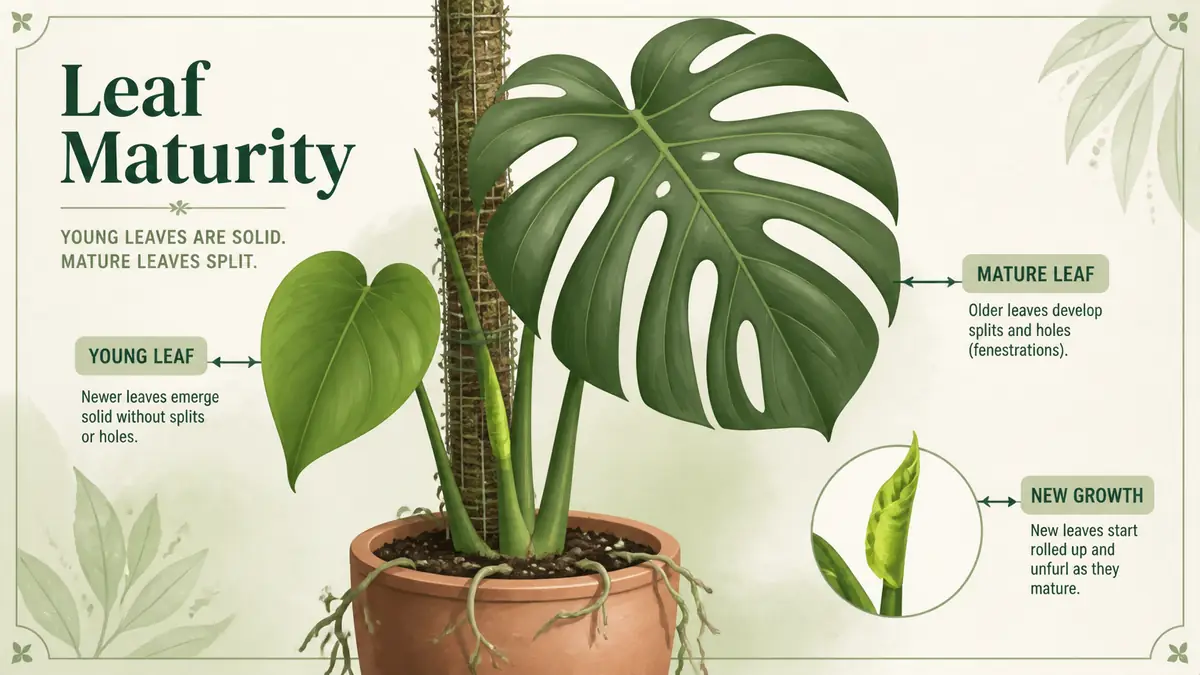
What maturity looks like in practice
- New leaves are gradually larger than older leaves.
- The stem is thickening rather than stretching thinly.
- Aerial roots are appearing along the vine.
- The plant is producing leaves during the growing season without long stalls.
- Some newer leaves may show shallow side cuts before interior holes appear.
If your plant is small but healthy, the fix is patience plus better growth conditions. Do not prune off every solid leaf in frustration. Those leaves are still feeding the plant and helping it reach the size needed for future fenestration.
2. Move It Into Brighter Indirect Light
Weak light is one of the most common reasons monstera leaves stay small and solid. A plant can survive in low light for a long time, but survival growth is not the same as strong adult growth. Fenestrated leaves require energy, and energy starts with light.
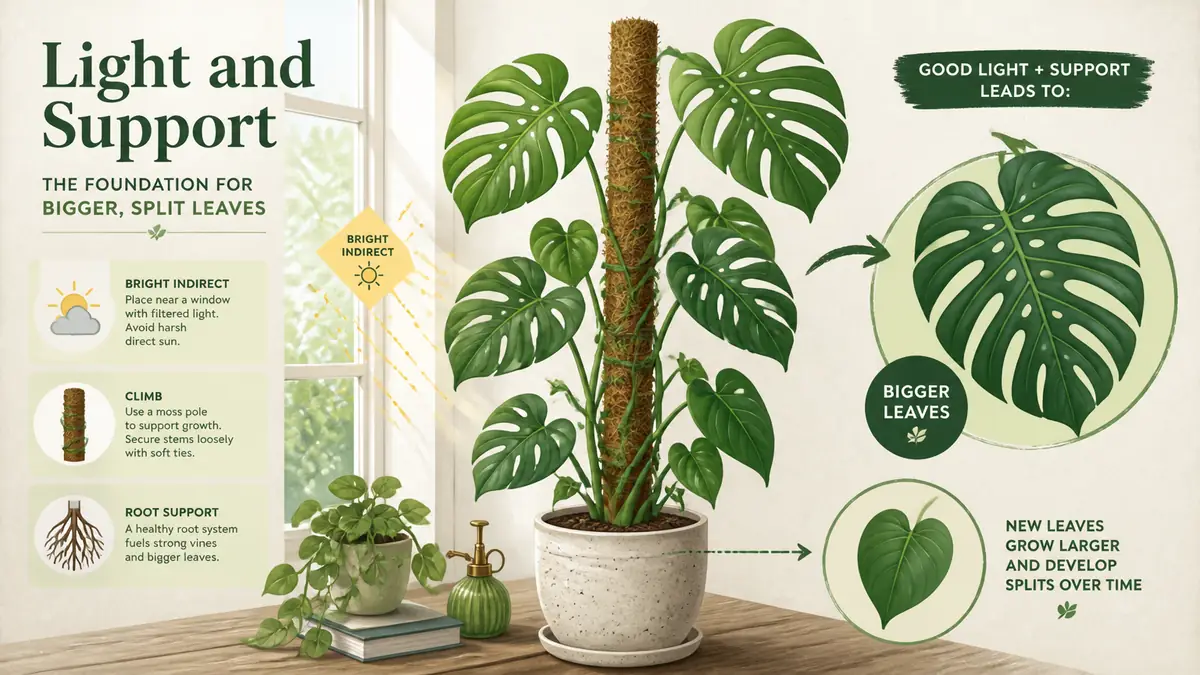
Bright indirect light means the plant is close enough to a window to see strong daylight, but not sitting in harsh midday sun that scorches the leaves. An east-facing window, a bright north window, or a spot a few feet from a south or west window can work, depending on your home.
If your monstera is 8 to 12 feet from a window, it may be in decorative light rather than growth light. Human eyes adjust well indoors, so a room can look bright to us while being dim for a tropical vine.
Signs of too little light include long spaces between leaves, small new leaves, thin petioles, leaning toward the window, and slow soil drying. The plant may look green but unproductive. It may also produce leaves that unfurl smaller than the previous leaf.
Move the plant gradually if it has been in a dim corner. Start by placing it closer to the window for a week or two. Watch for bleached patches, crisp tan spots, or sudden yellowing on leaves exposed to direct sun. Those symptoms mean the transition was too intense.
Do not confuse “no direct sun” with “shade.” Indoors, most monsteras appreciate more light than people expect. A few gentle hours of morning sun can be fine for many plants if they are acclimated, but hot afternoon sun through glass can burn leaves.
If your home lacks a bright window, a grow light can help. Place the light above or slightly in front of the plant so new growth does not lean sideways. The exact distance depends on the bulb strength, but many household grow bulbs work best around 12 to 24 inches from the upper leaves.
Run supplemental light for a consistent schedule, often 10 to 12 hours per day. More is not always better. Plants also need a dark period, and light that is too close can stress leaves.
Brighter light will not change existing solid leaves. It should improve the size and fenestration potential of future leaves once the plant adjusts. Expect to evaluate the next two or three leaves, not tomorrow morning.
Penn State Extension describes monstera as a tropical houseplant that needs bright, indirect light indoors. That matches what most growers see: the best fenestration usually appears when the plant is bright, warm, and actively growing.
Fast light test
- Can the plant see a window from where it sits?
- Does a hand held above the leaf cast a soft but clear shadow at midday?
- Is the newest leaf at least as large as the previous leaf?
- Does the soil dry within a reasonable period rather than staying wet for weeks?
- Is the plant growing toward the light source?
If most answers are no, improve light before buying fertilizer or changing the pot. Low light limits what every other fix can do.
3. Give the Vine a Real Climbing Support
Monstera is not naturally a compact tabletop plant. It is a climbing vine that uses aerial roots to attach to trees and climb upward. Indoors, when the vine has nothing to climb, it often sprawls sideways and produces smaller, less mature growth.
A support does not magically create fenestration, but it helps the plant grow in the form it is built for. Upward growth, steady light, and a stable stem can encourage larger new leaves over time.
Good support options include a moss pole, coco coir pole, wood plank, cedar board, trellis, or sturdy stake system. The support needs to be tall enough and strong enough to hold the main stem as it grows. A tiny decorative stake may not do much for a heavy vine.
Attach the stem, not the leaf petioles. Petioles need to move and orient leaves toward light. Tie the main vine loosely with soft plant ties, jute, Velcro-style plant tape, or cotton string. Do not cinch tightly around the stem.
Place the support behind the main stem and guide aerial roots toward it. If using a moss pole, keeping it lightly moist can encourage roots to grip, but do not soak the pot just to wet the pole. Wet support should not create constantly soggy soil.
A wood plank can work surprisingly well. In nature, monstera climbs tree trunks, not decorative poles. A rough plank gives aerial roots a surface to explore. It is also sturdy for large plants.
If your plant is already leaning or crawling out of the pot, repotting and staking at the same time may be easier. Set the support deep enough to stay stable. Then position the main stem against it and tie in several places.
For a related climbing setup, see our pothos moss pole guide. Pothos and monstera are different plants, but the support principles are similar: attach the vine, give it a vertical path, and keep expectations tied to new growth.
Support is especially important once the plant is making larger leaves. Heavy foliage can twist the stem, pull roots loose, or make the plant flop toward the floor. A stable support helps the plant keep growing upward instead of spending energy recovering from stress.
Some links are affiliate links. As an Amazon Associate I earn from qualifying purchases at no extra cost to you.
Useful only after light is improved; support helps a climbing monstera size up new leaves.
Useful when the plant is too far from a bright window to make bigger mature leaves.
How to tie a monstera to a pole
- Identify the main vine. This is the thick stem that leaves and aerial roots grow from.
- Place the support behind that stem, not in the middle of the leaf fan.
- Use soft ties around the stem and support.
- Leave petioles free so leaves can face the light.
- Adjust ties every few months as the stem thickens.
After adding support, watch the next new leaves. It may take several growth cycles to see a difference. Support helps most when paired with brighter light and steady root health.
4. Stop Judging Old Leaves That Will Not Split Later
Existing monstera leaves do not cut new holes after they harden. A solid leaf will stay solid. A leaf with two splits will not later become a leaf with ten splits. Fenestration is built into the leaf as it develops before and during unfurling.
This is the point that saves the most frustration. If you keep staring at old leaves, it can look like nothing is improving. Instead, label the newest leaf in your mind and compare each new leaf after that.
A new leaf may unfurl soft, pale, and slightly curled. Its cuts and holes are already present, although they may be folded or hard to see until the leaf opens fully. Once the leaf firms up and darkens, its fenestration pattern is set.
Judge progress by the newest three leaves. Are they larger? Are the petioles stronger? Are the cuts deeper? Are interior holes starting to appear? That trend matters more than whether the oldest leaves still look juvenile.
Do not remove old solid leaves just because they are not fenestrated. If they are green and healthy, they are helping feed the plant. Removing too much foliage can slow the plant and delay the mature growth you want.
It is fine to prune yellow, damaged, or badly placed leaves. It is also fine to prune to control size. But pruning is not a shortcut to fenestration. Cutting a plant back can temporarily lead to smaller leaves while it rebuilds.
If the newest leaves are fenestrated but old ones are not, your plant is behaving normally. The lower solid leaves are simply a record of its younger stage. Many mature monsteras have a mix of older simple leaves and newer split leaves.
If all new leaves remain solid after the plant has decent size, good light, and support, then look harder at roots, watering, and overall growth strength. The issue is likely not the individual old leaves. It is the plant’s current growing power.

What to track instead of old leaves
- Width of each new leaf after it hardens.
- Number and depth of side splits on new leaves.
- Appearance of interior holes on mature new leaves.
- Distance between leaves on the vine.
- Time between new leaves during spring and summer.
- Whether the newest leaf is larger or smaller than the previous one.
A simple photo every month is often enough. Take the photo from the same angle and compare new growth. This gives you a more accurate read than memory, especially because monstera changes slowly indoors.
5. Fix Watering and Root Problems That Keep Leaves Small
Even with good light, a monstera with stressed roots may keep producing small leaves. Roots supply water and minerals, anchor the plant, and support new growth. If they are rotting, suffocating, or badly cramped, fenestration can stall.
The most common watering mistake is keeping the potting mix constantly wet. Monstera likes moisture, but it also needs air around the roots. A dense, soggy mix can reduce oxygen and increase the risk of root rot.
Water thoroughly, then let the upper part of the mix dry before watering again. For many indoor plants, that means waiting until the top 2 to 3 inches of soil feel dry. In a small pot, check a little shallower. In a large pot, check deeper.
Do not water on a fixed calendar without checking the soil. A plant in bright summer light may need water much more often than the same plant in a dim winter room. Pot size, soil type, humidity, temperature, and root mass all change the schedule.
Signs of overwatering or poor drainage include yellowing lower leaves, a sour smell, fungus gnats, soil that stays wet for many days, and soft brown roots. The plant may continue to make leaves, but they can be smaller and weaker.
Signs of underwatering include drooping, curling, dry soil pulling away from the pot edge, crispy brown leaf edges, and new leaves that struggle to unfurl. Chronic drought can also limit leaf size.
The right pot matters. It must have drainage holes. A cachepot is fine, but empty standing water after watering. Roots sitting in a puddle at the bottom of a decorative pot are more likely to decline.
A chunky potting mix usually works better than dense garden soil. Many growers use a mix that includes potting soil plus orchid bark, perlite, pumice, coco chips, or similar coarse material. The goal is moisture retention with air space.
Repot if the plant is badly root-bound, unstable, drying out within a day, or pushing roots heavily through the drainage holes. Move up modestly, often 2 inches wider in diameter than the old pot. An oversized pot can stay wet too long around a small root ball.
If you suspect root rot, slide the plant out and inspect the roots. Healthy roots are usually firm and light tan to white, depending on the mix. Rotten roots are soft, dark, mushy, or smelly. Trim only dead roots with clean tools and repot into fresh, airy mix.
After repotting, do not expect immediate fenestration. Repotting is a reset. The plant may pause while roots establish. Once it resumes strong growth, the new leaves should tell you whether the root fix worked.
Florida’s IFAS Extension notes that tropical foliage plant production depends heavily on environmental factors such as light, water, nutrition, and growing media. Indoors, the same idea applies on a smaller scale: leaves reflect the whole growing system, not one magic input.
Root and watering checklist
- The pot has drainage holes.
- The plant is not standing in water after watering.
- The mix is airy, not heavy garden soil.
- The top 2 to 3 inches dry before the next watering.
- New leaves are not shrinking with each growth cycle.
- Roots are firm, not mushy or foul-smelling.
If roots are healthy and the plant is still not splitting, return to light and maturity. Watering supports fenestration, but it rarely creates adult leaves by itself.
6. Feed Lightly Only When Growth Is Active
Fertilizer can help a growing monstera, but it is not the first fix for leaves that will not split. If the plant is too dark, too young, unsupported, or root-stressed, fertilizer will not solve the main problem.
Feed only when the plant is actively growing. For many homes, that means spring through early fall. If your plant grows year-round under strong light, it may need light feeding more consistently. If it slows in winter, reduce or pause fertilizer.
Use a balanced houseplant fertilizer at a diluted rate. Many monstera owners do well with half-strength feeding every 4 to 6 weeks during active growth. Always follow the product label and err on the lighter side if you are unsure.
Too much fertilizer can burn roots, cause brown leaf tips, or leave salts in the potting mix. More fertilizer does not equal more holes. A lightly fed, well-lit plant with healthy roots usually performs better than an overfed plant in poor light.
Water before fertilizing if the soil is very dry. Applying fertilizer to a bone-dry root ball can increase stress. Also flush the pot occasionally by watering thoroughly until water runs from the drainage holes, then empty the saucer.
If leaves are pale, check light and watering before assuming a nutrient deficiency. Pale growth can come from low light, damaged roots, or natural new-leaf color. New monstera leaves often emerge lighter green and darken as they harden.
Do not fertilize a plant that is actively declining from root rot. Fix the roots first. Fertilizer added to a damaged root system can make the problem worse.
Do not fertilize immediately after a major repot if the fresh mix already contains fertilizer. Many commercial potting soils include starter nutrients. Read the bag, then wait until the plant resumes growth.
Feeding is best viewed as support for an already functional setup. First give the plant enough light, a suitable pot, stable watering, and a climbing path. Then feed lightly to maintain strong new growth.
When fertilizer may help
- The plant is in bright indirect light.
- Roots are healthy and the pot drains well.
- The plant is producing new leaves during the growing season.
- New leaves are healthy but growth seems modest.
- You have not fertilized for several months.
If your monstera is growing beside other large tropical plants, compare their light needs too. For example, a bird of paradise also needs strong indoor light to size up. Our bird of paradise care guide explains similar bright-light expectations for a different houseplant.
Other Reasons Monstera Leaves May Stay Solid
The six fixes above cover the main causes, but a few other details can affect expectations. Some are plant identity issues. Others are seasonal or environmental.
You may not have Monstera deliciosa
Several plants are sold with “monstera” in the name. Some have different growth habits and different leaf patterns. Make sure you are not comparing your plant to a different species or a mature greenhouse specimen.
Monstera deliciosa is the classic split-leaf houseplant. Monstera adansonii naturally has smaller leaves with holes rather than the same large split leaves. Juvenile forms can be especially confusing.
Winter growth is often smaller
Indoor monsteras often slow down in winter because days are shorter and light is weaker. A winter leaf may be smaller or less fenestrated than a summer leaf. That does not always mean something is wrong.
If winter leaves are disappointing, avoid overcorrecting with heavy fertilizer or constant watering. Improve light if possible, keep the plant warm, and wait for stronger spring growth before making big judgments.
Stress can interrupt leaf size
Moves, shipping, repotting, pest pressure, cold drafts, heat vents, and root disturbance can all lead to smaller new leaves. The plant may need time to stabilize before it resumes mature growth.
Check for pests if leaves are distorted, speckled, sticky, or failing to unfurl normally. Spider mites, thrips, and scale can reduce plant vigor. Pest-stressed plants often make weaker leaves, and weaker leaves are less likely to show strong fenestration.
Safety still matters
Monstera is not a pet- or child-friendly snack. The plant contains irritating calcium oxalate crystals. If you have pets or young children, place the plant and any pruned leaves out of reach. For details, see is monstera toxic?
Simple Fenestration Recovery Plan
If you want a practical order of operations, use this plan. It avoids changing everything at once, which can make it harder to know what helped.
- Confirm the plant is a monstera and not simply too juvenile for dramatic splits.
- Move it into brighter indirect light, or add a grow light if the room is dim.
- Add a sturdy climbing support and tie the main stem, not the petioles.
- Check watering by feeling the mix before watering again.
- Inspect the pot for drainage and root health if growth is shrinking.
- Feed lightly only once the plant is actively growing.
- Track the next two or three new leaves instead of old leaves.
Most healthy monsteras respond slowly. You may see better leaf size before you see dramatic holes. That is still progress. Bigger leaves usually come before more complex fenestration.
If the next leaf is slightly larger, keep going. If the next two leaves are smaller, reassess light, roots, and stress. Shrinking leaves are a clearer warning sign than old solid leaves.
FAQ
- Why are my monstera leaves not splitting?
- Most often, the plant is too young, not getting enough bright indirect light, lacking a climbing support, or not growing strongly because of root or watering problems. Old leaves will not split later, so judge the newest leaves.
- Will solid monstera leaves split later?
- No. Once a monstera leaf has unfurled and hardened, its shape is set. A solid leaf will remain solid. Fenestration appears only on new leaves as they develop.
- How old does a monstera need to be before it splits?
- There is no exact indoor age. Maturity depends on light, roots, support, and overall growth. Some plants start showing cuts while still fairly small, while others stay solid longer if conditions are weak.
- Should I cut off leaves without holes?
- Do not remove healthy solid leaves just because they lack holes. They still photosynthesize and support the plant. Remove leaves only if they are yellow, damaged, diseased, or in the way of necessary pruning.
- Does a moss pole make monstera leaves split?
- A moss pole does not force holes by itself. It gives the climbing vine support, which can help it produce larger, more mature new leaves when light and root health are also good.
- Can low light stop fenestration?
- Yes. Low light often leads to smaller leaves, longer stems, and weaker growth. A monstera may survive in low light but fail to produce the large mature leaves that usually show strong fenestration.
- How long after improving light will new leaves split?
- Expect to watch the next few new leaves. The plant needs time to adjust and produce new growth under better conditions. Existing leaves will not change.
- Do monsteras need direct sun for split leaves?
- They do not need harsh direct sun. Bright indirect light is the safer target indoors. Some gentle morning sun can be fine after acclimation, but hot afternoon sun through glass can scorch leaves.
- Can fertilizer create fenestrated leaves?
- Fertilizer can support active growth, but it cannot overcome poor light, immaturity, root rot, or lack of support. Feed lightly only when the plant is already growing well.
- Why did my monstera make one split leaf and then a solid leaf?
- A temporary setback can happen after lower light, winter conditions, repotting stress, underwatering, overwatering, or pest pressure. Compare several new leaves before assuming the plant has permanently gone backward.
Sources