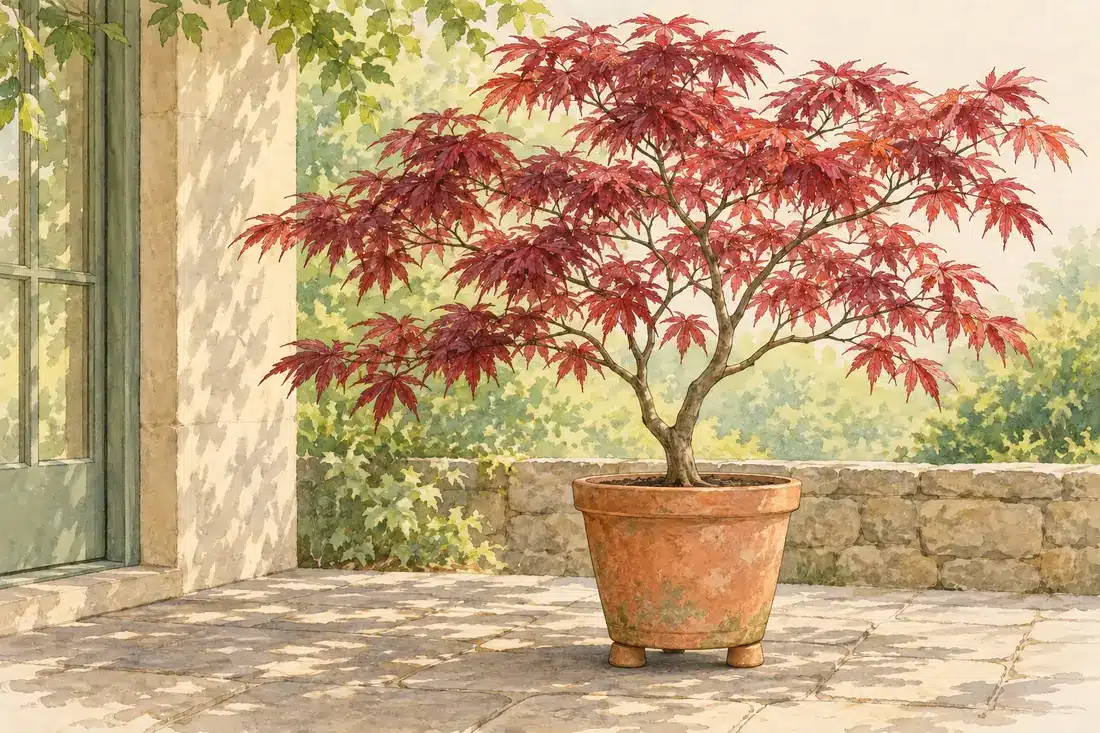
To grow Japanese maple in pots, use a draining outdoor container sized to the actual root ball, an airy potting mix, and a sheltered location. Keep the root ball evenly moist without leaving it in runoff, and protect exposed roots through winter with a locally suitable location, thawed-mix moisture checks and a spring return plan. Before buying a bigger pot, check drainage and root crowding; fast drying or one root at a hole does not prove the tree needs repotting.
For Japanese maples grown in pots, match the tree, container and site. This guide covers outdoor Acer palmatum cultivars grown as garden trees, with practical steps for choosing a pot, watering and repotting. Bonsai techniques are outside its scope. For the wider tree-care picture, including leaf scorch, use our Japanese maple care guide.
What size pot does a Japanese maple need?
Check the cultivar label or ask the nursery for the tree’s expected height, width and growth habit. “Japanese maple” covers trees with different mature forms; a weeping cultivar spreads over a rim, while an upright one needs room above it. A compact cultivar can reduce the effort of keeping a tree in a pot, but no label makes the tree permanently miniature. If its eventual size will outgrow the place you can provide, plan for a later move into a larger planter or the ground.
Then ask what the container must do: stay in one spot, fit a narrow patio, or be moved into shelter in winter. A larger volume can buffer moisture and temperature changes, but it is heavier when wet and can be hard to relocate. Virginia Cooperative Extension’s guidance for landscape containers calls attention to both root volume and total wet weight on patios and rooftops; its size framework is general tree guidance, not a Japanese-maple pot formula.
| Your situation | A useful starting decision | What to check before buying |
|---|---|---|
| The current root ball is still surrounded by usable medium and the pot drains | Keep the current pot for now; appearance alone is not a reason to size up | Check that roots are not densely circling the sides or base and that the cultivar still fits the site |
| Roots occupy most of the current root ball and growth space is genuinely tight | Compare a moderately larger container with planting the tree in the ground | As a starting comparison, UGA suggests 3–4 in. (8–10 cm) more diameter for many woody plants. Adjust for your maple’s roots and growth rate |
| The tree must be moved seasonally or the surface is a deck or balcony | Choose a size and material you can safely move, or plan a permanent protected position | Account for the weight of the pot, wet medium and tree, plus access to winter shelter and the deck’s load limits |
| You want to keep a large tree in a small display pot | Pause before choosing it | Long-term root management is specialist work; this is not a bonsai guide |
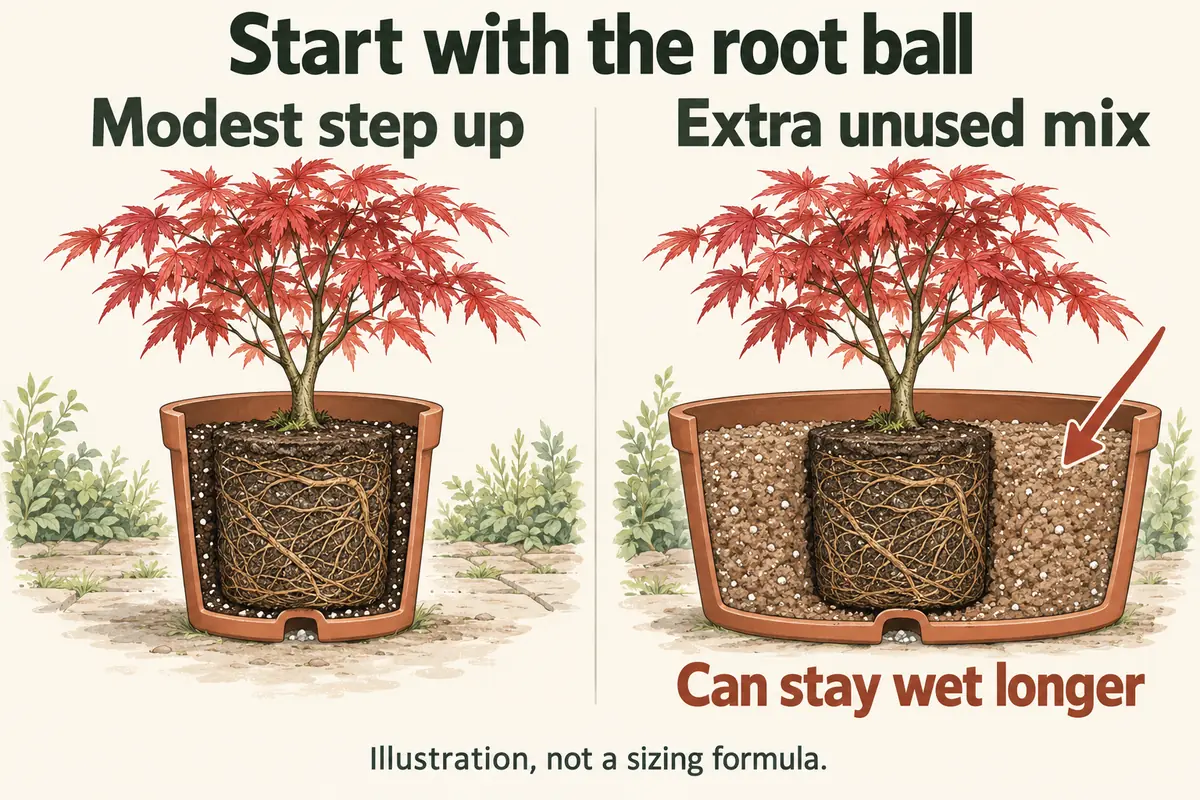
The best next pot is not automatically the biggest one available. UGA Extension notes that excess medium in a pot much larger than the plant can stay wet longer. A staged increase is a reasonable default when you have confirmed root crowding; an unusually large permanent planter is a separate design choice that needs a suitable medium, drainage and a plan for the tree’s mature form.
Choose the container for drainage, handling and climate
Every pot that holds the tree’s roots needs an unobstructed drainage opening. Skip the gravel layer beneath the potting mix; Illinois Extension explains that water can collect in the medium above a gravel layer before it drains. Raise the pot on feet or a firm stand if its base sits flush on a deck, soil or another surface that could block the holes.
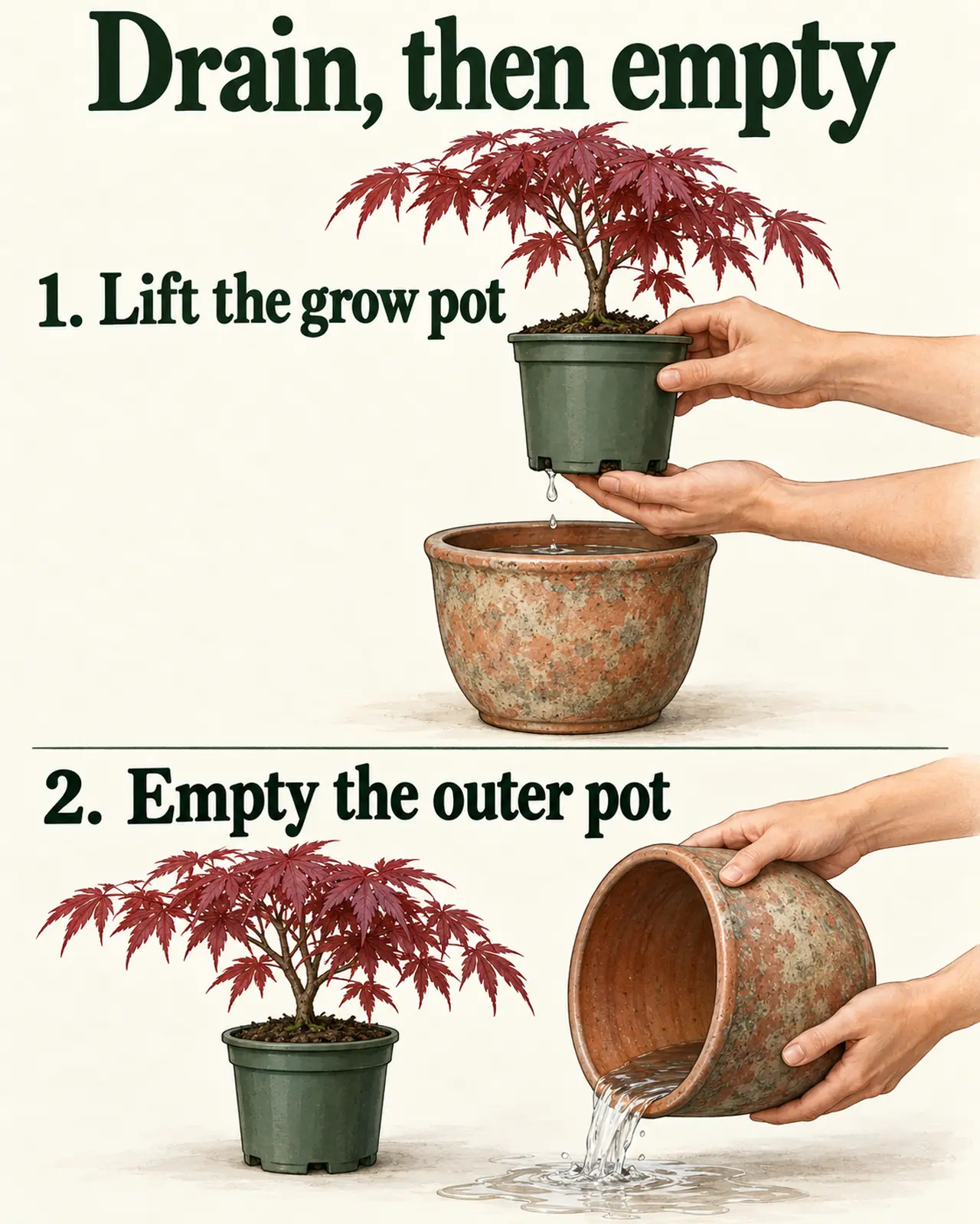
A decorative pot without holes can hold a separate draining grow pot. This outer pot is called a cachepot. Use this arrangement only if you can safely lift the inner pot and empty collected water after watering or rain.
| Material or feature | Practical trade-off | Choose it when… |
|---|---|---|
| Unglazed clay or terracotta | Porous walls lose water faster; pottery can crack if water in its pores freezes | You can monitor moisture and will protect the pot from freeze–thaw damage |
| Plastic or resin | Less-porous walls generally slow water loss; a lightweight pot is easier to move | Faster drying is a problem, or a removable inner pot makes winter handling easier |
| Dark or metal container | Dark surfaces and metal can heat or fluctuate more in strong sun; hotter medium can stress roots | You can keep the pot out of intense reflected heat or insulate it where appropriate |
| Any material without open drainage | Excess water has nowhere reliable to go | Use it only as an outer cachepot around a draining inner pot, and empty the outer pot |
These trade-offs come from Illinois Extension’s container guidance. Check outdoor durability before buying, including the manufacturer’s frost rating where winters freeze. Choose a filled pot you can manage safely.
Use a container medium, not ordinary garden soil
Choose a commercial potting mix intended for outdoor containers. It should hold some moisture and leave air around roots after excess water drains. University of Maryland Extension explains why ordinary garden soil is often too dense for pots. Commercial mixes combine materials such as bark, coir, peat and perlite in different proportions.
In a Maryland Extension response about a dwarf Japanese maple, a well-draining potting soil is considered suitable without a special recipe. Judge the mix by how it behaves in your container. A very coarse mix on a hot, windy patio may need more frequent attention than the same mix in a sheltered spot.
If a mix dries enough to shrink away from the pot, water may bypass it through the gap. Iowa State Extension describes this problem. Re-wet gradually and check the root ball itself: water leaving the holes does not prove that the center has absorbed any.
Place and water a potted Japanese maple by conditions
Where should I place a potted Japanese maple?
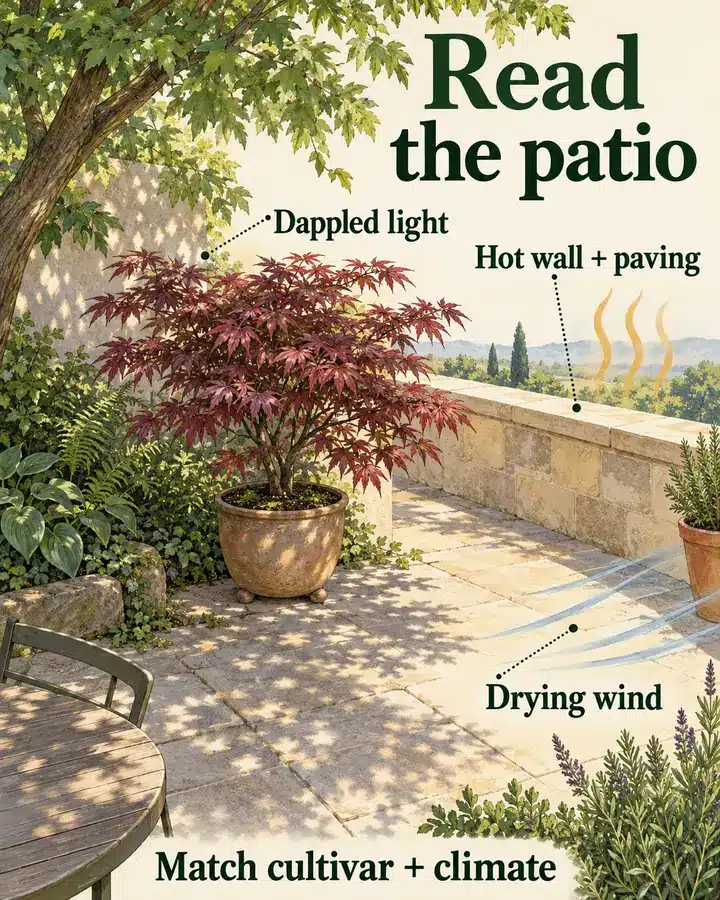
Start with shelter from drying wind and intense afternoon heat. NC State Extension recommends dappled shade and evenly moist, well-drained soil for Acer palmatum; excess sun, wind or drought can cause leaf scorch. Morning sun with afternoon shelter can be a useful patio arrangement, but check the named cultivar and your climate rather than assuming every maple has the same sun tolerance. A reflected-heat corner beside pavement or a wall may be harsher than the garden beside it.
How often should I water a Japanese maple in a pot?
During active growth, check moisture daily in hot or windy weather. Checking does not mean watering daily. Feel the mix about 1–2 in. (2.5–5 cm) down and compare moisture inside the old root ball with the newer mix around it when you can do so without damaging roots. If the root ball is becoming dry, water slowly across its surface until excess exits the holes. If it is still wet, check the drain path and wait rather than adding another dose on a schedule. Do not let the whole root ball dry out.
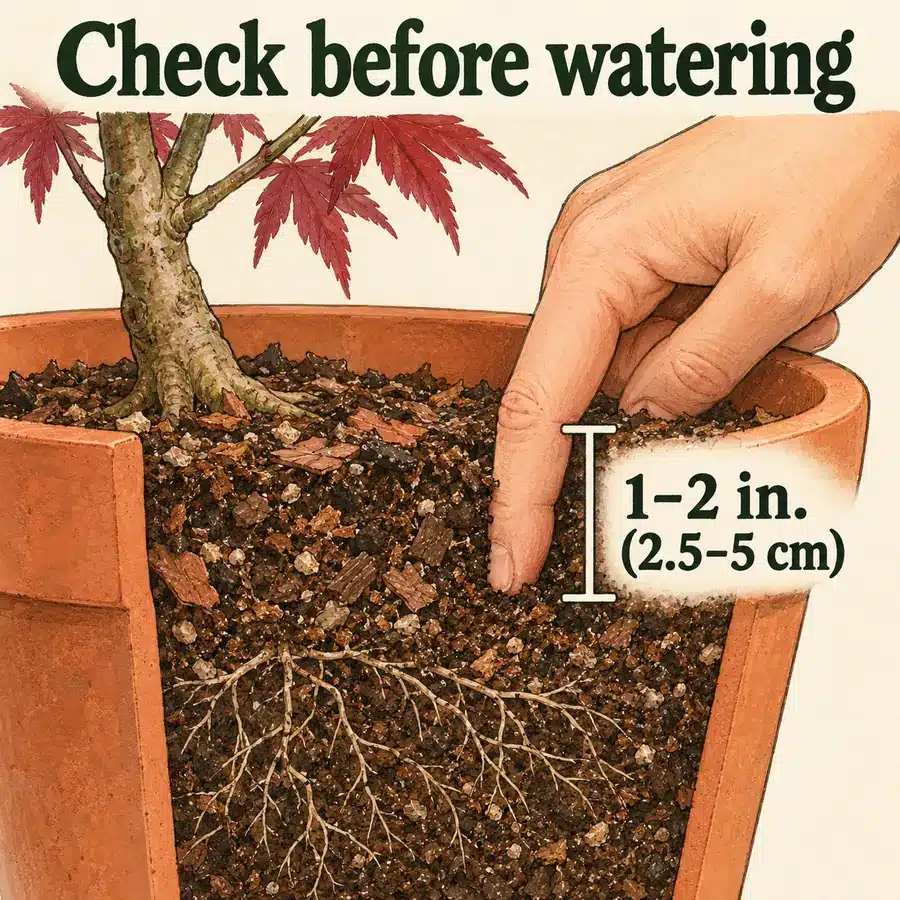
Iowa State Extension’s general container-care guidance supports checking the mix and watering through to the outlets; frequency changes with container, medium, plant and weather. A big planter can remain wet below a dry surface. Wilting or brown edges alone cannot tell you whether the roots need more water.
When should I consider fertilizer?
Before adding fertilizer, check the potting-mix label for any nutrients already included. Correct drainage, moisture and placement first; extra fertilizer does not repair blocked drainage or heat exposure. For a named cultivar’s feeding needs, ask the nursery or local Extension office rather than copying a flowering-container fertilizer schedule.
If your patio also includes flowering shrubs, our hibiscus-in-pots guide covers that separate plant’s setup. Use it for your hibiscus, and keep each plant’s moisture, light and feeding decisions separate.
Pot or repot without burying the root crown
A nursery pot does not automatically need replacing. Check its drainage and inspect the roots before deciding whether to keep it, pot up, or seek help with a tightly bound root ball. UGA Extension’s regional guidance for many container-grown woody plants identifies late winter through spring, before active growth, as a general window; local climate and the tree’s condition matter, so treat that as a starting point rather than a national date.
- Clear the route for drainage. Confirm that the grow pot’s holes are open and that its stand will not cover them. Moisten fresh container mix if it is dusty and hard to wet, following its label.
- Support the root ball. Tip or flex the nursery container while supporting the soil and roots. Do not pull the tree out by its trunk.
- Inspect before deciding on root work. Gently loosen fine outer roots if they separate easily. A dense, woody mat or large roots looping around the trunk need more than simply placing the whole ball in a bigger pot. Get help from an experienced nursery professional or local Extension office before cutting those roots.
- Find the correct planting depth. Add enough medium that the root crown—the point where the first main roots meet the trunk—will remain at or slightly above the finished surface, as recommended in UGA Extension’s woody-container repotting guide. Do not bury the crown to make the tree look shorter.
- Backfill lightly. Add mix around the root ball and firm only enough to remove large air pockets. Do not pack it hard. Water thoroughly until water exits the drain holes, then let the pot drain and empty the outer saucer or cachepot.
If the tree is too heavy to tip safely, get help. Keep the root ball supported throughout the move. Check the crown itself when setting depth; an old nursery soil line can already be too high.
Root-bound or blocked drainage? Check the difference first
The visible problem and the underlying cause can differ. A root-bound maple may use available water quickly, but fast drying can also come from a small or porous pot, heat, wind or a dry mix. Standing water points first to drainage or medium conditions, not automatically to roots filling the pot.
| What you observe | First check | Safer next step |
|---|---|---|
| Water sits on the surface or does not emerge from the bottom | Are the holes open? Is the pot flat on a surface, inside a water-filled cachepot, or sitting in a full saucer? | Clear the outlet or lift the inner pot and drain the outer vessel. Reassess before repotting. |
| One root appears at a drainage hole | Is the rest of the root ball still held together by medium, or is it a dense mat of roots? | Treat one root as a clue, not a diagnosis. Inspect the root ball when it is safe to lift. |
| Roots densely circle the side or base, with little medium visible | Is the ball crowded through much of its depth, rather than showing one root at the outlet? | Consider a modestly larger pot or local advice. Do not make large cuts to woody roots on guesswork. |
| The pot dries unusually fast | Check root density, material, pot size, recent heat and wind, and whether water is wetting the center | Correct the confirmed cause. Do not size up solely from a hot-week watering pattern. |
| The medium stays unusually wet between checks and the tree is declining | Check whether the drain path is clear and whether the medium is compacted or broken down | Fix drainage or ask for a local diagnosis; a bigger pot will not repair a saturated root zone. |
Root binding means roots have crowded and circled inside the container, as described by UGA Extension. The table combines that evidence with drainage and moisture guidance. It helps you choose the next check; it cannot identify a root disease from leaf symptoms alone.
Check the result after potting
After the first full watering, confirm that water exits the bottom, the root crown remains visible at the same depth, and the container is not left in runoff. Check the pot again after rain and during the next hot or windy spell: container moisture changes with pot size, material, medium and weather, so there is no single interval that fits every patio.
Keep a short record: weather, moisture inside the root ball, whether water drained, and what you changed. Compare the next check with the previous one before making another change. This gives you—and anyone helping diagnose a problem—something concrete to work with.
Overwintering Japanese maple in pots: protect the roots
Overwintering Japanese maple in pots means protecting exposed roots while allowing winter dormancy. Start with the shelter and materials you already have. Small containers are particularly vulnerable to temperature swings, as Maryland Extension explains. Choose protection before frozen ground or a heavy wet pot limits your options.
Choose a winter location before the ground freezes
Your cultivar, local winter extremes, container size and exposure determine the plan. USDA hardiness zones describe average annual extreme minimum temperatures, not the coldest possible night or a guarantee for exposed container roots. There is no reliable nationwide rule to subtract one or two zones from a plant label.
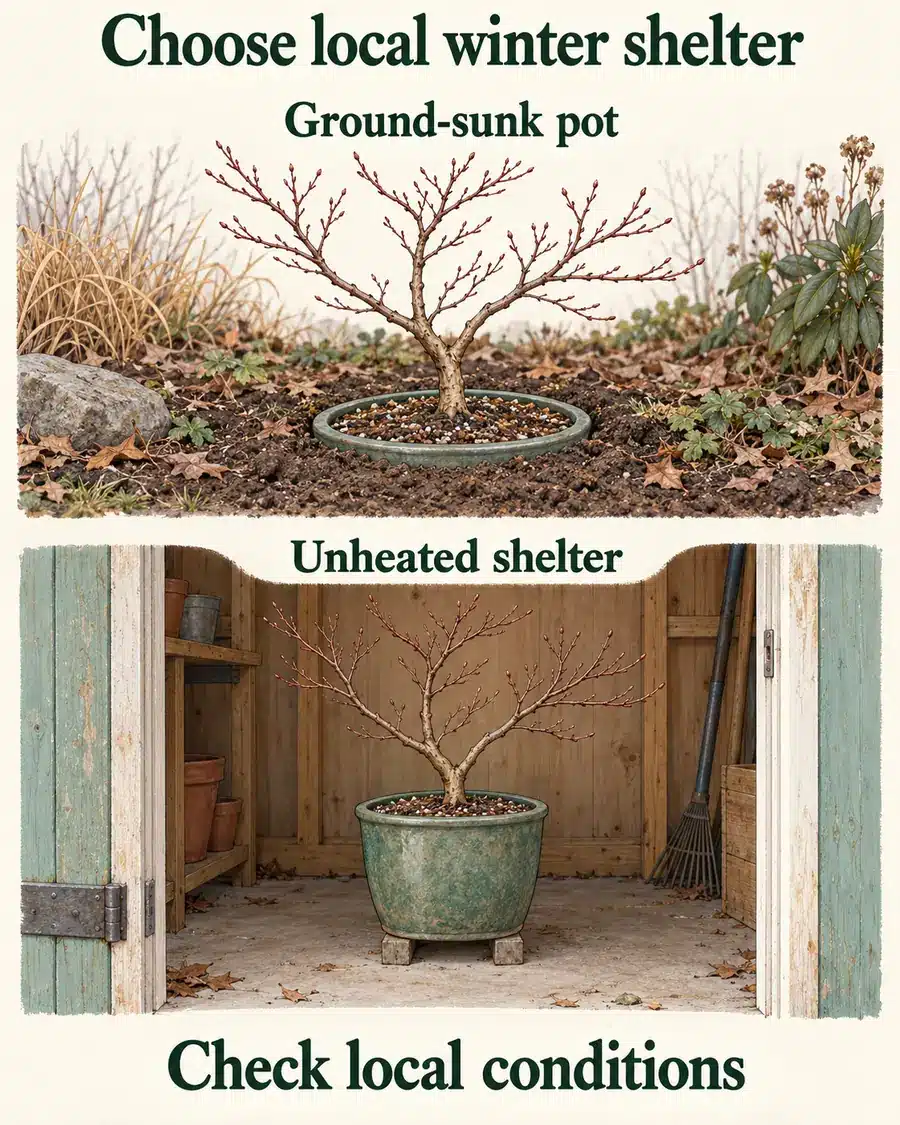
For a cold-region example, an Ask Extension response from Minnesota favors burying the pot or suitable unheated storage for a small Japanese maple. Its above-freezing storage advice is specific to that case. Iowa State’s broader woody-container guidance describes different conditions; neither establishes a universal safe temperature for every Japanese maple.
| Available option | Action | Follow-up check |
|---|---|---|
| Garden ground where you can bury the pot | After the tree goes dormant but before soil freezes, set the container into a prepared hole and backfill around it. Keep the tree at its existing planting depth. | A buried pot drains less readily. Check thawed mix before adding water and avoid a saturated root zone. |
| An unheated garage or outbuilding | Move the dormant tree into shelter only when its actual temperature pattern suits your cultivar and area. Use an existing minimum/maximum thermometer if available. | Check cold and warm extremes beside the pot after weather changes, plus moisture and bud stage. “Unheated” alone does not establish suitability. |
| A sheltered outdoor spot in a locally suitable climate | Group containers and insulate their sides with available wrapping while leaving drainage open. Confirm that this level of protection fits your local winter. | Reassess after cold spells. Wrapping alone does not make an exposed small pot suitable for a severe winter. |
Iowa State’s container-overwintering guide supports burial timing and warns that buried pots need less supplemental water because they drain more slowly. The outdoor grouping and wrapping method comes from the RHS Japanese-maple guide; its UK advice needs local judgment in colder US regions. Ask local Extension about the named cultivar if choosing between these methods.
Check thawed moisture, temperature and buds
Let the tree enter dormancy outdoors before protected storage; stopped seasonal growth and leaf drop are useful cues. The New York Botanical Garden’s maple guidance calls for cold dormancy and warns against complete winter drying. A heated living room is not its recommended storage method.
When the mix is frozen, do not force a finger or probe into it or add supplemental water. Once it thaws, gently check accessible mix without digging through roots. If it is becoming dry, water and let excess drain; if it remains moist, wait. Clear collected runoff. Check again during mild spells, especially under a roof that excludes rain. Use moisture observations rather than a fixed monthly schedule.
Record the nearby air minimum and maximum, whether the mix is frozen or thawed, its moisture, and whether buds remain closed. Air readings do not measure the whole root ball. Iowa State warns that unheated structures can fluctuate widely. Compare that pattern with locally appropriate advice before choosing another location.
Plan spring return before buds open
Check buds and the local forecast together. NYBG advises returning the tree outdoors before bud break, while New Hampshire Extension warns that early maple growth is sensitive to late frost. Plan a protected transition before growth starts; there is no single US move-out date. If leaves are already opening, get local transition advice and protect tender growth from freezing.
A warm spell is also a reason to reassess storage: Rutgers’ nursery-container guidance explains that prolonged winter warmth can reduce cold acclimation before another freeze. This general principle does not supply a safe household storage threshold. If you also move hibiscus indoors, use our hibiscus winter guide; the winter needs of tropical hibiscus cannot simply be transferred to a maple.
Japanese maple in pots: FAQ
How much bigger should the next pot be?
There is no Japanese-maple-specific diameter that fits every root ball and cultivar. UGA Extension gives 3–4 in. (8–10 cm) wider as general guidance for many woody ornamentals. Use it as a starting point only after confirming root crowding, drainage and the tree’s planned size; do not jump to a very large pot just to avoid checking it again.
Can I use garden soil in the pot?
Ordinary garden soil is often too dense for a container and may stay too wet. Choose a commercial medium meant for outdoor containers and judge it by its drainage and moisture behavior, not by an unverified “Japanese maple recipe.”
Do roots coming out of a drain hole mean I must repot now?
Not by themselves. Check whether roots densely occupy and circle the root ball, and first confirm that the drain opening is not blocked. A root at the hole may be one clue; it does not show that the whole pot is root-bound.
Does gravel in the bottom improve drainage?
No. Illinois Extension advises against a gravel layer beneath the medium in a single pot. For a decorative pot without holes, use a smaller draining grow pot as an inner liner and empty water from the outer pot.
Should I prune roots every few years?
Inspect before cutting. Dense, circling roots may need work, but a calendar alone does not tell you how much to remove. Get experienced local help with large or woody roots; bonsai uses separate techniques.
Can I keep a potted Japanese maple in an unheated garage?
Yes, if its actual conditions suit the dormant tree and your local winter. “Unheated” is not enough: record nearby cold and warm extremes, check moisture when the mix thaws, and watch bud development. A garage that becomes very warm or very cold needs reassessment with cultivar-specific local advice.
How often should I water a potted Japanese maple in winter?
Water according to the thawed mix, not a monthly calendar. Do not add supplemental water while it is frozen. When accessible mix is thawed and becoming dry, water and allow drainage; if it remains moist, wait. Buried pots drain more slowly, so check carefully before adding more.
Sources and scope
The container-care references below were retained from the October 6 source list. Winter references were checked October 22, 2026, including the Maryland and Minnesota responses. General woody-container guidance and individual regional replies do not establish a universal Japanese-maple storage temperature.
- University of Maryland Extension, “Growing Media (Potting Soil) for Containers” — choosing growing media; garden soil and commercial soilless mixes.
- Ask Extension / University of Maryland Extension HGIC, “Can I grow a dwarf Japanese maple in a container?” — expert response for Prince George’s County, Maryland; drainage, drying and winter root risk.
- UGA Extension, “Repotting Container Plants for Long-Term Health” — general guidance for container woody plants in Northeast Georgia; sizing and timing are not Japanese-maple trial results.
- UGA Cooperative Extension, “Repotting Basics: Tips to Ensure Vitality in Woody Container Plants,” Circular 1240 — general woody-container repotting, root crown and aftercare.
- Illinois Extension, “Container Drainage Options” — drainage holes, saucers, double-potting and gravel-layer clarification.
- Illinois Extension, “Container Material Choices” — general effects of material, porosity, color and temperature.
- Virginia Cooperative Extension, “Trees for Landscape Containers and Planters,” publication 430-023 — general container-tree considerations; Virginia publication issued 2009.
- Iowa State University Extension and Outreach, “Care of Plants Growing in Containers” — general container moisture and drainage context; reviewed June 2024.
- NC State Extension Gardener Plant Toolbox, Acer palmatum — species-level light, moisture, wind and leaf-scorch context; individual cultivars differ.
- Ask Extension, “How to overwinter potted Japanese maple” — 2018 expert response for Ramsey County, Minnesota; regional winter-protection options, not a nationwide temperature rule.
- Iowa State University Extension and Outreach, “Overwintering Unplanted Trees, Shrubs and Perennials” — general container burial, timing, reduced drainage and freeze/thaw watering guidance.
- Iowa State University Extension and Outreach, “How can I over-winter container grown trees and shrubs?” — exposed-root risk and monitoring of unheated storage; not a cultivar-specific temperature trial.
- New York Botanical Garden, “What is the best winter care for my outdoor container-grown Japanese maple?” — dormancy, protected storage, drying risk and spring return; its calendar watering suggestion is not applied universally here.
- Royal Horticultural Society, “Japanese maples: growing guide” — UK guidance on grouping, sheltering and wrapping containers, applied conditionally to US climates.
- USDA, “How to Use the Maps” — average minimum temperatures and the limits of hardiness zones.
- University of New Hampshire Extension, “How should I plant and care for a Japanese maple?” — early leafout and late-spring-frost sensitivity.
- Rutgers, “Management of Container Nursery Plant Material During Cold Weather” — nursery-stock dormancy and cold-acclimation principles, not a household Japanese-maple storage threshold.