Quick answer. Japanese maple care depends on the cultivar and where it grows. Most Acer palmatum do best in a sheltered spot with dappled light or protection from hot afternoon exposure, soil that stays evenly moist but drains, and mulch kept away from the trunk. Check the root zone before watering, especially during establishment and in containers. If leaves brown, compare the pattern with recent sun, wind, soil moisture and drainage before changing care.
Start with the plant you have
“Japanese maple” usually points gardeners toward Acer palmatum, but cultivars vary in size, branching, leaf shape, seasonal color and exposure tolerance. Some grow upright; others have a weeping form. A cultivar that holds red foliage in one setting may show different color in another. Use the plant tag or ask the nursery for the cultivar name before applying a size, cold-hardiness or sun recommendation to your tree. The North Carolina Extension Plant Toolbox describes the species’ forms and five- to nine-lobed leaves, while Virginia Tech notes that cultivar characteristics vary widely.
This guide covers landscape and container-grown Japanese maples. Bonsai have their own growing conditions and are outside its scope. For a young tree, an established landscape tree and a tree in a pot, the same watering calendar will not fit all three.
Choose a site for light, heat and wind
A sheltered location with dappled light is a cautious starting point. In hot, dry or windy sites, protect foliage from intense afternoon exposure. Some cultivars tolerate more sun, especially in cooler parts of the country, but sun tolerance also depends on moisture and the specific plant. The University of Florida’s IFAS profile distinguishes the sunnier northern part of the species’ range from the partial shade often needed farther south. New Hampshire Extension also warns that hot, dry full-sun sites can scorch leaves.
| Site condition | What to weigh before planting |
|---|---|
| Hot, dry summers or strong drying winds | Look for a sheltered place with dappled light or afternoon protection; plan to monitor soil moisture during dry weather. |
| Cooler summer conditions | Some cultivars may tolerate more direct sun. Check the cultivar label and local advice instead of assuming every Japanese maple has the same tolerance. |
| Cold springs or exposed winter winds | Choose a protected microclimate where possible. Japanese maples can leaf out early, and tender new growth may be damaged by a late frost. |
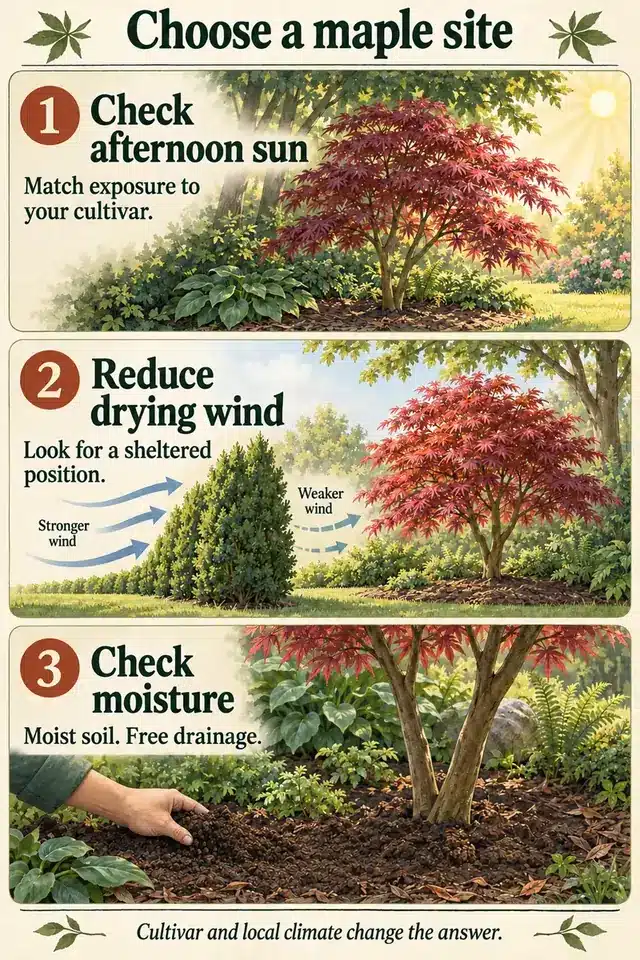
Do not choose a cultivar from a single national hardiness-zone range. Extension publications report different ranges and repeatedly qualify them by cultivar or location. Ask a local Extension office, public garden or experienced local nursery which named cultivars are suited to your site. A zone label is only one part of that decision; it does not describe afternoon heat, reflected warmth, wind or soil moisture.
Plant with drainage and the root flare in mind
For an in-ground tree, first locate the root flare: the point where the trunk widens as it joins the roots. University of Maryland Extension recommends keeping that flare visible at the finished soil level. A buried trunk base can contribute to root and oxygen problems. Set the tree so the flare is at or just above grade, and avoid piling soil or mulch against the trunk.
Before digging, remove excess nursery soil from the top of the root ball if needed to expose the flare. Measure planting depth from the flare to the base of the root ball. General tree-planting guidance from University of Maryland Extension calls for a hole no deeper than that measurement and at least twice as wide; leave firm soil below the ball so it cannot settle deeper. Remove the nursery pot. Gently loosen roots that circle the outside; if roots are tightly pot-bound or girdling, ask a nursery professional or Extension office for help before making major root cuts. Set the flare at or slightly above grade, backfill with the site soil, and water to settle the backfill.
Japanese maples prefer soil that drains rather than holding standing water around the roots. “Evenly moist” does not mean permanently wet. If the planting area stays soggy after rain or irrigation, investigate drainage before adding more water or fertilizer. Do not assume that a special soil recipe or a heavily amended planting hole will fix a site that holds water.
A loose 2–3-inch layer of mulch (about 5–8 cm) can help conserve moisture and moderate soil conditions. Keep the mulch off the trunk and visible root flare. UF/IFAS recommends a 2–3-inch layer; K-State Extension gives a similar depth and warns against placing mulch at the trunk.
A container changes the routine. Use a well-draining potting medium in a sturdy pot with clear drainage holes. The smaller soil volume can dry faster than garden soil, and the roots face larger winter temperature swings. Check the mix more often during active growth, and do not leave the pot standing in water. Maryland Extension’s Japanese maple container guidance notes faster drying and greater winter root-injury risk; another Maryland Extension answer about growing Japanese maples in pots warns that drainage holes can clog. For pot sizing, drainage, and watering checks, see our Japanese maple in pots guide.
After the tree has dropped its leaves and is dormant, protect the container according to the cultivar and your local winter. Options include insulating the pot outdoors or moving it to a cool, protected, unheated space; Iowa State Extension’s general guidance for container-grown woody plants also describes heeling pots into the ground after dormancy but before the soil freezes. A Minnesota Extension response about a potted Japanese maple recommends a cooler overwintering place rather than a heated home. Do not use a heated living room as winter storage for a dormant maple. The right protection depends on cultivar and regional temperatures, so ask a local Extension office before choosing an outdoor or garage method.
Check the potting mix during mild winter spells. If the root ball becomes dry and the mix is not frozen, water enough to moisten it and let the pot drain. Do not water in freezing conditions. Winter watering needs depend on the shelter and local weather; Oregon State Extension cautions against watering at or below freezing, while Maryland’s Japanese maple container guidance recommends regular moisture checks during mild spells.
Water by checking the root zone
There is no reliable one-size-fits-all watering schedule for Japanese maples. Rain, soil, heat, wind, cultivar, planting age and container size all change how quickly the root zone dries. Check the soil below the mulch and in or near the original root ball before watering. For a new planting, University of Maryland Extension recommends checking several inches down and watering when that soil is dry; if it is still moist, wait and check again.
| Tree situation | Check first | What to do |
|---|---|---|
| Newly planted, in the ground | Feel the soil in the root ball and the surrounding soil several inches down. Note recent rain and heat. | Water when the root-zone soil is dry; recheck rather than following a fixed weekly amount. Avoid keeping it saturated. |
| Established, in the ground | Check whether the root zone is dry, especially during a hot or windy stretch. Look at whether the tree is exposed to afternoon sun. | If the soil is dry, water the root area and reassess the site and mulch. If it is moist, more water may not help. |
| Growing in a container | Check the mix more often; pot, medium and weather affect how quickly it dries. Make sure the drainage holes are open. | When the mix needs water, apply enough for it to start flowing from the drainage holes, then let excess drain and empty any saucer. Do not borrow an in-ground schedule. |
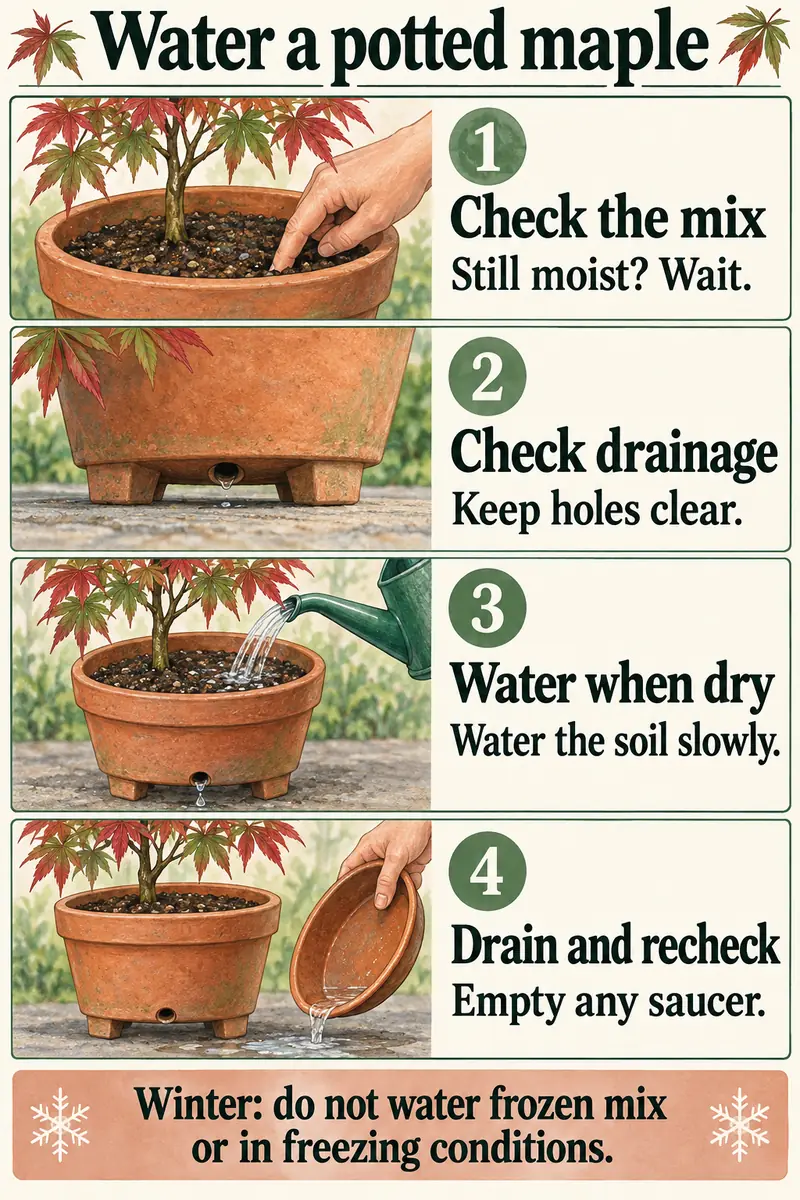
When an in-ground root zone is dry, apply water slowly at soil level over the original root ball and nearby rooting area so it can soak in. After it drains, check several inches down again; if the soil is still moist, wait. Aim water at the roots rather than spraying the foliage, and do not keep watering a site where water pools. This follows Maryland Extension’s tree-watering advice; Virginia Tech’s Japanese maple guidance also describes letting a hose trickle within the drip line during dry periods. Container watering uses the drainage-hole method in the table; Iowa State Extension describes that general container technique in Care of Plants Growing in Containers.
Brown leaf edges? Diagnose the conditions before acting
Brown or crispy foliage is a sign to inspect the tree, not a diagnosis by itself. UF/IFAS describes scorch as tan or brown dead areas between leaf veins and notes that heat with wind, an inadequate or damaged root system, or insufficient water can contribute. NC State Extension likewise lists excess sun, wind and drought as scorch risks. A dry root zone may contribute, but standing water and poor drainage are also concerns for Japanese maples.
| What you notice | Check before you act | Cautious next step |
|---|---|---|
| Brown margins or tan areas after hot, dry, windy weather | Which side of the canopy is exposed? Is the root-zone soil dry or still moist? | If the root zone is dry, water it and consider whether afternoon exposure or wind is adding stress. Do not assume a fixed daily watering routine is needed. |
| Browning on a recently planted tree | Is the root ball dry several inches down? Has water been pooling around the planting area? | Check both moisture and drainage. Water if the root zone is dry; do not add water to already wet soil. |
| A container tree browns during a hot spell | How quickly is the potting mix drying? Is the container able to drain? | Check more often in hot weather and keep moisture even without leaving the roots in standing water. |
| New foliage was exposed to a late cold snap | Did the browning appear after the frost, and is it limited to the newest growth? | Record the timing and watch for the next growth. Ask a local Extension service if damage continues or you are unsure what you are seeing. |
| One part of the tree looks different from the rest | Note the affected branches, exposure, recent weather, planting age and soil moisture. | Take clear photos and seek local plant-health advice if the pattern is spreading or the cause is unclear. Avoid treating from leaf color alone. |
Do not try to solve every brown leaf by adding water or fertilizer. First compare exposure, weather and soil moisture. A Japanese maple in afternoon heat with dry soil has a different problem to investigate from one whose roots stay wet. If the soil is moist, wait before watering again and look at drainage, wind and sun. Damaged leaf tissue is not a reliable scorecard for whether one recent change has worked; use the next growth and the underlying site conditions to reassess. For symptom checks across other plants, browse our plant-problems guide.
Prune lightly; do not fertilize by calendar
Japanese maples are valued for their natural shape and usually need little pruning once established. If a branch is dead or damaged, or clearly crosses into another, keep the goal modest and preserve the tree’s natural form. Do not make a large cut just to force a particular size or shape without checking the cultivar and getting appropriate advice.
Pruning timing differs among regional guidance. K-State Extension recommends heavier pruning while the tree is dormant in late winter in its Kansas City-area publication. New Hampshire Extension advises waiting until the spring growth flush has ended because maples may bleed sap after late-winter or early-spring cuts. That conflict is a reason to use local Extension guidance for timing; there is no single month to recommend across the United States. For major structural work, consult a qualified local tree professional.
For a landscape-grown maple, skip a routine fertilizer schedule. New Hampshire Extension says not to fertilize a newly planted maple and recommends feeding an established tree only if growth is slow or a soil test shows a need. Maryland Extension likewise notes that young landscape trees may not need fertilizer for one to three years, or at all when they are growing adequately. Container-grown trees need a separate check: repeated watering can leach nutrients from potting mix. If a potted maple remains weak after you review light, moisture and drainage, ask a local Extension office whether a slow-release fertilizer labeled for containers is appropriate, and follow its label. An Oregon State Extension response about a potted Japanese maple describes nutrient loss through frequent container watering; it does not establish a universal feed schedule or rate.
Keep a short observation record
When you check the tree, record:
- The cultivar, if known, and whether it is in the ground or a container.
- Whether it was recently planted or has been established for years.
- Recent rain, heat, wind or frost, and how much afternoon sun reaches the canopy.
- Whether soil below the mulch and within the root ball is dry, moist or persistently wet.
- Whether the root flare is visible and whether mulch touches the trunk.
- Where browning starts and whether it appears across the canopy or in one area.
- What you changed, then what you observe during the next weather and care cycle.
This record helps you separate a dry root zone from a site that stays too wet or too exposed. It also makes a local Extension question more useful. Reassess the conditions you changed; do not expect every leaf to recover on a fixed timetable.
The same plant-specific approach applies elsewhere in the garden. If hydrangeas are also on your list, see our Hydrangea care guide as a separate reference; do not transfer Japanese maple watering or pruning assumptions to another plant.
Japanese maple care FAQs
Can a Japanese maple grow in full sun?
Some cultivars and cooler sites tolerate more direct sun. In hot, dry or windy locations, dappled light or protection from afternoon exposure is safer because excess sun, wind and drought can contribute to leaf scorch. Check the cultivar and local conditions.
How often should I water a Japanese maple?
Check the root-zone soil instead of following a universal calendar. When it is dry, water slowly at soil level and recheck after it soaks in. For a pot, water until it drains through the holes. Newly planted and container trees need closer observation than established in-ground trees.
Why are the edges of my Japanese maple leaves brown?
Brown margins can fit scorch linked with heat, wind or inadequate water, but leaf color alone does not identify the cause. Check recent weather, the exposed side of the canopy, soil moisture and drainage before changing care.
Should I prune or fertilize it every year?
Usually, the guidance reviewed here supports light pruning to preserve natural form and no automatic fertilizer schedule. If pruning is needed, use local guidance for timing. Consider a soil test before fertilizing a tree that is growing poorly.
Sources
Sources consulted September 22–23, 2026. Regional recommendations are identified where they affect the advice; their dates and locations are not interchangeable.
- NC State Extension Gardener Plant Toolbox: Acer palmatum
- UF/IFAS: FPS009/FP009, Acer palmatum Japanese Maple
- University of New Hampshire Extension: How should I plant and care for a Japanese maple?
- K-State Research and Extension, Johnson County: Ensuring You and Your Japanese Maple Have a Happy Partnership (revised 2023)
- University of Maryland Extension: Planting a Tree or Shrub
- Ask Extension, University of Maryland Extension HGIC: Can I grow a dwarf Japanese maple in a container? (answered May 8, 2025)
- Virginia Tech Extension: Japanese Maple
- University of Maryland Extension: Watering Trees and Shrubs (updated May 29, 2026)
- Iowa State University Extension and Outreach: Care of Plants Growing in Containers (reviewed June 2024)
- Ask Extension, University of Maryland HGIC: Growing Japanese Maples in Pots
- Ask Extension, University of Minnesota response: How to winter a young Japanese maple (answered October 13, 2023)
- Iowa State University Extension and Outreach: How can I overwinter container-grown trees and shrubs? (updated December 6, 2024)
- Oregon State University Extension: Protect landscapes when freezing weather moves in (reviewed 2025)
- Oregon State University Extension: Container Gardening Basics
- Ask Extension, Oregon State University response: Potted Japanese Maple (answered August 18, 2022)
