A species-first guide to light, watering, soil, flower color, pruning, and common hydrangea problems.
Good hydrangea care starts by identifying the type before you prune it. Bigleaf and oakleaf hydrangeas commonly carry flower buds on older stems, while panicle and smooth hydrangeas flower on current-season growth. Give every hydrangea a root zone that stays evenly supplied with moisture but drains freely, protect leaves from harsh afternoon heat where necessary, and match pruning to the plant’s flowering wood. A calendar copied from another hydrangea can remove next year’s flowers.
Most garden hydrangeas prefer rich soil that holds moisture without remaining waterlogged. Water deeply when the root zone is drying, adjust for heat and rainfall, and use the plant’s wilt, soil, and weather together rather than a fixed weekly promise. Flower color changes are mainly a bigleaf-hydrangea question and are conditional on cultivar, soil chemistry, and aluminum availability.
This guide covers common landscape hydrangeas in the United States, with global-season and climate caveats. If the label is missing, identify the plant before making a major cut.
The one decision that protects blooms
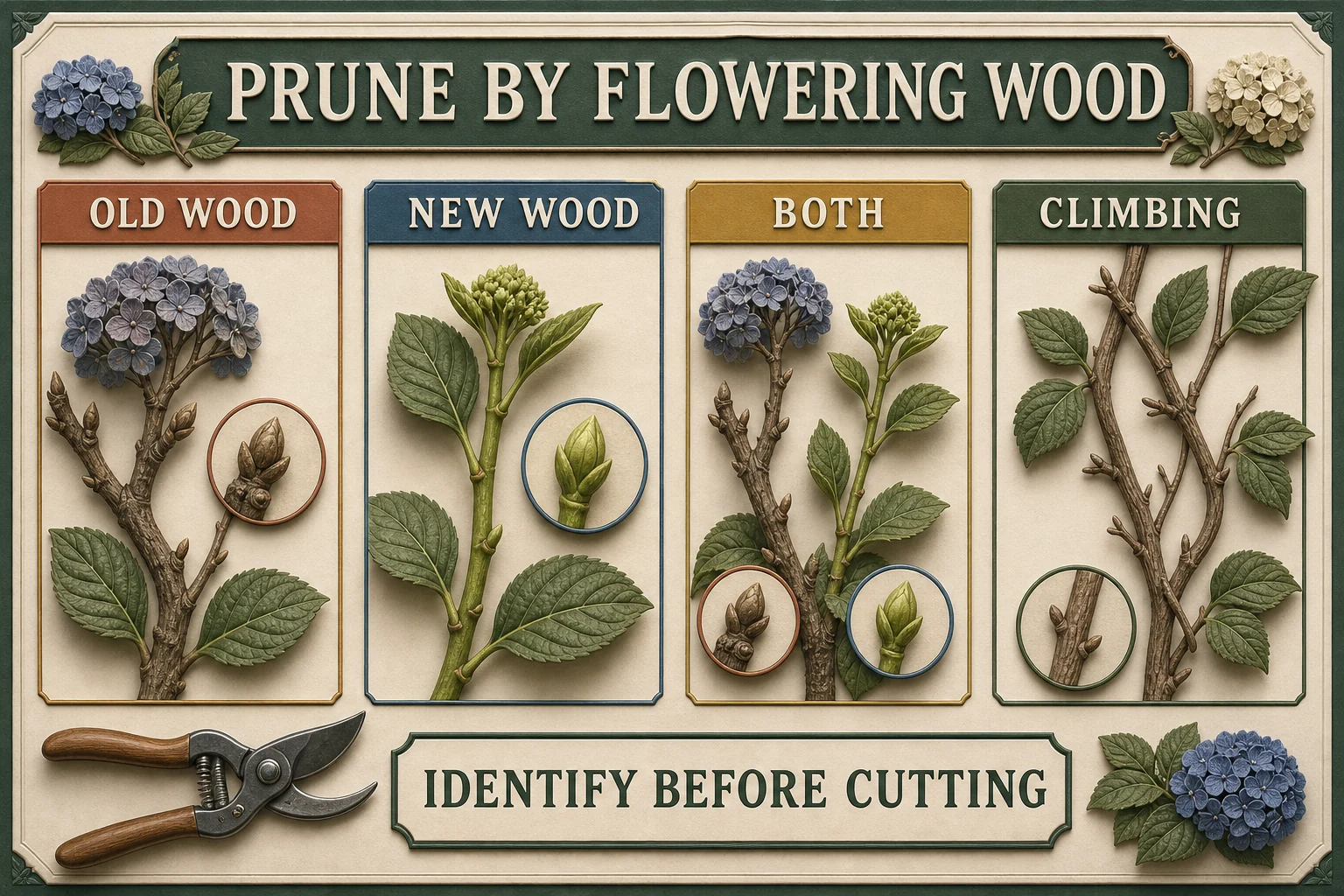
Ask: Does this hydrangea flower on old wood, new wood, or both? Old wood is a stem that grew in a previous season and may already carry dormant flower buds. New wood is the current season’s growth. If you cannot identify the type, remove only dead, damaged, or clearly crossing wood until the plant is identified.
Hydrangea care checklist
- Identify the group: check the label or cultivar before pruning; bigleaf and oakleaf often flower on old wood, while panicle and smooth types flower on new wood.
- Match light to heat: give useful light, protect from harsh afternoon heat where needed, and watch wind and soil moisture together.
- Water by the root zone: water deeply when the soil is drying, then let excess drain; do not follow a fixed weekly schedule.
- Protect next year’s flowers: remove only dead or damaged wood until you know whether the plant flowers on old wood, new wood, or both.
- Investigate before feeding: check drainage, light, roots, pests, and soil chemistry before reaching for fertilizer or a color-changing product.
Identify the Hydrangea Before You Change Its Care
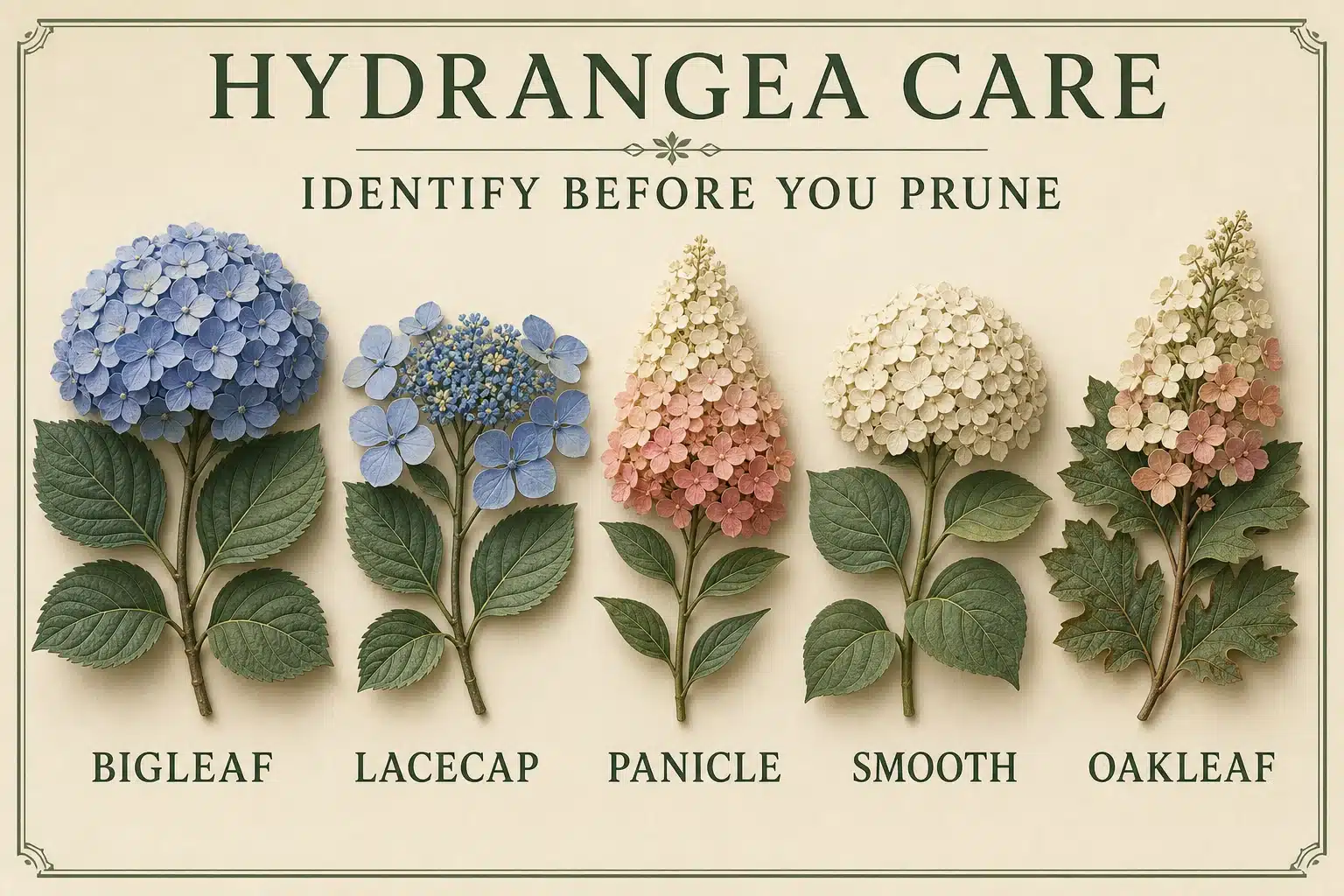
“Hydrangea” describes a genus, not one uniform shrub. Bigleaf hydrangeas (Hydrangea macrophylla) include mophead and lacecap forms. Panicle hydrangeas (H. paniculata) carry cone-shaped clusters. Smooth hydrangeas (H. arborescens) often have rounded clusters and flexible stems. Oakleaf hydrangeas (H. quercifolia) have oak-like leaves and elongated flower clusters. Climbing hydrangea (H. anomala subsp. petiolaris) is a woody vine with a different pruning habit.
Use the nursery label, cultivar name, flower shape, leaf shape, and growth habit together. Reblooming bigleaf cultivars can flower on old and new wood, so even a correct species label does not always predict every cultivar’s response. The University of Maryland Extension warns that pruning at the wrong time is a major reason hydrangeas fail to bloom.
| Common group | Useful visual clue | Typical flowering wood | Pruning caution |
|---|---|---|---|
| Bigleaf, mophead or lacecap (H. macrophylla) | Broad leaves; rounded or flat-topped flower heads | Often old wood; rebloomers may use both | Heavy fall, winter, or spring cuts can remove flower buds |
| Panicle (H. paniculata) | Conical flower clusters; often more upright shrub form | Current-season growth | Structure can be pruned before active growth, but local frost and cultivar timing matter |
| Smooth (H. arborescens) | Rounded clusters; softer, often arching stems | Current-season growth | Do not assume bigleaf timing; preserve a stable framework |
| Oakleaf (H. quercifolia) | Oak-shaped leaves and elongated clusters | Old wood | Prune lightly after flowering; preserve established stems |
| Climbing (H. anomala subsp. petiolaris) | Woody climber with aerial holdfasts | Previous-season shoots | Prune for space or shape after flowering, not as a routine hard cut |
Use this as an identification starting point, not a substitute for the cultivar label.
Bigleaf, mophead or lacecap (H. macrophylla)
Panicle (H. paniculata)
Smooth (H. arborescens)
Oakleaf (H. quercifolia)
Climbing (H. anomala subsp. petiolaris)
Choose Light and Site Protection
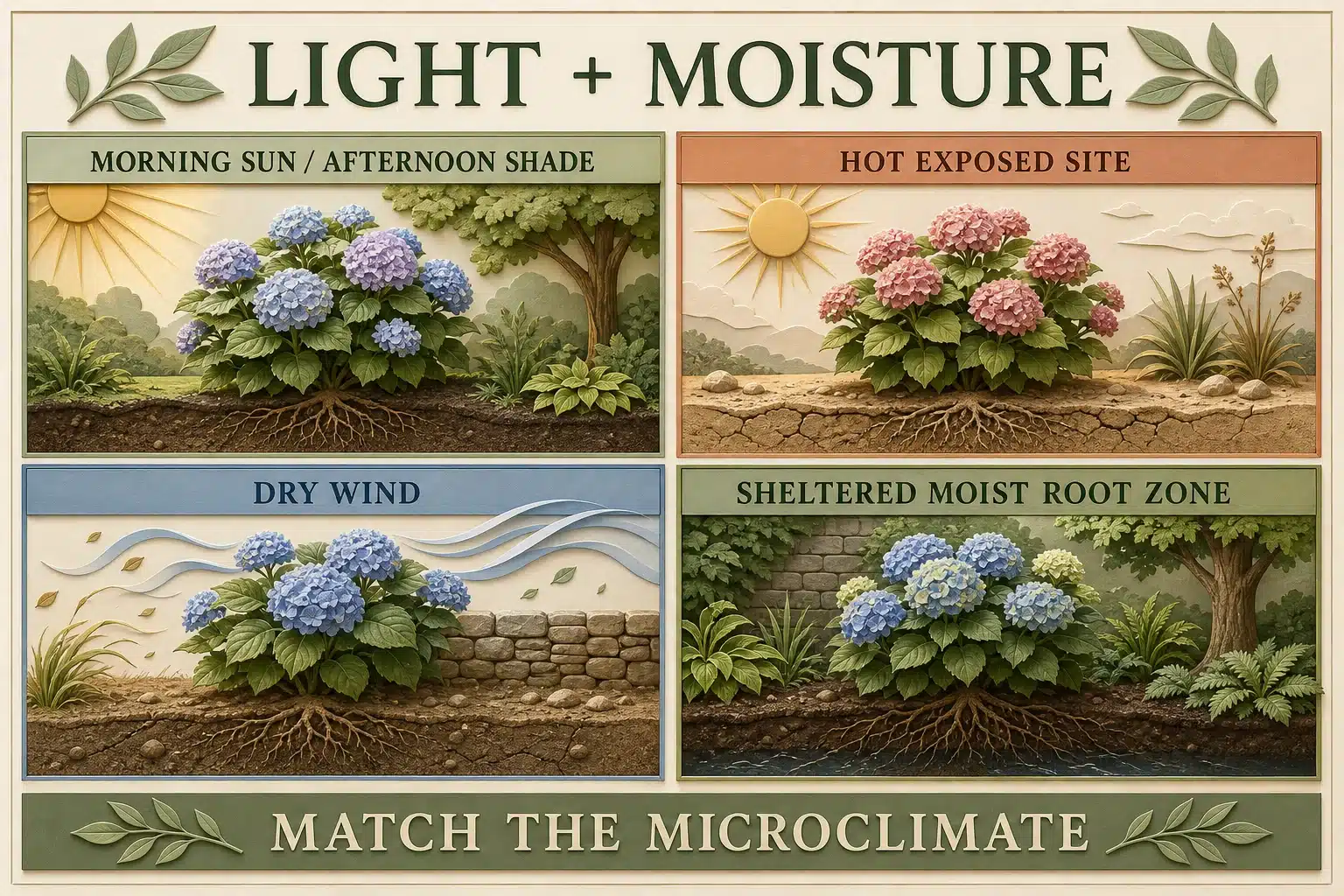
Many hydrangeas perform well with morning sun and afternoon shade, especially in hot climates, but the correct exposure depends on species, cultivar, latitude, soil moisture, and wind. A plant that thrives in bright light with reliable moisture in one region may scorch or wilt in a hotter, drier site. Give the shrub enough light for sturdy growth and flowering while protecting it from the combination of intense heat, dry wind, and a drying root zone.
Watch the plant at the hottest part of the day. Temporary afternoon droop can be a heat response, while repeated wilt that does not recover after the root zone is rehydrated deserves investigation. Brown, crispy margins can follow leaf water loss that exceeds root supply; strong light, heat, dry wind, and inadequate water can contribute. Ask Extension describes this leaf-scorch pattern as a water-balance problem rather than a single disease diagnosis.
Use a sheltered position for newly planted shrubs. Acclimate container-grown plants to outdoor sun and wind gradually, and avoid planting directly beside heat-reflective walls unless irrigation and shade are adequate. Do not use a grow-light or indoor-plant schedule as a substitute for an outdoor site assessment.
Water for a Moist, Draining Root Zone
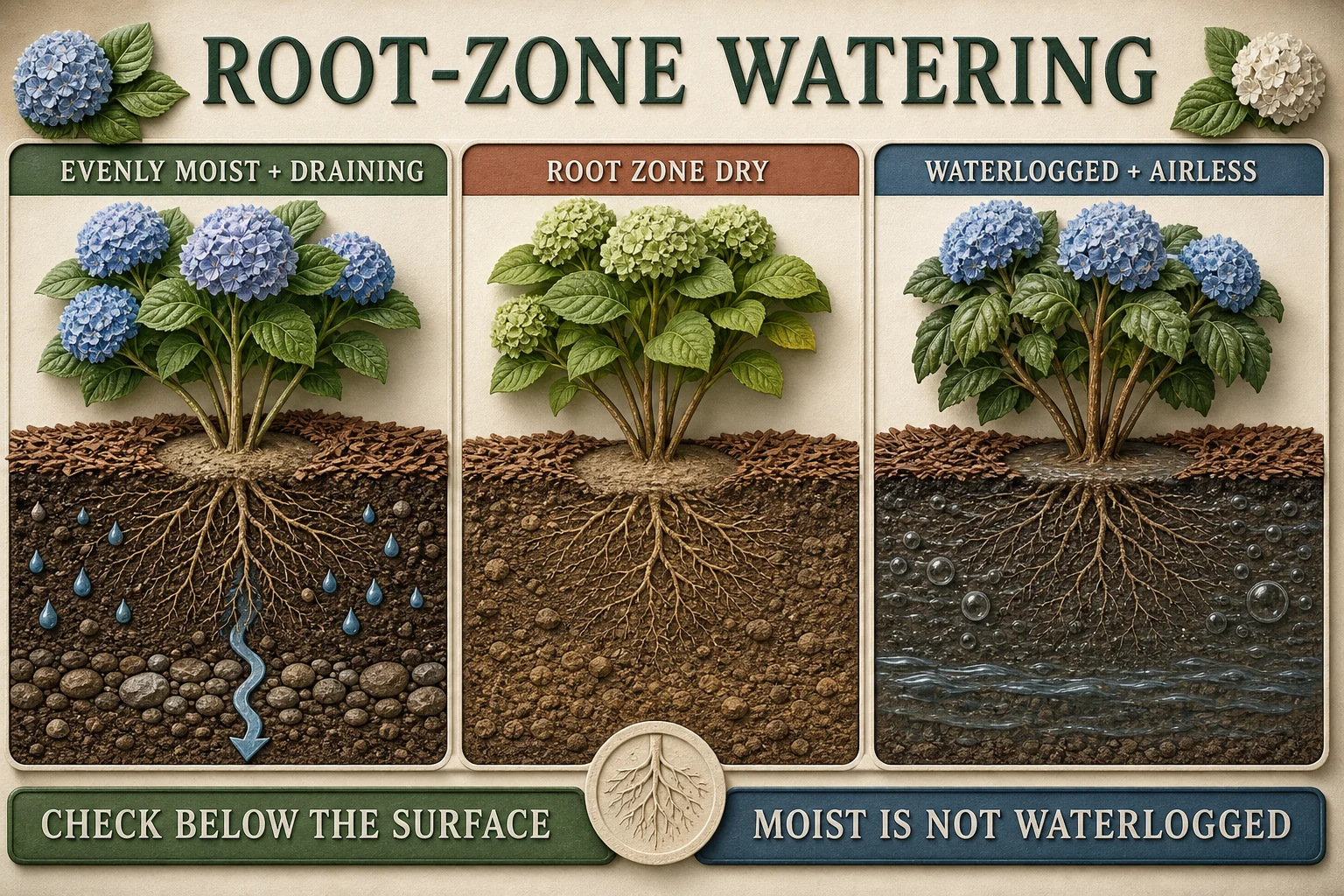
Hydrangeas use substantial water while establishing and during hot, dry weather, but their roots still need oxygen. Water thoroughly at the root zone when the surrounding soil is drying, then let excess move away. The interval depends on rainfall, soil texture, mulch, temperature, wind, plant size, and whether the shrub is newly planted or established. A fixed “once a week” rule can be too little in a heat wave and too much in cool wet soil.
- Check the soil several inches below the surface and look at the plant’s response, not only the top crust.
- Water slowly enough to wet the root zone rather than sending water down a narrow channel beside the root ball.
- After heavy rain, check whether the planting area drains or stays saturated.
- Use a mulch layer to reduce evaporation, but keep mulch away from direct contact with the crown and stems.
Newly planted hydrangeas need closer observation until roots extend into surrounding soil. Established shrubs may cope with short dry periods better than a fresh transplant, but tolerance varies with group, soil, roots, and weather. Repeated wilt, leaf scorch, yellowing, or leaf drop can also reflect root damage or disease. Do not keep adding water without checking drainage.
Soil, Mulch, and Flower Color
Hydrangeas generally prefer rich soil that retains moisture while draining excess water. Improve a poor planting site before planting rather than relying on repeated emergency fertilizer. Organic matter can improve structure, but the right amendment depends on the native soil and drainage. Container hydrangeas need a stable, draining potting medium and a container with drainage; they dry faster and require closer observation than shrubs in the ground.
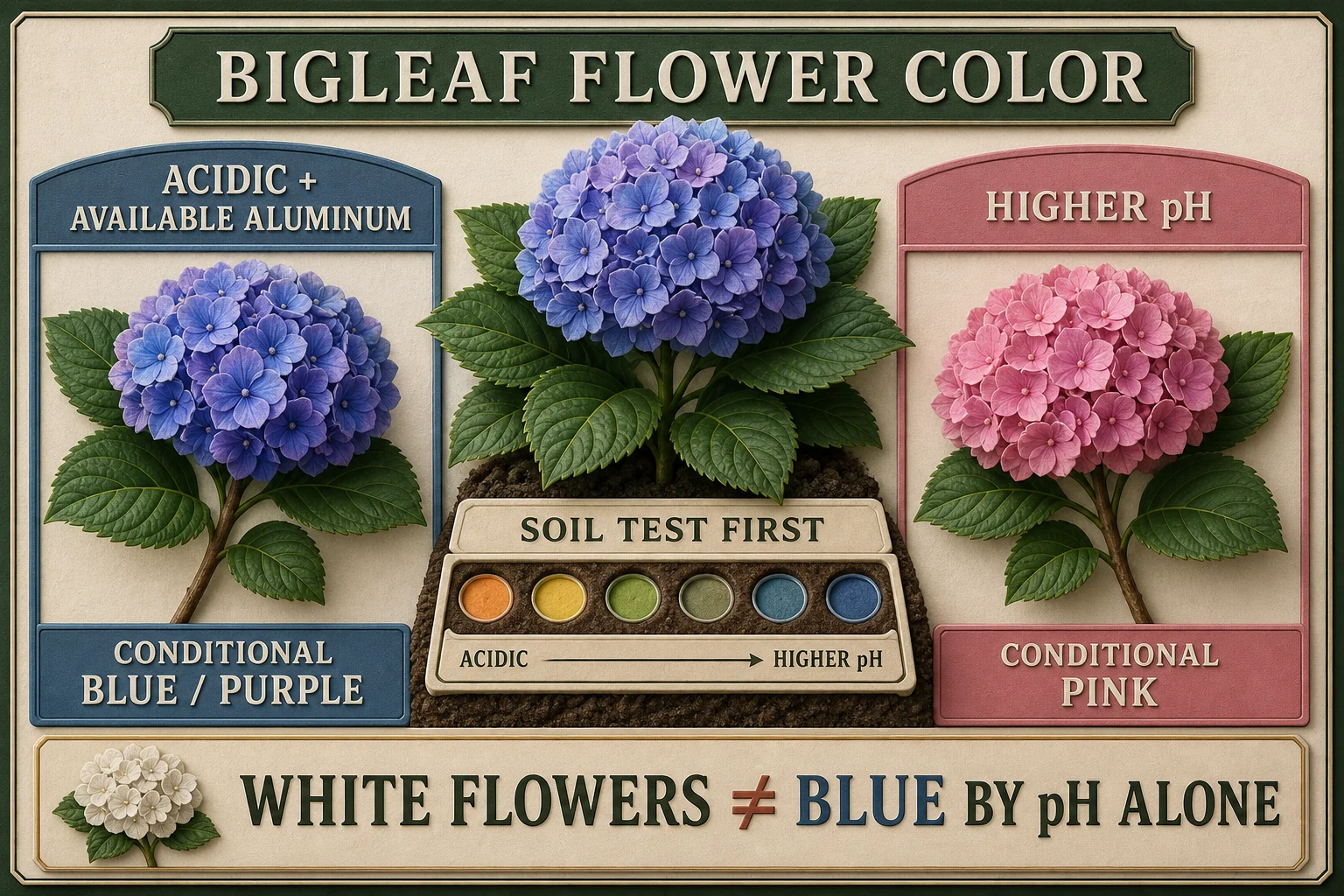
Flower color is mainly a bigleaf-hydrangea question. In suitable cultivars, lower pH can make aluminum more available and support blue or purple flowers; higher pH tends to support pink. The response varies with cultivar and soil chemistry, and white flowers are not turned blue by simply adding an acid product. Maryland Extension recommends testing soil and cautions against aluminum sulfate unless changing a pink bigleaf toward blue is actually the goal.
Test before changing pH. Do not use color additives to correct wilt, leaf spots, poor drainage, or a pruning mistake. A flower-color change is a multi-step soil-chemistry project, not a guaranteed seasonal result.
Prune by Flowering Wood
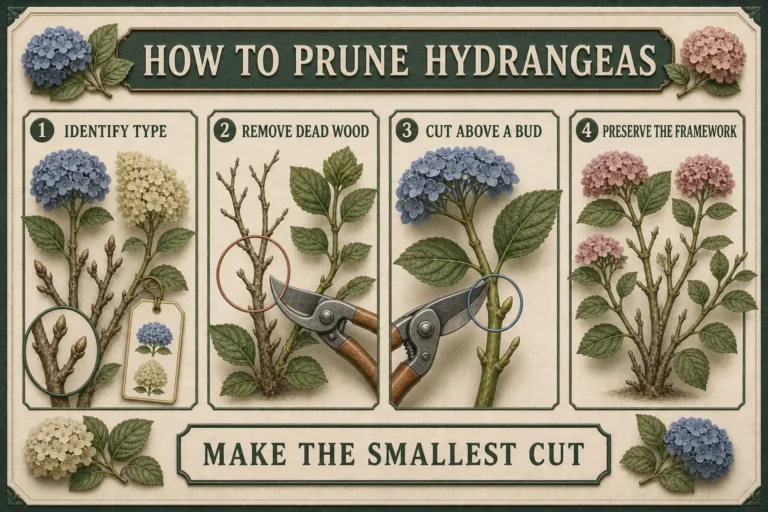
Pruning is where generic hydrangea advice causes the most damage. Identify the flowering wood first, then remove only what the plant and the season justify. Dead, broken, diseased, or dangerously crossing wood can be handled as a health or safety task, but a hard cut is not automatically “renewal.”
| If your hydrangea is… | Safer pruning starting point | What can go wrong |
|---|---|---|
| Bigleaf or oakleaf, flowering on old wood | Remove dead wood; after flowering, shorten only when you can identify spent stems and retain healthy framework | Fall, winter, or early-spring cuts can remove next season’s buds |
| Panicle or smooth, flowering on new wood | Structural pruning before active growth is often the relevant branch; keep a stable framework and follow local timing | Late or severe cuts can reduce current-season size and distort structure |
| Reblooming bigleaf cultivar | Light, selective pruning; preserve old stems if you want the earliest flush and accept that cuts may reduce some flowers | Treating it like a fully new-wood shrub can remove the old-wood crop |
| Climbing hydrangea | Prune for space or shape after flowering; remove damaged or unsafe growth | Hard cutting can remove the framework needed for climbing and bloom |
Pruning is conditional on type, cultivar, climate, and the plant’s current growth stage.
Bigleaf or oakleaf, flowering on old wood
Panicle or smooth, flowering on new wood
Reblooming bigleaf cultivar
Climbing hydrangea
UConn Extension summarizes the key timing rule: spring-blooming shrubs are pruned after flowering, while summer-blooming types can be pruned in spring or after bloom. That is a decision rule, not permission to cut an unidentified shrub on a fixed date.
For the full cut-by-cut process, see our step-by-step guide to how to prune hydrangeas, including old-wood versus new-wood timing, deadheading, and the safest cuts when the cultivar is unknown.
Feeding, Support, and Transplanting
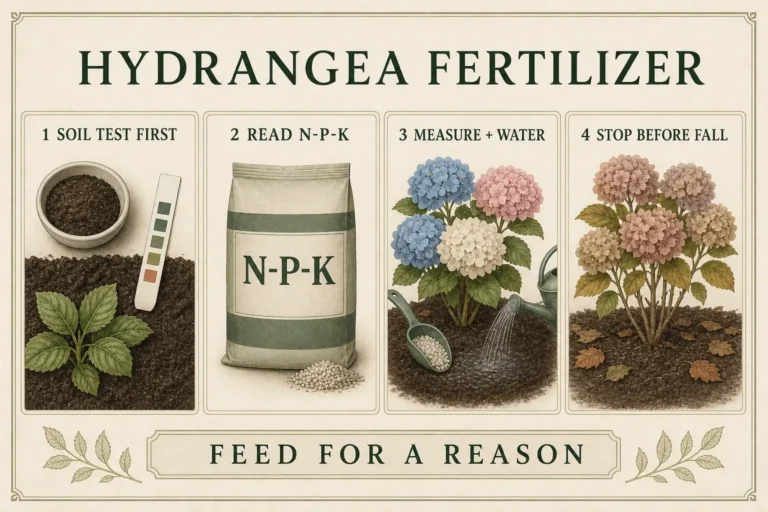
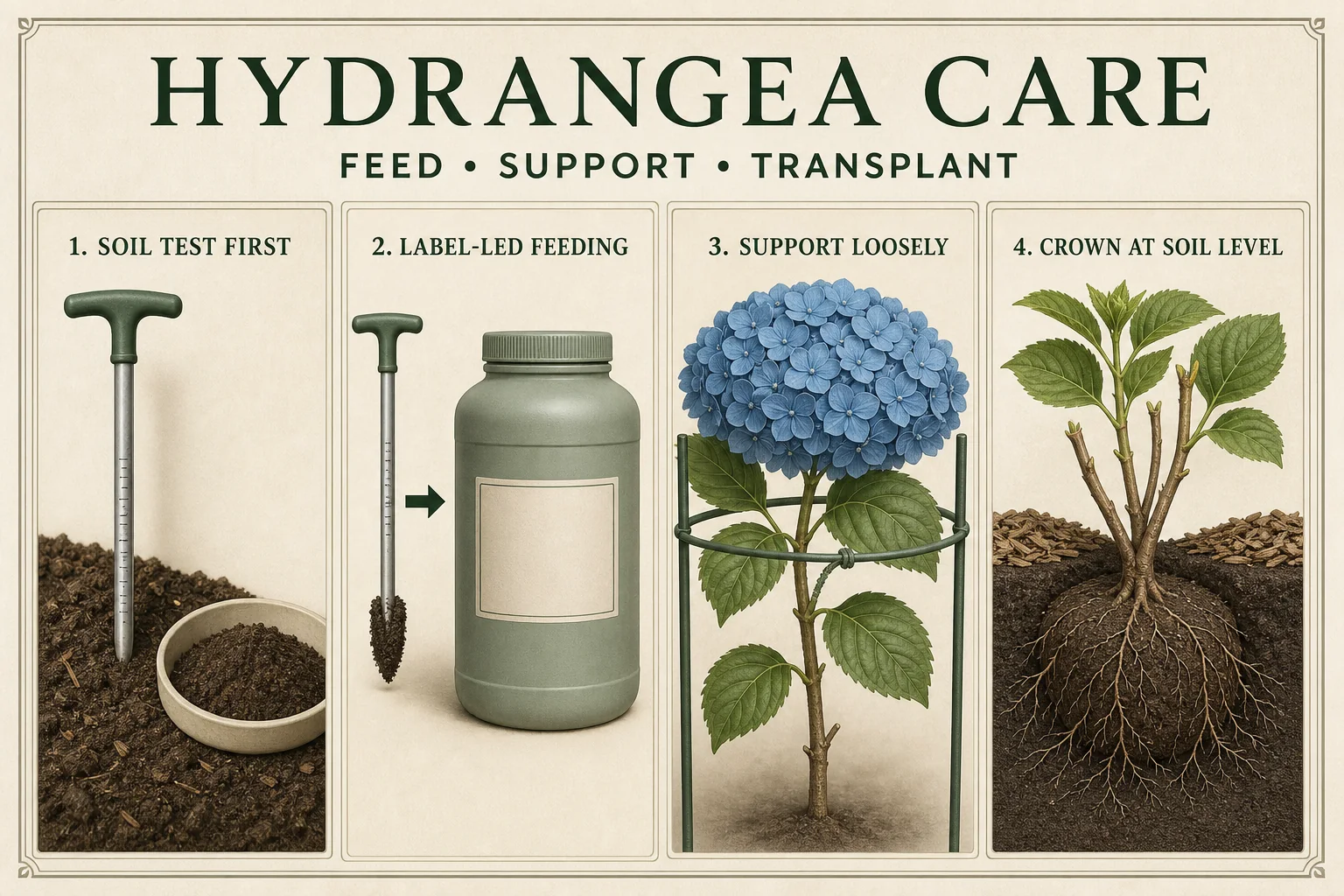
Fertilizer supports growth only when the root zone, light, and moisture are already workable. Excess nitrogen can produce leafy growth at the expense of flowering, and fertilizer cannot repair drought damage, root rot, frost injury, or a missing old-wood bud. Use a soil test or a product label suited to the planting rather than a universal monthly schedule.
For a type-first decision on products, timing, N-P-K, and when to skip feeding, see our hydrangea fertilizer guide. It separates nutrition from soil-pH color changes and explains why more fertilizer is not always more flowers.
Large flower heads may need support after rain, especially on young or heavily fed plants. UConn Extension notes that young stems can bend under large flower heads. Support is a structural choice, not proof that the shrub needs more fertilizer. Tie loosely and leave room for stems to expand.
Plant or transplant when the local climate gives the root system a reasonable establishment window. Dig a broad hole, keep the crown at the original level, water the root ball and surrounding soil, and mulch without burying the stems. Container hydrangeas may need more frequent checks because a small root volume heats and dries quickly.
Optional Tools After the Free Guidance
You do not need special equipment to follow this guide. These optional products are tied to specific bottlenecks: measuring soil before changing pH or nutrients, making a clean pruning cut, or supporting heavy flower heads after rain. Check the live Amazon listing for current price, stock, size, and compatibility before buying.
Affiliate disclosure: This section contains paid Amazon links. As an Amazon Associate, The Plant Manual may earn from qualifying purchases at no extra cost to you. Product suggestions are optional and never replace the free care guidance above.
For gardeners who want a lab-based soil report before changing pH or feeding.
A mail-in test that reports soil pH and nutrients with recommendations. It fits the article’s “test before changing chemistry” boundary; it is not a quick fix and does not guarantee blue flowers or better growth.
Skip it if: you already have a recent reliable soil report or you only need to check whether the root zone is currently dry.
For dead, damaged, or selectively pruned hydrangea stems within the tool’s capacity.
Bypass blades are a practical fit for clean cuts on live stems and small branches. Clean and disinfect the blades between plants, and do not use this hand pruner as permission to hard-cut an unidentified old-wood hydrangea.
Skip it if: your existing shears make a clean cut and can be cleaned safely.
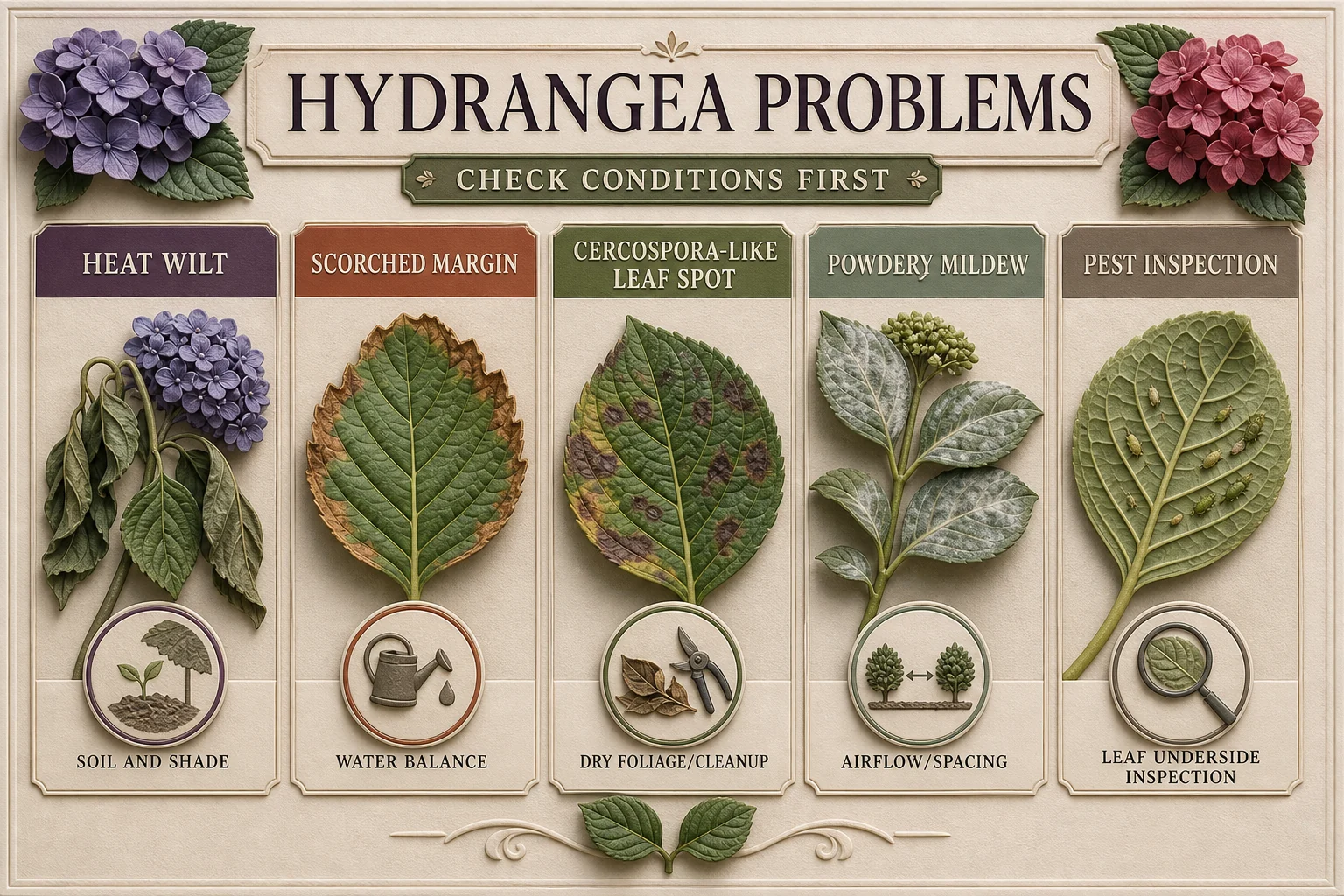
Read Wilt, Browning, Spots, and Pests
Start with the growing conditions before naming a disease. Maryland Extension notes that poor conditions, incorrect care, weather extremes, and soggy soil cause many plant problems, while pests may take advantage of a plant that is already declining.
| What you notice | Check first | Avoid as a reflex |
|---|---|---|
| Afternoon wilt that improves in cooler hours | Heat, wind, direct exposure, soil moisture, and whether the plant recovers overnight | Pruning healthy stems or flooding saturated soil |
| Brown, crisp margins or scorched patches | Dry root zone, hot sun, reflected heat, wind, frost, or recent transplanting | Assuming fertilizer deficiency or spraying a fungicide |
| Tan leaf spots with reddish or purple borders | Leaf wetness, crowded foliage, fallen leaves, and whether spots are spreading | Overhead irrigation and composting actively diseased tissue |
| White powder on leaves with yellow or purple blotches | Shade, stagnant air, humidity, and plant spacing | Increasing wetness or treating a color change as nutrient proof |
| Sticky leaves, stippling, webbing, notches, or skeletonized leaves | Leaf undersides, new growth, beetles, mites, aphids, and nearby plants | Using a broad-spectrum spray during bloom without considering pollinators |
| One shoot wilts while the rest declines later | Root-zone drainage, crown/stem tissue, and local extension diagnosis | Repeated watering without checking whether roots are functioning |
These are inspection prompts, not definitive diagnoses.
Afternoon wilt that improves in cooler hours
Brown, crisp margins or scorched patches
Tan leaf spots with reddish or purple borders
White powder on leaves with yellow or purple blotches
Sticky leaves, stippling, webbing, notches, or skeletonized leaves
One shoot wilts while the rest declines later
UConn Extension describes Cercospora spots, powdery mildew, root-rot conditions, aphids, beetles, and spider mites. Its disease guidance emphasizes minimizing leaf wetness and cleaning fallen leaves. If a plant is collapsing, several shrubs are affected, or lesions continue to spread, contact a local extension service or plant clinic.
Seasonal and Global Adjustments
US spring, summer, fall, and winter are useful planning labels, but the plant responds to temperature, day length, rainfall, frost, and soil moisture—not to a date on a calendar. In a hot US summer, afternoon shade and deeper root-zone moisture may matter more than fertilizer. In a cool, wet region, drainage and leaf-drying time may matter more. In the Southern Hemisphere, reverse seasonal examples while keeping the same biological decisions.
- After planting: prioritize root contact, steady moisture, and shelter from extreme sun or wind.
- During active growth: monitor water use, support heavy heads, and prune only when the type and flowering wood are known.
- After flowering: use spent flowers as a cue to check the pruning group, not as an automatic signal for a hard cut.
- Before winter: protect young plants from local frost and avoid late cuts on old-wood types.
For another ornamental plant with its own light, watering and pruning needs, see our Japanese maple care guide. Use the guidance for each plant separately when planning care around the garden.
Hydrangea Care FAQ
How often should I water hydrangeas?
There is no reliable universal interval. Check root-zone moisture, rainfall, heat, wind, soil drainage, and plant age. Water deeply when the surrounding soil is drying and let excess drain; newly planted shrubs need closer monitoring.
Do hydrangeas prefer sun or shade?
Many perform well with morning sun and afternoon shade, especially in hot climates. Exposure depends on species, cultivar, latitude, heat, wind, and moisture. Watch for repeated wilt and scorch rather than treating “full sun” or “shade” as universal instructions.
When is the best time to prune hydrangeas?
Identify the flowering wood first. Old-wood types are generally pruned after flowering and lightly; new-wood types can often be structured before active growth. Reblooming cultivars may use both, so a severe cut can still reduce flowers.
Why did my hydrangea not bloom?
Wrong-time pruning is a common cause, but late frost, excessive nitrogen, insufficient usable light, immature plants, deer, and weather damage can also matter. Check the type and whether old stems were removed before adding fertilizer.
Can I turn a pink hydrangea blue?
Some bigleaf cultivars can shift toward blue or purple when acidic soil and available aluminum support that response. Test the soil first. White flowers do not become blue simply because the soil pH changes, and no color change is guaranteed.
Why are my hydrangea leaves turning brown?
Heat, dry soil, wind, strong light, frost, transplant stress, soggy roots, pests, and leaf-spot diseases can all produce browning. Inspect the pattern and growing conditions before choosing a treatment.
Should I remove brown hydrangea leaves?
Remove leaves that are fully dead or clearly affected by a spreading leaf-spot problem, and clean up fallen tissue. Do not strip healthy foliage solely for appearance if the underlying stress is still active.
Do hydrangeas need fertilizer every month?
No universal schedule is safe. Fertilize only when the plant is actively growing and the soil, light, and water conditions are sound. Follow a suitable product label or soil-test recommendation; excess nitrogen can reduce flowering.
Can hydrangeas grow in containers?
Yes, with a container that drains, a stable moisture-holding mix, adequate root volume, and closer monitoring than an established shrub in the ground. Container roots heat and dry faster, and large plants may need support.
Sources
- University of Maryland Extension: Hydrangea — Identify and Manage Problems
- UConn Extension: When do I prune my hydrangea?
- UConn Extension: Hydrangea Diseases and Pests
- UConn Extension: Hydrangea varieties, planting, support, transplanting, and pruning
- University of Maryland Extension: Pruning tools and sanitation
- UC IPM: Hydrangea — identification, growing conditions, pruning, and disorders
- Ask Extension: Hydrangea leaf scorch and brown margins