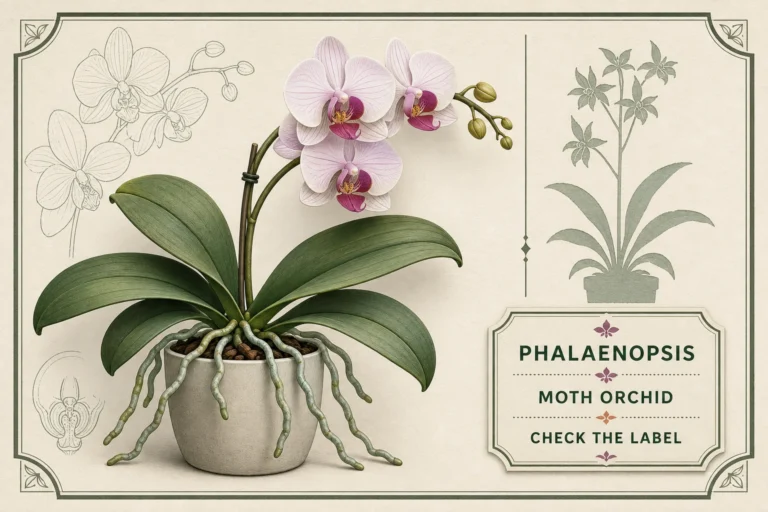
We bought our first orchid at a grocery store checkout. It was spectacular — cascading white blooms, deep green leaves, the whole display. We set it on the windowsill, watered it faithfully, and watched every single flower drop off over the next three weeks. What remained looked like a bare stick poking out of bark chips. We genuinely considered throwing it away.
We did not throw it away. And about four months later, it bloomed again — this time with even more flowers than when we bought it. That turnaround taught us more about orchid biology than any care guide we had read up to that point. If your orchid is sitting there looking like an expensive stick right now, this article is for you.
In this article – Table of Content
Looking to buy a healthy live plant online?

1-YEAR WARRANTY
Get a nursery-quality, well-rooted live White Phalaenopsis Orchid shipped directly to your door. Backed by a best-in-class plant warranty so you can shop with confidence.
Why Your Orchid Stopped Blooming (It Is Not What You Think)
Most people assume a bare orchid is a dying orchid. It is not. It is a resting orchid, and there is a significant difference. After flowering — which can last anywhere from 8 to 16 weeks — a Phalaenopsis orchid enters a vegetative rest phase. It is conserving energy, building up root mass, and waiting for the right environmental signal to tell it that conditions are favorable for another flowering cycle.
That signal is not just good intentions and regular watering. It is a specific combination of light, temperature, and nutritional cues. Without those cues, your orchid will sit in a holding pattern indefinitely — alive, healthy, and stubbornly refusing to produce a single bud. This is the situation millions of orchid owners find themselves in, and the fix is more straightforward than most guides make it sound.
If your plant is not getting enough natural light, this in a standard floor lamp changes everything:
Fits a standard lamp but delivers intense, full-spectrum light. Powerful enough for large floor plants in dark corners.
🔬 Research Note
Research on Phalaenopsis flowering physiology consistently shows that a diurnal temperature differential of 5.5–8°C (10–15°F) between day and night temperatures is the primary trigger for spike initiation. Studies at multiple horticultural institutions found that plants maintained at constant warm temperatures (above 24°C / 75°F around the clock) showed dramatically reduced or absent flowering compared to plants exposed to cooler nights in the 13–16°C (55–61°F) range for a period of 4–6 weeks. The mechanism involves the suppression of cytokinin activity during the cool phase, which shifts the plant’s hormonal balance toward reproductive rather than vegetative growth.
The Complete Step-by-Step Guide to Triggering a New Spike
Follow these steps in order. Skipping ahead — especially to fertilizing before a spike appears — is one of the most common reasons this process fails. Give each step its full time before moving to the next.
For anyone who forgets to fertilize, this is the answer:
Slow-release granules that feed for 6 months. Mix into the top of the soil and forget about fertilizing for half a year.
Step 1: Assess Plant Health Before Doing Anything Else
Before you try to trigger reblooming, your orchid needs to be in genuinely good health. A stressed or unhealthy plant will not produce a spike no matter what temperature tricks you try.
Look for these signs of a healthy plant:
- Leaves: Firm, upright, and medium to dark green. Slightly leathery is fine. Yellowing, soft, or wrinkled leaves indicate a problem that needs addressing first.
- Roots: Visible roots (in a clear pot) should be silvery-white when dry and bright green when recently watered. Firm roots are healthy. Black, mushy, or hollow roots indicate rot — deal with this before attempting to rebloom.
- No active pests: Check under leaves and in the crown for scale, mealybugs, or spider mites. A plant fighting a pest infestation cannot redirect energy to flowering. See our guide to common orchid pests if you spot anything suspicious.
If your orchid passes this health check, move on. If it does not, address the underlying issue first — then come back to this guide.
Step 2: Prune the Old Flower Spike Correctly
This is where a lot of people make a costly mistake. How you handle the old spike matters enormously.
If the spike is still green: Do not cut it to the base. A green spike may produce a secondary spray of flowers from a node further down. Locate the second or third node from the base (nodes look like small triangular bumps along the spike), and cut approximately 1 cm above that node using sterilized scissors or pruning shears. Some orchids will produce a secondary bloom branch from this point within 8–12 weeks.
If the spike has turned brown or yellow: It is spent. Cut it all the way down to the base, leaving about 2–3 cm above the potting medium. There is no benefit to leaving a dead spike — it draws no energy, but it can harbor pests and disease.
Always sterilize your cutting tool with rubbing alcohol before and after to prevent transmission of viral disease between plants.
Step 3: Optimize the Light Environment
Orchids need significantly more light than most houseplant owners provide. The default instinct to “protect” them from windows is exactly backwards. Phalaenopsis orchids need bright, indirect light — ideally 1,500 to 3,000 foot-candles, which corresponds to a spot within about 1 meter (3 feet) of a large east or west-facing window, or further back from a south-facing window with light shade.
Signs of insufficient light: dark, limp leaves; no new leaf growth; no spike even after a successful temperature treatment. Signs of too much direct sun: bleached, yellowish leaves with dry crispy patches.
For more detail on getting the light balance right, our dedicated guide on orchid light requirements covers this thoroughly.
Step 4: Create the Temperature Differential (The Core Trigger)
This is the step most guides mention but few explain practically. Your orchid needs cooler nights — specifically in the range of 13–16°C (55–61°F) — for a period of at least 4 weeks, ideally 6. The day temperature should remain in the normal range of 21–27°C (70–80°F). That gap between day and night is what triggers spike initiation.
The most practical way to achieve this without a greenhouse:
- Move the orchid to a windowsill during the evening and overnight — glass conducts cold from outside and will drop the temperature near the window by several degrees, even in a heated home.
- A north-facing or east-facing window in autumn or early winter tends to produce the right conditions naturally.
- An unheated spare room or enclosed porch that stays cool overnight works well.
- Avoid placing the orchid near a heating vent, radiator, or fireplace during this period.
Maintain this cool-night regime for a minimum of 4 weeks. Check nightly temperatures with an inexpensive thermometer if you are unsure — guessing often leads to conditions that are too warm.
Step 5: Adjust Watering During the Cool Period
During the 4–6 week temperature treatment phase, reduce watering slightly compared to your normal schedule. Allow the potting medium to dry out more fully between waterings — where you might normally water every 7 days, stretch this to every 10–12 days during the cool phase.
This slight moisture reduction mimics the drier conditions of the seasonal cue that triggers flowering in the wild. Do not let the plant desiccate completely — you will see wrinkled leaves if you go too far — but err toward dry rather than wet during this stage.
Once you see a new spike emerging (a small green nub, usually appearing at the base of a lower leaf), return to your normal watering frequency.
Step 6: Begin Fertilizing Once the Spike Reaches 5 cm
Fertilizing at the wrong stage is one of the top reasons rebloom attempts fail. Too much nitrogen during or before the temperature treatment phase encourages leafy vegetative growth instead of flowers — the plant has plenty of energy to grow green tissue and no incentive to flower.
Wait until the new spike is clearly visible and has grown to approximately 5 cm (2 inches) in length. At that point, switch to a bloom-boosting fertilizer with a low nitrogen, high phosphorus ratio. Look for products labeled with an N-P-K ratio like 10-30-20 or 3-12-6. These formulations support flower development rather than leaf growth.
Apply at half the recommended strength every two weeks while the spike is developing. Continue through blooming. After flowers drop, return to a balanced fertilizer for the maintenance phase.
💚 Emilie’s Tip
I mark the start of my temperature treatment on my phone calendar so I know exactly when 4 weeks is up. It is easy to think “it has probably been long enough” when it has actually only been 10 days. The full 4–6 weeks makes a real difference — the first year I tried this I gave up at 3 weeks, got nothing, and assumed the method did not work. The second year I was patient. Spike appeared at week 5. Patience is the actual secret ingredient here.
Realistic Timeline: When Will You See Results?
One of the most frustrating aspects of orchid reblooming is that nothing appears to be happening for a long time. Here is what the realistic timeline looks like so you know you are on track:
- Weeks 1–6: Temperature treatment phase. No visible change — the hormonal shift is happening internally. This is normal. Do not increase heat or fertilize early.
- Weeks 6–10: A small green or reddish nub should become visible at the base of the lowest leaves or from a node on a previously cut spike. This is the new inflorescence beginning to emerge.
- Weeks 10–16: The spike elongates, branching and developing bud sheaths. Individual buds become visible. At this stage the plant needs consistent conditions — avoid moving it, changing its orientation to the light, or dramatic temperature swings.
- Weeks 16–20: First flowers open. Full bloom typically follows over 1–2 weeks as buds open sequentially from bottom to top.
From starting the temperature treatment to full bloom, expect 4–5 months. This is not a fast process, and that is completely normal. An orchid that blooms for 3–4 months is making a significant biological investment — it takes time to build up to that.
Why Most Rebloom Attempts Fail
The House Is Too Warm at Night
This is the number one cause of failure. Modern homes maintained at a constant 22–24°C (72–75°F) year-round give orchids no seasonal signal. A spot that “feels cool” to you near a window may still only be dropping to 20°C (68°F) at night — not nearly cold enough. Use a min/max thermometer to actually measure overnight temperatures where the orchid is sitting. If the overnight reading is above 18°C (64°F), the trigger is not happening.
The Spike Was Cut at the Wrong Point
Cutting a still-green spike all the way to the base eliminates the chance of a secondary bloom from a lower node. On the other hand, leaving a completely brown, dead spike does nothing — it will not produce new flowers. Know the state of your spike before cutting.
High-Nitrogen Fertilizer During the Trigger Phase
Nitrogen encourages vegetative growth. If you are feeding a balanced or high-nitrogen fertilizer during the cool period, you are signaling to the plant that resources should go into leaves and roots — not flowers. Stop all fertilizing during the temperature treatment phase, then switch to a low-N bloom formula only after the spike appears.
🔬 Research Note
The relationship between nitrogen availability and flowering in Phalaenopsis has been studied in commercial greenhouse production. Growers routinely use a “nitrogen starvation” approach in the weeks before and during temperature treatment — reducing or eliminating nitrogen inputs to prevent vegetative dominance. This, combined with the temperature differential, has been shown to increase spike initiation rates by 40–60% compared to continuous fertilization protocols in controlled trials. The phosphorus component in bloom fertilizers also plays a direct role in flower bud development and pigmentation once the spike is growing.
Troubleshooting: What Is Going Wrong With Your Spike
The Spike Is Turning Yellow and Dying
A yellowing spike that shrivels before buds open is almost always caused by overwatering or root rot. The plant cannot support the energetic demand of flowering if its root system is compromised. Check the roots — if they are brown, mushy, or few in number, the spike will not survive. Deal with the root issue, let the plant recover, and try the rebloom process again from the start.
For this part of the guide, a researched product option that fits the job is:
Selected because this section is specifically about soil moisture meter use. Check Amazon for current price and availability.
Keikis Are Forming Instead of Blooms
A keiki (pronounced “KAY-kee”) is a plantlet that forms on the flower spike — essentially the orchid producing a clone of itself. While keikis can be a bonus (you can eventually separate and pot them), their appearance instead of flowers usually indicates excess nitrogen fertilization. Cut back on fertilizer, ensure you are using a bloom formula with low nitrogen once the spike appears, and the next cycle should produce flowers rather than plantlets.
A Spike Appeared, Then Stopped Growing (Bud Blast)
Bud blast — where buds form but then dry up and drop before opening — is typically caused by sudden environmental changes. Low humidity (below 40%), a nearby heating vent blowing dry air, or moving the plant after buds have set are the most common culprits. Once a spike has buds, keep the plant in one place, maintain humidity with a pebble tray or humidifier, and keep it away from drafts and heat sources.
For this part of the guide, a researched product option that fits the job is:
Selected because this section is specifically about humidifier use. Check Amazon for current price and availability.
💚 Emilie’s Tip
Once I can see individual buds forming on a spike, I basically treat the orchid like it is not allowed to move until it has finished blooming. I put a little sticky note on the pot that says “do not move” — it sounds silly but it has saved me from absent-mindedly shuffling it around the room when I am tidying up. Consistency at the bud stage is everything.
Reblooming Different Types of Orchids
Phalaenopsis (Moth Orchid)
The most common type. Responds to the temperature differential method described in this article. Tolerates lower light than most orchids. Blooms last 2–4 months and the plant can rebloom 1–2 times per year under good conditions. For potting medium guidance, see our article on the best orchid potting mix.
Dendrobium
Dendrobiums need a dry, cool winter rest to trigger flowering. Unlike Phalaenopsis, they should be watered very infrequently — sometimes just once every 3–4 weeks — during their rest period from autumn through late winter. Temperatures in the 10–15°C (50–60°F) range for 6–8 weeks are ideal. Resume regular watering when new growth appears in spring, and buds should follow within 4–6 weeks. Do not mist the canes during dormancy.
Cattleya
Cattleyas are light-hungry orchids that need a distinct dry rest combined with bright indirect or even filtered direct sun. After pseudobulbs mature (they will look plump and firm), reduce watering significantly for 6–8 weeks and ensure the plant is in the brightest location available. New growth following the rest period typically carries flower sheaths. Cattleyas are more sensitive to overwatering than Phalaenopsis — their potting medium should dry completely between waterings at all times, not just during rest.
Quick Reference: The Reblooming Checklist
- Plant health confirmed — firm leaves, healthy roots, no pests
- Old spike pruned correctly (green = cut above node 2 or 3; brown = cut to base)
- Light increased to bright indirect position near a window
- Night temperatures dropping to 13–16°C (55–61°F) for minimum 4 weeks
- Watering reduced slightly during cool phase
- No fertilizer during temperature treatment
- Spike visible and 5 cm long before switching to 10-30-20 bloom fertilizer
- Plant kept in stable position once buds form — no moving, no drafts
That orchid that looked like a bare stick? It is not done. It is waiting for the right signal. Give it that signal, and you will very likely be rewarded with a bloom display that rivals or exceeds what you brought home from the store.
Recommended Orchid Essentials
Each product below was hand-picked after thorough research and testing.
Great as a standalone or mixed into regular potting soil. Creates the air pockets aroids and epiphytes need to thrive.
Check Price → (paid link)
Premium long-fibre sphagnum moss. Used for propagating in moss, air layering, wrapping moss poles, and orchid potting.
Check Price → (paid link)
The long, narrow spout lets you water directly at the soil level without splashing leaves — keeps foliage dry and reduces fungal risk.
Check Price → (paid link)
Complete liquid fertilizer with all 16 essential nutrients. The 7-9-5 ratio is dialled in for lush foliage plants.
Check Price → (paid link)
Related Guides
- Orchid Light Requirements: How Much Is Enough? — Everything you need to know about positioning, measuring light intensity, and adjusting for different orchid types.
- Best Orchid Potting Mix: What Actually Works — Bark, moss, perlite, and mix ratios explained so you can repot with confidence.
- Common Orchid Pests and How to Deal With Them — Identification and treatment for the bugs most likely to show up on your plants.
Related guide: the full Phalaenopsis orchid care guide