
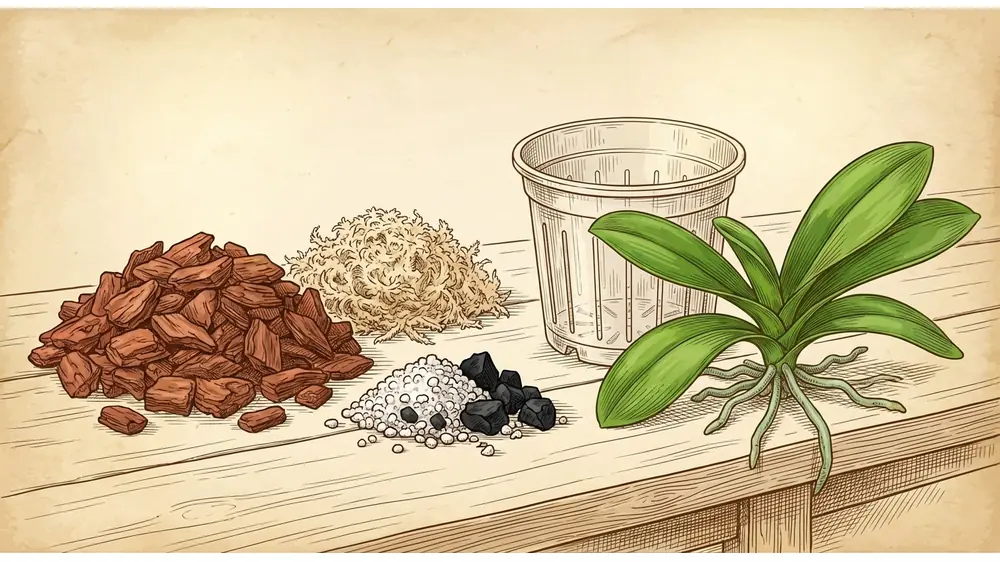
The Bag That Almost Killed Our Orchid
We bought the bag labeled "Orchid Mix" from the garden centre, repotted our Phalaenopsis, and three weeks later the roots had turned to mush. The plant looked fine on the outside and was rotting from the inside out.
The culprit was the potting mix. Not overwatering, not the light — just the wrong substrate packed too tightly around roots that needed air as much as they needed water.
Orchids are not like your Pothos or your Monstera. Most of them never touch soil in the wild. They grow on tree bark, in rock crevices, clinging to branches in tropical canopies where every rainstorm is followed by drying wind. Pack them into dense moisture-retaining compost and you slowly suffocate them.
This guide covers exactly what goes into a good orchid mix, how to match it to your specific plant, and the mistakes we made so you do not have to repeat them.
Why Normal Soil Kills Orchids
Most houseplant orchids — Phalaenopsis, Cattleya, Dendrobium — are epiphytes. They evolved to live on tree bark, exposed to heavy rain that drains away instantly, followed by drying breezes. Their roots are not built for constant moisture.
🔬 Research Note
The white or silver coating on healthy orchid roots is called velamen radicum — a layer of dead cells designed to absorb atmospheric moisture rapidly and then dry out completely. When you bury velamen in dense potting soil, gas exchange stops. Without oxygen at the root zone, the tissue dies and fungal pathogens move in fast. Orchid roots also uptake nutrients best at a substrate pH of 5.5–6.5. As organic media breaks down it becomes more acidic, often dropping below 5.0, which burns the roots directly.
The goal of your potting mix is to engineer a wet-dry cycle inside a pot — holding just enough humidity around the roots without ever cutting off the oxygen supply. That is a fundamentally different job to what regular potting compost does.
The Five Ingredients Worth Knowing
Most good orchid mixes combine two or three of these. You rarely need all five at once.
1. Fir Bark — The Foundation
The standard base for almost every orchid mix. It drains fast, mimics the tree-bark habitat orchids evolved on, and holds a slightly acidic pH that suits them well. The downside: it breaks down over 12–24 months into a compacted sludge that suffocates roots. When buying, look for hard chunky pieces with no dust. If it looks like mulch, decomposition has already started.
Grade matters. Use fine bark for seedlings or thin-rooted orchids like Oncidium. Use medium to coarse bark for thick-rooted plants like Phalaenopsis and Cattleya.
2. Sphagnum Moss — The Moisture Buffer
Sphagnum holds up to 20 times its own weight in water, making it ideal for moisture-loving orchids in dry heated homes. The risk is packing it too tightly — if it stays saturated, root rot follows quickly. Use it as an amendment to your bark base, not as the base itself.
3. Perlite — The Air Gap
Expanded volcanic glass — inert, sterile, and excellent for increasing airflow and preventing the mix from compacting over time. It holds no nutrients so it is purely structural. It does float to the surface when watering, which is a minor annoyance.
4. Horticultural Charcoal — The Purifier
Charcoal absorbs fertiliser salts that accumulate in the mix over time. Orchids are sensitive to high mineral levels, and salt buildup is a slow killer. It also creates large air pockets and keeps the mix from going sour. Use horticultural charcoal only — not BBQ briquettes.
5. LECA — The Semi-Hydro Option
Baked clay balls that never rot and provide exceptional airflow. LECA works best in semi-hydroponic setups rather than traditional potting — it holds almost no water or nutrients on its own and is not a direct swap for bark in a standard pot.
The Right Mix for Your Orchid
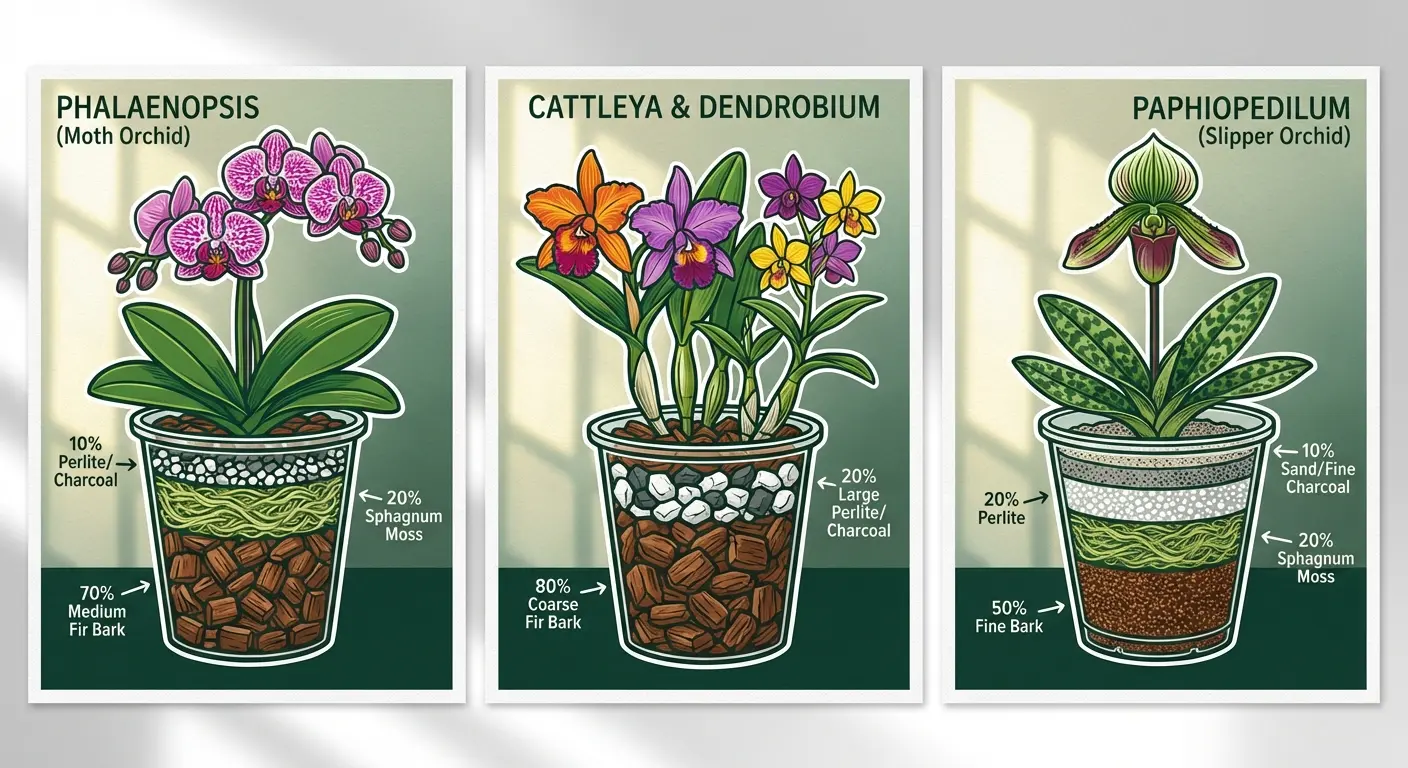
The Orchidaceae family has over 28,000 species. One mix does not fit all. Here is how to approach the three most common groups you will find as houseplants.
Phalaenopsis (Moth Orchids)
The most common houseplant orchid — monopodial growers from Southeast Asia with no pseudobulbs to store water. They cannot dry out completely between waterings, especially in heated indoor environments where humidity often drops below 40%.
Recipe: 70% medium fir bark, 20% sphagnum moss, 10% perlite or charcoal. The moss keeps roots from dehydrating between waterings while the bark provides structure and airflow.
Cattleya and Dendrobium
Sympodial orchids with thick pseudobulbs that store water. Adapted to distinct dry periods, their roots are highly prone to rot if kept consistently moist.
Recipe: 80% coarse fir bark, 20% large perlite or charcoal. No sphagnum moss unless your home is unusually dry or warm. These plants need to dry out almost completely between waterings.
Paphiopedilum (Slipper Orchids)
Semi-terrestrial orchids that grow in leaf litter on forest floors. They prefer a finer, more moisture-retentive mix than the epiphytes above.
Recipe: 50% fine bark, 20% sphagnum moss, 20% perlite, 10% fine charcoal or horticultural sand. Their hairy roots should not dry out completely between waterings.
How to Prepare Your Mix and Pot Your Orchid
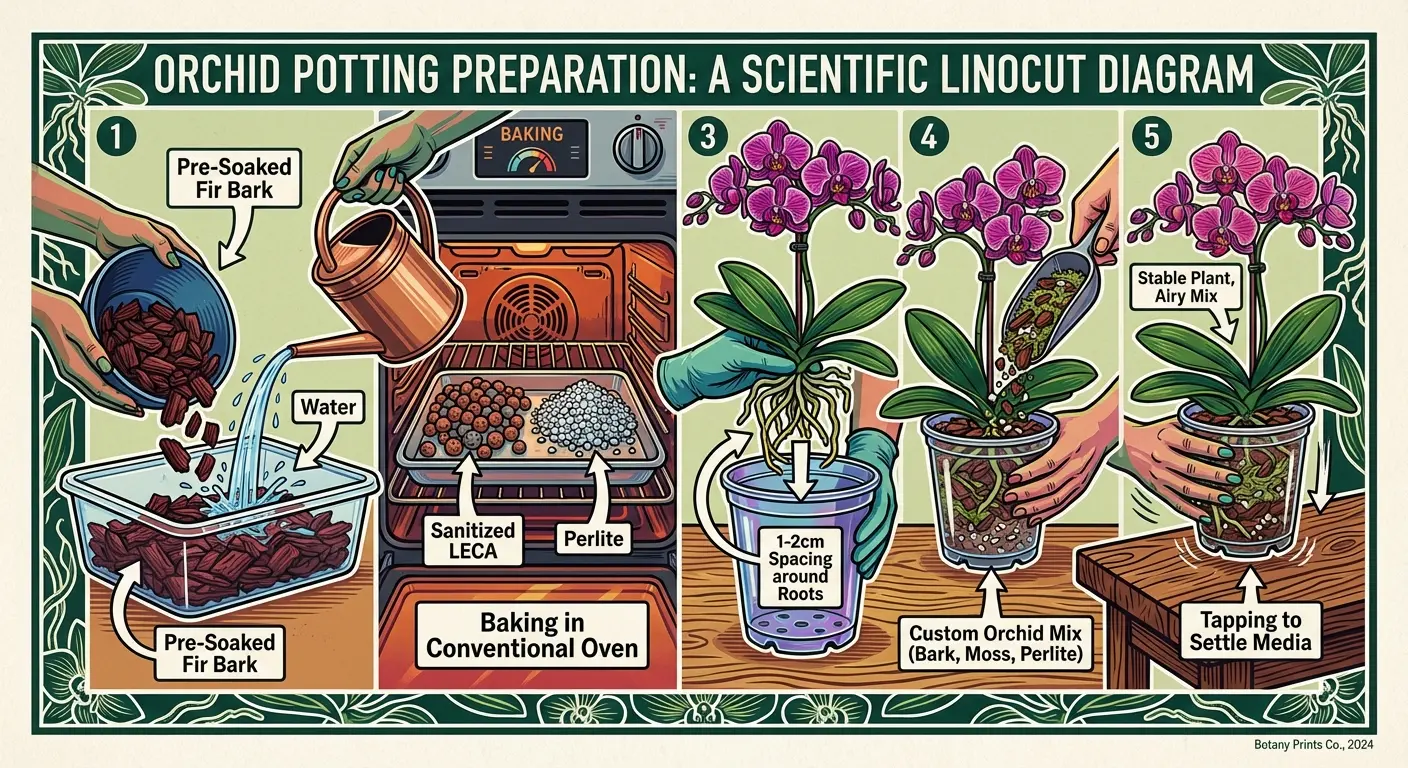
- Pre-soak your bark. Dry bark repels water. Soak it for 24 hours before use so it absorbs moisture properly rather than channelling water straight past the roots.
- Choose the right pot size. Orchids like to be snug. A pot that is too large holds excess mix that stays wet in the centre — that wet core breeds rot. Leave only 1–2 cm of space around the root ball.
- Layer from the bottom. Place a layer of large bark or LECA at the base for drainage, then hold the orchid in place and pour the mix around the roots.
- Tap, do not press. Never push the mix down hard — that crushes the air pockets. Tap the pot firmly on the table to settle the media into the gaps. The plant should feel stable but the mix should still feel loose and airy.
- Use clear pots if you can. Clear plastic nursery pots inside decorative ceramic ones let you see exactly when the roots turn silvery-white and dry — a reliable signal it is time to water.
The Most Common Potting Mistakes
Using Regular Potting Soil
The particle size is too fine. It packs into a dense cake around the velamen and cuts off oxygen within days. Even bags labelled "for tropical plants" will kill epiphytic orchids if the texture looks like dirt.
Over-Potting
A pot that is too large leaves the roots unable to absorb moisture from the excess volume of mix, creating a permanently wet anaerobic centre that breeds rot. Tight pots are not cruel — they are correct for orchids.
Ignoring Decomposition
Bark and moss break down over 18–24 months, compacting the mix and acidifying it below the 5.5 pH threshold where root burn begins. If you smell something musty or see small white mushrooms growing on top of the mix, repot immediately — even if the plant is in bloom.
Quick Summary
- No soil. Orchids are epiphytes. Their roots need air as much as water.
- Start with fir bark. Fine grade for thin roots, medium-coarse for thick roots.
- Add moss for moisture, perlite or charcoal for airflow. Adjust the ratio to your home's humidity level.
- Repot every 18–24 months. Decomposing bark turns acidic and burns roots.
- Keep the pot tight. Over-potting causes the rot that kills most indoor orchids.
Frequently Asked Questions
Why are my orchid's roots turning black and mushy?
Root rot — almost always caused by a mix that retains too much water or has broken down into dense sludge. Remove the dead roots, let the remaining roots air dry for a few hours, then repot into fresh coarse bark with perlite and charcoal to restore airflow.
Why are my orchid leaves wrinkled despite regular watering?
Wrinkled leaves often mean the roots cannot absorb water — either because the mix is too coarse and water runs through too fast, or because the roots have already rotted. Check the root system first. If roots are healthy but dry, add sphagnum moss to your mix to increase moisture retention.
What does white fuzz on top of my orchid bark mean?
Snow mould or fungal growth — a sign the media is breaking down and becoming anaerobic. The bark has likely turned acidic and compact. Replace the mix immediately rather than waiting for the next scheduled repot.
Why are my orchid leaf tips turning brown and crispy?
Salt burn from fertiliser buildup in the mix. Flush the pot thoroughly with distilled water, but if it keeps returning, repot into fresh media — old decomposing bark holds onto mineral deposits no matter how much you flush.
Why are there tiny black flies in my orchid pot?
Fungus gnats. Their larvae need moist decaying organic matter to survive. Switch to a chunkier, faster-draining bark mix to remove the damp environment they breed in.


0 Comments