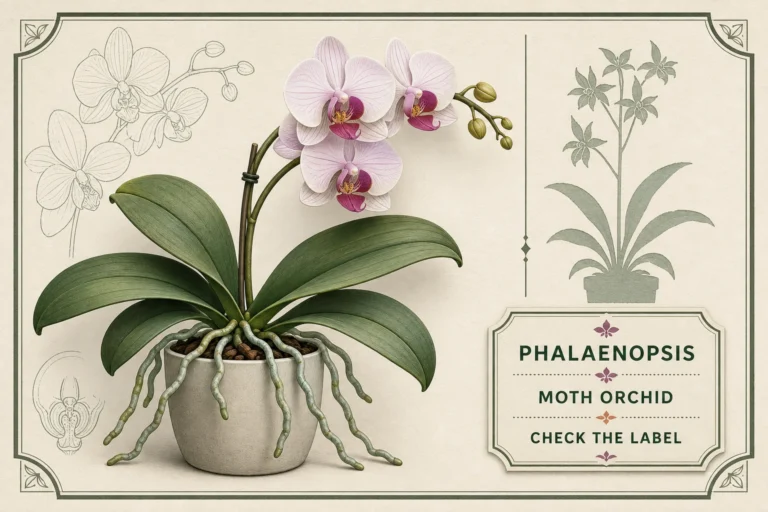
We almost gave up on orchids entirely because of one mistake we made early on. We had a beautiful Phalaenopsis — healthy roots, glossy leaves — and we tucked it into a cozy corner of the living room because we had read that orchids needed “indirect light.” That corner was dim and sheltered, exactly what “indirect” sounded like to us. Six months later, the plant was alive but barely. No new leaves, no spike, no blooms. Just sitting there, slowly running out of energy.
Transparency note: Some links in this article are affiliate links. As an Amazon Associate I earn from qualifying purchases — at no extra cost to you. I only recommend products I have personally researched and believe are useful.
It turned out we had confused “indirect” with “low.” Those two words are not the same thing, and that single misunderstanding is probably the most common reason orchid owners never see a second bloom. Light is not just one factor among many for orchids — it is the engine that powers everything. Get it right, and your orchid will grow, spike, and rebloom reliably. Get it wrong, and no amount of perfect watering or fertilizing will compensate.
In this guide we are going to walk you through exactly what orchids need in terms of light, how to measure it, how to read your plant’s leaves as a live feedback system, and how to adjust for seasons and artificial lighting. By the end, you will know precisely where to place every orchid in your home.
Why Light Is the #1 Driver of Orchid Blooming
Every orchid bloom you have ever seen started with light. Not water, not fertilizer, not a lucky placement — light. Here is why that is true at a biological level.
Photosynthesis is the process by which a plant converts light energy into sugars. Those sugars are the plant’s currency — they pay for every cellular process, every root tip, every new leaf, and critically, every flower spike. Orchids are not heavy feeders by plant standards, but they are heavy energy investors when it comes to flowering. Producing a spike with multiple blooms costs a significant amount of stored energy. If a plant is not receiving enough light, it cannot accumulate the sugar reserves required to trigger or sustain that investment. The plant simply will not bloom, no matter how perfect everything else is.
🔬 Research Note
Studies on Phalaenopsis flowering have consistently shown that daily light integral (DLI) — the total amount of light a plant receives over a full day — is more predictive of bloom induction than any single moment of peak brightness. A plant receiving moderate consistent light throughout the day outperforms one that gets a brief burst of intense light. This is why window placement matters more than occasional direct sun. Research published in horticultural science journals on controlled Phalaenopsis production environments places the optimal DLI range at 4–6 mol·m⁻²·d⁻¹ for reliable bloom induction, which corresponds to roughly 1,000–1,500 foot-candles over a 12-hour photoperiod.
Before moving your plant, measure the actual light levels. Gut feeling is usually wrong:
Measures light in foot-candles and lux. Takes the guesswork out of window placement and grow light positioning.
Understanding Foot-Candles and Lux: How We Measure Plant Light
When orchid growers talk about light requirements, they use a unit called foot-candles (FC). One foot-candle is the amount of light produced by one candle at a distance of one foot. Lux is the metric equivalent — 1 foot-candle equals approximately 10.76 lux. Neither unit is something you can see with your eyes, which is exactly why so many growers misjudge their light levels.
A shaded interior corner of a room on a bright day might measure 50–150 FC. Near a north-facing window you might get 200–400 FC. Near an east or west window without obstruction you can reach 800–1,500 FC. In direct outdoor sun, values exceed 10,000 FC. The difference between a bright room and what orchids actually need is larger than most people realize.
The simplest way to get accurate readings is to use a light meter app on your phone, or a dedicated lux meter. Hold it at the level of your plant’s leaves and take readings at different times of day. The morning reading, midday reading, and afternoon reading will often differ dramatically, giving you a realistic picture of what your orchid is actually experiencing.
💚 Emilie’s Tip
I check light levels at 10 AM and again at 2 PM and average the two. That gives me a more realistic sense of what the plant is working with across the day. I also check in summer and again in winter, because the same window can read 1,400 FC in July and only 600 FC in December. Those are two completely different growing conditions even though nothing in the room has changed.
Decoding “Bright Indirect Light” Once and for All
“Bright indirect light” is probably the most repeated and least explained phrase in all of houseplant care. Here is what it actually means in practical terms for orchids.
Bright indirect light means the plant is receiving high levels of ambient light — enough to cast a soft shadow — but it is not in the direct path of the sun’s rays during the harshest part of the day. An east-facing window delivers direct morning sun from roughly sunrise until 10 or 11 AM, then bright indirect light for the rest of the day. That combination is ideal for most orchids. A west-facing window gives direct afternoon sun, which is more intense but still workable with a sheer curtain. A south-facing window in the northern hemisphere delivers the longest day of direct sun and needs a sheer curtain or some setback distance for most orchids. A north-facing window is genuinely low light and is difficult for all but the most shade-tolerant orchids.
If your plant is not getting enough natural light, this in a standard floor lamp changes everything:
Fits a standard lamp but delivers intense, full-spectrum light. Powerful enough for large floor plants in dark corners.
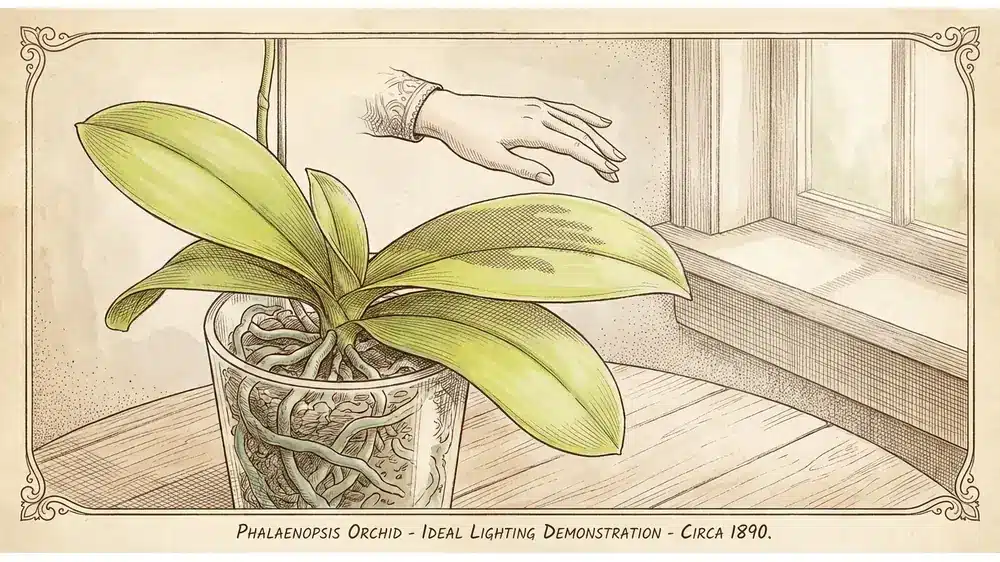
The key practical test: if you hold your hand about a foot above a white piece of paper in the spot where your orchid lives, and you see a soft but defined shadow, you have good light. If you see no shadow at all, the light is too low. If the shadow is crisp and dark, the sun is hitting too directly.
Light Requirements by Orchid Type
Not all orchids have the same light needs. Understanding where your specific orchid falls on the spectrum is the first step to placing it correctly in your home.
Low Light Orchids: Phalaenopsis and Paphiopedilum (1,000–1,500 FC)
Phalaenopsis — the moth orchid — is by far the most common orchid sold in stores, and it is the most forgiving in terms of light. In its natural habitat it grows in the filtered shade of tropical forest canopies, so it has adapted to lower light levels than most other orchid genera. Paphiopedilum, the slipper orchid, shares a similar background and similar needs.
Both of these orchids thrive at 1,000–1,500 foot-candles (approximately 10,000–16,000 lux). An east-facing window is the classic placement — they get gentle morning sun and bright indirect light through the rest of the day. A west-facing window also works well with a sheer curtain to diffuse the stronger afternoon sun. Keep them at least 12–18 inches back from a south-facing window, or use a sheer curtain to knock the intensity down.
Medium Light Orchids: Cattleya, Dendrobium, Oncidium (2,000–3,000 FC)
Cattleyas are the classic corsage orchids with large, dramatic blooms. Dendrobiums are cane-forming orchids with cascading flowers. Oncidiums — often called dancing lady orchids — produce long sprays of small blooms. All three require more light than Phalaenopsis and will struggle to bloom in the same east-window setup that works for moth orchids.
The target range is 2,000–3,000 foot-candles (approximately 21,500–32,000 lux). A south-facing window with a thin sheer curtain is often ideal. An east-facing window that receives long morning sun — several hours of direct rays — can also work. West windows with direct afternoon sun are a possibility if you monitor for leaf burning.
🔬 Research Note
Cattleya and Dendrobium orchids in their native tropical habitats often grow on exposed tree branches or in open canopy gaps where they receive several hours of direct or near-direct sun daily. The light intensity in those conditions can reach 4,000–6,000 FC. The indoor target of 2,000–3,000 FC represents a conservative growing environment that still enables reliable blooming without the water stress that comes with full tropical exposure.
High Light Orchids: Vanda and Cymbidium (3,000–4,500 FC)
Vanda orchids are among the most spectacular in the family — large, waxy, long-lasting blooms in vivid colors. Cymbidiums produce tall elegant spikes that can carry dozens of blooms for weeks. Both are known as high-light orchids, and they are genuinely difficult to grow indoors without a very specific setup.
The light requirement of 3,000–4,500 foot-candles (approximately 32,000–48,000 lux) means these plants need direct morning sun and as much bright indirect light as possible for the rest of the day. An unobstructed south-facing window or a covered patio or greenhouse space is typically what makes these plants happy. If you are determined to grow Vandas or Cymbidiums indoors without ideal windows, a high-output grow light setup is essentially mandatory.
💚 Emilie’s Tip
I keep our Vandas in a hanging basket right in the window during spring and early summer, then move them outdoors to a covered porch when temperatures are reliably warm. The outdoor light — even filtered through a shade cloth — is dramatically better than anything indoors, and you can see it in the growth. New roots and new leaves appear much faster once they are outside. If you have Vandas and access to any outdoor space in summer, use it.
Reading Your Orchid’s Leaves as a Light Meter
You do not need any equipment at all to get a reasonable read on whether your orchid is receiving the right amount of light. The leaves will tell you, if you know what to look for. This is one of the most useful skills in orchid growing — learning to interpret what the plant itself is communicating.
What Leaf Color Tells You About Light
- Deep, dark green leaves — The plant is not getting enough light. Dark green is the plant maximizing its chlorophyll production to capture whatever little light it has. This is a survival response, not a sign of health. A dark-green Phalaenopsis is almost certainly not going to spike. Move it closer to the window.
- Medium green leaves — The plant is photosynthesizing adequately but may still be on the lower end of its preferred range. Acceptable but not optimal for blooming.
- Yellow-green or slightly olive-toned leaves, sometimes with a faint reddish blush — This is the target. This color indicates the plant has almost more light than it needs for maximum chlorophyll efficiency, and that abundance is exactly what triggers bloom production. Many experienced growers aim for this leaf tone deliberately.
- Yellow patches or overall washed-out yellow — Possibly too much direct sun, or other stress (overwatering, nutrient deficiency). Check placement and context carefully.
- Brown or rust-colored dry patches, bleached white areas, or leathery texture on exposed surfaces — Sunburn. Too much direct intense sun, particularly midday or afternoon in summer. Move the plant back or add a sheer curtain. Sunburned patches do not recover, but healthy new leaves will grow if the cause is removed.
Seasonal Adjustments: The Window That Changes Twice a Year
One thing that catches many orchid growers off guard is how dramatically the same window changes between summer and winter. In summer, the sun rises earlier, sets later, and climbs higher — meaning more total hours of light and more intense midday sun. In winter, the sun stays low on the horizon, rises late, sets early, and the total daily light through the same window can drop by 40–60 percent compared to midsummer.
This means your orchid placement should not be static. What worked perfectly in February might cause leaf burn by July. What kept your Cattleya happy in July might leave it starving for light by November.
Seasonal Light Management
- Late spring through summer: Move orchids slightly back from south and west windows, or add a sheer curtain. Even east windows can deliver surprisingly intense morning sun in midsummer — check leaf color and watch for bleaching.
- Fall through winter: Move orchids closer to windows. Remove sheer curtains if you were using them. A Phalaenopsis that was 18 inches from the window in July may need to be right on the windowsill by December.
- Clean your windows: Dirty glass can reduce light transmission by 10–15%. Clean windows in fall before the low-light season begins.
- Watch for obstruction changes: A deciduous tree that provided nice dappled shade in summer will be bare in winter. Check your windows in both seasons.
💚 Emilie’s Tip
I put a small sticky note on the back of each orchid pot with the date I last moved it and what light reading I got. When I move it seasonally, I update the note. After two seasons you start to know your windows instinctively, but that first year the notes are genuinely useful.
Grow Lights: When Your Windows Are Not Enough
Not every home has great windows. North-facing apartments, heavily shaded rooms, and offices are all real environments where people want to grow orchids. Modern LED grow lights have made supplemental lighting genuinely viable — far better than the fluorescent tubes of previous generations.
Setting Up Grow Lights for Orchids
- Distance: Position the grow light 6–8 inches above the top of the plant for most LED panels. Check the manufacturer’s recommendations — output varies enormously between products.
- Duration: Run the light for 12–14 hours per day on a timer. Orchids need a dark period — running lights 24 hours can disrupt their biological rhythms.
- Supplement, don’t replace: If you have any natural light at all, use grow lights to extend or supplement it. Set the timer to run a few hours before sunrise and again after window light fades.
- Choose full-spectrum: Look for full-spectrum LED with far-red supplementation (around 730nm) — research shows this produces better flowering outcomes than red-blue lights alone.
- Rotate your plants: The center of the panel delivers more intensity than the edges. Rotate orchids a quarter turn every week or two for even exposure.
Light and Reblooming: The Connection You Cannot Ignore
If you have an orchid that has not rebloomed in more than a year, the single most likely reason is insufficient light. We have been there. We adjusted watering, tried temperature drops, changed fertilizer — and none of it made any difference until we moved the plant to a genuinely bright window. Within ten weeks there was a new spike.
Reblooming requires energy. That energy comes from photosynthesis. If the plant has been running on a deficit — taking in less light energy than it needs to fully thrive — it will not invest in flowering. Moving a non-reblooming orchid to better light is almost always the right first intervention, before trying anything else.
For a deeper dive into everything that drives reblooming — including temperature drop techniques and fertilizing schedules — see our full guide on how to make orchids rebloom.
💚 Emilie’s Tip
When someone tells me their orchid hasn’t rebloomed, my first question is always: where is it sitting? Nine times out of ten it’s somewhere beautiful but dim — on a coffee table, on top of a bookshelf, in the center of a room. I ask them to move it to the closest east or south window they have, right up against the glass, and check back in eight weeks. Most of the time, that’s the whole fix. Light is not one variable among many. For orchids, it is the variable.
Quick Reference: Orchid Light Requirements at a Glance
Light Summary by Orchid Type
- Phalaenopsis and Paphiopedilum: 1,000–1,500 FC / 10,000–16,000 lux. East window, or west window with sheer curtain.
- Cattleya, Dendrobium, Oncidium: 2,000–3,000 FC / 21,500–32,000 lux. South window with sheer curtain, or east window with 4+ hours direct morning sun.
- Vanda, Cymbidium: 3,000–4,500 FC / 32,000–48,000 lux. Unobstructed south window, outdoor covered porch in summer, or high-output grow light setup.
- All types — seasonal: Move closer to windows in fall/winter; slightly back or add sheer curtain in summer.
- All types — grow lights: Full-spectrum LED with far-red, 6–8 inches above plant, 12–14 hours/day on a timer.
Recommended Orchid Essentials
Each product below was hand-picked after thorough research and testing.
Great as a standalone or mixed into regular potting soil. Creates the air pockets aroids and epiphytes need to thrive.
Check Price → (paid link)
Premium long-fibre sphagnum moss. Used for propagating in moss, air layering, wrapping moss poles, and orchid potting.
Check Price → (paid link)
The industry standard for plant shelves. Run cool, easy to mount under shelves, and give a warm pleasant light.
Check Price → (paid link)
The long, narrow spout lets you water directly at the soil level without splashing leaves — keeps foliage dry and reduces fungal risk.
Check Price → (paid link)
As an Amazon Associate I earn from qualifying purchases.
Related Guides
- Best Orchid Potting Mix: What to Use and Why It Matters — The right mix ensures roots get the air circulation and drainage orchids evolved to need.
- How to Make Orchids Rebloom: The Complete Guide — Everything from light and temperature to fertilizing and timing to get your orchid flowering again.
- Common Orchid Pests: How to Identify and Treat Them — The bugs that attack orchids, how to spot them early, and how to deal with infestations without harming your plant.
Related guide: the broader Phalaenopsis orchid care routine