| Symptom | Most likely cause | First fix to try |
|---|---|---|
| Long splits in otherwise firm green leaves | Normal leaf behavior, movement, or age | Leave the leaf on the plant unless it is mostly damaged |
| Leaves curling inward or canoeing | Watering stress, unevenly dry soil, or root trouble | Check moisture deep in the pot before watering again |
| Brown crispy edges spreading from the margins | Dry air, drought swings, mineral salts, or heat stress | Flush the soil, stabilize watering, and move away from vents |
| Soft stems, yellowing, sour soil smell | Overwatering or poor drainage | Let the root zone dry partway and inspect drainage |
| Stalled new leaves or tight spear that will not unfurl | Low light, dry air, pests, or root stress | Improve light and inspect the newest growth closely |
| Fine speckling, webbing, sticky leaves, cottony patches | Spider mites, scale, or mealybugs | Isolate the plant and clean both sides of the leaves |
| Top-heavy plant, roots circling, water racing through | Rootbound pot | Repot only after confirming crowded roots |
Most bird of paradise problems come from light, watering rhythm, dry air, pests, or root stress. Leaf splits can be normal, but curling, spreading brown edges, soft stems, or stalled new leaves mean the care pattern needs fixing.
This troubleshooting article supports our main bird of paradise care guide. Use that care hub for the baseline routine, then use the seven fixes below to diagnose what changed when your plant starts looking stressed.
Bird of paradise plants are sturdy, architectural houseplants, but they are not silent. Their leaves show stress clearly. A split may only mean the plant is maturing. A curled leaf, however, usually means the root zone or air around the plant is not matching what the foliage is trying to support.
Before you cut, repot, fertilize, or move the plant, slow down and read the pattern. One damaged leaf is not the same as a whole plant decline. The goal is to correct the cause, not chase every mark with a new product.
1. Decide Whether Leaf Splits Are Normal or Stress
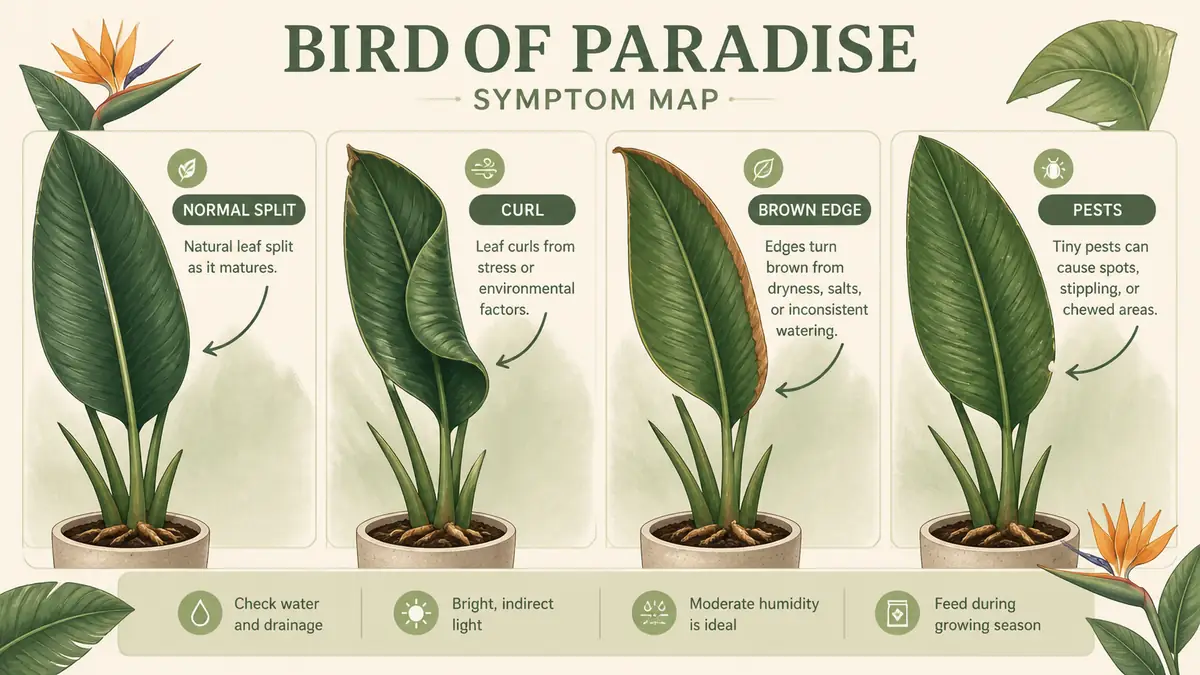
Leaf splitting is the bird of paradise problem that causes the most unnecessary panic. These plants naturally develop large paddle-shaped leaves that can tear along the veins. Outdoors, splits help the leaves tolerate wind. Indoors, the same structure can split from brushing, turning the pot, pets, cleaning, or the weight of an older leaf.
A normal split is usually clean and vertical. The leaf stays firm, green, and functional. The split may look dramatic, but it does not mean the plant is dying. If the rest of the leaf is green and the newest growth looks healthy, treat it as cosmetic damage.
Stress-related splitting looks different. The leaf may split while also curling, browning, yellowing, or becoming papery. New leaves may emerge stuck, accordion-folded, or torn before they fully open. That combination points to dry air, irregular watering, pests, or low light rather than a simple mechanical tear.
Bird of paradise species are naturally bold plants. North Carolina State Extension describes Strelitzia reginae as a broadleaf evergreen perennial with large leaves and orange-blue flowers, while Strelitzia nicolai is the larger white bird of paradise with a tree-like habit. Both can carry big leaves that show physical wear over time.
Do not trim a split leaf just because it is split. A green split leaf is still feeding the plant. Removing too many imperfect leaves reduces the plant’s energy supply and can slow recovery, especially indoors where light is already weaker than outdoor conditions.
Cut a split leaf only when it is mostly brown, badly broken at the stem, diseased, or blocking airflow in a crowded cluster. Use clean pruners and cut the leaf stem close to the base without gouging neighboring stems.
If your bird of paradise has many split leaves but no curling, no pests, and no spreading brown edges, the fix is usually gentler handling and better placement. Keep it away from narrow walkways, door swings, blinds, heaters, and places where people brush the leaves every day.
2. Fix Curling Leaves by Checking Water First
Curling leaves are a stronger warning sign than simple splits. When bird of paradise leaves curl inward, the plant is usually trying to reduce moisture loss or reacting to roots that cannot supply enough water. That can happen from underwatering, overwatering, compacted soil, a pot that is too large, or a dry root ball that has become hard to rewet.
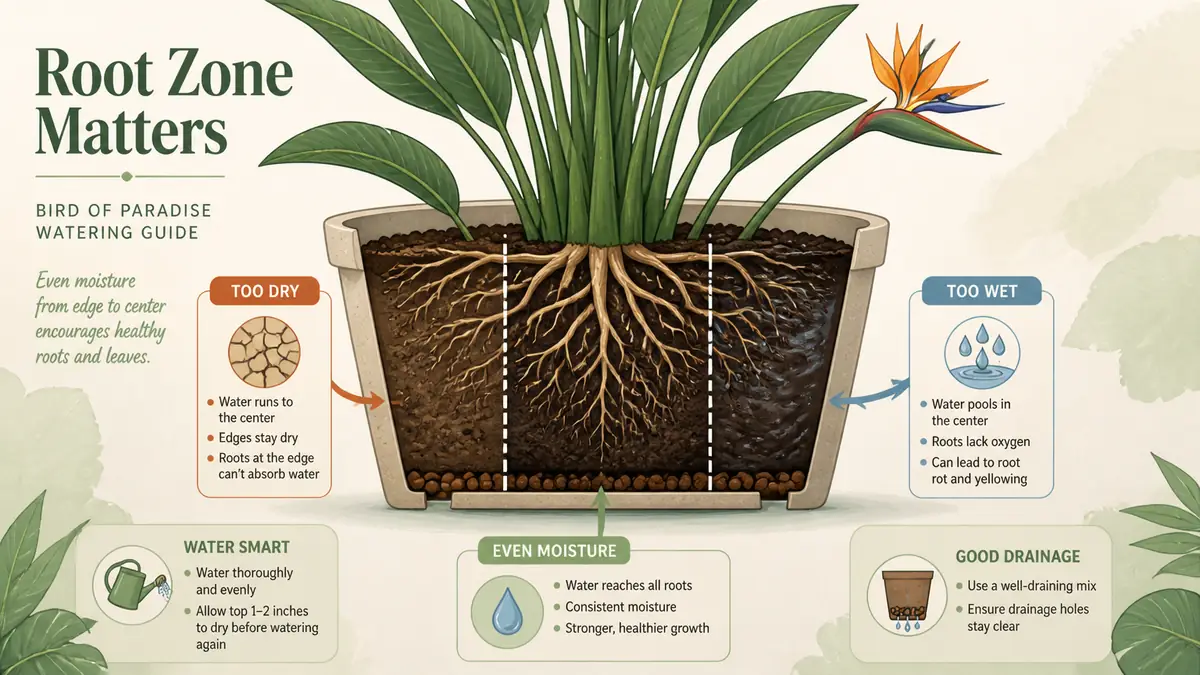
Start with the soil, not the calendar. Push a finger, wooden skewer, or moisture probe several inches into the pot. In a large floor pot, the top 1 inch may be dry while the lower root zone remains wet. Watering from the surface alone often leads to mistakes.
If the pot is dry several inches down and feels light, water thoroughly. Add water slowly until it runs from the drainage holes. Empty the saucer after 10 to 15 minutes. A shallow splash is not enough for a big bird of paradise because it encourages dry pockets around the roots.
If water runs straight down the sides and out the bottom, the root ball may be hydrophobic. Set the nursery pot or inner pot in a tub and water slowly in rounds. Let the soil absorb moisture, then drain fully. Do not leave the plant sitting in water for hours.
If the soil is wet, heavy, sour-smelling, or still damp many days after watering, do not water again. Curling can also happen when roots are oxygen-starved. Overwatered roots cannot move moisture properly, so the leaves may curl even while the soil is wet.
Soft stems, yellowing lower leaves, fungus gnats, and a swampy smell point toward excess moisture. In that case, increase light, improve airflow, and let the mix dry partway before watering again. If decline continues, slide the root ball out and inspect for brown, mushy roots.
Uneven drying is common in oversized decorative pots. A bird of paradise in a pot that is much larger than its root mass can stay wet in the lower half while the top looks dry. That mismatch causes repeated stress: the owner waters because the surface is dry, while the lower roots remain saturated.
For most indoor plants, a better rhythm is to water when the upper few inches are dry and the pot is noticeably lighter, while the lower root zone is not bone-dry for long periods. Exact timing changes with light, season, pot size, soil mix, and room temperature.
Do not fertilize a curling plant until you know the root zone is stable. Fertilizer does not repair dehydration or rot. In a stressed pot, extra salts can make edge burn and curling worse.
If your plant curls after every watering, check drainage and soil structure. Dense peat-heavy mixes can hold too much water around thick roots. A chunky, well-draining mix is usually safer than a fine mix that stays wet for long stretches.
Some links are affiliate links. As an Amazon Associate I earn from qualifying purchases at no extra cost to you.
Useful in deep bird of paradise pots where the top can dry while the lower root zone stays damp.
3. Trace Brown Edges to Dry Air, Salt, or Drought
Brown edges on bird of paradise leaves usually come from moisture stress at the leaf margins. The edges are the first areas to crisp when the plant loses more water than the roots can replace. Indoors, that often means dry air, inconsistent watering, mineral buildup, heat, or a combination of these.
Look at the pattern. Thin tan edges on older leaves often point to dry air or past drought. Dark brown tips with a yellow halo can mean root stress. Random bleached patches may be sun scorch. Brown edges plus sticky residue or speckling may involve pests.
Dry indoor air is a common trigger, especially in winter. Bird of paradise plants can tolerate average home humidity, but they often look better when kept away from heating vents, fireplaces, drafty doors, and hot window glass. A plant beside a vent may dry at the leaf edge even if the pot is watered correctly.
Humidity trays do little for a large plant unless the surrounding conditions are already close. A better fix is placement. Grouping plants, using a room humidifier, and keeping the plant out of forced-air paths are more effective than misting once a day.
Drought swings also create brown edges. If the plant goes very dry, then gets soaked, then goes very dry again, the leaves show it. Bird of paradise prefers a steady rhythm: thorough watering, full drainage, then partial drying before the next watering.
Mineral salts can also burn edges. Tap water minerals and fertilizer salts accumulate when a pot is watered lightly or never flushed. You may see a white crust on the soil surface, pot rim, or drainage holes.
To flush the pot, water slowly and deeply so excess water drains through the bottom. Use enough water to move dissolved salts out of the root zone, then empty the saucer. Do this only if the pot drains well. Do not flush a pot that is already waterlogged or lacks drainage holes.
If your water is very hard, consider using filtered water, rainwater, or a mix of tap and filtered water for routine care. This is not always necessary, but it can help when edge burn keeps returning despite correct light and watering.
Trim brown edges only for appearance. Use clean scissors and follow the natural leaf shape, leaving a tiny brown margin instead of cutting into green tissue. Cutting into living green tissue often creates a fresh brown line.
Brown edges will not turn green again. The success sign is that new leaves emerge cleaner and existing brown patches stop spreading. Judge recovery by the next one or two leaves, not by old damage.
4. Move It Into Stronger Light Without Scorching
Low light is one of the biggest hidden causes behind bird of paradise problems. The plant may not collapse quickly, but it becomes slower, weaker, and more sensitive to watering mistakes. Soil dries slowly, new leaves stall, and the plant may lean toward the nearest window.
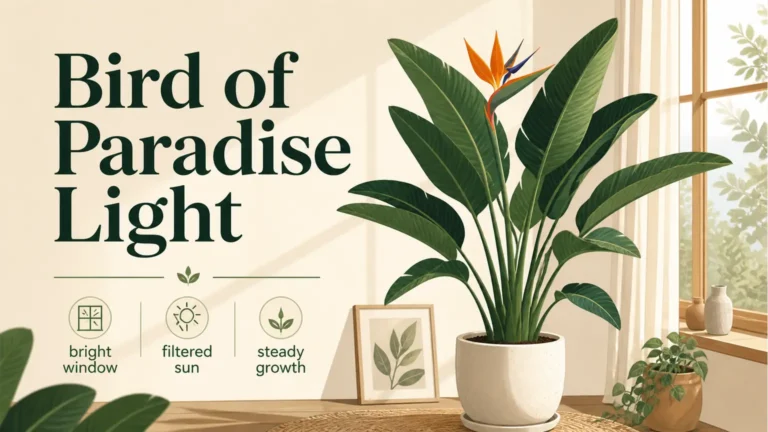
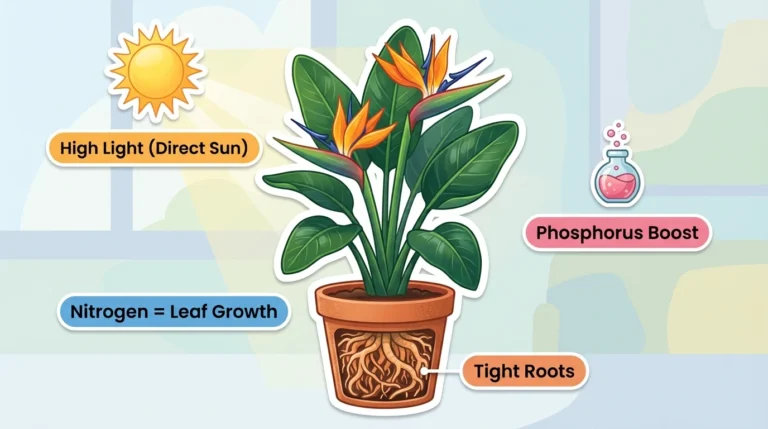
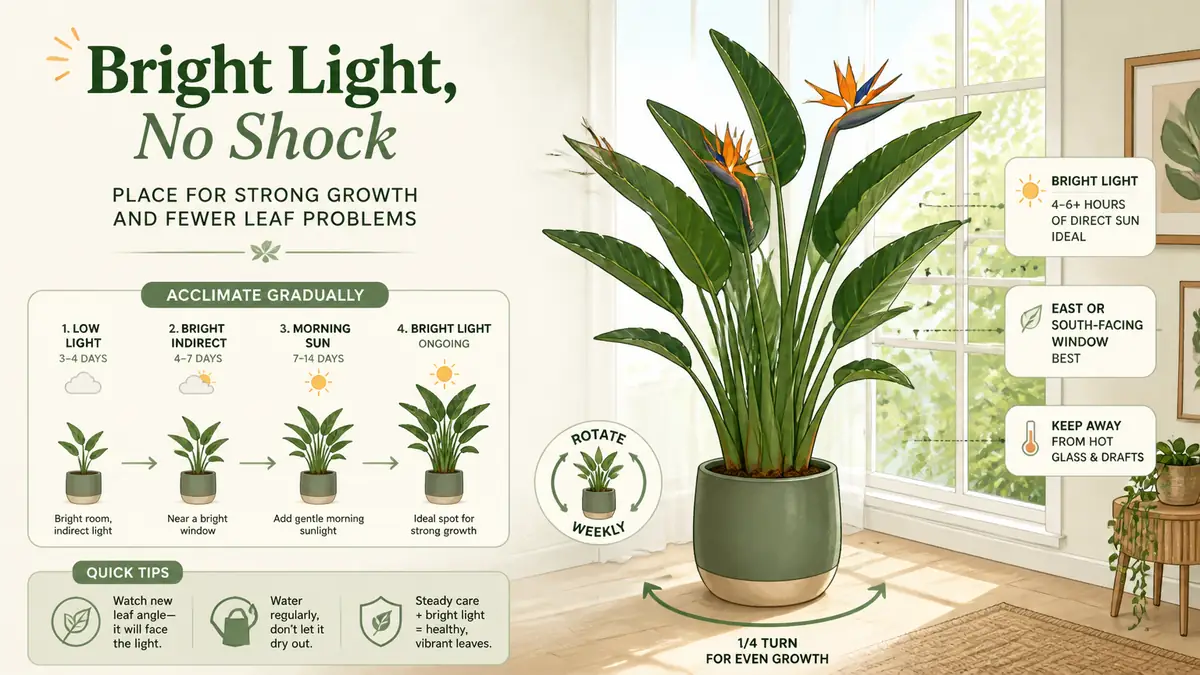
Bird of paradise is often sold as a bright indoor statement plant, but it is not a low-light plant. Indoors, it usually performs best close to a bright window with several hours of strong indirect light and, if acclimated, some direct sun. A dark corner across the room is usually not enough.
NCSU lists Strelitzia reginae for full sun to partial shade outdoors. Indoors, glass, walls, and distance reduce light dramatically. A spot that looks bright to your eyes may still be weak for a plant built for open, sunny conditions.
Move the plant gradually if it has been in low light. A sudden shift from a dim room to hot direct afternoon sun can scorch leaves. Scorch often appears as pale tan or brown patches on the sun-facing side of the leaf, especially near a window where heat builds.
A safer move is to place the plant near an east window, a bright south or west window with some distance, or behind a sheer curtain at first. After one to two weeks, increase exposure if the leaves remain firm and unscorched.
Rotate the pot every week or two so growth stays balanced. Large leaves lean heavily toward light, and a one-sided plant becomes easier to tip, split, or damage when moved.
Weak light and overwatering often appear together. If your bird of paradise is in a dim spot, the pot may stay damp too long. Fixing the watering schedule without improving light only solves half the problem.
If you cannot provide a brighter window, a strong grow light can help. Position it above the plant rather than far to the side. A weak decorative bulb across the room will not replace a bright window.
If the symptoms point toward dim placement, use the dedicated guide to not enough light for Bird of Paradise before changing watering or fertilizer.
Light also affects blooming. Indoor bird of paradise plants often fail to flower because they are not mature enough, not bright enough, or not receiving the seasonal strength they would outdoors. If flowers are your main concern, read our guide to why bird of paradise will not bloom.
If you grow several houseplants, remember that “bright indirect light” is not one universal level. A bird of paradise generally wants more light than many foliage plants. For a useful comparison, see how we explain placement in our spider plant light guide; the principle of distance from the window matters for both plants, even though their tolerance differs.
5. Check for Spider Mites, Scale, and Mealybugs
Pests are easy to miss on a bird of paradise because the plant is large and the leaves have strong ribs and folds. By the time damage is obvious from across the room, the pest population may already be established.
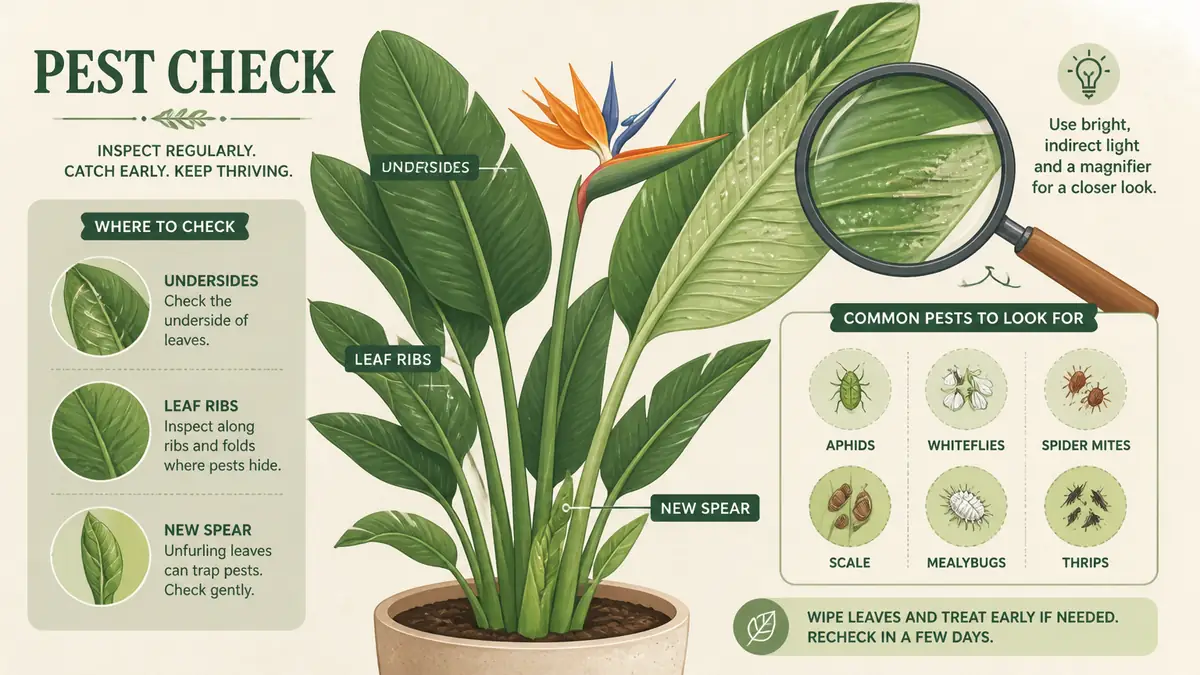
Check the undersides of leaves, the central rib, the base of stems, and any new leaf spear that is trying to unfurl. Use a flashlight. Wipe a white tissue along the underside of a leaf and look for reddish-brown streaks, sticky residue, or tiny moving specks.
Spider mites often cause fine pale speckling before you see webbing. Leaves may look dusty, faded, or sandblasted. Mites are more common in warm, dry rooms and on plants that are dusty or stressed.
Scale insects look like small brown, tan, or gray bumps attached to stems and leaf ribs. They may not move when touched. Sticky honeydew on leaves, floors, or nearby furniture is a strong clue.
Mealybugs look like small white cottony clusters. They hide in tight spaces, especially where leaf stems meet the base. New growth may emerge distorted if mealybugs feed in the crown.
Start pest control with cleaning. Isolate the plant if possible. Rinse leaves in a shower or wipe both sides with a damp cloth. For scale and mealybugs, remove visible insects with a cotton swab dipped in isopropyl alcohol, testing a small area first and keeping alcohol away from hot sun.
Repeat inspections every five to seven days. Pest eggs and hidden juveniles can survive a single cleaning. Consistency matters more than one harsh treatment.
If you use insecticidal soap, horticultural oil, or neem oil, follow the product label exactly. Do not spray a drought-stressed plant, a plant in direct hot sun, or a plant with leaves heated by a window. Oils can damage foliage when conditions are wrong.
Always treat the whole plant, not just the leaf with visible pests. Large bird of paradise leaves provide many hiding places. Also inspect nearby plants, because mites and mealybugs move easily through a collection.
Pest-stressed plants need care correction too. Improve light, rinse dust from leaves, and stabilize watering. A plant under chronic stress is more likely to be reinfested.
Use only when you have confirmed pests and the product label fits your indoor/outdoor situation.
6. Repot Only When Roots Are Actually Crowded
Repotting can fix real root crowding, but it can also create new problems. Many bird of paradise owners repot as soon as they see curling or brown edges. If the issue is low light, pests, dry air, or overwatering, a larger pot will not solve it.
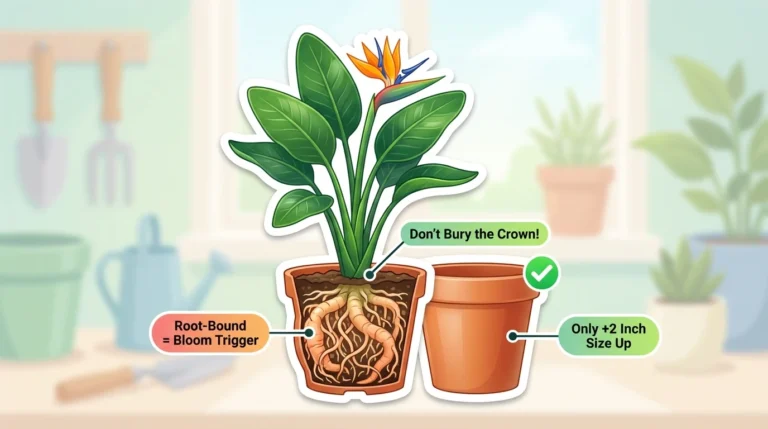
Repot when the evidence points to a crowded root system. Signs include roots circling tightly around the pot, roots pushing through drainage holes, water racing through because there is little soil left, a plant that dries extremely fast in bright conditions, or a top-heavy plant that cannot stay stable.
A bird of paradise can tolerate being somewhat snug. In fact, a slightly snug pot is often easier to manage indoors because it dries more predictably. Moving into a pot that is too large leaves excess wet soil around the root ball and raises the risk of rot.
When repotting is needed, move up gradually. Choose a pot about 2 inches wider in diameter than the current pot for most indoor plants. For very large specimens, a modest step up is still safer than jumping to a huge container.
Use a sturdy pot with drainage holes. Bird of paradise plants become heavy, and a lightweight pot can tip as the leaves lean toward light. If you use a decorative cachepot, keep the plant in a draining inner pot and empty standing water after each watering.
The potting mix should drain well while holding some moisture. A mix amended with bark, perlite, pumice, or other coarse material is usually better than a dense, fine mix that stays wet too long.
Do not bare-root the plant unless there is rot, pest contamination, or a serious soil problem. Bird of paradise roots are thick and can be damaged by aggressive handling. Loosen only the outer circling roots if needed, then set the plant at the same depth it was growing before.
After repotting, expect a short adjustment period. Leaves may droop slightly while roots settle. Keep the plant in bright indirect light, water thoroughly once, and then wait until the mix begins to dry before watering again.
If your main goal is dividing a crowded clump, read our bird of paradise propagation guide first. Division is more stressful than a simple pot upgrade and is best done when the plant is healthy enough to recover.
For step-by-step pot size, timing, and aftercare details, use our dedicated guide to repotting bird of paradise. Repotting is a tool, not a universal cure.

7. Reset the Care Routine Before Cutting Leaves Off
Once a bird of paradise looks messy, it is tempting to cut away every damaged leaf. Pruning can make the plant look cleaner, but it does not fix the cause. If you remove too much foliage before correcting light, water, pests, or root conditions, the plant has less energy to recover.
Reset the routine first. Put the plant in the brightest suitable spot you can provide. Check the soil deeply before watering. Keep it away from vents and cold drafts. Clean dust from the leaves. Inspect for pests weekly until new growth looks normal.
Then decide what to prune. Remove leaves that are mostly brown, collapsed, pest-damaged beyond recovery, or broken at the stem. Keep leaves that are split but mostly green. They are still useful.
Use clean, sharp pruners. Cut the entire leaf stem near the base rather than trimming large leaves into odd shapes. For small brown tips, cosmetic trimming is fine, but do not repeatedly cut green tissue.
Do not remove more than one-third of the foliage at once unless the plant has a severe pest or disease issue. A hard prune on a stressed indoor bird of paradise can slow growth for months.
Watch the next new leaf. It is the best report card. If the next leaf unfurls larger, greener, and with fewer crispy edges, your corrections are working. If the next leaf is smaller, stuck, torn, or already browning, keep troubleshooting the root zone, light, and pests.
Season matters. A bird of paradise may grow slowly in winter even when healthy, especially in cooler rooms or lower light. Do not force growth with heavy fertilizer during a low-light season. Resume light feeding when the plant is actively producing new leaves.
Fertilizer should support a healthy routine, not rescue a struggling plant. If the plant is actively growing in bright light, use a balanced houseplant fertilizer at label strength or weaker. If the plant is stressed, wait until watering and roots are stable.
Also consider safety. The ASPCA lists bird of paradise as toxic to dogs, cats, and horses. Keep leaves, flowers, and seeds away from pets that chew plants, and contact a veterinarian if you suspect ingestion.
A simple 14-day reset plan
- Day 1: Move the plant to brighter light if its current spot is dim, avoiding sudden hot afternoon sun.
- Day 1: Inspect the undersides of leaves and the central ribs for mites, scale, and mealybugs.
- Day 2: Check moisture deep in the pot. Water only if the root zone has dried enough.
- Day 3: Wipe dust from both sides of the leaves with a damp cloth.
- Day 5: Trim only leaves that are mostly dead or broken at the stem.
- Day 7: Recheck for pests and repeat cleaning if needed.
- Day 10: Check whether the pot is drying evenly or staying wet too long.
- Day 14: Decide whether repotting is truly needed based on roots, drainage, and pot stability.
What not to do when a bird of paradise looks bad
- Do not water on a fixed weekly schedule without checking the soil.
- Do not move a low-light plant directly into harsh afternoon sun.
- Do not repot into a much larger pot as a first response.
- Do not fertilize a plant with wet soil, soft stems, or suspected root rot.
- Do not remove every split leaf if it is still green.
- Do not ignore pests because the plant is large and still standing.
The best bird of paradise fix is usually boring: brighter placement, steadier watering, cleaner leaves, fewer drafts, and a pot that matches the roots. Dramatic interventions should come only after the basic pattern is corrected.
FAQ
- Why are my bird of paradise leaves splitting?
- Leaf splits are often normal on bird of paradise plants. The leaves are large and naturally tear along the veins from movement, age, handling, or airflow. If the split leaf is still green and firm, leave it on the plant.
- Why are my bird of paradise leaves curling?
- Curling usually points to water stress. The soil may be too dry, too wet, drying unevenly, or compacted around the roots. Check moisture several inches down before watering again, especially in large pots.
- Should I cut off brown edges?
- You can trim brown edges for appearance, but they will not turn green again. Use clean scissors and avoid cutting into healthy green tissue. More importantly, fix the cause, such as dry air, drought swings, salt buildup, or heat.
- How much light does a bird of paradise need indoors?
- It needs very bright indoor light. A position close to a bright window is usually best, with some direct sun if the plant is acclimated. Low light often causes slow growth and makes watering problems worse.
- Can overwatering make bird of paradise leaves curl?
- Yes. Overwatered roots can lose oxygen and stop moving water properly, so the leaves may curl even though the soil is wet. Wet soil, yellowing, soft stems, and a sour smell are warning signs.
- How do I know if my bird of paradise has spider mites?
- Look for fine pale speckling, dusty-looking leaves, tiny moving dots, and delicate webbing. Check leaf undersides and ribs with a flashlight. Spider mites often build up in warm, dry rooms.
- Does a bird of paradise like to be rootbound?
- It can tolerate being somewhat snug, but severely crowded roots can cause fast drying, instability, and stalled growth. Repot only when roots are clearly crowded or the pot no longer supports healthy watering.
- Why is my new bird of paradise leaf stuck?
- A stuck new leaf can come from dry air, inconsistent watering, low light, or pests feeding in the new growth. Increase humidity around the plant, stabilize watering, improve light, and inspect the leaf spear closely.
- Is bird of paradise toxic to pets?
- Yes. The ASPCA lists bird of paradise as toxic to dogs, cats, and horses. Keep the plant away from pets that chew foliage, flowers, or seeds.
- How long does it take a bird of paradise to recover?
- Old damage will not heal, so recovery shows in new growth. In bright conditions, you may see improvement with the next leaf. In winter or low light, it can take several weeks to months.