Can You Propagate Bird of Paradise at Home?
The first time I brought home a Strelitzia reginae, I spent three years staring at a fan of stiff, grey-green leaves, convinced I had been sold a dud. I was waiting for that explosion of orange and electric blue—the “Crane Flower” that gives the plant its common name—but all I had was foliage. I wasn’t failing; I was simply learning the plant’s primary language: patience.
Transparency note: Some links in this article are affiliate links. As an Amazon Associate I earn from qualifying purchases — at no extra cost to you. I only recommend products I have personally researched and believe are useful.
Native to the windswept Eastern Cape and KwaZulu-Natal provinces of South Africa, the Bird of Paradise is not a plant for the impatient gardener, nor is it a simple houseplant. It is a biological investment.
More Than Just a Flower
Taxonomically, Strelitzia reginae sits in the order Zingiberales, making it a distant cousin to gingers and bananas. You can feel this relationship in the texture of the leaves. They are thick, leathery, and arranged in a precise distichous pattern—growing in two opposing rows like a fan.
Many new growers panic when they see these leaves splitting laterally, assuming their humidity is too low or their cat has been destructive. While humidity matters (ideally 60–80%), those splits are actually a feature, not a bug. In botany, this is a morphological adaptation to wind. If the large surface area of the leaf remained solid, the coastal gales of South Africa would snap the plant’s neck. Instead, the leaf tears along the veins, allowing the wind to pass through unharmed. It is nature’s engineering at its finest.
Understanding the Rhizome
To truly understand this plant—and specifically to succeed at bird of paradise propagation—you have to look beneath the soil. Unlike plants with fine, fibrous root balls, Strelitzia possesses a rhizomatous root system.
When repotting, the soil you choose matters more than the pot. This is what I always reach for:
A powerhouse blend with earthworm castings and bat guano. Perfect for hungry tropicals that want to grow big.
If you were to unpot a mature specimen, you would find:
- Thick, fleshy roots: These can be up to 2–3 cm in diameter, resembling carrots or tubers.
- Water storage: These structures store hydration, granting the plant significant drought tolerance once established.
- Brittleness: Despite their size, these roots snap easily like fresh celery.
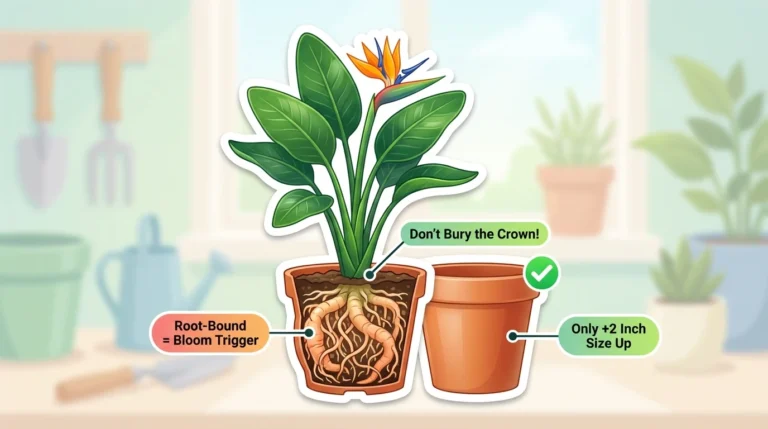
This root structure dictates everything about how we care for and multiply this plant. It prefers to be slightly root-bound to trigger blooming, which creates a tension for the grower: re-potting often delays flowering, but dividing the rhizome is the only way to create a genetic clone.
The Promise of the Bloom
We grow Strelitzia reginae for the architectural drama of its foliage, but we love it for the inflorescence. The “beak” is actually a spathe—a hard, beak-like sheath—from which the flowers emerge in succession.
However, biology dictates a waiting period. This is an evergreen perennial that requires maturity—often 3 to 5 years—before it possesses the energy reserves to flower. Whether you are attempting to grow from seed (fighting through a hard, impermeable seed coat) or dividing a mature clump, you are engaging with a plant that operates on its own timeline.
Division vs. Seed: Which Method Works
🧪 Joakim’s Science Corner: The Science of Watering
Did you know that overwatering isn’t about the volume of water, but the lack of oxygen? When soil is constantly waterlogged, roots experience hypoxia. Without oxygen, roots cannot convert sugar into energy, causing cell death and eventual rot. Always let the soil breath between drinks!
To successfully replicate Strelitzia reginae, we must first understand the biological hurdles the plant puts in our way. A bird of paradise propagation explanation essentially boils down to a choice between two difficulties: the physical trauma of division or the chemical fortress of the seed.
Because this plant belongs to the order Zingiberales—making it a cousin to gingers and bananas—it does not behave like a standard woody shrub or a simple herbaceous perennial. It has evolved specific defense mechanisms to survive the Eastern Cape’s droughts and winds, and these adaptations are exactly what make propagation challenging for the home grower.
The Trauma of Division
The most common issue with vegetative propagation (dividing an existing plant) is transplant shock. As we touched on earlier, the root system is rhizomatous and fleshy. These thick roots (up to 3 cm in diameter) act as water reservoirs.
When you unpot a mature Bird of Paradise to divide it, you aren’t just untangling roots; you are performing invasive surgery on the plant’s hydration system.
- The Snap: The roots are brittle. Even with the gentlest hands, snapping them is inevitable.
- The Reaction: When these fleshy roots are damaged, the plant immediately shifts energy from foliage production to root repair.
- The Sulk: This results in a prolonged period of dormancy. It is common for a divided plant to refuse to flower for 1 to 2 years post-division while it rebuilds its below-ground biomass.
We often see growers panic during this phase, increasing water to “help” the plant, which only leads to rot in the damaged tissues. The issue here isn’t lack of resources; it is physiological shock.
The Fortress of the Seed
If division is traumatic, seed propagation is a test of endurance. Strelitzia seeds are encased in a hard, impermeable testa (seed coat) and topped with a bright orange tuft of hair called an aril.
From a survival standpoint, this design is brilliant. The hard coat prevents the seed from germinating during dry spells, and the orange aril attracts birds to spread the seed. However, for the cultivator, these are barriers:
- Chemical Inhibition: The orange aril contains natural germination inhibitors. If you plant the seed with the orange fluff attached, it chemically signals the seed not to grow.
- Physical Barrier: The seed coat is so dense that water cannot easily penetrate it to trigger the embryo. Without human intervention (scarification), germination can take upwards of 6 months.
- Thermal Requirement: The chemical reactions required for germination are heat-dependent. The soil temperature must be maintained constantly between 24°C and 29°C (75°F – 85°F). A standard room temperature of 21°C (70°F) is often biologically insufficient to wake the seed.
The “Broken” Leaf Misconception
Finally, there is a morphological issue that often causes new growers to discard healthy propagations: fenestration.
As new leaves emerge, they often split laterally along the veins. This looks like mechanical damage or low humidity tearing. In reality, the leaf structure is penni-parallel, meaning the veins run parallel from the midrib. The leaf is designed to split. This is an evolutionary wind adaptation—if the large leaf remained solid, it would act as a sail in high winds and snap the entire petiole. The splitting reduces wind resistance. Do not mistake this natural structural trait for a failure in your propagation care.
How to Divide a Bird of Paradise
✨ Emilie’s Pro Tip: Lighting Reality Check
The “bright indirect light” label is often misleading. For a Bird of Paradise, I always recommend the Shadow Test: hold your hand 12 inches from the leaf. If the shadow is sharp and defined, the light is perfect. If it’s fuzzy or faint, your plant won’t have enough energy to produce those iconic flowers.
Propagation is where the biological reality of the Strelitzia reginae meets the practical limitations of your living room. You have two routes: Division (cloning an existing plant) or Seed (playing the long, patient game).
Most home growers should opt for division. While seed propagation is a fascinating botanical experiment, it requires precise thermal regulation and years of patience before you see a single flower. Division leverages the plant’s existing maturity, though it is physically more demanding.
Method 1: Rhizome Division (The Vegetative Route)
This is best performed in late spring or early summer, just after the flowering cycle slows. Strelitzia creates a dense, entangled network of roots that can be intimidating. We are dealing with a rhizomatous root system—thick, fleshy storage units up to 3 cm in diameter. These roots are evolutionarily adapted to store water for droughts, making them incredibly turgid but paradoxically brittle.
- Unpotting and Inspection: This is often the hardest part. A mature Bird of Paradise loves to be slightly root-bound, meaning the pressure against the pot walls will be immense. You may need to slide a flat knife around the rim or, in plastic pots, cut the container away. Once exposed, you will see a mass of thick, pale, tuber-like roots. Handle them gently; they snap like fresh carrots, and every break is a potential entry point for pathogens like Pythium (root rot).
- Identifying the Division: Look for a natural separation in the foliage fans. A viable division requires two things: a section of the rhizome (the horizontal underground stem) with healthy roots attached, and at least one “fan” of leaves. Do not try to separate a single leaf; it lacks the apical dominance required to generate new growth.
- The Incision: You cannot tease these roots apart with your fingers. Use a sterilized, serrated knife or a sharp spade. Cut vertically through the rhizome connection. You will hear a crunch—this is normal. Ensure the cut is clean to minimize tissue bruising.
- Potting Up: Dust the cut surfaces with cinnamon or a fungicide to seal the wound. Pot the new division into a loamy, well-draining mix (1 part peat/coir, 1 part perlite, 1 part loam). Crucial: Do not plant too deep. The point where the fan meets the root system should be just at the soil surface. Burying the stem encourages rot.
- The “Pout”: Water thoroughly, then wait. The plant will likely experience transplant shock. The leaves may droop or curl as turgor pressure drops due to root loss. Keep the plant in bright, indirect light (avoiding the full 4,000+ fc intensity) for a few weeks until it stabilizes. Note that dividing a Bird of Paradise often pauses flowering for 1–2 years while the plant re-establishes its energy reserves.
Method 2: Seed Germination (The Sexual Route)
If you choose seeds, you are fighting two biological defense mechanisms: a hard, impermeable seed coat (testa) and chemical germination inhibitors located in the orange tuft (aril).
For taking cuttings, you need a sharp blade that does not crush the stem. These are my go-to:
Sharp, spring-loaded, and precise. Makes clean cuts that heal fast — essential for propagating without crushing the stem.
- The Pre-Treatment (Scarification): The smooth, black seeds are encased in a hard shell that prevents water uptake. You must physically breach this fortress. Using a file or sandpaper, nick the seed coat just enough to reveal the lighter endosperm beneath. Do not crush the seed.
- Removing the Inhibitor: The bright orange tuft attached to the seed contains chemicals that suppress germination (a mechanism to prevent sprouting inside the fruit). This aril must be removed. Soak the seeds in tepid water for 24 to 48 hours. The orange tuft will soften; scrape it off completely with your fingernail or a knife.
- Sowing and Heating: Plant the seeds about 1 inch (2.5 cm) deep in moist sand or a sterile seed-starting mix. Here is where the science is non-negotiable: you need a heat mat. The soil temperature must stay consistent between 24°C and 29°C (75°F – 85°F). If the soil drops below this range at night, the chemical signals for germination stall.
- The Wait: Even with perfect scarification and heat, germination is erratic. It may take 4 to 8 weeks. Without a heat mat, it can take 6 months or fail entirely. Keep the substrate humid (roughly 60-80% humidity) but not waterlogged. Once the sprout emerges, increase light intensity immediately to prevent leggy growth.
Why Most Propagation Attempts Fail
Propagation and cultivation of the Strelitzia reginae require a shift in mindset. You are not dealing with a standard woody shrub or a delicate tropical fern. You are managing a semi-succulent, architectural beast. The most common bird of paradise propagation mistakes usually stem from misunderstanding the plant’s anatomy or misjudging its stubborn need for stability.
1. Treating Rhizomes like Fibrous Roots
When dividing a mature clump, many gardeners treat the root ball with the same rough enthusiasm they might use on a Daylily or Hostas. This is disastrous.
- The Physiology: Strelitzia roots are rhizomatous and fleshy, often reaching 2-3 cm in diameter. They function as water storage vessels, similar to tubers.
- The Reality: These roots are incredibly brittle. If you try to pull a root ball apart by force, you will hear a sickening “snap” akin to breaking a fresh carrot.
- The Fix: Be surgical. Use a sterilized, sharp knife or a pruning saw to slice through the rhizome connections. Never pull. Damaged fleshy roots are highly susceptible to Pythium (root rot), especially if planted immediately into wet soil. Let the cut callous over for a few hours before potting.
2. The “Bigger is Better” Potting Fallacy
After successfully germinating a seed or dividing a clump, the instinct is to give the plant a spacious new home to encourage growth. However, giving a Bird of Paradise too much legroom is one of the fastest ways to stall blooming.
- Why it happens: If the pot is too large, the plant re-routes its energy from foliage and flower production into expanding its root system to fill the void. Furthermore, excess soil volume holds excess water, creating anaerobic conditions that suffocate those thick roots.
- The Sweet Spot: These plants actually prefer to be slightly root-bound. Restriction at the roots triggers the hormonal signals required for flowering. Keep the pot size tight—no more than 2 inches (5 cm) wider than the root ball.
3. Misdiagnosing “Leaf Splitting”
We often see growers panicking—and even taping leaves back together—because the pristine, paddle-shaped leaves develop lateral tears. This is not a mistake in care; it is a mistake in interpretation.
- The Science: This splitting is called fenestration. The leaf venation is penni-parallel (prominent midrib with parallel side veins). Anatomically, the leaf is designed to tear between these veins to reduce wind resistance.
- The Perspective: In its native Eastern Cape of South Africa, a solid leaf of this size would act as a sail, snapping the entire plant in high winds. The splitting is a survival mechanism. Unless the edges are brown or curling (signs of low humidity below 40%), accept the ragged look as a sign of maturity.
4. Underestimating Light Intensity
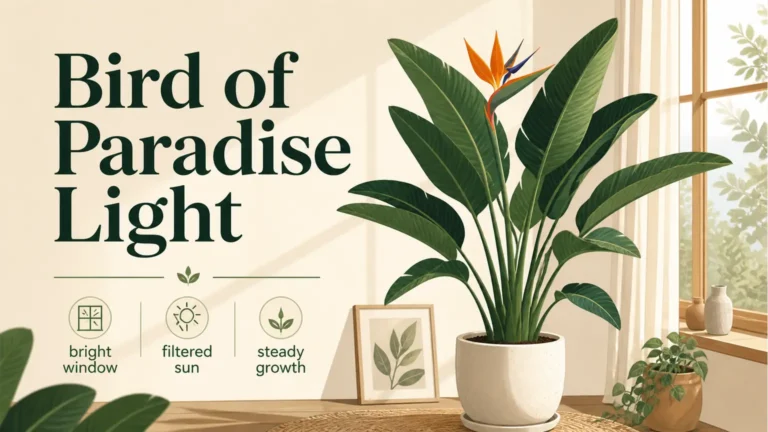
If you have successfully propagated a division but it hasn’t bloomed in two years, you likely have a light deficiency. A plant can survive in medium light, but it will not reproduce.
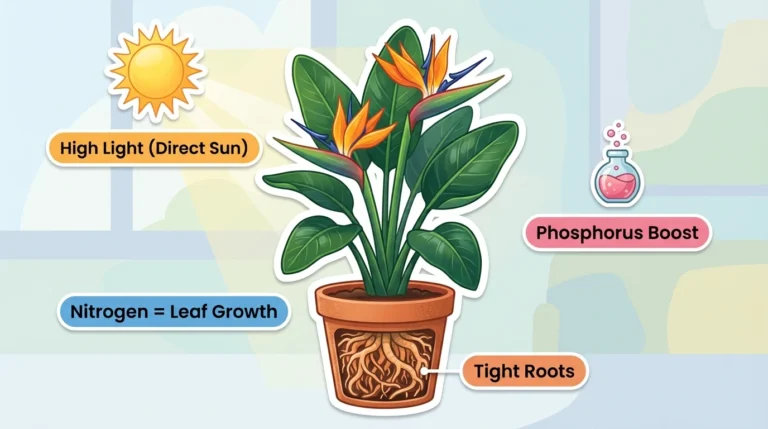
- The Data: To initiate blooms, Strelitzia requires high intensity—between 4,000 and 8,000 foot-candles. That is the equivalent of full, direct sun for at least 4 to 6 hours a day.
- The Symptom: If the petioles (leaf stems) are growing long, spindly, and leaning heavily, the plant is stretching for light (etiolation). Move it to a southern exposure or supplement with high-output grow lights.
5. Premature Disposal of Seed Trays
Patience is the scarcest resource in propagation. Because the Strelitzia seed coat is so impermeable, water uptake is slow, and the embryo wakes up on its own timeline.
Many growers assume their seeds have rotted after a month of silence and toss the tray. Remember the data: germination is erratic and can take up to 8 weeks even with heat, and 6 months without it. Keep the soil warm (24°C – 29°C) and moist. Do not give up until you are certain the seeds have collapsed or rotted.
Recommended Bird of Paradise Essentials
Each product below was hand-picked after thorough research and testing.
Dip cut stems before placing in water or soil. Dramatically improves rooting success rate and speeds up the process.
Check Price → (paid link)
Produces an ultra-fine continuous mist with one pump. Better than trigger sprayers for foliar feeding and applying neem oil evenly.
Check Price → (paid link)
The industry standard for plant shelves. Run cool, easy to mount under shelves, and give a warm pleasant light.
Check Price → (paid link)
The industry standard for garden pruning. Sharp bypass blade makes clean cuts on stems up to 3/4 inch — perfect for trimming iris fans and removing dead yucca leaves.
Check Price → (paid link)
As an Amazon Associate I earn from qualifying purchases.
Common Questions About Propagation Bird Of Paradise
Why are the leaves on my Bird of Paradise curling inward?
Curling leaves are the plant’s defense mechanism to retain moisture, typically indicating dehydration. If the soil is dry, the plant needs a deep watering. However, if the soil is wet and the leaves are still curling, it may indicate root rot preventing water absorption, or exposure to cold drafts.
Is it normal for Bird of Paradise leaves to split and tear?
Yes, leaf splitting is a natural morphological trait known as fenestration. Evolved to let wind pass through the large leaves without snapping the stem, these splits will increase as the leaf matures. While you cannot repair split leaves, you can minimize excessive tearing by increasing humidity and protecting the plant from physical traffic.
Why won’t my Bird of Paradise bloom indoors?
The most common reason for a lack of blooms is insufficient light. These plants require at least 4-6 hours of direct sunlight (or very strong grow lights) to flower. Additionally, the plant must be mature (usually 3-5 years old) and often blooms better when slightly root-bound.
What causes the edges of the leaves to turn brown and crispy?
Brown, crispy edges usually signal low humidity or chemical buildup from tap water. Bird of Paradise plants thrive in humidity above 60%. If humidity is adequate, the browning may be caused by sensitivity to chlorine or fluoride in tap water, or excessive salt buildup from over-fertilization.
Why are the stalks drooping or falling over?
Drooping stalks are often caused by insufficient light, leading the plant to grow weak, etiolated stems that cannot support the weight of the leaves. If the base of the drooping stalk is soft, mushy, or smells foul, it indicates root rot caused by overwatering or poor drainage.