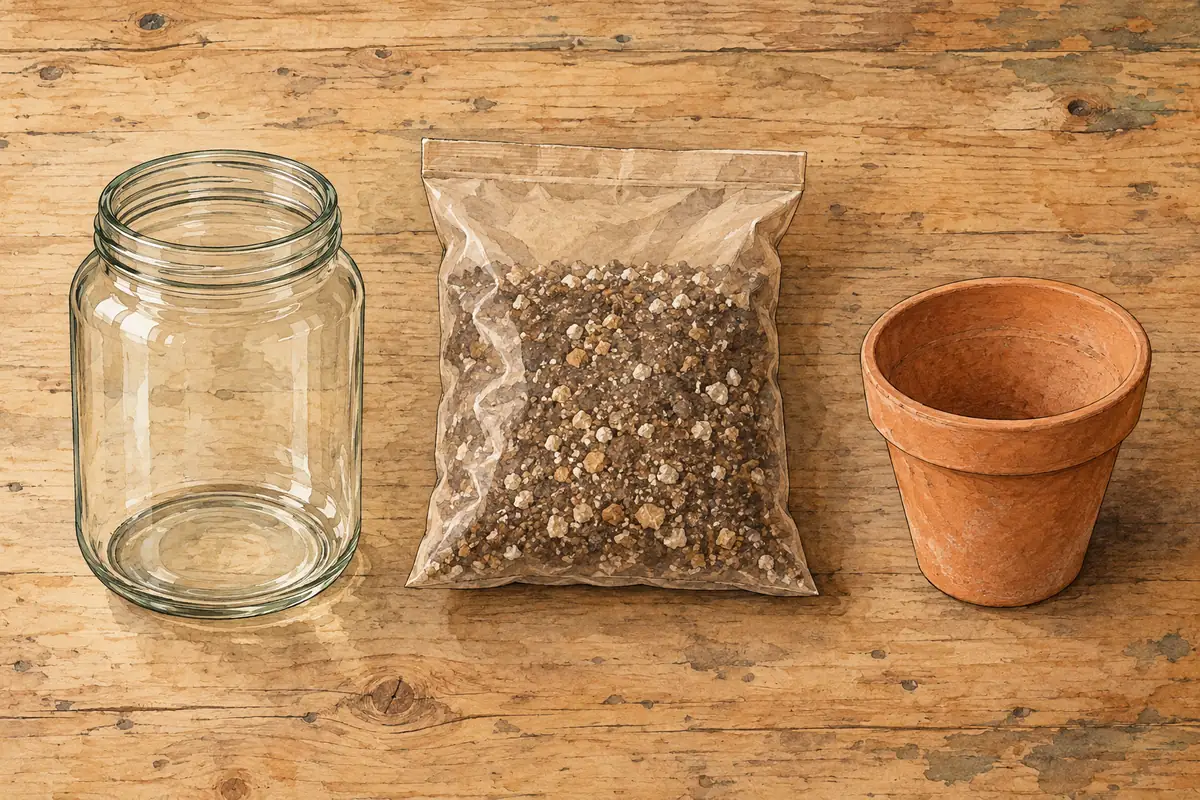
To learn how to propagate philodendron from a trailing stem, take a healthy 3–6-inch cutting with nodes and root it in water or an airy, moist medium. This guide walks through that cutting and first-pot process. An upright plant may offer a suitable stem section or an offset, but do not assume either is present. Check roots before potting and watch the cutting as it establishes.
How to propagate philodendron: which method fits your plant?
Look at the stem before choosing a container. A long trailing or climbing stem provides a different starting point from a short upright center. If you cannot distinguish the stem and its nodes, leave the plant intact until you can. The Iowa State philodendron guide describes both forms, with different options for each.
| What you have | Possible next step | Check first |
|---|---|---|
| A healthy trailing or climbing stem | Take a node-bearing stem cutting; root in water or airy medium. | Identify at least two nodes on the planned cutting and keep its lower end oriented downward. |
| An upright, non-trailing plant | A stem section with at least two nodes may be an option; an offset may be separated if present. | Do not cut into an unclear growing center or assume the plant has an offset. Defer if the material or separation is unclear. |
| A detached leaf and leafstalk only | Do not count it as an equivalent to a stem cutting. | For the documented heartleaf leaf-bud technique, the leaf must retain a short stem piece and developed axillary bud. |
Iowa notes that non-trailing stem sections with aerial roots tend to root more reliably. It does not establish that every upright philodendron makes offsets or explain a readiness test for each one. If you cannot identify a suitable section or safely separate an offset, wait rather than cut a compact plant apart. See Iowa’s guidance for the scope of those options.
Where do you cut a philodendron stem?
A node is the point on the stem where a leaf attaches. Trace the leafstalk back to the main stem; do not mistake the leafstalk itself for the stem. Select a healthy trailing section with at least two nodes and cut just below the lower node. The lower node stays on the piece you intend to root.
Iowa’s general stem-cutting instructions recommend at least two nodes; the Royal Horticultural Society describes cutting below a leaf joint for trailing or climbing philodendrons. Iowa State’s philodendron-specific FAQ suggests 3–6 inches (about 8–15 cm) for trailing types. Use both as a practical starting point, not a promise that every piece will root.
- Choose healthy material and a clean, sharp cutting tool. Clean the container too; use disease-free rooting medium if choosing that method. University of Illinois Extension recommends cleaning tools between cuts.
- Locate two nodes on the section you want to keep. Note which end was nearer the plant’s base before removing the piece. Iowa cautions that a stem segment should not be planted upside down.
- Cut just below the lower node. Remove the lower leaf or leaves so the lower node can be placed in water or medium while remaining leaves stay above it.
- Keep the remaining leaves attached. If the cutting has flowers or fruit, Iowa’s general method says to remove them. Make the rooting setup ready promptly rather than leaving the cut stem to dry out.
Leaf versus leaf-bud cutting: NC State describes a heartleaf philodendron leaf-bud cutting as a leaf, its stalk, a short stem piece and a developed bud in the leaf axil—the junction between leafstalk and stem. That is a different piece from a leaf and stalk alone. Illinois notes that some plants can make roots from a leaf without making a new stem and leaves, so roots alone do not prove a complete new shoot. This evidence does not establish an absolute leaf-only rule for every species in the genus.
Should you root philodendron cuttings in water or medium?
Water lets you see developing roots without disturbing them. An airy rooting medium gives roots a different environment from the start and needs moisture checks. Both are described by Iowa for trailing philodendrons; the water-to-potting-mix move is an extra adjustment to monitor.
| Choice | During rooting | Before the first pot |
|---|---|---|
| Water | Keep a lower node in water and leaves above it; change the water frequently. | Iowa’s philodendron FAQ suggests waiting for roots several inches long. Watch the plant after moving it into mix. |
| Rooting medium | Place a lower node in clean, moist, aerated medium in a draining container. Check moisture without keeping it soggy. | Inspect for developed roots; general guidance suggests several roots at least an inch long before potting. |
Illinois Extension discourages water rooting because roots formed in water may adapt less readily to potting mix. Iowa’s philodendron FAQ accepts water for trailing types. These sources differ in preference; neither means a water cutting is certain to fail. If you already have a clean jar, suitable cutting and water, you can start without buying a rooting product. A clean container and suitable medium already on hand are another option.
How do you propagate a trailing philodendron in water?
Use the prepared stem cutting, a clean jar and water. Place a lower node below the waterline, keeping leaves above water. Change the water frequently as Iowa advises, and observe the submerged stem and roots rather than relying on a calendar.
- Set the cutting in the jar with its lower end down. Adjust the water level so the node is covered but the leaves are not submerged.
- Place it in bright, indirect light. Keep it out of direct sun; Illinois Extension recommends indirect light for propagation. If your space needs supplemental light, the indoor grow light guide explains how to choose a setup; a purchase is not required to start a cutting.
- Change the water frequently. Iowa does not specify an exact interval in its philodendron FAQ, so inspect the jar regularly rather than treating a particular number of days as a rule.
- Watch for new roots, then use the philodendron-specific transfer guidance below. If the submerged material becomes soft or appears to decay, inspect the cutting and seek a diagnosis before deciding whether any material is suitable to use.
A rooted cutting still has to adapt to potting mix. Keep checking it after the move instead of assuming the first appearance of roots marks the end of the process.
How do you root philodendron cuttings in soil or another medium?
Use a clean, aerated rooting medium and a container that drains. Premoisten the medium, make a hole, and place at least one lower node below the surface without burying leaves. Keep it evenly moist but not soggy while roots develop.
- Prepare the medium. South Dakota State Extension describes moistening it until it is damp but not dripping, then loosely filling a clean container. Iowa names perlite or well-drained potting soil for trailing philodendron; its general guide cautions that potting soil alone may lack sufficient drainage and air, so use a suitable airy rooting mix rather than assuming any soil will work.
- Make a hole with a clean pencil or similar tool. Insert the lower end with at least one node in the medium and no leaves buried. Gently firm the medium around the stem and water; allow excess to drain.
- Put the container in bright, indirect light. A clear loose cover can retain humidity; do not put a covered cutting in direct sun. Ventilate the cover as needed rather than sealing it tightly. Illinois advises ventilation and a moist, not soggy, medium.
- Check every few days. If the medium is drying, add a little water; if it remains saturated, pause watering and check drainage. Do not repeatedly pull the cutting out to look for roots.

South Dakota State describes a gentle tug as a preliminary check: resistance suggests roots may be forming, but does not show how many or how long. If it is time to inspect more closely, carefully lift a cutting with a label or pencil. Handle new roots gently and return a cutting that is not yet sufficiently rooted to the medium. New leaves are another clue, not a substitute for checking root development.
When are the roots ready for a pot?
Look for developed roots rather than a fixed date. For a trailing philodendron rooted in water, Iowa’s plant-specific FAQ suggests potting when new roots are several inches long. For a cutting in medium, South Dakota State suggests checking for several roots at least 1 inch (2.5 cm) long.
There is a real difference in the published water guidance: Iowa’s general houseplant stem guide also mentions about 1 inch for water-grown roots, while its philodendron-specific FAQ says several inches. Use the latter as the specific starting guidance for a trailing philodendron, not as a proven universal threshold. The general guide also warns that water-grown roots may need time to adjust to soil. Root length is a cue, not a guarantee of establishment.
Pot a sufficiently rooted cutting gently in regular, well-drained potting mix in a container with drainage. Arrange the roots without forcing them into a tight space, fill around them, and water so the mix settles. Iowa recommends keeping newly potted cuttings well watered and in bright indirect light. For choosing a suitable potting mix after rooting, see the indoor potting mix guide. Check the mix and plant regularly during the transition; do not leave the pot standing in runoff. Once the cutting is established, move on to the philodendron care guide for the longer-term watering and light decisions.
What should you check if a cutting stalls?
First inspect the cutting and its environment; do not assume that slow roots mean it needs fertilizer or another cut. Check that a node is present, the medium has not dried out or stayed saturated, and the cutting is in bright indirect light. Make one appropriate adjustment and check again.
- No visible progress: Confirm that the lower node remains in water or medium. In medium, inspect moisture and resist frequent lifting. South Dakota State estimates 2–3 weeks for some easy-rooting plants including heartleaf; Iowa gives 3–6 weeks for most houseplant stem cuttings. These are different, scoped estimates, not deadlines for every philodendron.
- Mix stays wet or smells unpleasant: Check whether the container drains and whether the medium has air spaces. Illinois advises keeping the medium evenly moist but not soggy; if it remains wet, wait before adding more water. An odor alone does not establish a diagnosis; seek help if the cutting declines.
- Cutting wilts after potting: Check moisture and drainage as well as light. Water roots may need time to adjust; avoid repeatedly moving or disturbing the cutting while you assess it.
- No node or uncertain material: Recheck the piece against the stem anatomy above. If you cannot identify a suitable node or an upright plant’s separable material, pause and seek identification before cutting more.
How should you handle cuttings around pets?
Keep cuttings, trimmings and the rooting container away from pets and children. The ASPCA lists heartleaf philodendron, Philodendron hederaceum, as toxic to dogs, cats and horses because of insoluble calcium oxalates. Its listed signs include oral irritation, pain and swelling of the mouth, tongue and lips, excessive drooling, difficulty swallowing, and vomiting except in horses.
If a pet may have ingested plant material, contact your veterinarian or ASPCA Animal Poison Control promptly; a consultation fee may apply. Do not wait for symptoms to ask for help. Handle the plant with gloves and wash hands after pruning.
For a suspected human exposure, Poison Control advises using its online tool or calling the US poison center at 1-800-222-1222. For excessive drooling, severe mouth swelling, or difficulty swallowing or breathing after ingestion, call 911. This human guidance is separate from the veterinary advice above.
Philodendron propagation: frequently asked questions
Can I grow philodendron from a cutting?
Yes. Iowa State describes stem cuttings for trailing philodendrons and suitable stem sections for non-trailing types. For a trailing plant, select healthy material with nodes, remove lower leaves and root the lower node in water or an airy medium. If an upright plant’s suitable stem or offset is unclear, wait before cutting.
Do philodendrons root in water?
Yes. Iowa State describes water rooting for trailing philodendron stem cuttings. Keep a lower node submerged and leaves above the water, change the water frequently, and provide bright, indirect light. Iowa’s philodendron-specific guidance suggests waiting until roots are several inches long before potting; check the cutting as it adjusts to mix.
What to do with a leggy philodendron?
First check its growing conditions and growth form. The RHS notes that insufficient light can cause legginess and describes pruning climbing or trailing plants in spring. A healthy removed stem with suitable nodes may be rooted using the steps above. For broader light and ongoing care, use the philodendron care guide linked earlier.
Where is the node on a philodendron?
A node is the point on the stem where a leaf attaches. Follow the leafstalk back to the main stem rather than cutting the leafstalk alone. For the trailing stem method in this guide, choose a healthy piece with at least two nodes and cut just below its lower node, leaving that node on the cutting.
Sources
- Iowa State University Extension: How do I propagate a philodendron? — growth forms, cutting methods and water-root transfer.
- Iowa State University Extension: How to propagate houseplants by stem-tip cuttings — nodes, rooting and general transfer guidance.
- South Dakota State University Extension: Propagating houseplants — rooting medium, checks and scoped timing.
- University of Illinois Extension: Propagation — clean tools, light, moisture and water-root limitations.
- NC State Extension: Propagation — heartleaf leaf-bud cutting structure.
- ASPCA: Heartleaf philodendron — animal toxicity and signs.
- Poison Control: Dieffenbachia and philodendron — human exposure guidance.

