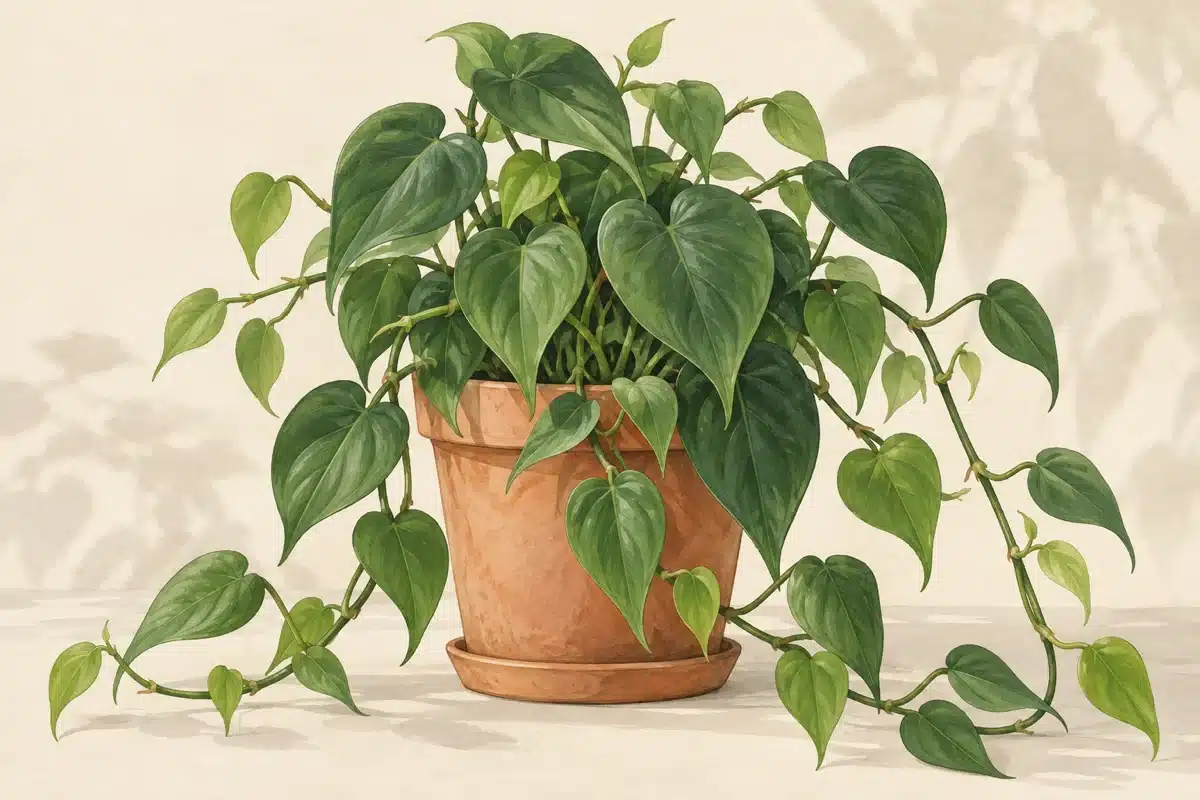
“Philodendron” is a large genus, so a care routine for one plant is not automatically a rule for another. Give roots air as well as moisture, keep harsh direct sun off foliage, and follow the plant’s growth habit. Keep the nursery tag if you have it; young and mature plants can look very different.
Start with the growth habit
North Carolina State Extension groups philodendrons into climbing or vining types and non-climbing, upright types often called self-heading. “Self-heading” is a useful growth-habit label here, not a promise that every named plant follows exactly the same rule. Look for the pattern of growth before you buy a support or take a cutting.
| What you see | Likely care path | Avoid assuming |
|---|---|---|
| Long stems that trail, climb, or make aerial roots | A vining or climbing type can trail from a basket or be trained gently to a trellis or pole. | That every vine needs a moss pole. Choose support only if you want to change how it grows. |
| Leaves emerging from a short, upright center in a rosette-like clump | An upright or self-heading type usually needs a stable pot and room around its leaves, rather than vine training. | That a generic trailing-cutting method is the best way to propagate it. |
| No tag and an unclear habit | Observe new growth and postpone major pruning or propagation until the form is clearer. | Leaf shape alone identifies the species or cultivar. |
A climbing plant may attach with aerial roots to a pole or trellis. A trailing plant can also be left to trail. Either choice can be healthy when light, water, and pot size suit the plant. Support is a training decision, not a cure for drooping leaves or slow growth.
Place it in usable light
Bright, indirect or diffused light is a practical starting point for most indoor philodendrons. South Dakota State University Extension notes that poor light can reduce leaf and plant size, while too much light can yellow leaves. North Carolina State Extension also cautions that direct sun can scorch foliage. The best window is therefore not one fixed direction: the useful question is whether sun is hitting the leaves directly and for how long.
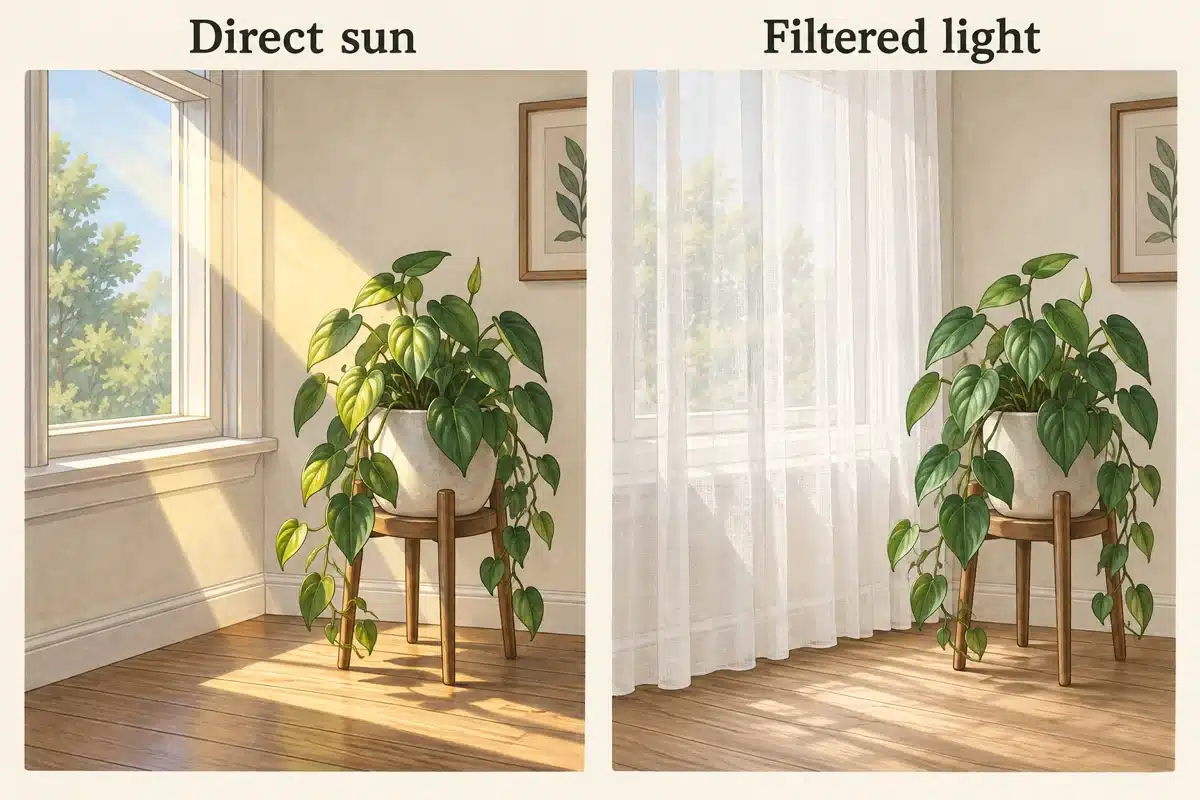
Start a little back from a bright window or filter strong sun with a sheer curtain. Small, stretched, sparse new growth can mean the location is too dim. Bleached patches, crisp areas, or repeated yellowing on the window-facing side can mean the light is too intense. Move the plant in small steps and reassess before changing water or fertilizer too.
Keep it away from cold drafts and air-conditioning vents. Typical household temperatures are usually suitable; the point is to avoid a repeated cold blast rather than to chase an exact room reading.
Water by the potting mix, not the calendar
There is no reliable “water every Sunday” schedule. Pot size, season, room temperature, light, plant size, and the mix all change how quickly the root zone dries. South Dakota State advises watering when the top inch of soil is dry and using a well-drained potting mix. Check below the surface with a finger rather than judging only the color of the top crust. The upper inch is a starting check, not proof that the whole root ball is dry; if the lower mix is still wet or the pot feels unusually heavy, wait and check again.
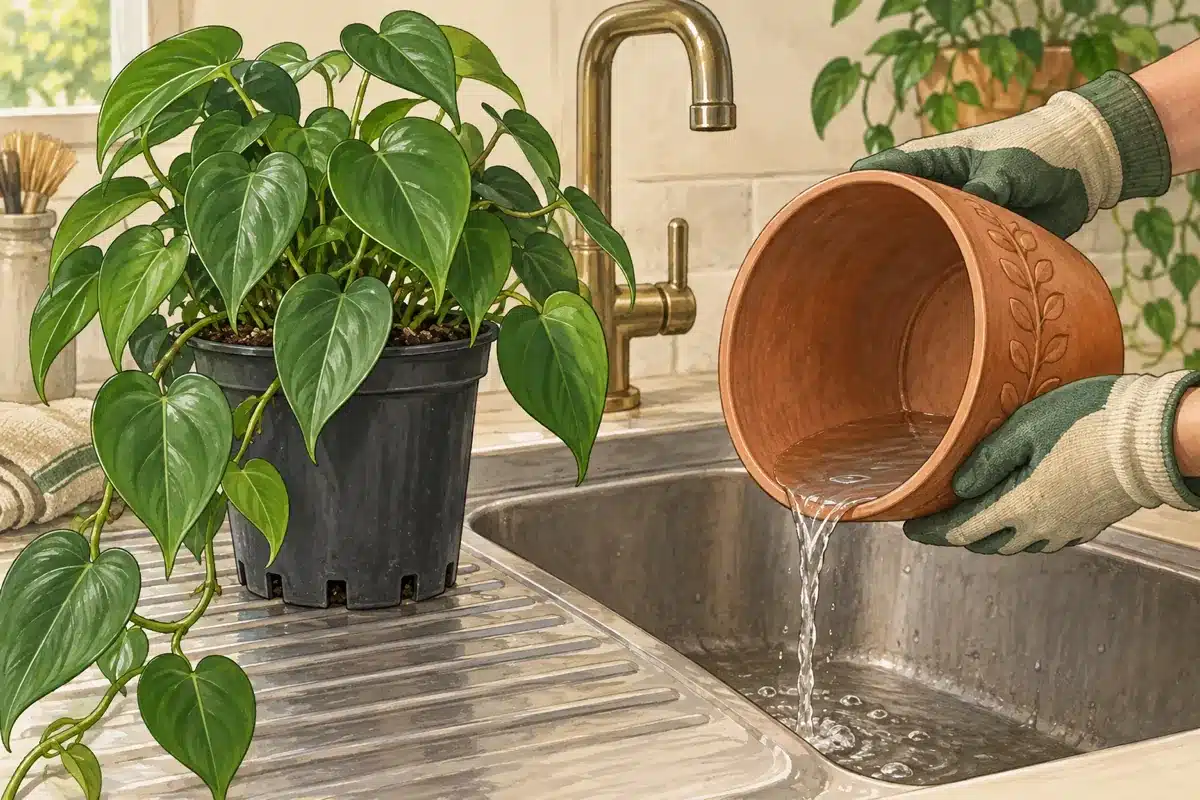
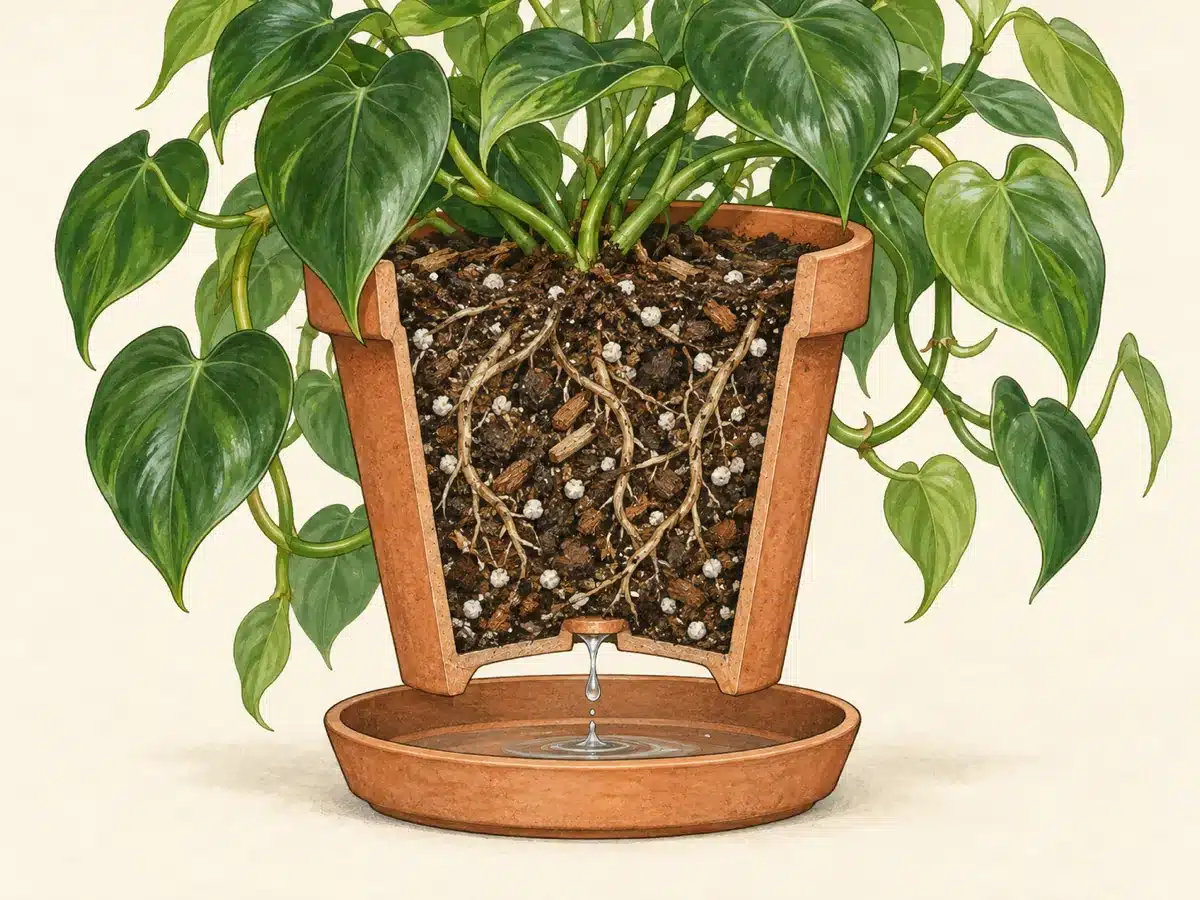
University of Maryland Extension recommends watering thoroughly enough that excess drains out, then emptying any collected runoff. When the upper layer is dry, water slowly until the root ball is moistened. Empty a saucer or cover pot after it has collected runoff. Do not let the inner pot stand in water. If the upper inch is still moist, wait and check again; roots need oxygen as well as water.
| What you notice | Check before acting | A measured next step |
|---|---|---|
| Leaves droop and the upper mix is dry | Is the pot unusually light? Did water recently run straight down the side without soaking the root ball? | Water thoroughly, let it drain, and check leaf position and mix moisture again later. |
| Leaves droop but the mix stays wet | Drainage hole, saucer water, odor, and whether the potting mix remains saturated for days. | Stop adding water. Improve the drainage situation and seek a plant diagnosis if decline continues. |
| Yellowing or pale leaves near a bright window | Direct sun, recent move, and whether yellowing is localized to exposed leaves. | Reduce direct exposure first; do not assume a nutrient deficiency. |
| Brown tips or margins | Dry mix, hot or cold air flow, and whether the problem is spreading or accompanied by pests. | Correct the observed stress, then watch new growth. A damaged edge will not turn green again. |
These are inspection prompts, not diagnoses. Both overwatering and underwatering can make leaves droop, according to South Dakota State. A leaf color change can also follow light, temperature, pests, or a root problem. Change one supported condition, record what you changed, and reassess rather than treating the same symptom with more water, more fertilizer, and a larger pot all at once.
Use a pot and mix that can drain
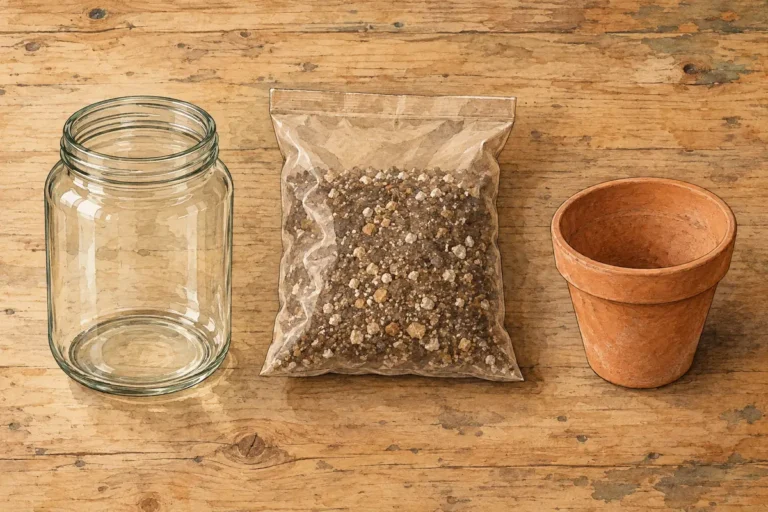
Choose a container with a drainage hole and a potting medium that is well drained. North Carolina State describes the preferred soil as moist, well drained, and high in organic matter. A decorative outer container is fine only if it does not trap runoff around the inner pot.
For a broader comparison of potting media, use our guide to choosing soil for indoor plants.
Repot because the plant has outgrown the pot or the mix is no longer functioning well, not just because a leaf has yellowed. North Carolina State recommends repotting when a plant is root-bound or pot-bound, with spring as a useful time. Slide the root ball out and look for roots circling tightly around the pot or filling nearly all of the available mix. University of Minnesota Extension advises moving up just one pot size; a much larger container can hold excess moisture around the roots.
After repotting, keep normal indirect light and monitor moisture while it settles. Avoid combining a major location change and heavy pruning with repotting.
Feed only during active growth
Fertilizer cannot repair poor light, a saturated root zone, scorch, or insect damage. If the plant is growing and its light and watering conditions are working, South Dakota State recommends a balanced fertilizer monthly, following the product label, and reducing feeding in winter. Use the label’s dilution and timing for that product; more fertilizer is not a shortcut to bigger leaves.
Support and prune for a clear purpose
For a vining plant, a pole, trellis, or other support can guide growth upward; a hanging basket can let stems trail. Attach stems loosely enough that they can expand. Do not force aerial roots into a support or cut healthy vines merely because they are long.
Prune to remove damaged growth, shorten a vine, control size, or maintain shape. North Carolina State notes that pruning may be needed to maintain shape. Use clean, sharp tools and make a deliberate cut rather than taking many small cuts at once. On an upright plant, remove only what the plant and your space require. If you are unsure where a new leaf or node is, wait until the growth pattern is clearer.
Propagate by form, not by one universal method
For trailing philodendrons, Iowa State Extension says 3- to 6-inch (8–15 cm) stem sections with lower leaves removed can root in water, perlite, or well-drained potting soil. A cutting needs a node; a leaf alone is not a complete new plant. If you root in water, change it regularly and pot the cutting once roots are several inches long.
Non-trailing philodendrons take a different route. Iowa State says they can be propagated from offsets, when present, or from stem sections with at least two nodes; pieces that include aerial roots tend to root more reliably. That is why copying a single water-cutting tutorial can disappoint with an upright type. Take only healthy material and keep propagation separate from a plant that may have pests or disease symptoms.
Inspect problems before naming a cause
Check the underside of leaves and new growth for mealybugs, aphids, scale, thrips, or spider mites. North Carolina State also lists overwatering as a root-rot risk and notes that leaf spots may be reduced by better air circulation and keeping leaves dry. Isolate a plant with an unexplained spreading pattern while you inspect it, and clean tools before using them on another houseplant.
If yellow markings form a mosaic-like pattern, several leaves develop lesions, or decline continues after you correct a clear light or moisture problem, do not keep escalating home treatments. South Dakota State notes mosaic virus as a philodendron concern and recommends getting proper diagnosis. A local Extension service or plant clinic can use clear photos, your watering record, and the plant’s recent history.
Place and handle philodendron with care
North Carolina State identifies calcium oxalate crystals in philodendron and lists people, cats, and dogs among its safety concerns. Keep the plant and fallen cuttings away from children and pets, avoid getting sap on your skin, wear gloves when pruning, and wash your hands afterward. If a person or animal may have ingested plant material or has concerning symptoms, contact the appropriate poison-control or veterinary service promptly rather than relying on a houseplant care guide.
Philodendron care FAQs
How often should I water a philodendron?
Check the upper inch of potting mix rather than following a fixed interval. When it is dry, water thoroughly and let excess drain. If it is still moist, wait and recheck.
Does every philodendron need a moss pole?
No. A climbing or vining type can be trained to a pole or trellis, but it can also trail. Upright, self-heading types should not be given a generic vine-training requirement.
Why are my philodendron leaves drooping?
Dry mix and saturated mix can both contribute. Check soil moisture, drainage, light, temperature changes, and pests before choosing an action. Correct one observed issue, then reassess.
Can I propagate a philodendron in water?
Many trailing types root from node-bearing stem cuttings in water. Non-trailing types may be better propagated from offsets or suitable stem sections with nodes. Identify the growth habit first.
Sources
- South Dakota State University Extension: Philodendron—Houseplant How-To
- Iowa State University Extension and Outreach: How do I propagate philodendron?
- University of Maryland Extension: Watering Indoor Plants
- University of Maryland Extension: Potting and Repotting Indoor Plants
- University of Minnesota Extension: Spring Houseplant Care
- North Carolina State Extension Gardener Plant Toolbox: Philodendron