While fertilizing pothos is key to pushing larger, fuller growth, these popular houseplants are actually relatively light feeders. Most problems people blame on fertilizer — yellowing leaves, slow growth, pale color — are actually caused by improper lighting or watering, but the right feeding schedule makes a real difference.
Source note: This guide checks pothos-specific care advice against Clemson Cooperative Extension pothos care guidance, and University of Missouri Extension home propagation and care guidance. Generated visuals are educational illustrations, not proof photos.
This article includes paid links. As an Amazon Associate, The Plant Manual may earn from qualifying purchases.
Looking to buy a healthy live plant online?

1-YEAR WARRANTY
Get a nursery-quality, well-rooted live Golden Pothos shipped directly to your door. Backed by a best-in-class plant warranty so you can shop with confidence.
Fertilizing Pothos: Quick Reference Schedule
| Season / Condition | Feeding Frequency | Fertilizer Strength | Core Action / Check |
|---|---|---|---|
| Spring & Summer (March–Sept) | Once a month (twice if bright light/high growth) | Half strength | Apply diluted liquid feed on watering day |
| Winter (Oct–Feb) | Stop completely | None | Let plant rest; run a plain water flush in late Feb |
| After Repotting | Wait 6–8 weeks | None | Fresh potting soil contains starter nutrients |
| Hydroponic (Water Vases) | Every 2–4 weeks | Quarter strength | Use hydroponic feed, change water every 2 weeks |
Spring & Summer
Winter
After Repotting
1. How Often to Fertilize Pothos
Once a month during the growing season (March through September) is enough for most pothos in a home environment. That is it. Twice a month if your plant is in bright light and pushing new leaves every few weeks. Never more than that.
The instinct to fertilize more when a plant looks unhappy is almost always wrong. More fertilizer on a stressed plant causes salt burn, which looks like the very deficiency you were trying to fix.
The schedule that works in our apartment:
- March–September: Once a month with diluted liquid fertilizer on watering day
- October–February: Nothing. Growth slows, metabolism drops, fertilizer just builds up as salt in the soil
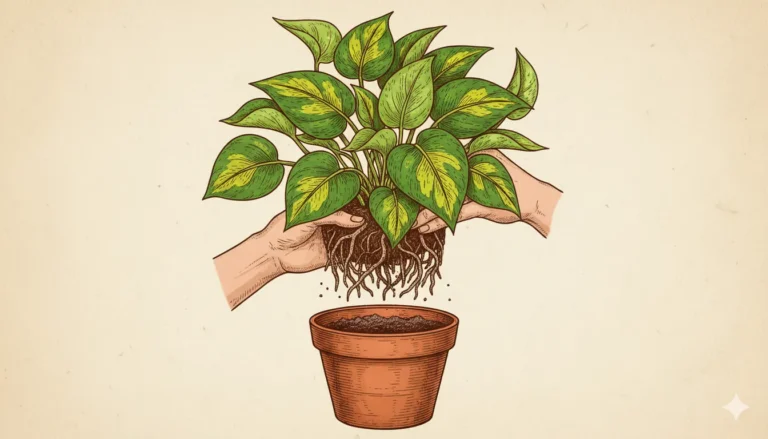
- After repotting: Wait 6–8 weeks before fertilizing — fresh potting mix already contains nutrients
✨ Emilie’s Pro Tip: The New Leaf Test
I only fertilize when the plant is actively growing — meaning it has pushed a new leaf recently or I can see one unfurling. If nothing new has appeared in the last 3–4 weeks, I skip that month. A plant that is not growing cannot use the nutrients, and they just accumulate in the soil.
2. What Fertilizer to Use for Pothos
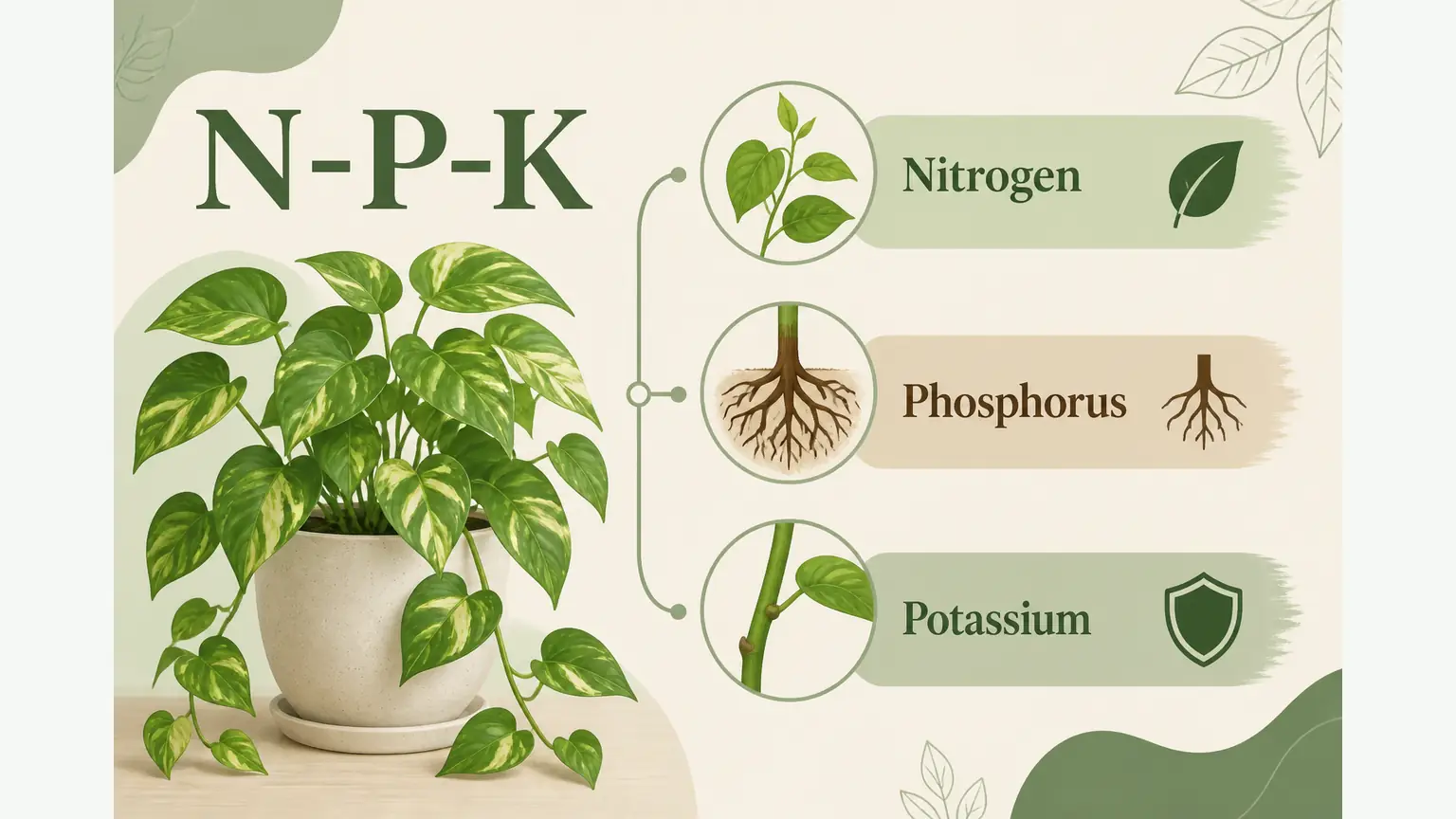
A balanced liquid fertilizer — equal parts nitrogen, phosphorus, and potassium — diluted to half the recommended strength. That covers 95% of cases.
The numbers on the package (like 10-10-10 or 20-20-20) are the percentage of each nutrient by weight. For pothos, the ratio matters less than the habit: consistent, dilute feeding beats occasional heavy doses every time.
Liquid vs. Slow-Release Granules
Liquid fertilizer — mix with water and apply on watering day. Gives you direct control. Easy to flush if you over-do it. Best for active growers who water on a regular schedule. We consistently recommend using a high-quality feed like Dyna-Gro Foliage Pro (7-9-5) for the best vegetative growth.
Slow-release granules — sprinkle on the soil surface every 4–6 months. Releases nutrients gradually with each watering. Better if you tend to forget monthly tasks or travel frequently. Less control, but far less risk of burn. A reliable beginner choice is Osmocote Smart-Release Plant Food.
We use liquid fertilizer as the main feed and occasionally top up with slow-release granules when repotting. Both work — pick the one you will actually stick to.
🧪 Joakim’s Science Corner: Why Half Strength Works Better Than Full Dose
Fertilizer salts accumulate in potting soil over time. At full strength, monthly applications can raise salt concentration to levels that draw water out of roots through osmotic pressure — the opposite of what you want. At half strength, you get the nutrient uptake without the salt buildup. Most commercial liquid fertilizers are formulated for nursery production, not home growing. Half strength is calibrated for the real-world indoor environment.
Use this only if: Your pothos is actively growing (unfurling new leaves) and is potted in soil that is at least 6–8 weeks old. Do not use if the plant is dormant in winter, has fresh potting mix, or is showing signs of root rot or water stress.
Complete liquid fertilizer with all 16 essential nutrients. The 7-9-5 ratio is dialed in for lush foliage plants.
Use this only if: You prefer a low-maintenance, hands-off feeding schedule and want to apply nutrients only once every 6 months. Skip if your pothos is grown in water or you want precise control over liquid feeding.
Slow-release granules that feed for 6 months. Mix into the top of the soil and forget about fertilizing for half a year.
Going Organic: The Best Natural Option
If you prefer a 100% organic approach to keep your potting soil alive, standard synthetic fertilizers are not ideal. Instead, look for a liquid fish and kelp emulsion like Neptune’s Harvest Organic Fish & Kelp Fertilizer that feeds soil microbes and roots simultaneously without chemical salt buildup.
Use this only if: You prefer a 100% organic feeding routine and want to improve long-term soil health. Skip if you grow your pothos in water or dislike the strong, temporary organic aroma during application.
An organic liquid blend that builds soil microbial life while feeding. Promotes deep green variegation and leaf thickness naturally.
3. Yellow Leaves Are Rarely a Fertilizer Problem
This is the most common mistake we see: someone notices yellow leaves, immediately buys fertilizer, and makes things worse.
Yellow leaves on pothos are almost always caused by:
- Overwatering — the most common cause by a significant margin. Check the soil at 2 inches deep before blaming anything else.
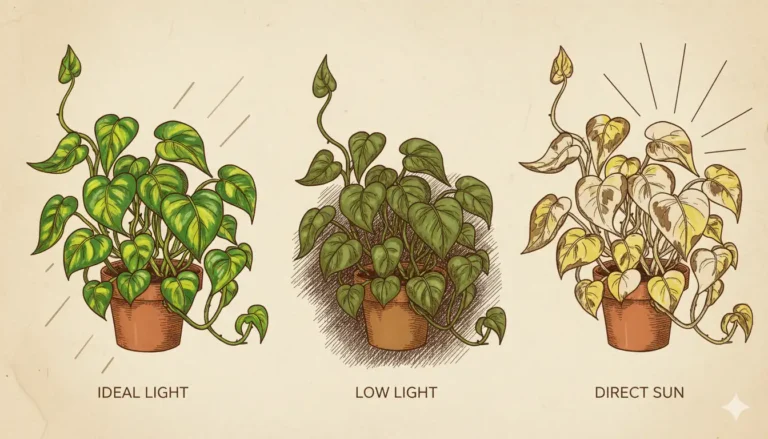
- Insufficient light — pothos tolerate low light but do not thrive in it. Pale, washed-out leaves with slow growth is a light problem. For details on how light affects foliage color and growth rates, see our guide to pothos light requirements.
- Root-bound conditions — when roots circle the pot and can no longer absorb efficiently, leaves yellow from the bottom up.
- Actual nutrient deficiency — least common, and only if the plant has been in the same soil for 2+ years with zero feeding
How to tell the difference: if the yellowing is on lower, older leaves only and the new growth looks healthy — it is natural leaf aging, not deficiency. If the yellowing is uniform across new and old leaves with pale color — check light first, then consider a light feed.
→ Full guide: Why Pothos Leaves Turn Yellow — all causes diagnosed
4. How to Apply Fertilizer — The Actual Steps
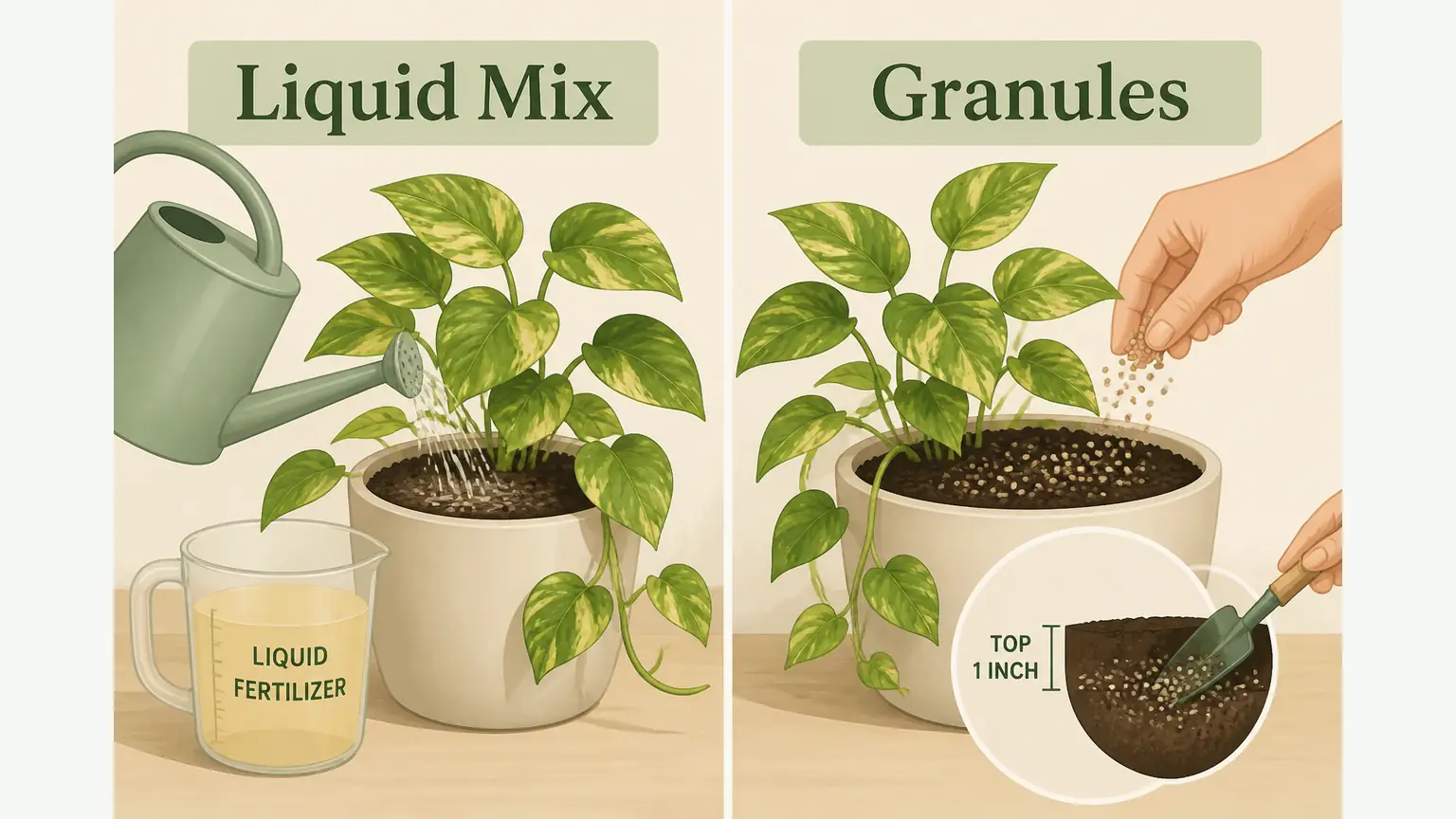
- Water first. Never apply fertilizer to dry soil — concentrated nutrients on dry roots cause burn. Water normally, let it drain, then apply the fertilizer solution on the same day.
- Mix to half strength. If the label says 1 teaspoon per quart, use ½ teaspoon. For pothos in normal home conditions, half strength applied consistently beats full strength applied irregularly. Using a graduated liquid measuring syringe makes it extremely easy to get this dose right without spilling.
- Apply evenly to the soil surface — not on the leaves or stems. Pour until it drains from the bottom of the pot. Using a narrow-spout indoor watering can allows you to deliver the solution directly to the root zone without wetting the foliage.
- Skip the next plain watering if you fertilize monthly. There is no need to flush immediately after — let the roots absorb the nutrients over the next week or two.
- Flush every 2–3 months regardless. Run plain water through the pot until it drains freely — this clears accumulated fertilizer salts before they reach damaging levels.
🛠️ Recommended Application Tools
To dilute and apply liquid fertilizer precisely without making a mess or wetting the leaves, we recommend having these simple tools in your plant care kit:
Use this only if: You use concentrated liquid fertilizer and want to ensure accurate, repeatable dilutions without the risk of over-fertilization salt burn. Skip if you use slow-release granules or pre-mixed spikes.
Reusable plastic syringes with clear graduation markings. Perfect for measuring out precise half-strength or quarter-strength liquid fertilizer doses.
Use this only if: You are watering dense pothos vines and want to apply water and fertilizer directly to the soil, avoiding wet leaves that attract fungal spot. Skip if you only have small starter pots or prefer bottom watering.
Features a long, narrow brass watering rose that delivers a gentle, targeted pour. Perfect for reaching the soil line without wetting pothos foliage.
5. Over-Fertilizing — The More Likely Problem
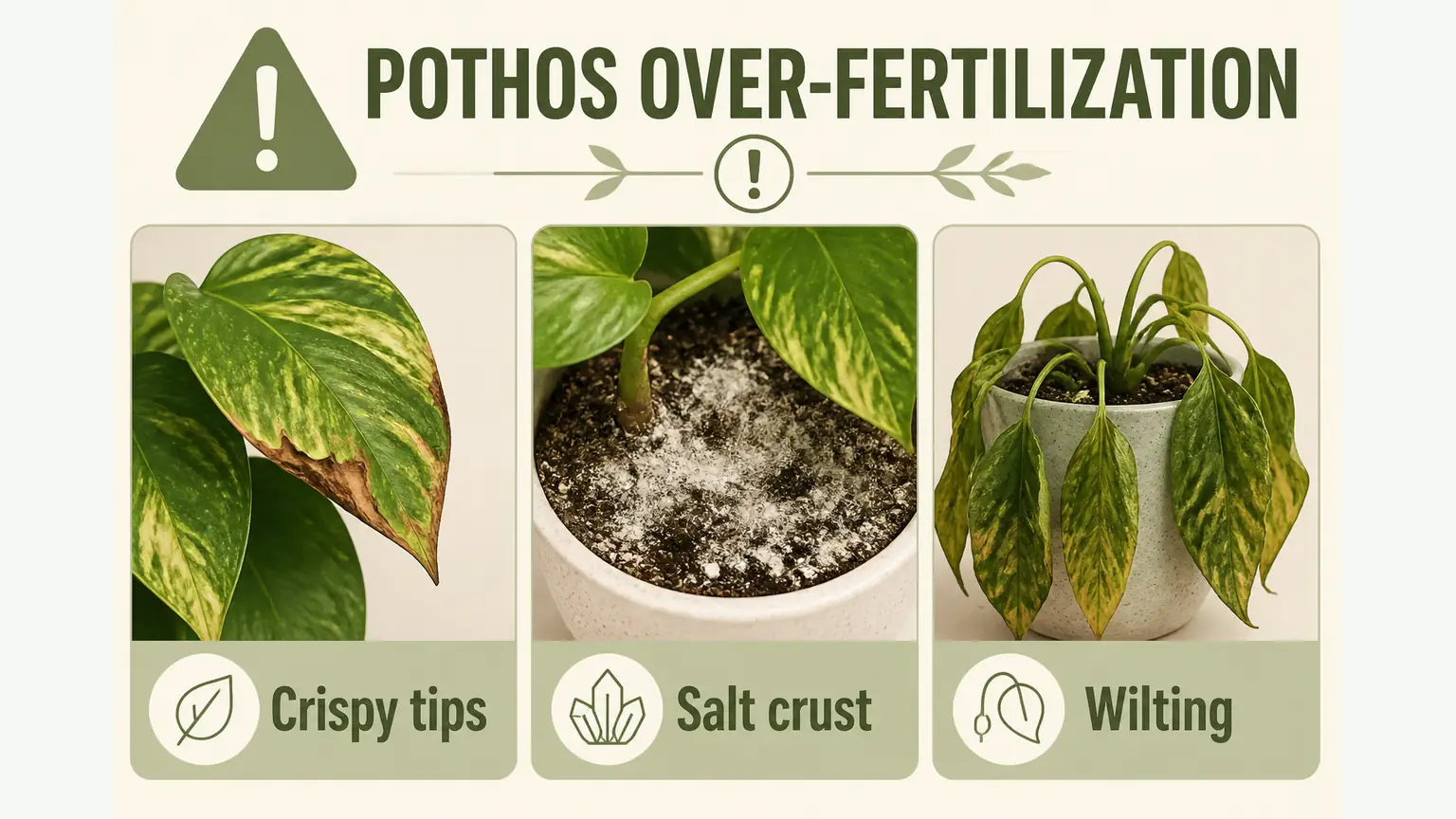
In six years of growing pothos, we have seen more damage from over-fertilizing than under-fertilizing. The plant will tell you, but the signals are easy to misread.
Signs of over-fertilization:
- Brown, crispy leaf tips — not edges, but specifically the very tip of the leaf
- White crust on the soil surface — visible salt deposit from accumulated minerals
- Wilting despite moist soil — salt concentration is drawing water out of roots (osmotic stress)
- Sudden yellowing after fertilizing — burn from concentrated application
How to fix it:
- Take the pot to a sink and run plain water through it for 2–3 minutes — this flushes dissolved salts out through the drainage holes.
- Do this 2–3 times over the next two weeks.
- Do not fertilize again until new growth appears and the plant looks stable.
- When you resume, start at quarter strength and work back up to half.
The brown tips are permanent — trim them if they bother you. New growth will emerge clean once salt levels normalize.
6. Winter Fertilizing — Stop Completely
Pothos slow down significantly from October through February, especially in northern homes where light levels drop. Metabolism slows, growth pauses, and the plant simply cannot process nutrients at the same rate. Pothos kept in darker conditions grow slowly and require almost no fertilizer. Check our best low-light indoor plants for growth expectations in dim spaces.
Continuing to fertilize through winter does not accelerate growth — it just deposits salts in soil that is not being flushed by active root uptake. By spring, you end up with a plant that looks stressed for no obvious reason.
What to do instead:
- Stop fertilizing in October
- Resume in March when you see the first new leaf of the season
- Do a plain water flush in late February to clear any winter salt buildup before you start feeding again
The exception: if you grow pothos under artificial grow lights year-round and the plant is actively pushing new growth in winter, maintain a reduced schedule — once every 6–8 weeks at half strength.
7. Fertilizing Pothos Growing in Water
Pothos grown in water (hydroponically or in vases) need fertilizer differently to soil-grown plants — the water itself contains no nutrients and does not buffer concentration the way soil does.
What to use: A dedicated hydroponic liquid fertilizer that includes trace minerals (calcium and magnesium) which are completely absent in standard foliage fertilizers. Use it at a highly diluted, quarter-strength rate. We recommend a balanced hydroponic formula like General Hydroponics FloraGro.
What not to do: Do not use slow-release granules in water — they dissolve unevenly and can spike nutrient concentration. Do not use the same strength as soil applications — there is no soil to buffer the salt concentration.
Use this only if: Your pothos is grown long-term in water (vases or jars) or semi-hydroponics (LECA). Do not use as a standard soil drench, and avoid adding to water vases without running a fresh water rinse first.
A specialized hydroponic mineral formula that provides essential calcium, magnesium, and micro-nutrients. Essential for long-term growth in water vases.
Change the water completely every 2–3 weeks even with fertilizer added — this prevents algae and keeps oxygen levels high for healthy roots.
→ Full guide: Growing Pothos in Water — setup, fertilizing, and maintenance
Common Questions About Fertilizing Pothos
How often should I fertilize my pothos?
Once a month during the growing season (March through September) using a balanced liquid fertilizer at half the recommended strength. Stop completely from October through February when growth slows. Resume in spring when you see new leaf growth.
What is the best fertilizer for pothos?
A balanced liquid fertilizer with roughly equal nitrogen, phosphorus, and potassium (such as 10-10-10 or 20-20-20) diluted to half strength. Dyna-Gro Foliage Pro (7-9-5) is a complete formula with all 16 essential nutrients and works well long-term. For low-maintenance feeding, slow-release granules like Osmocote applied every 4–6 months are a reliable alternative.
Can you over-fertilize pothos?
Yes — over-fertilizing is actually more common than under-fertilizing for indoor pothos. Signs include brown crispy leaf tips, white salt crust on the soil surface, and wilting despite moist soil. Fix it by flushing the pot with plain water 2–3 times over two weeks and stopping fertilizer until new growth appears.
Why are my pothos leaves turning yellow — is it a fertilizer problem?
Rarely. Yellow leaves on pothos are most commonly caused by overwatering, insufficient light, or root-bound conditions. Nutrient deficiency is the least likely cause unless the plant has been in the same soil for 2+ years with no feeding. Check soil moisture and light levels before reaching for fertilizer.
Should I fertilize pothos in winter?
No. Stop fertilizing from October through February. Pothos growth slows significantly in winter and the plant cannot process nutrients at the same rate. Continuing to fertilize deposits salts in the soil that cause stress when growth resumes in spring. Resume monthly feeding in March when you see the first new leaf.
More Pothos Guides
Use the focused guide that matches what you are doing next.
Sources
- Clemson Cooperative Extension: How to Grow Pothos Indoors
- University of Missouri Extension: Home Propagation of Houseplants