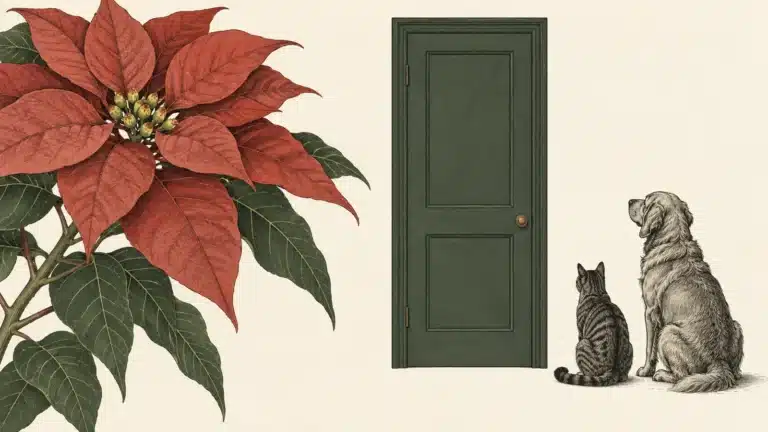
For poinsettia care, keep the plant in bright indirect light at about 65–70°F (18–21°C), away from cold drafts and heaters. Check the soil daily; water when the surface begins to dry or the pot feels noticeably light, then let it drain completely. Skip fertilizer during the holiday display. You can keep it as a green houseplant afterward; producing colored bracts again requires a separate fall light-and-dark routine.
What are the colored parts of a poinsettia?
Poinsettia, Euphorbia pulcherrima, belongs to the Euphorbiaceae family. Its showy red, pink, or cream-colored parts are bracts: modified leaves surrounding the small yellow or yellow-green true flowers in the center. Color alone does not identify a cultivar, so a care decision does not require a named variety.
If you are choosing a plant, look for dark green foliage and fully colored bracts, then inspect the small central flowers. Illinois Extension recommends fresh-looking central flowers rather than flowers covered in yellow pollen. Oklahoma State similarly favors mostly closed flowers with little pollen as a sign of longer remaining ornamental life. Yellow or yellow-green true flowers are normal; their freshness and pollen are more useful selection checks than flower color alone.
Understanding that distinction helps you choose your goal. Keeping the plant alive and leafy after Christmas is one task; encouraging a fresh colored display for another holiday season is another. A green poinsettia can still be worth keeping even if you choose not to manage its fall nights.
How can you help a poinsettia keep its holiday color?
For a poinsettia already in color, start with ordinary display care: bright suitable light, steady indoor temperatures, moisture checks, and complete drainage. Illinois Extension explains that display life depends on starting maturity and care. These steps help preserve the display; they cannot guarantee color through a particular date.
- Already has colored bracts? Check light, drafts, surface moisture, and trapped runoff before changing care.
- Healthy but green after its display? Keep it as a foliage plant if that suits you; green leaves do not by themselves mean the plant needs rescuing.
- Want new color for another holiday season? Use the separate fall routine below. Starting late or allowing night-light interruptions cannot promise a finished Christmas display.
Where should you put a poinsettia indoors?
Place a holiday poinsettia near a bright south-, east-, or west-facing window, with protection from harsh direct sun. Aim for an indoor temperature of 65–70°F (18–21°C). Keep leaves away from cold glass, door drafts, and heating registers; a warm room can still contain a cold or drying spot.

The U.S. Botanic Garden’s display-care guidance emphasizes bright light and separation from cold windows and drying heat. Use the light already available before adding equipment: move the plant to a brighter suitable window rather than leaving it in a dim decorative corner.
Protect the plant on the trip home and whenever it moves outdoors. University of Minnesota Extension warns that temperatures below 50°F (10°C) can cause damage and freezing kills poinsettias. That threshold is a warning, not a guarantee that every brief exposure above it is harmless. Avoid leaving the pot outside while you finish errands or displaying it beside a frequently opened winter door.
How do you water a poinsettia without drowning it?
Water when the soil surface begins to feel dry or the pot feels noticeably lighter, rather than on a fixed weekly schedule. Check daily during the display, but do not confuse checking with watering. The goal is to avoid both severe drying and repeated watering while the root zone remains wet.
- Check before watering. Feel the soil surface and lift the pot gently. If it is still moist and heavy, wait and check again rather than adding more water.
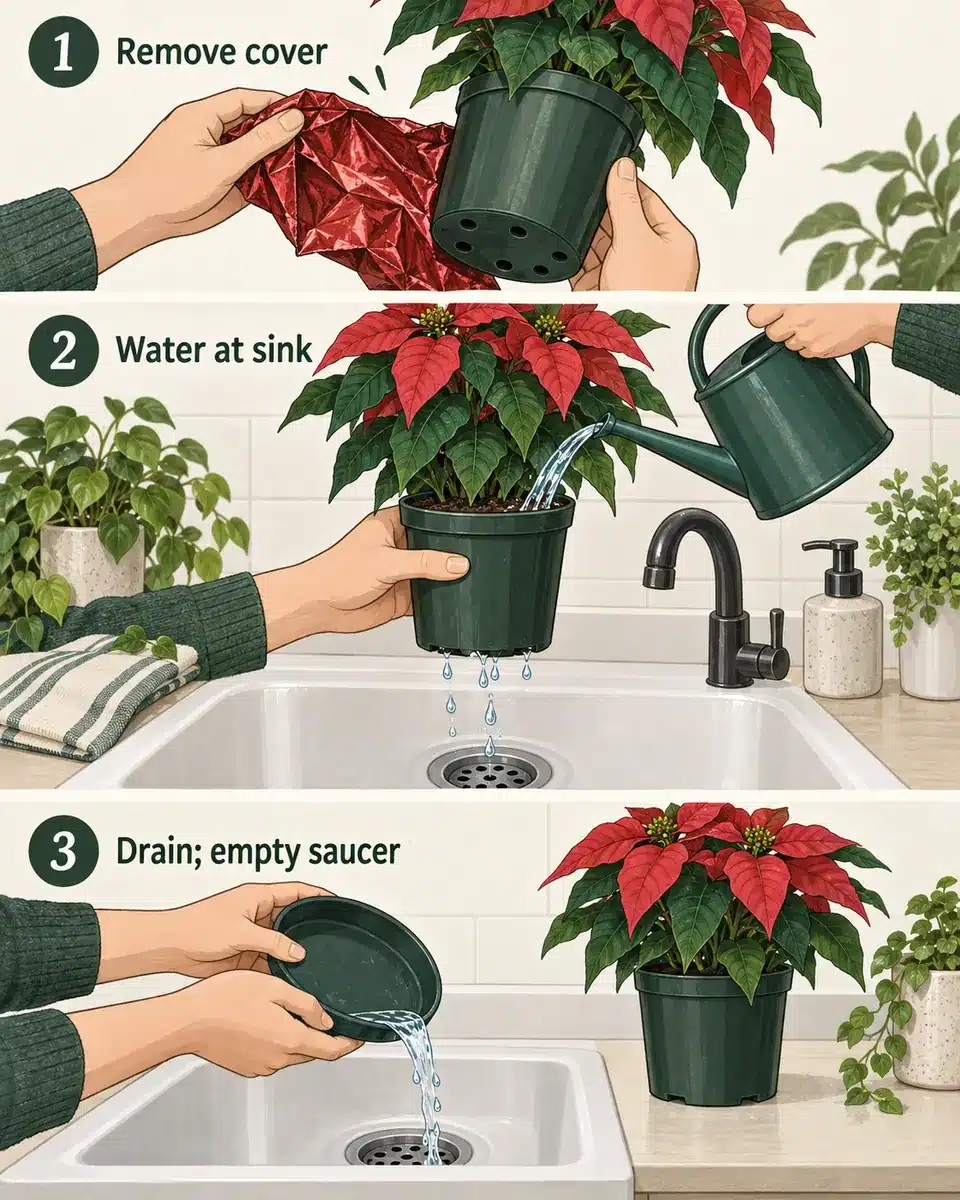
- Expose the drainage holes. Remove decorative foil or take the nursery pot out of its outer container. The growing pot needs drainage holes; a decorative cover must not become a reservoir.
- Water at the sink. Apply water to the soil until it runs through the drainage holes. Keep the pot out of the collected runoff.
- Let it drain completely. Return it to its display only after drainage stops, and empty any water that collects in the saucer or outer pot.
- Recheck the conditions. Before the next watering, repeat the moisture and pot-weight checks. A date on the calendar cannot tell you whether this pot is ready.
This guide uses the surface-drying approach supported by the U.S. Botanic Garden, Minnesota, and Oklahoma State. Utah State’s alternative guidance allows the top 2–3 inches (5–8 cm) to dry; that is a different protocol, not an additional step to combine with this one. Do not wait for severe wilting to make a holiday poinsettia qualify for water.
Repeatedly soaking already-wet potting medium can deprive roots of oxygen and lead to root rot, wilting, yellowing, and leaf loss. Severe drying can also accelerate leaf and bract loss. Fixing drainage and checking actual moisture are more useful first actions than buying a care accessory.
Why is your poinsettia wilting or dropping leaves?
Wilting or leaf loss does not prove a poinsettia needs water. First check the soil and trapped runoff, then consider recent cold exposure and the amount of light. Several stresses produce similar symptoms, so use the conditions you can observe to choose an action instead of diagnosing from a fallen leaf alone.
| What you observe | Possible problem | Free action now | What to check afterward |
|---|---|---|---|
| Dry surface, noticeably light pot, and drooping growth | Drying stress; severe dryness can speed leaf and bract loss. | Water thoroughly at the sink and let the pot drain completely. | Recheck soil moisture and whether drooping or further leaf loss continues. Do not water again while the soil remains wet. |
| Wet, heavy pot or runoff trapped in foil, with wilt or yellowing | Waterlogged roots; root rot is possible, but these signs do not confirm it. | Empty trapped water, uncover drainage holes, and stop adding water to wet soil. | Check that runoff can escape and monitor whether the soil begins drying. Persistent wilt despite corrected moisture needs further assessment rather than repeated watering. |
| Leaf loss after a cold trip, an open doorway, or contact with cold glass | Chilling or draft stress may be contributing. | Move the plant to a stable bright indoor location away from drafts and glass. | Check the temperature at the plant’s position and watch whether additional leaves fall. A warmer room does not erase previous cold damage. |
| Dim placement with leaf loss or spindly growth | Insufficient light may be contributing. | Move to a bright suitable window with protection from harsh sun. | Check the actual daytime light and observe leaf retention and later growth. Keep using the moisture checks after changing placement. |
These are observation-based paths, not a complete disease diagnosis or a promise of recovery. Oklahoma State Extension’s poinsettia guide explains the wet-root, drought, and light risks; New Mexico State’s care guide also identifies cold drafts and low temperatures as leaf-loss causes. Keep checking the conditions you changed, rather than expecting a fixed recovery deadline.
How do you keep a poinsettia after Christmas?
You can keep a poinsettia as a green houseplant after its holiday display. Continue bright light, drainage, and moisture checks; fertilizer is unnecessary during the display. When new growth appears, University of Minnesota recommends an all-purpose houseplant fertilizer at half label strength every 3–4 weeks, without exceeding the label’s instructions.
This guide follows Minnesota’s growth-stage feeding advice. Utah State recommends weekly feeding during the holidays, but that is an alternative protocol. Do not add its weekly feeding to the Minnesota routine or use fertilizer as a substitute for fixing wet roots, poor light, or cold exposure.
| Stage | What to do | Decision check |
|---|---|---|
| Holiday display | Provide bright indirect light, check moisture, and drain after watering. Skip fertilizer. | Are the pot and saucer draining freely? |
| Spring growth | Feed when new growth appears. If overgrown, cut stems back to 4–6 inches (10–15 cm) above the soil using Oklahoma State’s approach; repot if the plant outgrows its pot. | Does it need shaping or more root space, rather than an automatic seasonal repot? |
| Summer outdoors, if suitable | Wait until frost danger has passed and nights stay above 50–55°F (10–13°C). Introduce outdoor conditions gradually, using partial shade or morning sun and avoiding hot drying wind. | Is your local weather suitable? A calendar month alone is insufficient. |
| Late summer and fall | Stop summer pinching around mid- to late August. Bring the pot indoors before autumn nights turn cold; decide whether to attempt reblooming. | Can you provide bright days and uninterrupted dark nights? |
Summer pinching encourages branching, but it need not become a project if your goal is simply a manageable green houseplant. Wear gloves when pruning because sap can irritate skin, and avoid contact with your eyes or mouth. The spring cutback above follows Oklahoma State’s protocol rather than mixing different extension pruning calendars.
If you are caring for another holiday plant too, use the separate Christmas cactus care guide; its watering and darkness requirements should not be assumed identical. For another indoor flowering-plant care project, see African violet care.
How do you get colored poinsettia bracts again?
To encourage another colored display, give a kept poinsettia uninterrupted dark nights and bright days in fall. This guide follows Oklahoma State Extension’s reblooming routine: complete darkness from 5 p.m. to 8 a.m., starting in late September, with bright window light during the day. Continue until good bract color appears; holiday timing is not guaranteed.
- Choose the goal. Keeping the plant green is a valid option. Attempt reblooming only if you can manage the daily light-and-dark routine.
- At 5 p.m., begin complete darkness. Use a suitable existing dark room or lightproof box until 8 a.m. Household lights must not leak into or interrupt this period.
- At 8 a.m., return it to a bright window. The routine provides 15 hours of darkness and a 9-hour daytime window, from 8 a.m. to 5 p.m. Permanent darkness is not the goal.
- Keep conditions steady. Oklahoma State recommends about 60–70°F (16–21°C) during this phase. Continue moisture checks and complete drainage.
- Watch the endpoint. Continue the routine until good bract color develops, often before Thanksgiving in the source’s guidance. Starting the routine or initiating flower buds is not the same as having a finished colored display.

Why the schedules you find differ: Minnesota describes 16 hours of darkness, while Utah State describes at least 14. Those are alternative source protocols, not three requirements to average or alternate. The 15-hour Oklahoma State routine above gives you one consistent method. Even brief artificial-light interruptions can delay or disrupt flowering; check for evening room lights rather than assuming a closed door guarantees darkness.
Are poinsettias toxic to cats and dogs?
Yes. The ASPCA lists poinsettia (Euphorbia pulcherrima) as toxic to cats and dogs: sap can irritate the mouth and stomach and sometimes cause vomiting. Keep it away from chewing pets. After suspected ingestion, contact your veterinarian or ASPCA Poison Control as soon as possible at (888) 426-4435; a consultation fee may apply.
Pet Poison Helpline describes mild toxicity: ingestion may cause vomiting or drooling and, rarely, diarrhea; sap can also irritate skin or eyes. The danger is often overstated, but “not poisonous” wording elsewhere does not guarantee harmlessness. This guide does not provide home treatment or predict an individual pet’s outcome.
For broader species-specific context, read our guide to plants toxic to cats and dogs. Keep the plant’s identity available when discussing an exposure with a veterinary professional.
Poinsettia care FAQ
How do I save my poinsettia plant for next year?
Keep it in bright light, water according to soil moisture, and let the pot drain completely after watering. Feed when new growth appears, shape an overgrown plant in spring if needed, and protect it from cold. If you want new colored bracts, add the separate fall darkness routine rather than expecting ordinary care alone to produce them.
Why are leaves dropping off my poinsettia?
Leaf loss can follow drought, waterlogged roots, cold drafts, low temperatures, or inadequate light. Check the soil and trapped runoff first, then recent cold exposure and placement. The same drooping appearance can occur in a wet or dry pot, so adding water without checking can make the problem worse.
Can you keep poinsettias alive all year?
Yes, a poinsettia can remain a green houseplant after its holiday color fades. Continue suitable light, moisture checks, drainage, and growth-stage feeding. Keeping it alive does not guarantee another colored display, because fall bract development depends on a consistent bright-day and uninterrupted-dark-night routine as well as the plant’s condition.
Is it safe to leave potted poinsettias outside year-round?
Usually not: most US holiday pots need winter protection indoors. NC State lists poinsettia for USDA Zones 9–11 as a landscape range, while USDA zones reflect average annual extreme minimum winter temperatures, not a forecast or survival guarantee. For flowering pots, avoid temperatures below 50°F (10°C), frost, and freezing; follow actual local forecast lows.
How often should I water a poinsettia?
Check daily and water when the surface starts drying or the pot feels noticeably light, rather than automatically watering once a week. Water through the drainage holes and let the pot drain completely. A still-wet, heavy pot needs observation and clear drainage, even if the plant is drooping.
Sources and further reading
- NC State Extension: Euphorbia pulcherrima — attributed USDA Zones 9–11 landscape range.
- USDA: How to Use the Plant Hardiness Maps — zone definitions and limitations.
- U.S. Botanic Garden: Poinsettia Care — holiday placement, foil removal, moisture checks, and drainage.
- University of Minnesota Extension: Growing and caring for poinsettia — temperatures, growth-stage fertilizing, and year-round care.
- Oklahoma State Extension: Poinsettia Care — moisture stress, pruning, summer care, and the selected rebloom routine.
- Utah State Extension: Keeping a poinsettia beyond the holidays — alternative watering, feeding, and darkness guidance distinguished above.
- University of Florida IFAS: Poinsettia — frost protection and warm-climate outdoor context.
- ASPCA: Poinsettia — plant identity, pet toxicity, and veterinary contact advice.