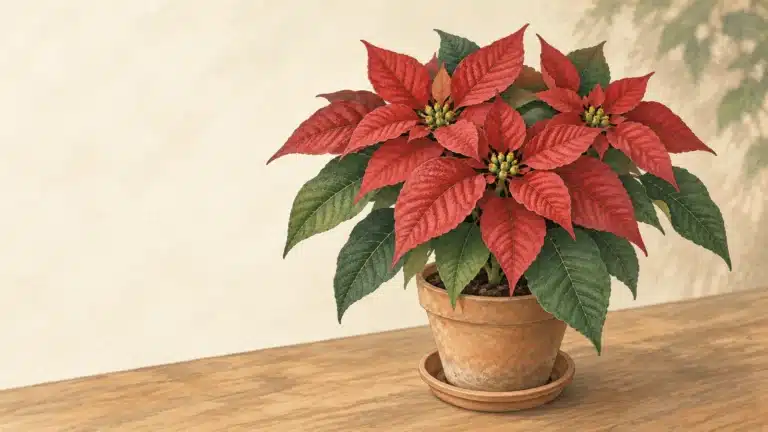
If you’re asking “are poinsettias poisonous to cats,” yes: ASPCA classifies poinsettias as toxic to cats and dogs, while Pet Poison Helpline rates their toxicity as mild. If your pet chewed one, prevent further access and contact your veterinarian or ASPCA Poison Control at (888) 426-4435 promptly; a consultation fee may apply.
Are poinsettias poisonous to cats and dogs?
Yes. ASPCA classifies poinsettia (Euphorbia pulcherrima, family Euphorbiaceae) as toxic to cats and dogs; its irritant sap can affect the mouth and stomach, sometimes causing vomiting. Pet Poison Helpline rates toxicity as mild for both. ASPCA also lists horses, but this guide addresses cats and dogs, not horse-specific care.
See ASPCA’s exact species, family and toxicity record and Pet Poison Helpline’s severity guidance.
The sources do not establish a different safe amount for a cat versus a dog. They also do not provide a universal number of leaves that can be eaten safely. Tell the professional which pet was exposed and how much you think is missing rather than trying to decide whether a bite is below an online threshold.
What should you do if your pet eats a poinsettia?
Begin by stopping additional exposure. ASPCA recommends removing the pet from the area, assessing its condition, collecting evidence and seeking professional guidance. For a plant exposure, use that sequence this way:
- Separate the pet and plant. Move the pet to an area without access to the poinsettia or loose plant pieces.
- Check the pet’s condition. If it has emergency signs listed below, get immediate veterinary care. Do not delay urgent transport to finish a checklist.
- Save useful identification information. Have the plant label or a photo ready. Note the approximate exposure time, what may have been chewed, how much appears missing and any signs you have noticed. Say when those details are uncertain.
- Contact your veterinarian or poison control promptly. ASPCA Poison Control is available 24/7 at (888) 426-4435; a consultation fee may apply, according to ASPCA’s contact information.

Be ready to give your pet’s species, breed, age, weight, health history and current condition. These details help the poison specialist assess the individual exposure; they are not a reason to postpone the call. Follow the professional’s instructions about monitoring, treatment and whether your pet needs an examination.
Do not induce vomiting or give home antidotes without professional instruction. Pet Poison Helpline explicitly warns against these actions. A generic internet remedy is not a substitute for advice about your pet, the identified plant and the actual exposure.
What signs can follow chewing or sap contact?
Pet Poison Helpline’s poinsettia entry distinguishes ingestion from contact with sap. Chewing can cause drooling and vomiting, with diarrhea occurring rarely. Sap on skin may cause redness, swelling or itchiness; sap in the eyes can cause irritation. ASPCA specifically describes mouth and stomach irritation that may include vomiting.
These signs can help you describe what you observed, but they do not prove which plant caused the problem. Tell the veterinarian about other plants or substances your pet could have reached. If the label is missing or you are unsure it was a poinsettia, make that uncertainty clear rather than applying poinsettia reassurance to an unidentified exposure.
When should you go to an emergency veterinarian?
For unconsciousness, breathing difficulty, bleeding or seizures after a suspected poisoning, ASPCA advises immediate veterinary care. These are general emergency warning signs. They are not a list of expected effects from an ordinary poinsettia exposure.

| What you observe | Next step | Why it matters |
|---|---|---|
| Known poinsettia chewing; pet appears normal | Prevent further access and contact your veterinarian or ASPCA Poison Control promptly. | A mild toxicity rating does not establish a safe dose or remove the need for case-specific advice. |
| Drooling, vomiting, or skin or eye irritation | Describe the signs and exposure route during the call; follow professional instructions. | These can occur with poinsettia, but signs alone do not confirm the cause. |
| Severe or persistent signs | Seek veterinary assessment rather than relying on a recovery timer. | Pet Poison Helpline notes that these cases may require medical treatment. |
| Unconsciousness, breathing difficulty, bleeding or seizures | Get immediate veterinary care. | These are ASPCA’s general poisoning emergency signs, not typical poinsettia signs. |
| Plant identity uncertain or another plant may have been eaten | Contact a veterinarian or poison control promptly and share identification evidence. | Advice for poinsettia may not apply to another plant. |
This table combines ASPCA’s poinsettia contact advice, Pet Poison Helpline’s severity guidance and ASPCA’s emergency response guidance. It helps you choose a next step; it does not diagnose your pet.
Why do some sources call poinsettias harmless?
The apparent disagreement often mixes up classification and usual severity. ASPCA lists poinsettia as toxic while explaining that its dangerous reputation is exaggerated. Pet Poison Helpline calls the toxicity mild and describes signs as generally self-limiting, while allowing for treatment when signs are severe or persistent. Neither point supports calling the plant harmless.
Purdue’s discussion of the poinsettia myth also describes historical human poison-center research alongside pet advice. Human exposure findings are not a pet-dose study and cannot supply a safe number of leaves for your cat or dog. Read reassurance as a correction to an exaggerated reputation, not permission to ignore chewing or skip professional contact.
Can you keep poinsettias in a home with pets?
Preventing access is the useful first action. Purdue notes that cats and puppies may chew newly introduced plants and advises keeping poinsettias out of reach. Use an existing room your pet cannot enter if that is practical. A high shelf is not a dependable barrier for a pet that can reach it.
Check the surrounding area for loose plant pieces, especially after moving or handling the pot. This is ordinary exposure prevention, not veterinary treatment. If you cannot keep the plant inaccessible, reconsider where it is displayed rather than assuming your pet will know to avoid it.

What about other holiday plants?
Identify each plant separately. ASPCA’s entry for lilies in the genus Lilium lists toxicity to cats and kidney failure. Do not apply poinsettia’s usually mild irritation profile to suspected Lilium exposure, and do not extend that exact warning to every plant with “lily” in its common name. Tell a veterinarian promptly if this could be the plant involved.
For a plant already in your home, ASPCA lists its Christmas cactus entry, Schlumbergera bridgesii, as non-toxic to cats and dogs. That record does not identify every plant sold as Christmas, Thanksgiving or Easter cactus. Our Christmas cactus and cats guide provides related reading; the ASPCA species record supplies the classification used here.
Use the plant toxicity guide for cats and dogs for broader plant lookups. If your question is “Why are poinsettias so hard to keep alive?”, that is a separate plant-care task. Once the pet-safety question is addressed, use our poinsettia care guide for watering and leaf-loss concerns.
Questions after a suspected exposure
How much poinsettia is safe for a cat or dog to eat?
No universal safe amount is established by the sources used here. A mild toxicity rating does not tell you that one leaf or one bite is safe for your particular pet; report the estimated amount, exposure time and any signs to your veterinarian or poison control for individualized guidance.
How long do poinsettia symptoms last?
There is no universal recovery timer in the cited guidance. Pet Poison Helpline describes signs as generally self-limiting but says severe or persistent signs may need treatment; ask the professional who assesses your pet what to monitor, when to report changes and whether an examination is needed.
Are poinsettias okay to be around cats?
Keep poinsettias inaccessible to cats rather than treating them as harmless decorations. ASPCA classifies the plant as toxic, and Purdue notes that cats may chew plants introduced into the home; an existing room your cat cannot enter is a practical prevention option if you can reliably maintain that separation.
Do cats know not to eat toxic plants?
Do not rely on a cat to avoid a toxic plant on its own. Purdue specifically notes that cats may chew newly introduced plants, so prevent access instead of using your pet’s past behavior as a safety guarantee; if chewing occurs, contact a veterinarian or poison control promptly.
What is the most toxic flower to cats?
The cited sources do not establish one “most toxic” flower. They do identify Lilium species as toxic to cats, with kidney failure among the clinical signs. If a lily may be involved, contact a veterinarian promptly; do not apply poinsettia’s usually mild risk profile to that exposure.
ASPCA’s Lilium record supports this warning. Common names alone cannot identify every plant called a lily.
Sources
- ASPCA: Poinsettia — species, classification and clinical signs
- Pet Poison Helpline: Poinsettia — exposure routes and severity
- ASPCA: What to do if your pet is poisoned
- Pet Poison Helpline: Emergency instructions
- Purdue: Poinsettias are not as poisonous as their reputation suggests
- ASPCA: Lily — Lilium species
- ASPCA: Christmas cactus — Schlumbergera bridgesii