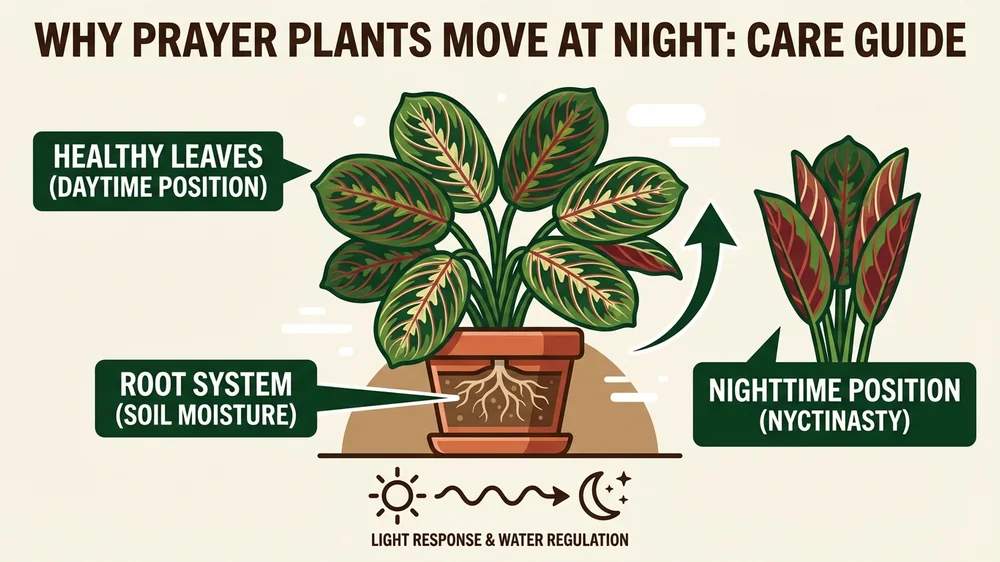
Your prayer plant isn’t broken. It’s performing one of the most remarkable daily rhythms in the plant kingdom.
Every evening, the leaves of Maranta leuconeura — the praying plant, as it’s sometimes called — fold upward into a vertical position, resembling hands pressed together in prayer. Every morning, they open flat again. This process happens regardless of whether you’re watching.
Joakim got fascinated enough to research the actual biology behind it. Here is what drives the movement, what it means for your care routine, and why it stops when something goes wrong.
Quick Reference
- Movement name: Nyctinasty — light-triggered leaf folding
- Trigger: Decreasing light (not just darkness — light quality matters)
- Mechanism: Turgor pressure changes in pulvinus joints at the leaf base
- Daily cycle: Leaves open at sunrise, fold upward at sunset
- When it stops: Stress signal: low humidity, inconsistent watering, or wrong light
- Is it harmful?: No — it’s a sign of a healthy, active plant
What Is Nyctinasty? (The Answer in One Sentence)
Nyctinasty is the circadian movement of plant leaves in response to changing light — open during the day, closed at night.
The word comes from the Greek nyktos (night) and nastos (pressed close). It’s not a stress response. It’s not the plant sleeping. It’s an active biological process the plant performs every single day of its life.
Prayer plants are one of the most visible examples of nyctinasty in the houseplant world, but they’re not alone. Calatheas, Oxalis, and some legumes perform similar movements.
The Science: Pulvini Joints and Turgor Pressure

Here is the mechanism Joakim found most surprising: the movement is not driven by muscles or any kind of motor protein. It’s driven by water.
At the base of each prayer plant leaf sits a thickened joint called a pulvinus. This structure contains specialised cells called motor cells. When these cells are full of water (turgid), they expand, which pushes the leaf into the open position. When they lose water (flaccid), they contract, pulling the leaf upward into the folded position.
The trigger is phytochrome — a light-sensitive protein in the plant’s cells that detects changes in red versus far-red light. As the ratio shifts at dusk, the phytochrome triggers potassium and water to flow out of the motor cells, initiating the fold.
Why this matters for care: The pulvinus is sensitive. Chronic low humidity means less water available for the motor cells. Inconsistent watering means the plant’s hydraulic system is compromised. Both show up as reduced or absent movement before any visible leaf damage appears.
The 24-Hour Movement Cycle

We check ours at around 10 PM. If the leaves are folded up — the plant is healthy and the mechanism is working. If they’re still flat after dark, something needs attention.
The typical daily cycle:
- Sunrise (6–8 AM): Leaves begin to open as light increases. Fully flat within 1–2 hours.
- Midday: Leaves fully horizontal, maximising surface area for photosynthesis.
- Dusk (6–8 PM): Movement begins as light quality shifts. Leaves angle upward.
- Night (10 PM+): Leaves fully vertical. The plant “prays.”
The exact timing shifts with the seasons because day length and light quality change. In our Aarhus apartment, the movement starts noticeably earlier in January than in June.
Why Is It Called a Prayer Plant?
The common name comes directly from this nightly folding movement. When the leaves are fully vertical, they closely resemble human hands pressed together in a prayer gesture.
The name “praying plant” is sometimes used interchangeably with “prayer plant” — both refer to the same species, Maranta leuconeura. The scientific name “leuconeura” (white-veined) describes the leaf marking on some cultivars, not the movement.
Other common names — herringbone plant, rabbit’s foot plant — refer to specific cultivars based on their leaf patterns, not to the species as a whole.
When the Movement Stops: What It Means
A prayer plant that has stopped folding at night is the earliest warning sign of stress — often appearing before leaf discolouration, crispy tips, or drooping.
The most common causes, in order of frequency:
- Humidity below 40%: The motor cells don’t have enough water to complete the movement. Our apartment in winter drops to 35% humidity without the humidifier — the first thing we notice is reduced leaf folding, not brown tips.
- Inconsistent watering: Drought stress compromises the plant’s hydraulic system. The pulvini depend on adequate water pressure throughout the plant.
- Light quality wrong: If the plant never experiences true darkness (light pollution, left-on artificial lights), the phytochrome trigger doesn’t fire correctly.
- Root bound pot: A severely root-bound plant can’t move water efficiently from roots to leaves.
If the leaves have fully stopped moving for more than a week and you’ve ruled out light and humidity, check the roots. A root-bound plant in a pot too small often loses its movement first.
Do All Prayer Plant Varieties Move? What About Calatheas?
Yes — all seven Maranta leuconeura cultivars perform nyctinasty. The movement is a species trait, not a cultivar-specific one. The Red Herringbone, Lemon Lime, Purple Kim, and Silver Band all fold up at night.
Calatheas (now reclassified as Goeppertia) also perform nyctinasty, but the movement is generally less dramatic. Maranta leaves fold more fully vertical; Calathea leaves tend to angle upward rather than fully close.
Some people confuse the two plants because of the shared leaf movement and family membership (both Marantaceae). But prayer plants and Calatheas are different genera with meaningfully different care requirements. See our prayer plant vs Calathea comparison for the full breakdown.
🌱 Prayer plant care
The movement connects to every care element — light, water, humidity. Prayer Plant Care Guide
🌞 Light requirements
Light quality is the primary trigger. Here’s what foot-candle ranges actually mean. Prayer Plant Light Requirements
🌿 All 7 varieties
Every Maranta leuconeura cultivar performs nyctinasty. Prayer Plant Types: 7 Maranta Varieties
Prayer Plant Night Movement FAQ
Why do prayer plants move at night?
Prayer plants fold their leaves at night through a process called nyctinasty. Specialised cells in a joint (pulvinus) at the leaf base gain or lose water in response to changing light quality, causing the leaf to open during the day and fold upward at night.
Why is it called a prayer plant?
The name comes from the nightly folding movement — when the leaves are fully vertical, they resemble hands pressed together in prayer. “Praying plant” is another common name for the same reason.
Why has my prayer plant stopped moving?
The most common causes are low humidity (below 40-50%), inconsistent watering, or a room that never gets fully dark. The movement is driven by water pressure in specialised cells — drought stress or low humidity disrupts this. Check humidity first.
Do all prayer plant varieties fold at night?
Yes. Nyctinasty is a species trait of Maranta leuconeura — all cultivars perform it, including the Red Herringbone, Lemon Lime, Fascinator Tricolor, Kim (Purple), and Silver Band.
Is it bad if my prayer plant leaves are not fully closing?
Partially reduced movement is usually an early stress signal, most commonly low humidity. If the leaves are otherwise healthy (no yellowing, no brown tips), increase humidity to 50-60% and ensure consistent watering. Full movement should return within 1-2 weeks.
About The Plant Manual
We’re Joakim and Emilie, a plant-loving couple from Aarhus, Denmark. Joakim researches and builds. Emilie keeps things alive. Together, we share what we’ve learned (including plenty of failures) to help you grow happy, healthy plants.
We’re passionate plant enthusiasts, not professional botanists. Our advice comes from research and real experience in our own apartment.