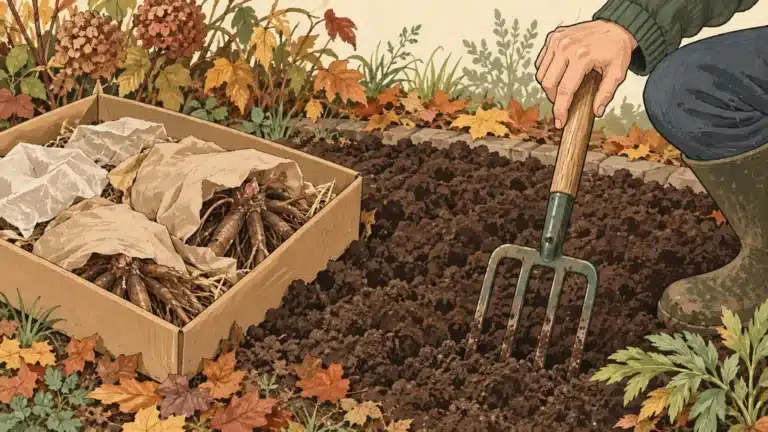
Peony care starts with a sunny, well-drained site and shallow planting for herbaceous garden peonies. Water during establishment and dry weather, support heavy flowers, and keep healthy leaves after bloom. Cut dead herbaceous stems at ground level after fall frost. This guide covers living, in-ground peonies; identify tree and Itoh types before applying planting or pruning rules.
Which peony type do you have?
Herbaceous peonies grow fresh stems each spring and die back above ground in winter. Tree peonies retain woody branches, while Itoh hybrids combine herbaceous and woody ancestry. Check the plant label and its dormant stems before pruning: flower color alone cannot establish a cultivar, and these groups do not share every care rule.
Peonies belong to the genus Paeonia. Many familiar herbaceous garden plants are cultivars of P. lactiflora, but other species contribute to herbaceous hybrids. North Carolina Extension’s herbaceous peony profile distinguishes those groups rather than treating every garden peony as one species.
| Peony type | Useful clue | Care boundary |
|---|---|---|
| Herbaceous garden peony | Soft annual stems; above-ground growth dies back in winter. | The shallow-eye planting and dormant ground-level cleanup below apply to this group. |
| Tree or woody peony | A shrub framework of woody branches remains after leaves fall. | Keep those branches. Do not perform the herbaceous fall ground cut; planting depth also needs type-specific instructions. |
| Itoh/intersectional hybrid | Woody and herbaceous ancestry; the label is especially useful because short woody stem portions can remain. | The American Peony Society permits ground-level season-end cutting in cold climates. Confirm local guidance for other climates rather than assuming one height everywhere. |
These distinctions follow Clemson’s tree and herbaceous guidance and the American Peony Society glossary. If the type remains uncertain, keep woody stems until you can check the label or ask a local Extension office.
Where do peonies grow best in the US?
Herbaceous peonies flower best with at least six hours of direct sunlight, well-drained soil, and air movement. North Carolina Extension gives USDA zones 3–8 as a general range, with best performance in zones 5–7. Warm southern gardens need attention to winter chilling and cultivar choice; a zone number alone does not promise flowers.
Start with a free site check: observe where direct sun actually reaches the clump and whether water pools after rain. Avoid close competition from large trees and shrubs. Iowa State Extension links shade and competing roots with poor growth and flowering; the American Peony Society also warns against sites that collect standing water.
In hot southern locations, afternoon shade can protect flowers while the plant still receives adequate direct sun. Clemson’s South Carolina guidance treats tree peonies separately, recommending dappled or afternoon shade for their flowers. North Carolina Extension notes that herbaceous peonies can languish where winter chilling is insufficient, even within their broad zone range.
Peony care at planting: when and how deep?
Plant bare-root herbaceous peonies in fall, with their eyes close to the finished soil surface. Iowa guidance specifies 1–2 inches (2.5–5 cm); South Carolina guidance limits the eye tips to 1 inch (2.5 cm) deep. Measure to the growth buds, not the bottom of the storage roots, and retain the regional difference.
The eyes are the swollen growth buds at the crown, where stems and roots meet. A deep planting hole can accommodate the roots without putting the eyes deep underground. The following numbers describe eye burial, not hole depth.
| Plant and setting | Depth or action | What to check |
|---|---|---|
| Bare-root herbaceous peony in Iowa/Midwestern conditions | Eyes 1–2 inches (2.5–5 cm) below finished soil. | Locate the upper growth buds before backfilling; do not measure to the lowest root. |
| Herbaceous peony in South Carolina/warm-region guidance | Eye tips no deeper than 1 inch (2.5 cm). | Do not turn the colder-region 2-inch depth into a nationwide instruction. |
| Container-grown herbaceous peony being transplanted into the garden | Approximately its existing planted depth. | Avoid extra soil or accumulated mulch over the crown; investigate an obviously buried crown rather than adding more cover. |
| Tree or Itoh peony | Use instructions for the exact plant and regional conditions. | This herbaceous eye-depth table does not specify a tree graft depth or universal Itoh planting depth. |
Depth guidance comes from Iowa State, Clemson, and North Carolina Extension.
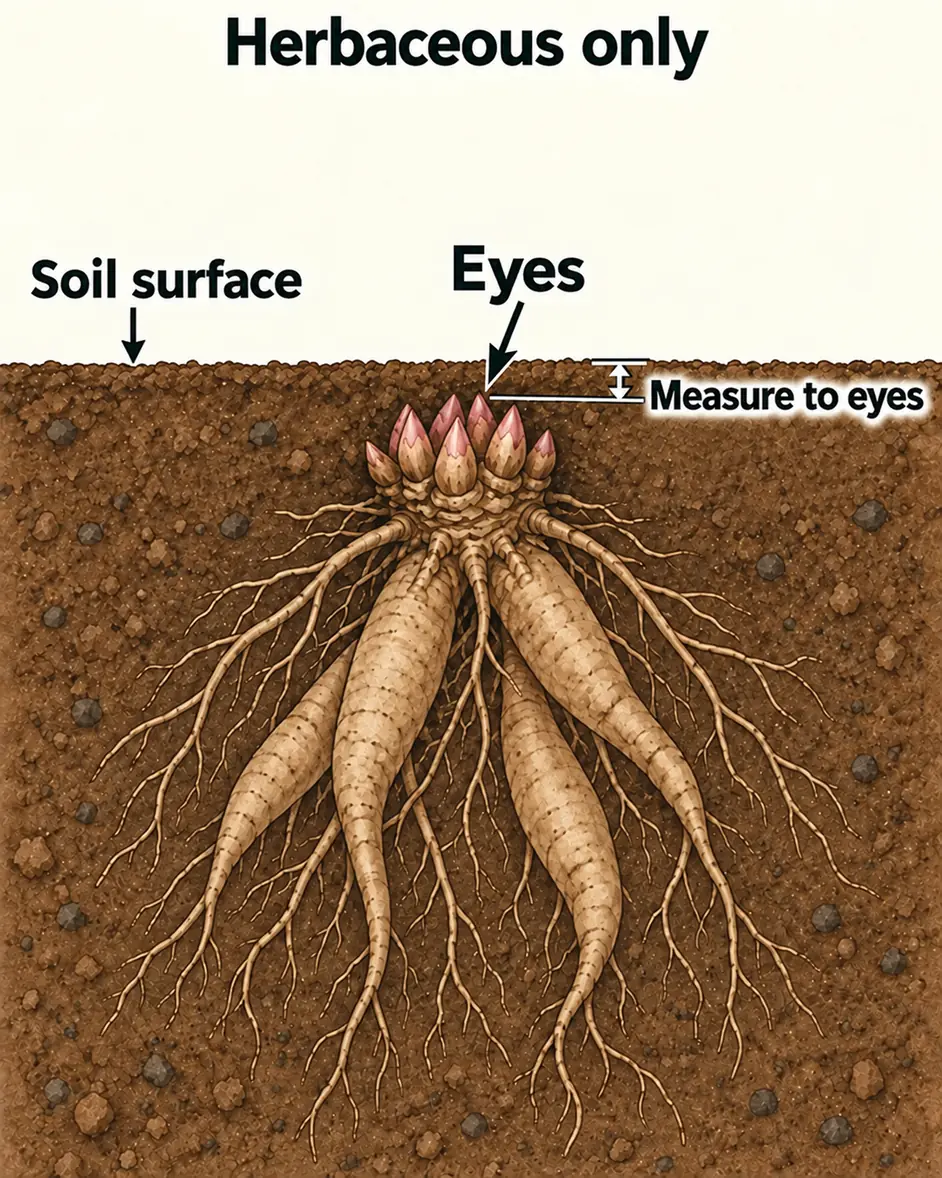
- Choose the site first. Check direct sun, drainage, and space away from competing roots.
- Set the root position. Give the storage roots room in the hole, with eyes upward at the regional depth above.
- Backfill and settle. Firm soil around the roots and water thoroughly.
- Check the final surface. Verify eye depth after settling and keep extra soil and routine mulch off the crown.
Fall timing varies: Iowa State favors September for dividing and planting; Clemson uses late September or October for moves in South Carolina. The American Peony Society allows fall planting while soil remains unfrozen. A nursery plant bought in spring is a different situation: the University of Michigan care calendar advises planting available potted peonies promptly rather than holding them until fall.
How should you water new and established peonies?
Water newly planted peonies thoroughly, then supply water during establishment when rainfall and soil conditions call for it. Established plants need deep watering during dry weather, especially as buds develop and flowers open. Water the soil rather than the leaves; stop adding water to an already wet site and investigate poor drainage.
Check the soil around the plant before turning on a hose. A young plant in drying soil needs closer attention than an established clump after soaking rain. The University of Michigan separates establishment watering from mature-plant summer watering, while American Peony Society care advice directs water around the drip line, beneath the outer foliage.
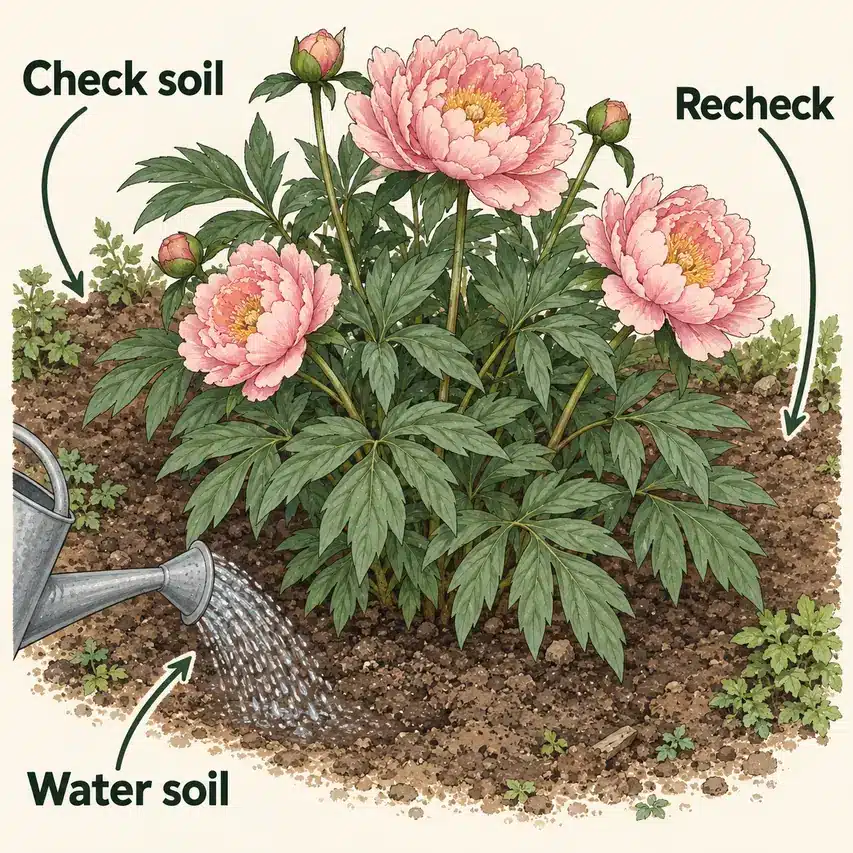
For dry-weather watering, Iowa State recommends wetting soil about 12 inches (30 cm) deep. That is the depth reached by moisture, not 12 inches of water to apply. Rainfall, drainage, and establishment stage determine the next watering; there is no single weekly dose for every US garden. Buds can fail to enlarge and open when plants are dry.
How do you support blooms and care for peonies after flowering?
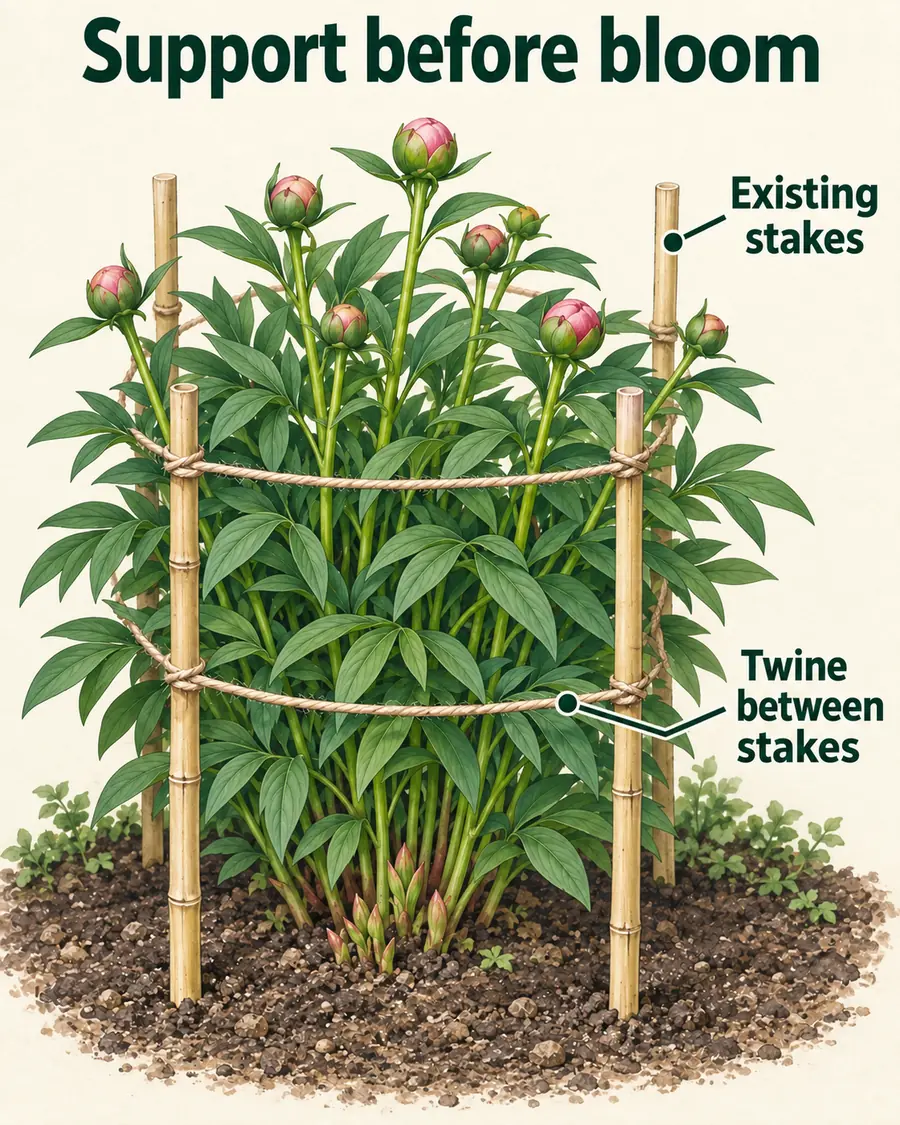
Support heavy flowers before they pull stems over, then remove spent flower heads while keeping healthy leaves. Existing stakes and twine can support a clump; a new support is not always necessary. Deadheading removes the fading flower or seed head, while fall cutback removes dead stems later. Those are separate jobs.
Large double flowers are more likely to flop than lighter single or Japanese flower forms. Iowa State recommends placing rings early in spring; if you already own suitable stakes and twine, Michigan’s care calendar describes surrounding the clump with supports as it reaches roughly half to three-quarters of its full height. Keep supports clear of tender emerging shoots.
- Before heavy blooms open: position existing supports so stems can grow through or rest within them.
- When petals fade: remove the spent flower head or developing seed head.
- Through summer: retain healthy green foliage. Do not shear the clump down just because flowering is over.
Healthy leaves help replenish stored reserves. Iowa State’s poor-bloom guidance warns that premature summer foliage removal weakens plants and can reduce the following spring’s flowers.
For a few stems to bring indoors, Clemson recommends the soft-bud stage, when the bud feels soft rather than tight and hard. Leave at least three leaves per stem on the garden plant. This preserves foliage; the guide’s main watering and winter instructions concern garden plants, rather than flowers already in a vase.
When should you cut peonies back and use mulch?
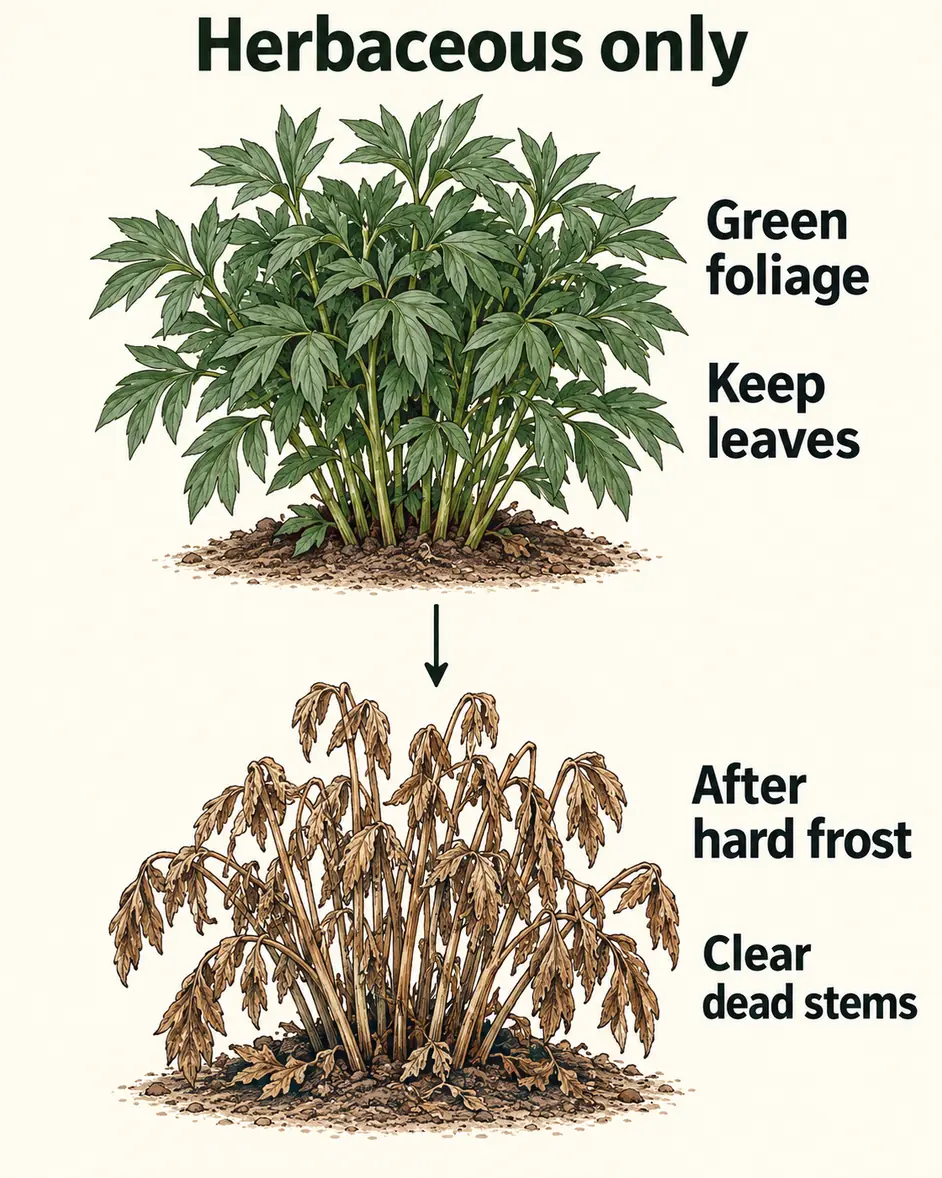
Cut dead herbaceous peony stems to ground level after a hard fall freeze, and remove the debris. Keep tree peony branches intact. Mulch needs depend on climate and establishment: temporary frost-heave protection for a new cold-region planting is different from insulating an established crown in a warm garden.
Use foliage condition and frost as the trigger, rather than copying a northern garden’s month into every region. Iowa State places cleanup after a hard freeze, and Clemson specifies dead herbaceous stems after frost. Remove diseased material from the bed; do not put affected foliage in home compost.
For new plantings subject to frost heaving, the American Peony Society describes protection after soil freezes, removed from the emergence area in early spring. In warm regions, North Carolina Extension discourages winter crown mulch because insulation can reduce chilling. Keep routine mulch from accumulating against crowns and stems.
If peonies share your border with hydrangeas, check when to prune each hydrangea type before cleaning up neighboring shrubs. A herbaceous peony’s ground-level cut is not a mixed-border pruning rule.
Why is your peony not blooming?
First separate a plant that never formed flower buds from one whose buds formed but failed to open. Recent planting, shade, excessive depth, and other site conditions can limit flowering; dry weather or disease can affect formed buds. These checks narrow the possibilities without identifying a cause from one symptom alone.
| What you observe | Check next | Action and reassessment |
|---|---|---|
| Few or no flower buds after recent planting or division | Planting history, direct sun, regional eye depth, drainage. | If conditions are suitable, maintain care and record the next bloom season. Plants may bloom poorly for two or three years after planting; this is not a guaranteed countdown. |
| Leaves grow well but no flower buds appear | Actual hours of direct sun, soil or mulch over the eyes, past fertilizer use. | Remove accumulated crown mulch; stop reflex feeding. If shade or planting depth needs a move or reset, plan it for fall and reassess the following bloom season. |
| Flower buds formed but stay small or fail to open in dry weather | Whether soil is drying and rainfall has reached the root area. | Water deeply if dry, then recheck soil moisture and remaining buds. Correcting dryness does not guarantee recovery of buds already damaged. |
| Buds turn brown and young shoots wilt or collapse in cool, wet weather | Possible Botrytis pattern; other damage can overlap. | Remove visibly diseased shoots and discard them, avoid wet-foliage work and overhead watering. Seek local Extension help if the cause is unclear or damage continues; watch remaining shoots for new symptoms. |
| Failure follows a late freeze or recurs in a warm southern garden | Weather history and cultivar suitability; insufficient winter chilling is one possibility. | Keep healthy foliage and review regional suitability before moving or replacing the plant. Assess again in the next bloom season; added fertilizer cannot establish the cause. |
The no-bud checks follow Iowa State’s poor-flowering FAQ and Clemson’s bloom-failure list. The dry-bud branch comes from Iowa State’s growing guide; the cool, wet brown-bud pattern comes from Illinois Extension’s disease guidance. The table is a care decision aid, not a confirmed diagnosis.
Should you fertilize a peony that will not flower?
Do not make fertilizer your first response. Clemson lists excess nitrogen among possible causes of bloom failure, and the American Peony Society recommends fertilizing only for a reason. Check light, depth, establishment, and past feeding first. Use local soil and nutrient guidance if a deficiency needs investigation, rather than inventing a universal peony dose.
What about powdery leaves or purple-brown spots?
White-to-gray powdery growth is consistent with powdery mildew; purple-brown blotches fit a different leaf-blotch pattern. Many late-season cases mainly affect appearance. Illinois Extension explains that fungicides protect unaffected tissue rather than cure infected leaves, and are often unnecessary for plant health.
Begin with air movement, watering at soil level, avoiding work among wet leaves, and removing diseased debris at season’s end. Keep the earlier rule to preserve healthy foliage separate from removing diseased shoots. Worsening damage or uncertain symptoms justify a local diagnosis before choosing a chemical treatment.
What should you do at each growth stage?
Use the plant’s stage to choose the job: support emerging stems, water dry soil during bud growth, deadhead faded blooms, preserve summer foliage, and clean up dead herbaceous stems after frost. Check the result before repeating an action. Regional seasons shift these stages, so calendar dates alone are an incomplete guide.
| Trigger | Do this | Check or stop condition |
|---|---|---|
| New shoots emerge | Remove temporary frost-heave covering from the emergence area; place supports if needed. | Keep the crown clear and avoid tender shoots. |
| New planting or developing buds, with dry soil | Water the root area thoroughly. | Check rain and soil first; do not keep watering wet ground. |
| Flower petals fade | Remove spent heads. | Green leaves remain on the plant. |
| Green summer foliage remains | Retain it; inspect visible problems and water during dry weather. | No routine whole-plant summer cutback. |
| Dead stems after hard fall frost | Cut herbaceous stems to ground level; remove debris. | Confirm type first; tree peony branches remain. |
This checklist combines the region-qualified practices from Iowa State, the American Peony Society, and the University of Michigan cited above. It is an editorial synthesis of those tasks, rather than a measured schedule for every garden.
Do you need to divide established peonies?
No routine division is needed just because a clump is old. Mature peonies can remain undisturbed for many years. A move, propagation, or crowding that reduces air movement can make division useful. Plan it for fall; Clemson describes divisions with three to five eyes and good roots, replanted promptly. Very small divisions can take longer to mature.
Peony care FAQ
Should peonies be cut back every year?
Herbaceous peonies should have dead stems removed at ground level after fall frost, while tree peonies keep their woody branches. Do not cut healthy herbaceous foliage down immediately after flowering. Itoh cutback needs climate context: the American Peony Society permits ground-level cutting in cold climates, rather than prescribing it universally.
Do coffee grounds help peonies?
Coffee grounds are not an established peony bloom fix in the sources used here. Oregon State’s general soil guidance says spent grounds are not a major nutrient source or dependable acidifier, and excessive fresh applications can hinder growth. Add them moderately to mixed compost instead of piling them around a peony crown.
Oregon State Extension’s coffee-ground advice concerns general soil and compost use, not a peony flowering trial.
Are peonies high maintenance?
Established herbaceous peonies usually need a small set of seasonal jobs, rather than frequent division or automatic feeding. Heavy flowers may need support, spent heads need removal, and dead stems need fall cleanup. A poor site or recurring disease adds work, so light, drainage, and appropriate regional planting depth matter first.
What helps peonies grow better?
A suitable site and correct planting depth are the first checks: give herbaceous peonies adequate direct sun, drainage, and room away from competing roots. Water new plants and during dry weather, and keep healthy foliage after bloom. Check those conditions before adding fertilizer; more nitrogen is not automatically better for flowering.
Are ants needed for peony flowers to open?
No, ants are not required for peony flowers to open. They visit buds for sweet secretions, according to the American Peony Society and Clemson. Ordinary ants on buds do not call for treatment; if flowers fail, investigate the plant’s light, depth, moisture, and bud symptoms instead of blaming or encouraging ants.
Why did a newly planted peony not bloom?
A newly planted or divided peony may need time to establish before flowering well. Iowa State notes that poor bloom can persist for two or three years, but that is not a promise of flowers by a deadline. Check sunlight, drainage, and eye depth while maintaining care, and retain healthy summer foliage.
Sources and regional scope
- Iowa State University Extension: Growing Peonies in Iowa — Midwestern planting, watering, support, and dormant cleanup.
- Iowa State University Extension: Why peonies bloom poorly — light, depth, establishment, and foliage retention.
- Clemson Cooperative Extension: How to Grow Peonies in South Carolina — southern depth, sun, woody-stem exceptions, cutting, and division.
- North Carolina Extension Plant Toolbox: Herbaceous Peonies — identity, zones, chilling, and warm-region limitations.
- American Peony Society: Care — free-first care, fertilizer restraint, foliage, and ants.
- American Peony Society: Site — drainage, root competition, and dormancy.
- American Peony Society: Planting — fall rooting and temporary protection for new plantings.
- American Peony Society: Glossary H–M — growth habits and cold-climate Itoh cutback.
- University of Michigan: Peony Care Calendar — an Ann Arbor garden’s establishment, support, and sanitation tasks.
- University of Illinois Extension: Powdery Mildew and Leaf Blotch — symptom patterns, sanitation, and limits of fungicides.
- Oregon State University Extension: Coffee Grounds and Soil — general amendment guidance, not a peony-specific bloom study.