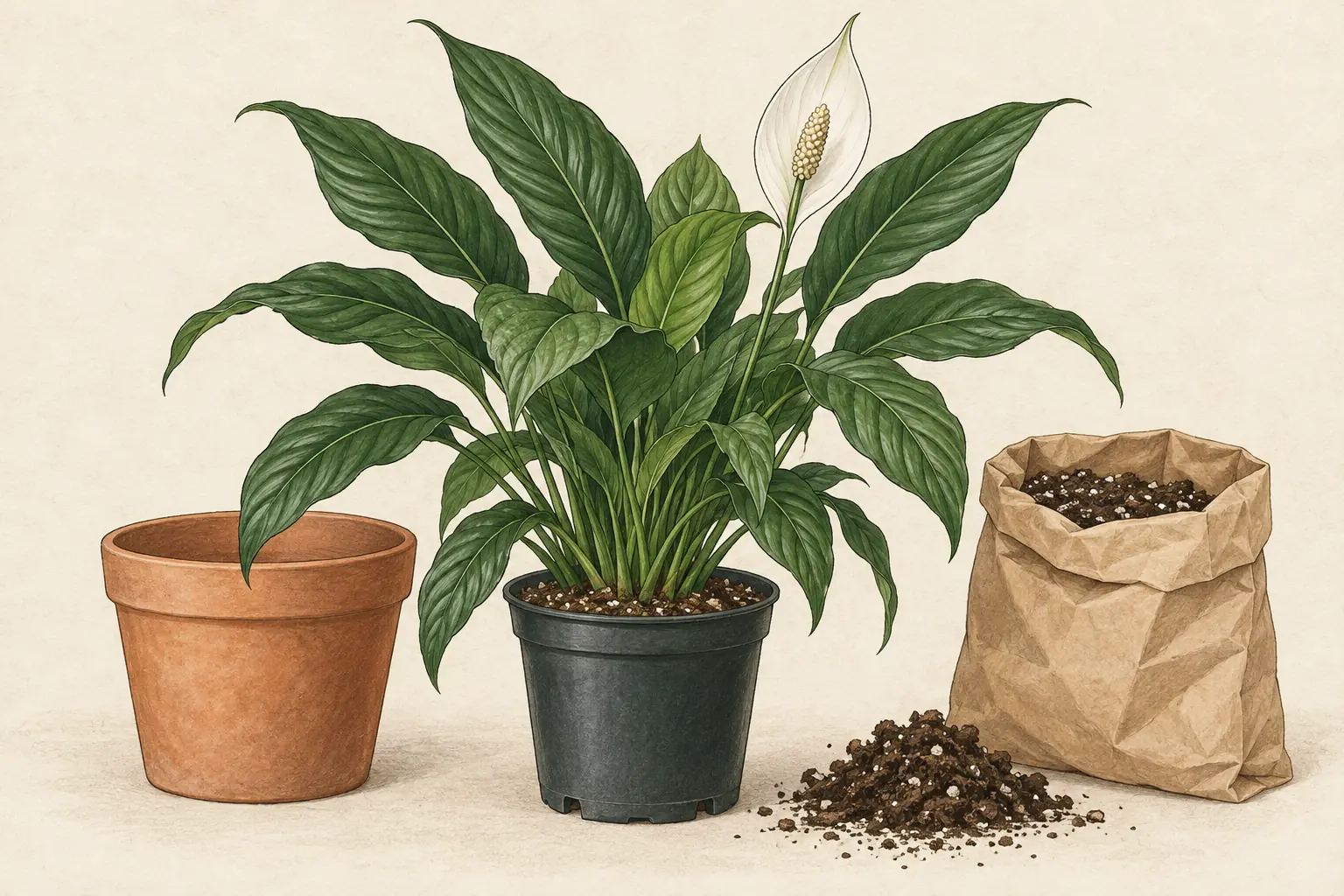
The best soil for peace lily is a well-drained potting mix that retains some moisture without staying soggy. Keep an existing mix that already does that. If you need fresh mix, start with a product intended for indoor containers, then check its ingredients and added fertilizer before deciding whether any extra perlite or bark is useful.
Clemson Extension says peace lilies can grow in almost any well-drained potting mix. NC State Extension adds that Spathiphyllum prefers a mix rich in organic matter. Together, those recommendations leave room for a suitable bagged mix without requiring a special recipe.
Do you need to change the mix you already have?
No change is needed just because you found a different recipe. Keep a suitable mix if your peace lily is growing well and its pot drains. Before blaming the soil, check for trapped runoff and an oversized container. Those problems can keep even an otherwise suitable mix too wet.
Start with a free check: lift the nursery pot out of its decorative cover and empty any collected water. Check the inner pot’s drainage holes. Clemson specifically warns against leaving peace lilies in a saucer of runoff and against using an excessively large pot.

If you need help deciding whether roots are crowded or how to water a drooping plant, use the peace lily care guide. This guide focuses on choosing the growing medium rather than replacing that care routine.
How do you read a US potting-mix bag?
Read the intended use, ingredients, and fertilizer directions together. A container mix may already contain both moisture-holding material and coarse ingredients, so extra amendments are optional. The ingredient list helps you understand the starting material; it does not measure how much air or water the finished mix holds in your pot.

Illinois Extension’s container-media guide explains that commercial recipes vary and need to balance air, drainage, and retained moisture. Use the following translation when comparing a US bag with advice written elsewhere.
| What you read | What it tells you | Your next decision |
|---|---|---|
| Indoor potting mix or container growing medium | A prepared growing medium intended for pots. | Consider it as a complete base. Check the ingredients and directions before adding anything. |
| Peat, coir, or composted bark in a blend | Organic ingredients used in container media; the blend and particle sizes vary. | Do not assume that an organic-rich base needs extra garden compost. |
| Perlite, bark, or other coarse material already included | The manufacturer has already included material that contributes to the mix’s structure. | Do not automatically add the full amendment amount from a recipe with a different base. |
| Added fertilizer or a feeding claim | The bag supplies nutrients as well as growing medium. | Read its feeding directions before adding another nutrient source. Do not add fertilizer to solve poor drainage. |
| UK “potting compost” | A prepared medium for container plants, as used in the RHS recipe below. | Compare it with a US container mix, rather than interpreting it as garden compost alone. |
| Garden soil or topsoil | A different product category from a prepared indoor container mix. | Avoid using it alone to fill a peace lily pot. Illinois explains that garden soil alone drains and aerates poorly in containers. |
The RHS glossary distinguishes garden compost, used to improve soil, from potting compost, used to grow plants in containers. Its recommendation for potting compost is not an instruction to fill a pot with homemade compost.
Fertilizer deserves its own check. Clemson says peace lilies need little feeding, and NC State warns that excess fertilizer and accumulated salts can damage roots and leaf tips. A recipe’s optional handful of compost or worm castings is therefore not a required finishing step, especially when the base already contains fertilizer.
Why do peace lily soil recipes use different ratios?
The recipes start with different growing media and add different ingredients. Their numbers describe those particular blends, so they are not interchangeable instructions for every bag. The RHS offers a horticultural recommendation; the other two examples below are independent editorial recipes. None of the inspected pages establishes a universally superior formula through comparative testing.
| Source | Recipe described | What to keep in mind |
|---|---|---|
| Royal Horticultural Society | Peat-free multipurpose potting compost and perlite, ideally 3:1. | A source-backed option for repotting. The recipe sentence does not specify a measurement basis; it does not explicitly say equal-volume scoops. |
| Peace Lily Care | Indoor potting mix, perlite, and fine orchid bark, 3:1:1 by volume. | An adjustable editorial example that adds bark as well as perlite. The page also says a suitable ready-made mix may need no amendment. |
| Houseplantpedia | Indoor potting mix, perlite or pumice, and fine bark or coco chips, 2:1:1; its small-batch example uses cups. | A different editorial starting blend. Its optional compost or worm castings are separate from that ratio and are not a necessary addition. |

For example, adding perlite to a fine-textured base is a different change from adding the same amount to a mix already containing substantial coarse material. Substituting an unknown bagged base also changes a recipe. That is why the useful first question is “What is already in my mix?” rather than “Which ratio has the most ingredients?”
You can choose the RHS option if you want an attributed recipe, but do not present it as a tested winner over the other blends. Likewise, the two editorial examples are not evidence that every peace lily needs bark, pumice, or a freshly mixed batch. Clemson’s broader well-drained-mix recommendation remains a valid starting point.
Should you use a bagged mix as-is or amend it?
Use a suitable complete container mix as supplied when it meets the plant’s needs. Consider an amendment only for a clear remaining mix problem after checking drainage, pot size, and watering. Choose with the base ingredients in mind, and avoid changing the structure and adding extra fertilizer at the same time.
- Retain: If the current mix works, keep it. A new ratio alone is not a reason to disturb the roots.
- Use: When fresh medium is actually needed, choose a container mix and follow its preparation directions. Illinois recommends lightly dampening dry media before planting.
- Consider an amendment: If the mix’s structure remains unsuitable after the pot and care checks, compare its ingredients with the source recipe you intend to use. Perlite in the RHS option is an addition to that specified base, not a compulsory extra dose for all products.
- Pause and investigate: A wilting plant with wet mix needs a root-zone assessment rather than another watering or fertilizer addition. Maryland Extension describes soft, mushy, dark roots as concerning for root disease; wet soil alone does not identify the cause.
The last branch is a troubleshooting problem, not a recipe contest. See Maryland Extension’s root-rot guidance for the distinction between symptoms and disease management. Do not assume a more elaborate blend will restore damaged roots.
What should you check after changing the mix?
Reassess moisture in the new mix instead of continuing the old watering schedule. Compare how the pot feels when lifted with moisture below the surface, and confirm that runoff can escape. A change in drying behavior is useful information, but it does not by itself diagnose a bad mix or root disease.
Maryland Extension supports finger checks and changes in pot weight, and notes that peace lilies can wilt from both too little and too much water. Light also affects water use; the peace lily light guide provides placement context if conditions have changed.
Do not add a gravel layer beneath the mix. Illinois Extension explains that water can collect above that layer instead of draining more effectively. A draining inner pot and an emptied cover pot address a different issue: allowing runoff to leave the root zone.
Peace lily soil questions
Can I use regular potting soil for a peace lily?
Yes, if it is a suitable well-drained container mix. Clemson does not require a special peace lily formula. Check the intended use and ingredients before amending it, and keep a mix that already works. Garden soil alone is a different choice and performs poorly in containers, according to Illinois Extension.
Do I have to add perlite to every bag?
No. The RHS recommends perlite with its peat-free multipurpose potting compost, but that is not a universal instruction for every commercial mix. Your bag may already contain coarse ingredients. Read the base composition, check how it performs in a draining pot, and add material only for a specific remaining need.
Does “potting compost” mean garden compost alone?
No. In the RHS recipe, potting compost means a prepared growing medium for containers. Its glossary separates that from garden compost used as a soil improver. US readers should compare the recipe with a container potting mix, rather than replace the base with homemade compost or add compost automatically.
Should I add fertilizer when making the mix?
Not automatically. First check whether the base contains fertilizer and read its directions. Clemson says peace lilies need little feeding; NC State warns about root and leaf-tip damage from excessive fertilizer and salts. Adding compost, castings, or another fertilizer is not a required way to complete a soil recipe.
Does peace lily soil need replacing every year?
No fixed yearly replacement follows from the guidance used here. Illinois explains that organic media eventually decompose and lose structure, but the useful trigger is their condition. Keep suitable medium, investigate recurring wetness or poor wetting, and use root crowding and plant condition to inform repotting rather than an anniversary.