
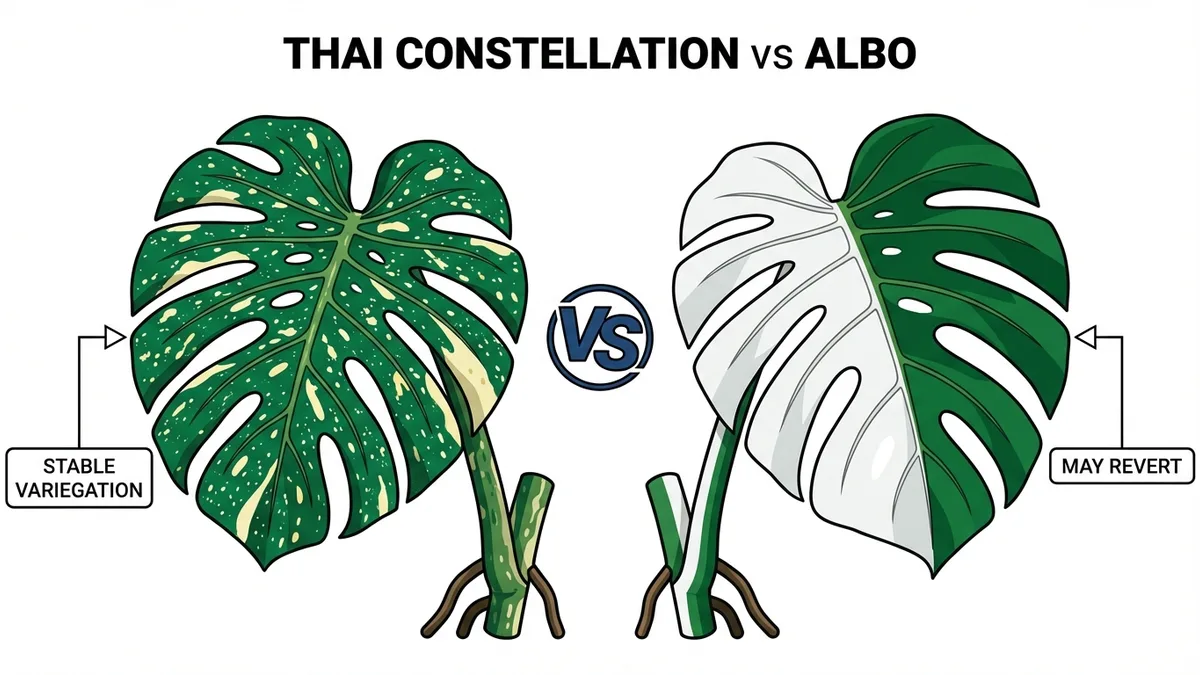
Thai Constellation vs Albo Monstera: Which One Should You Buy?
Both are variegated forms of Monstera deliciosa, both have cream-and-green leaves, and both command premium prices. But they are fundamentally different plants with different genetics, different care needs, and different long-term outcomes. Here is everything you need to know to make the right choice.
| Feature | Thai Constellation | Albo Monstera |
|---|---|---|
| Variegation origin | Tissue culture (stable) | Chimeral mutation (unstable) |
| Can it revert? | ✅ No — permanent | ⚠️ Yes — can revert to all-green |
| Leaf pattern | Speckled, scattered cream sectors | Half-half or large cream sections |
| Price (small plant) | $80–$180 | $150–$400 |
| Care difficulty | Moderate | Moderate–High |
| Growth speed | Slow–Medium | Very Slow (heavy cream) |
| Propagation success | High — stable variegation guaranteed | Variable — reversions possible |
| Availability | Increasingly common | Less common, higher demand |
The Core Difference: How the Variegation Works
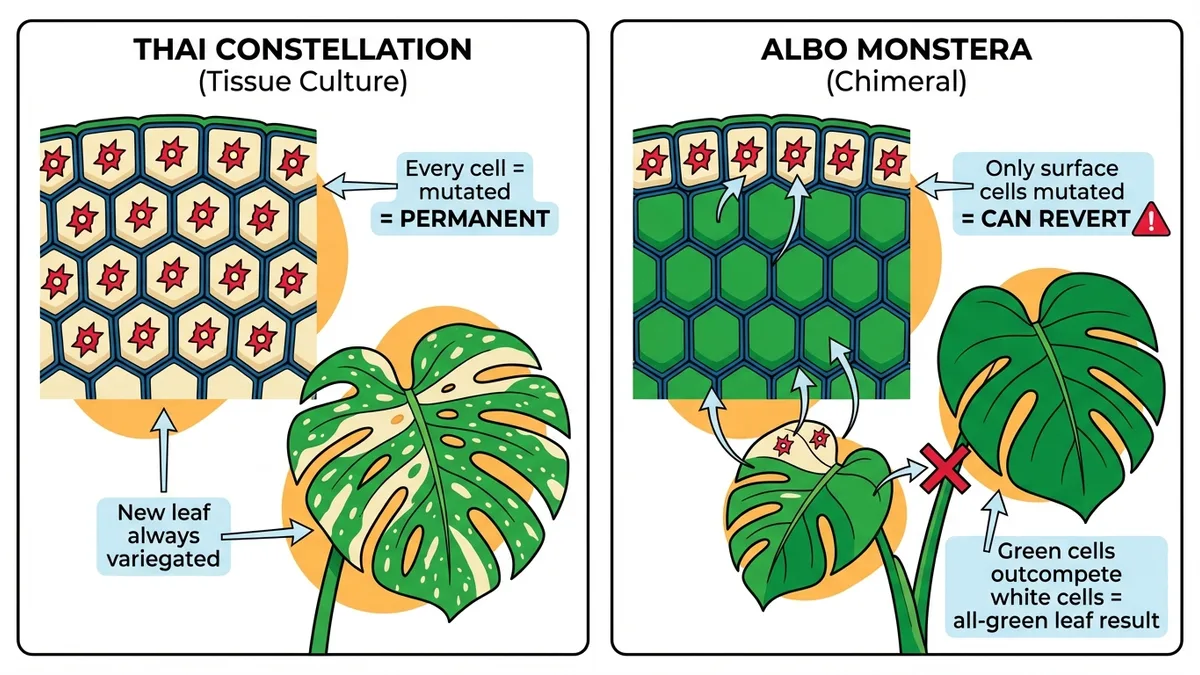
This is the most important thing to understand about both plants:
Thai Constellation — Tissue Culture Origin
Scientists in Thailand altered the DNA of every single cell in the plant through tissue culture manipulation. The cream mutation is present in all cells — leaves, stems, roots, everything. There is no “competition” between green and cream cells. New leaves will always show variegation. The pattern will shift from leaf to leaf but the trait is genetically locked in.
Albo Monstera — Chimeral Mutation
The white coloration comes from a spontaneous mutation that occurred in only one layer of cells during the plant’s development. This creates a “chimera” — a plant with two genetically different cell populations coexisting. Green cells and white cells are in constant competition. Under stress, low light, or sometimes for no obvious reason, the green cells can outcompete the white ones and the plant begins producing all-green leaves. This is called reversion, and it is permanent once it happens.
Leaf Patterns: What Each Plant Looks Like
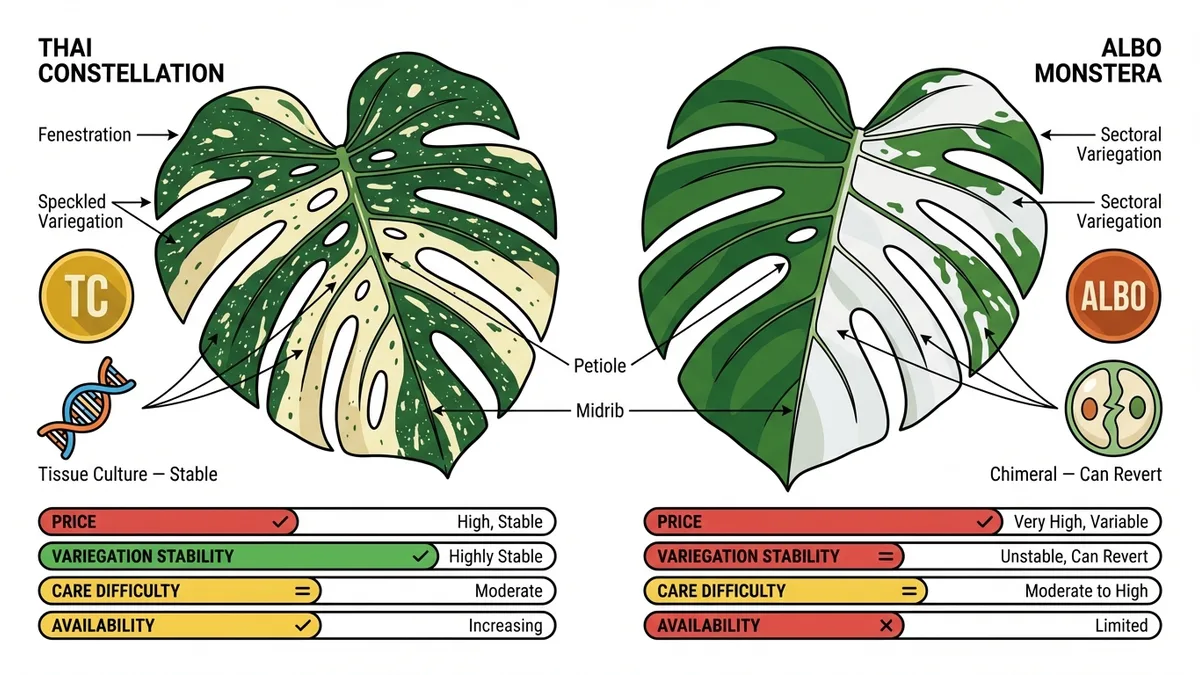
Thai Constellation: Cream appears as scattered speckles, specks, and irregular sectors distributed across the leaf. No two leaves look the same, but the pattern is always mixed — green and cream interweaved. The result is a “galaxy” appearance — hence the name “Constellation.”
Albo Monstera: Cream appears as large solid sectors — often half the leaf is pure white while the other half is pure green. The contrast is more dramatic and graphic. Some leaves emerge nearly all-white; others nearly all-green.
Neither pattern is “better” — it is entirely a matter of personal preference. However, Albo’s heavily white leaves are more fragile and the plant typically grows slower as a result.
Care Differences
Both plants have identical basic care requirements — same light range, same soil mix, same humidity needs. The differences lie in the nuances:
Light tolerance: Albos with very large white sectors are even more sensitive to direct sun than Thai Constellations, because the white sections can be enormous. Both need bright indirect light, but Albos with heavy cream need careful management.
Growth rate: Both are slower than standard green Monsteras. Albo, particularly specimens with very heavy cream, grows noticeably slower because there is less green tissue available for photosynthesis.
Stability under stress: Thai Constellations handle inconsistent care better because their variegation cannot revert regardless of conditions. Albos under prolonged low light or stress may shift toward producing more green leaves as the green cells gain dominance.
Which One Should You Buy?
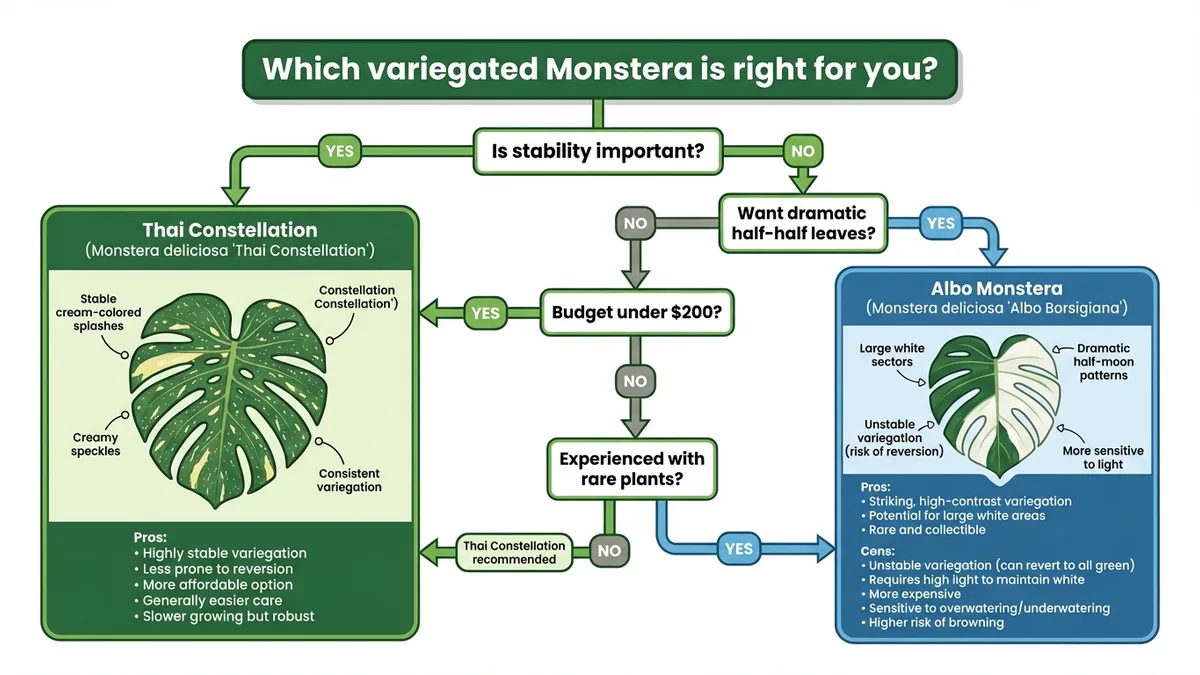
Choose Thai Constellation if:
- This is your first rare variegated plant
- You want guaranteed, permanent variegation
- Your budget is under $200 for a starter plant
- You plan to propagate and want all cuttings to be variegated
- You prefer the scattered speckle aesthetic
Consider Albo Monstera if:
- You are an experienced grower comfortable managing reversion risk
- You strongly prefer the dramatic half-half leaf pattern
- You have a specific high-light spot that can support heavy white leaves
- You are buying a collector-grade specimen from a reputable seller
For the vast majority of plant owners, the Thai Constellation is the more sensible choice — better value, guaranteed variegation, and equal visual impact.
📚 Price guide
Ready to buy? See current prices and what to look for: Thai Constellation Monstera Price Guide (2026)
Common Questions: Thai Constellation vs Albo
Is Thai Constellation or Albo more expensive?
Albo Monstera is consistently more expensive — typically 30-50% more than a Thai Constellation of equivalent size. This is partly due to lower supply and partly due to the dramatic half-half leaf pattern that collectors prize.
Can Thai Constellation revert like Albo?
No. Thai Constellation cannot revert because the mutation exists in every single cell via tissue culture origin. Albo can revert because its chimeral mutation is only in one cell layer.
Which is easier to care for?
Both require the same fundamental care. Thai Constellation is slightly more forgiving because there is no reversion risk. Albo plants with very heavy cream are more fragile and need more careful light management.
Which has better variegation?
This is subjective. Albo produces more dramatic, graphic half-half patterns. Thai Constellation produces a more detailed, complex speckled pattern. Both are beautiful — choose based on which aesthetic you prefer.
Can I propagate both plants?
Yes. Thai Constellation cuttings always produce variegated plants. Albo cuttings usually do too, but there is a risk of propagating from a reverting section and getting a green plant.
⬅️ Back to the full care guide


0 Comments