
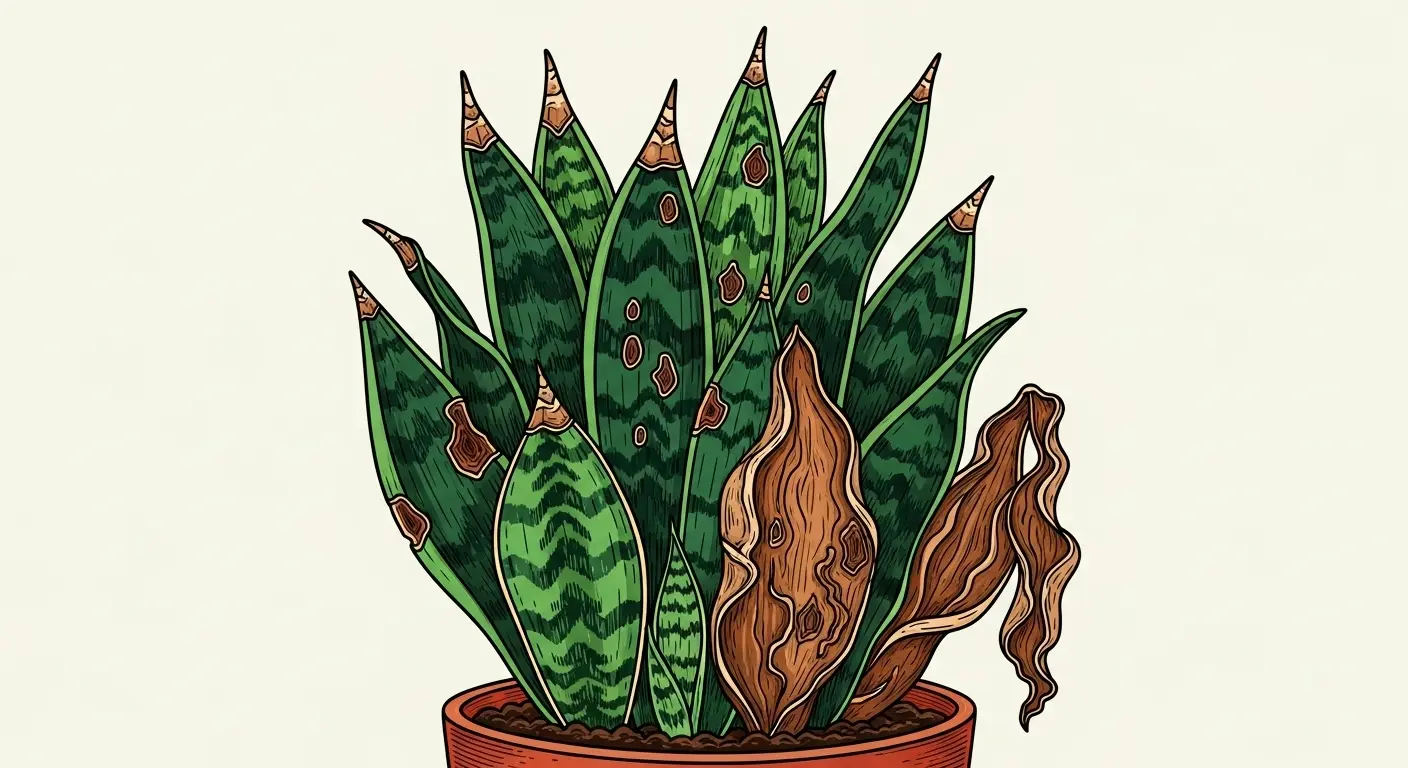
Snake Plant Brown Leaves: 7 Causes & Proven Fixes
Snake plant brown leaves can feel like a personal failure—we get it. You see that first brown spot on snake plant leaves and immediately wonder what you did wrong.
Here’s the truth we wish someone had told us years ago: snake plant brown leaves are usually fixable. Unlike yellow leaves (which often signal root rot and require drastic action), brown leaves are typically cosmetic issues caused by environmental stress—not disease.
In this guide, we’ll walk you through the 7 most common causes of browning snake plant leaves, show you how to diagnose exactly what’s happening to YOUR plant, and give you the precise fixes that actually work. We’ll cover everything from brown tips on snake plant leaves to large brown spots, and explain when browning is harmless aging versus when it’s screaming for help.
Understanding Different Types of Snake Plant Brown Leaves
Not all snake plant brown leaves are created equal. The pattern and location of browning tells you exactly what’s wrong. Here’s how to read your plant’s distress signals:
Brown Tips Only (Most Common)
What it looks like: The top ½-1 inch (1-2.5 cm) of leaves turn crispy and brown, but the rest of the leaf stays green and healthy. Snake plant tip brown issues are the #1 complaint we hear.
Urgency level: Low. This is cosmetic and won’t kill your plant.
Brown Spots or Patches
What it looks like: Circular or irregular brown spots on snake plant leaves, either soft and mushy or dry and papery. May have yellow halos around them.
Urgency level: Medium to High (depends on if spots are spreading).
Brown Edges
What it looks like: The entire leaf margin turns brown and crispy, working inward from the edges.
Urgency level: Medium. Usually environmental stress.
Entire Leaf Turning Brown
What it looks like: A whole leaf, usually starting from the bottom, turns brown, mushy, and eventually collapses.
Urgency level: High. This is usually root rot.
Cause #1: Inconsistent Watering (The #1 Culprit)
This is what causes 60% of all snake plant brown leaves cases we’ve seen. And it’s not what you think.
Most people assume browning snake plant tips mean overwatering. Actually, it’s usually the opposite—or more specifically, inconsistent watering. Here’s what happens: you let your plant get bone-dry for 6-8 weeks, then suddenly give it a big drink. The leaf tips, which have adapted to drought conditions, can’t handle the sudden moisture influx. Cells burst. Tips turn brown and crispy.
How to Diagnose
- Brown tips on snake plant that are dry and crispy (not soft or mushy)
- The browning happened 1-2 weeks after a watering session
- You can’t remember the last time you watered (be honest!)
- The rest of the plant looks healthy and firm
The Fix
Establish a consistent watering routine. We water our snake plants every 3-4 weeks in summer, every 6-8 weeks in winter. The key word is consistent. Your plant adapts to a schedule—stick to it.
Pro tip: Set a phone reminder. Check soil moisture 2-3 inches (5-7.5 cm) deep with your finger. If it’s completely dry, water thoroughly until it drains from the bottom. Empty the saucer after 15 minutes. That’s it.
For complete watering guidance: Snake Plant Watering: 7 Essential Tips.
Cause #2: Tap Water Quality (The Hidden Problem)
This one surprised us. We were doing everything “right” but kept getting brown tips on snake plant leaves. Turns out, our tap water was the villain.
Municipal tap water contains fluoride, chlorine, and dissolved salts. Snake plants are sensitive to fluoride especially—it accumulates in leaf tips over time, causing necrosis (tissue death). You’ll see snake plant tip brown and crispy, often with a yellow band between the brown tip and green leaf.
How to Diagnose
- You water consistently but still get brown tips on snake plant leaves
- Tips turn brown gradually over months (not suddenly)
- White crust builds up on soil surface or pot edges (salt accumulation)
- You use tap water exclusively
The Fix
Option 1 (Best): Switch to filtered, distilled, or rainwater. We use a simple countertop filter pitcher—game changer.
Option 2 (Budget): Let tap water sit out in an open container for 24-48 hours before using. Chlorine evaporates (fluoride doesn’t, but this still helps).
Option 3 (Damage control): Flush your soil every 2-3 months. Water thoroughly until water runs clear from drainage holes for 3-5 minutes. This washes away salt buildup.
Can you trim brown tips? Yes! Use sterilized scissors to cut at an angle, leaving a tiny bit of brown (don’t cut into green tissue). It won’t grow back, but it looks tidier.
Cause #3: Direct Sunlight Burn (Scorched Leaves)
Snake plants tolerate low light, so people assume they hate bright light. Wrong. They love bright indirect light—but direct sun will scorch them, creating brown spots on snake plant leaves that look like someone held a lighter to them.
How to Diagnose
- Brown spot on snake plant leaves that are dry, papery, and usually pale yellow around the edges
- Spots appear only on the side facing the window
- Your plant is in a south or west-facing window with direct afternoon sun
- Spots appeared suddenly after moving the plant or during summer months
The Fix
Move your plant 3-4 feet (90-120 cm) back from the window, or use a sheer curtain to diffuse direct rays. If you’re in a south or west window, move to an east window for gentle morning sun instead.
Can sunburn heal? No. Those cells are dead. But the plant will produce new healthy growth once you move it. Trim severely scorched leaves at the base if they’re more than 50% brown.
Learn optimal placement: Snake Plant Light Requirements: Everything You Need.
Cause #4: Overwatering & Root Rot (The Serious One)
When snake plant leaves turning brown and crispy actually means mushy and brown, you’ve got root rot. This is the one cause where snake plant brown leaves actually signal a life-threatening problem.
How to Diagnose
- Leaves are brown AND soft/mushy (not crispy)
- Browning starts at the base and works up
- Entire leaves collapsing, not just tips
- Soil stays wet for weeks after watering
- Foul smell from soil
- When you remove the plant, roots are brown/black and slimy (healthy roots are white/tan and firm)
The Fix (Emergency Protocol)
Step 1: Remove plant from pot immediately. Brush away all soil to expose roots.
Step 2: Use sterilized scissors to cut away ALL brown, mushy roots and rhizomes. Be aggressive—cut until you see only healthy white/tan tissue. Sterilize scissors between cuts with rubbing alcohol.
Step 3: Cut away any leaves that are more than 30% brown or mushy. They won’t recover.
Step 4: Let the plant air-dry for 24-48 hours. Yes, really. This allows cut surfaces to callus and prevents reinfection.
Step 5: Repot in FRESH soil (never reuse old soil—it’s contaminated). Use a mix that’s 50% cactus soil, 30% perlite, 20% coarse sand. Soil recommendations: Best Soil for Snake Plant.
Step 6: Water lightly just to settle soil. Then don’t water again for 2-3 weeks.
Root rot guide: Snake Plant Yellow Leaves: Causes and Solutions.
Cause #5: Cold Damage (Temperature Shock)
Snake plants are tropical. Expose them to temperatures below 50°F (10°C) and you’ll see snake plant brown leaves—fast.
How to Diagnose
- Browning happened suddenly overnight or after a cold snap
- Leaves are mushy and collapse easily
- Plant was near a drafty window, AC vent, or outside door
- It’s winter and your home is chilly at night
The Fix
Move your plant away from cold sources. Maintain temperatures between 65-85°F (18-29°C). If you have cold windows, move plants 2-3 feet (60-90 cm) away during winter.
Can cold-damaged leaves recover? No. Trim brown leaves at the base. The plant will produce new growth once warm temperatures return.
Cause #6: Fungal or Bacterial Leaf Spot
If you see brown spots on snake plant leaves with yellow halos that are spreading rapidly, you might have a fungal or bacterial infection. This is less common but needs quick action.
How to Diagnose
- Circular brown spots with yellow halos
- Spots are spreading to new leaves
- High humidity environment or water sits on leaves
- Spots may have a water-soaked appearance
The Fix
Step 1: Isolate the plant from others immediately to prevent spread.
Step 2: Remove affected leaves entirely at the base with sterilized scissors. Don’t just trim spots—remove the whole leaf.
Step 3: Improve air circulation. Move to a less humid location or add a small fan nearby.
Step 4: Never mist or get water on leaves. Water at soil level only.
Step 5: Apply a copper-based fungicide if spots continue spreading. Follow product instructions carefully.
According to Penn State Extension, proper sanitation and environmental control are more effective than fungicides for houseplant diseases.
Cause #7: Natural Aging (Not Actually a Problem)
Sometimes snake plant leaf turning brown is just… life. The oldest, bottom leaves naturally die off as the plant matures. This is 100% normal.
How to Diagnose
- Only the OLDEST, BOTTOM leaves are browning (new growth looks perfect)
- Browning is gradual over weeks/months
- The plant is producing new healthy growth at the same time
- Only 1-2 leaves affected, not multiple
The “Fix” (It’s Not Broken)
Just trim brown leaves at the base once they’re fully brown. This is the plant’s natural lifecycle—it’s shedding old leaves to make energy for new growth. Don’t stress about it!
Preventing Snake Plant Brown Leaves (The Best “Cure”)
Prevention beats treatment every time. Here’s your checklist to avoid browning snake plant issues:
- Water consistently: Every 3-4 weeks in summer, 6-8 weeks in winter. Set reminders.
- Use quality water: Filtered, distilled, or tap water that’s sat out 24 hours.
- Perfect drainage: Pot with drainage holes + gritty soil mix. No exceptions.
- Bright indirect light: 3-4 feet (90-120 cm) from a south/west window or directly in an east window.
- Stable temperatures: Keep between 65-85°F (18-29°C), away from drafts.
- Low humidity is fine: No misting needed. Average home humidity (40-60%) is perfect.
- Fertilize sparingly: Once monthly in spring/summer only, half-strength.
Complete care guide: Snake Plant Care: Complete Guide.
Common Questions About Snake Plant Brown Leaves
Why does my snake plant have brown tips?
Brown tips on snake plant leaves are usually caused by inconsistent watering (too much drought followed by heavy watering) or tap water quality (fluoride/salt buildup). Less commonly, low humidity or over-fertilizing can cause tip browning. Fix by watering consistently every 3-4 weeks and switching to filtered water. Trim brown tips with sterilized scissors for appearance—they won’t grow back green.
Can brown leaves turn green again?
No. Once snake plant brown leaves or tips turn brown, those cells are dead and won’t recover. However, fixing the underlying cause prevents NEW browning. Trim heavily damaged leaves at the base to redirect energy to healthy growth. The plant will produce new, healthy leaves once you’ve corrected watering, light, or water quality issues causing the browning snake plant problem.
What do brown spots on snake plant leaves mean?
Brown spots on snake plant leaves indicate either sunburn (dry, papery spots on sun-facing side), fungal/bacterial infection (spots with yellow halos that spread), or physical damage. Sunburn spots won’t spread—just move the plant away from direct sun. Spreading spots require removing affected leaves and improving air circulation. Isolated spots that don’t spread are usually old injury and harmless.
Should I cut off brown leaves?
Cut off snake plant brown leaves if more than 50% of the leaf is brown, if leaves are mushy (root rot), or for aesthetic reasons. Use sterilized scissors and cut at the base where the leaf meets the soil. For brown tips on snake plant leaves, you can trim just the brown portion at an angle, leaving a tiny bit of brown (don’t cut into green). The plant redirects energy to healthy leaves once damaged ones are removed.
Why are my snake plant leaves turning brown and crispy?
Snake plant leaves turning brown and crispy (not mushy) indicates underwatering, tap water issues, or direct sun exposure. Check soil—if bone dry, establish consistent watering every 3-4 weeks. If you use tap water, switch to filtered. If in direct sun, move to bright indirect light. Crispy brown is different from mushy brown (which indicates overwatering/root rot). Crispy = too dry; mushy = too wet.
Is it normal for old snake plant leaves to turn brown?
Yes! If only the OLDEST bottom leaves are gradually turning brown while new growth looks healthy, this is normal aging. Snake plants shed old leaves to redirect energy to new growth—just like deciduous trees dropping leaves. Simply trim brown leaves at the base once fully brown. This is not a problem requiring treatment. Only worry if multiple leaves or NEW growth shows snake plant brown leaves symptoms.
How do I fix brown spots on my snake plant?
For brown spot on snake plant leaves: if caused by sunburn, move plant away from direct light—spots won’t heal but won’t spread. If spots have yellow halos and spread, remove affected leaves entirely at the base, isolate plant, improve air circulation, and avoid getting water on leaves. If spots are isolated and not spreading, it’s likely old damage—monitor but don’t panic. Spots never turn green again but healthy new growth will emerge.
Your Snake Plant Brown Leaves Action Plan
Here’s what we want you to do right now. Look at your browning snake plant and answer these questions:
Are the brown areas crispy or mushy? Crispy = environmental stress (fixable easily). Mushy = root rot (needs immediate action).
Where is the browning located? Just tips = watering/water quality. Spots on one side = sunburn. Whole leaves from base up = root rot. Bottom leaves only = normal aging.
When did it start? After moving = light shock. After winter = cold damage. Gradually over months = tap water buildup. Suddenly = watering shock or temperature change.
Match your answers to the causes we covered, implement the specific fix, and give it 4-6 weeks. You should see NEW growth emerging healthy and green. Old brown won’t heal, but you’re saving the plant’s future.
The truth about snake plant brown leaves? They’re almost never fatal. They’re your plant’s way of communicating that something in its environment needs adjusting. Now you know exactly what it’s saying—and exactly how to respond.
For ongoing snake plant success, bookmark our Complete Snake Plant Care Guide. It covers everything from propagation to pest control, ensuring your plant thrives for years to come.
You’ve got this. Those brown leaves don’t mean you failed—they mean you’re learning to speak plant. 🌱
Expert Resources