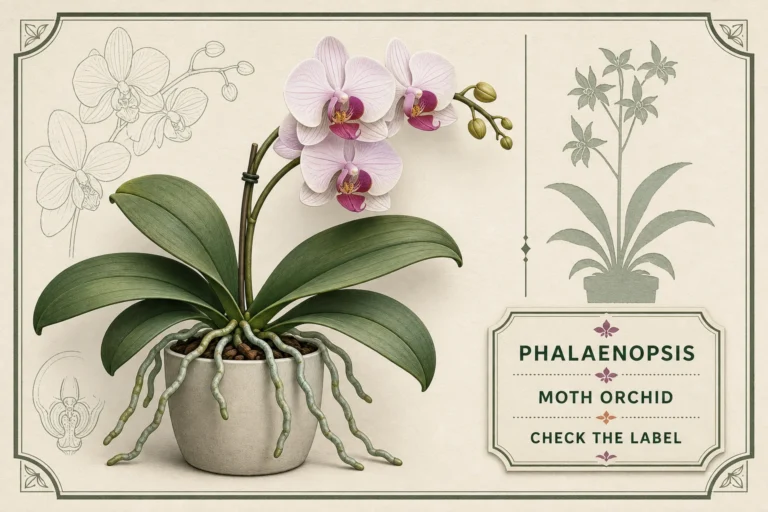
A bag marked “orchid mix” is a starting point, not a watering plan. This guide focuses on Phalaenopsis, the moth orchids commonly sold as houseplants. If your label names another orchid, check its requirements before using the same setup. For the rest of the routine, start with our Phalaenopsis care guide.
Why orchids need a different kind of mix
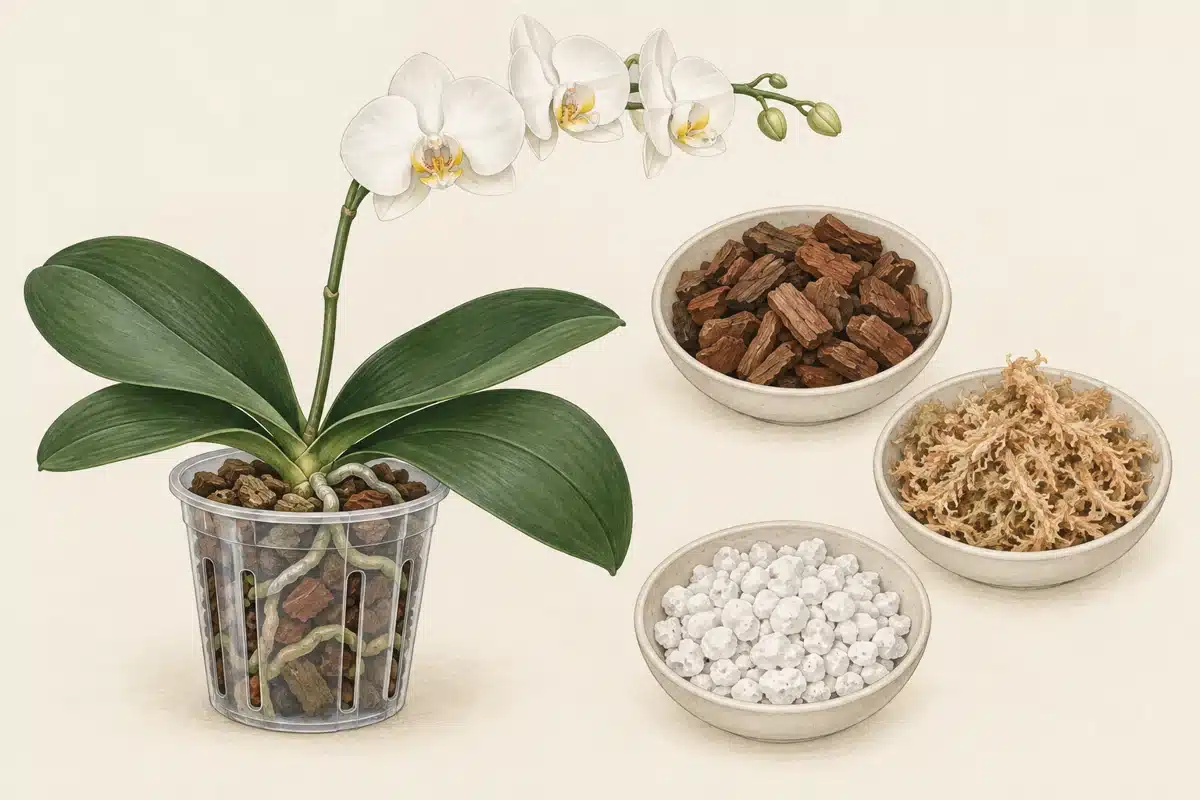
Many familiar houseplant orchids grow attached to trees in nature. A pot must support those roots while giving them both moisture and air. Ordinary fine houseplant soil is therefore a poor default for a moth orchid: it can hold water around the roots for too long. “Orchid soil” usually means a specialized growing medium, such as bark or sphagnum, rather than garden soil. Iowa State Extension explains this distinction.
There is no single winning ingredient. The American Orchid Society describes successful bark, peat-based, and inorganic systems. What matters is how the whole setup behaves: plant, medium, pot, environment, and watering. A mix that works in a warm greenhouse may behave differently beside a cool apartment window.
Bark vs. sphagnum: what changes?
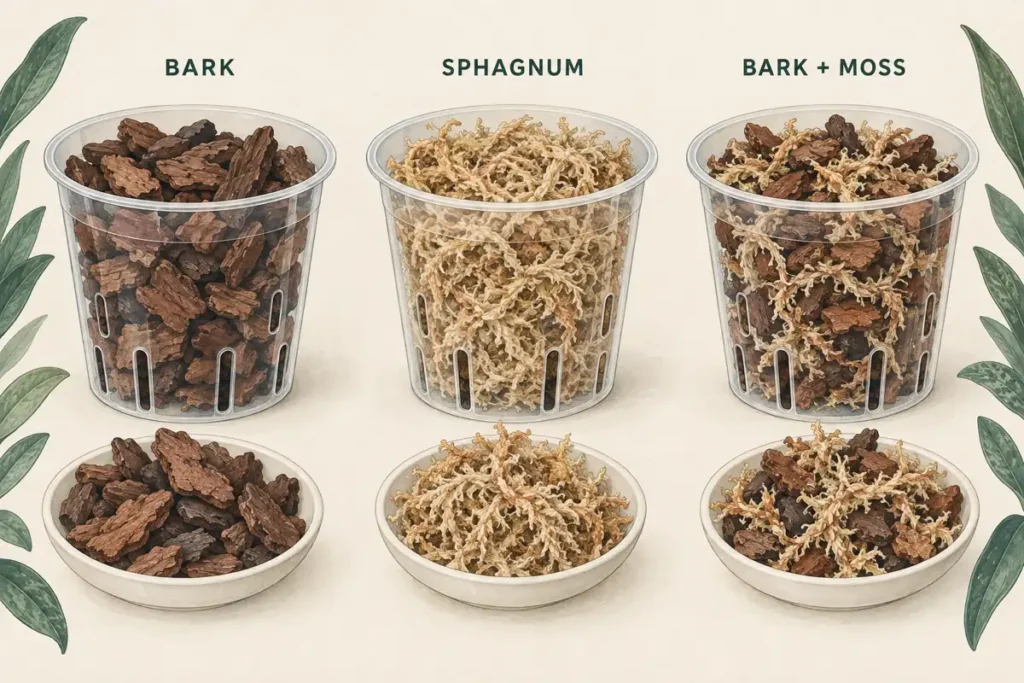
Compare the structure first. Bark leaves visible gaps between pieces; long-fiber sphagnum forms a network of moisture-holding fibers. A blend combines those materials, but its behavior still depends on particle size, packing, and the container.
| Medium | Why choose it? | What to watch |
|---|---|---|
| Bark-based mix | An open structure that generally dries faster; a practical default for many indoor moth orchids. | Fresh, coarse bark can dry faster than you expect in a warm, dry room. |
| Long-fiber sphagnum | More moisture retention when the root zone dries quickly. | The center can stay wet after the surface feels dry. Check before watering again. |
| Bark + sphagnum | A way to retain more moisture than a comparable bark-only setup. | No percentage works everywhere. Avoid forcing a fixed recipe onto a different pot or home. |
Sphagnum is not automatically a problem. University of Maryland Extension’s orchid-medium guidance says both moss and bark can work, with changes to watering when you switch. Long-fiber sphagnum is also different from finely milled peat moss; read the bag rather than treating the names as interchangeable.
Perlite, volcanic rock, and horticultural charcoal also appear in commercial orchid mixes. They contribute to the structure of a blend; they are not a reason to buy five separate ingredients. UF/IFAS describes these materials as options. Adding charcoal does not make a persistently wet pot safe.
Choose by the pot you actually have
Before buying another bag, answer three questions: which orchid is it, does its inner pot drain, and what happens to the medium between waterings? Use the table to choose a direction, then check the result.
| Your situation | Starting direction | Check first |
|---|---|---|
| First moth orchid; no drying history | Commercial orchid bark mix and a draining nursery pot. | Identify the existing medium. A healthy orchid already in moss does not need an emergency change. |
| Mix remains persistently wet | Check drainage and watering before considering a coarser, more open mix. | Empty standing water. An oversized pot or degraded medium may be the main problem. |
| Mix dries before you can maintain watering | Consider a finer bark grade or a blend containing long-fiber sphagnum. | Confirm the medium is getting thoroughly wetted and assess heat and airflow. |
| A different or unidentified orchid | Use that orchid’s culture requirements. | Cattleya, Dendrobium, slipper orchids, and terrestrial orchids are not one watering group. |
This is a starting decision, not a prescription to repot after one wet day. A pot taking several days to dry can be normal. Look for a pattern and signs of trouble, rather than declaring a particular number of days “too long.” The AOS repotting guide explains how material texture and watering habits affect the choice.
What to look for on the bag
- The intended plant: a blend described for epiphytic orchids or Phalaenopsis.
- The actual ingredients: bark, moss, and additives can differ even between two bags from the same brand.
- A suitable texture: open pieces that fit around the roots, rather than choosing the biggest chunks simply because they drain quickly.
- A sensible quantity: enough for the pot you need, without buying a collection of amendments you may never use.
The pot matters as much as the mix
Use an inner container with drainage holes. A decorative outer pot is fine as long as it does not leave the nursery pot standing in water. Clear plastic can make observation easier, but transparency cannot replace drainage.

Choose a container that accommodates the roots without a large surplus of wet medium. Do not automatically size up whenever you replace the bark. Keep the plant secure without crushing its roots or compressing moss into a hard plug. UConn’s repotting guidance emphasizes a suitable pot, drainage, and careful handling.
Follow the new medium’s preparation directions. Some bark needs wetting before use; there is no reason to impose the same soaking time on every product. A separate gravel or clay-ball layer is not a substitute for drainage holes and a suitable medium.
Learn one drying cycle before changing the recipe
After repotting or switching materials, reassess watering. For a common indoor Phalaenopsis, check as the medium approaches dryness; avoid both persistent saturation and leaving the roots dry for a prolonged period. Water thoroughly, let excess water leave the pot, and empty the saucer or cachepot. AOS’s watering guidance recommends observations such as medium feel and pot weight rather than a fixed schedule.
Your first-cycle field notes
After watering
Note the date, the medium, and how heavy the drained pot feels. Check the outer pot for leftover water.
Before watering again
Check below the surface where accessible without damaging roots. Record the medium’s moisture and the pot’s weight.
Choose the next action
Water if the plant and medium need it; wait if still moist. Investigate a repeated wet or rapidly drying pattern before buying another mix.
A worked example: suppose the top bark looks dry, but the pot still feels heavy and visible medium lower down is moist. The useful next step is to wait and reassess that pot, rather than water because the top changed color. If the inner pot is instead sitting in water, empty the outer pot first. Those are different observations with different actions.
Record a change in season or heating alongside the watering dates. Yesterday’s successful interval is a clue, not a standing instruction. For placement decisions, use our orchid light guide.
When a fresh mix is actually needed
Replace a medium that is breaking down, compacting, or draining poorly. For Phalaenopsis under common indoor conditions, University of Maryland Extension gives roughly one to two years as a reference. Its condition matters more than the anniversary. Healthy aerial roots outside the pot, by themselves, do not mean the plant urgently needs a larger one.
- Check the plant and medium. If the orchid is healthy and the mix is sound, avoid repotting solely to change brands.
- Prepare the suitable pot and fresh medium. Follow the bag’s wetting instructions and keep clean tools ready.
- Ease the plant out and remove degraded material gently. Preserve healthy roots. If roots are soft, collapsing, or extensively damaged, assess that problem before treating this as a routine mix change.
- Settle the roots into the new medium. Keep the crown — where the leaves meet — above it, leave drainage open, and stabilize the plant without forcing roots into place.
- Restart observation. The new medium may dry differently from the old one, so do not automatically resume the old watering interval.
Orchid potting mix questions
Can I keep my orchid in sphagnum moss?
Yes, if the orchid and your care suit it. Moss is a workable medium, not proof of poor nursery care. Watch moisture within the pot and avoid watering a wet center just because the surface has dried.
Can I mix orchid bark with regular potting soil?
For a typical moth orchid, start with an orchid-specific medium instead. Adding a few bark pieces to a fine houseplant soil does not tell you how much air or moisture remains around the roots. Other orchid groups can have different needs.
Does green or silver root color tell me when to water?
It is one clue, not the whole answer. Visible roots and the center of the pot may dry at different rates. Check the medium too. NC State’s Phalaenopsis record also cautions that wrinkled leaves can accompany either insufficient water or damaged, overly wet roots.
Does mold on bark mean the roots are rotting?
A surface growth alone does not establish the condition of the roots or a specific pH. Inspect the medium’s condition, drainage, and the plant together. A photograph of the surface is not enough to choose a chemical treatment or decide to cut roots.
Can I use LECA instead?
Orchids can grow in inorganic systems, but changing to LECA also changes water and nutrient management. Treat it as a different growing method to learn, rather than a direct one-for-one substitute in this bark-based routine.
Keep the rest of the routine consistent
Once the potting setup is working, avoid changing light, feeding, and watering all at once. Use the orchid care guide for the whole routine, the light guide for placement, and our reblooming guide when a healthy plant needs its next step.
Our approach
The Plant Manual is made by Joakim and Emilie, plant enthusiasts who turn research into practical checks. For this guide, we compared orchid-society and university guidance and used the differences to build the choice table and observation sequence. We have not run a controlled comparison of these mixes, and the product selection is based on ingredients and suitability.
Sources & research notes
Sources consulted September 13, 2026. The notes identify what each source supports; they do not imply that its authors reviewed this article.
- Iowa State Extension — Growing Orchids Indoors. Epiphytic growth and common indoor media.
- American Orchid Society — What is the best potting media? Why successful media vary with culture.
- American Orchid Society — Repotting. Texture, container choices, and matching watering habits.
- University of Maryland / Ask Extension — Orchid potting-medium question. Bark and sphagnum can both work; switching requires a care adjustment.
- UF/IFAS — Orchids. Materials used in orchid growing media.
- UConn — Orchid Care and Repotting. Containers and repotting. Its annual-refresh guidance differs from Maryland’s one-to-two-year reference; we prioritize medium condition.
- American Orchid Society — Orchids 101. Watering observations and growing conditions.
- University of Maryland Extension — Care of Phalaenopsis Orchids. Moth-orchid bark mixes and replacement cues. Updated March 13, 2023.
- NC State Extension — Phalaenopsis. Plant identity and the limits of interpreting leaf symptoms.
- Better-Gro — Special Orchid Mix. Manufacturer information for ingredients and dry-quart package size; not independent comparative performance evidence.